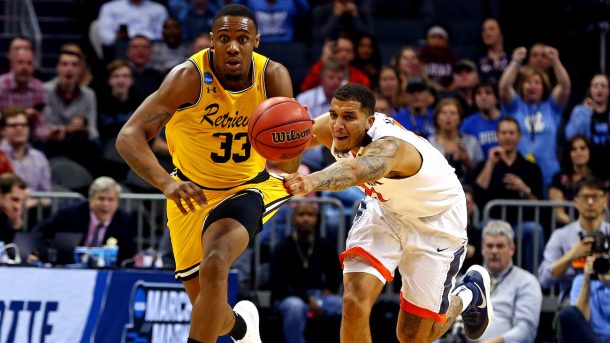

You never know what you’re going to get with the NCAA Tournament, particularly in the opening weekend.
We’ve had years with unbelievable comebacks, thrilling upsets and the birth of Cinderella stories that get told for generations.
We’ve also had years like 2025, where the first round had a few exciting games (shoutout to Derik Queen) but scant few upsets.
Last year’s NCAA Tournament was so devoid of surprises that it actually had fans and media wondering if NIL and the transfer portal had forever altered the nation’s greatest sporting experiment. This is despite the fact that we had zero top-3 seeds in the Final Four as recently as the 2023 NCAA Tournament.
Now, it is true that the sport is more top-heavy than it used to be — at least in the regular season. In 2025, Duke was +39.29 in adjusted net rating on KenPom. That was the best adjusted net rating since 1999 Duke. But this year, the Blue Devils (+40.61) and Michigan (+39.35) are both above last year’s Duke team and Arizona (+37.33) is not far behind.
The rising dominance from teams at the top of the sport has had a tangible impact on the betting markets. In 2025-26, games between a ranked favorite and an unranked underdog had an average point spread of -15.8. That number has steadily been rising over the last decade-plus.
As recently as 2 years ago, the average point spread under those parameters was -12.6. In 2012-13, the first year of our data set that will be explored in this story, it was -11.5 (the median point spread has also risen from -10.5 to -13.5 from 2013 to 2026).
As for NCAA Tournament games, mean and median point spreads have also risen over the last 13 years, albeit more gradually and to a lesser degree. Here’s a chart showing the trend:
Average Point Spread by Season
Regular season: ranked favorite vs. unranked underdog | NCAA Tournament: all games
| Season | Regular Season | NCAA Tournament | ||
|---|---|---|---|---|
| Mean | Median | Mean | Median | |
* 2019-20 tournament cancelled (COVID-19) | 2025-26 tournament not yet played
Spreads sourced from TeamRankings via CollegeBasketballData.com | Shown as absolute value (points the underdog is getting)
However, that doesn’t necessarily mean that upsets are happening at a lower rate than they used to in March Madness. What is the point of the NCAA Tournament if not to defy point spreads?
In fact, evidence suggests upset rates in the regular season are relatively stable since 2013. There’s been a downward trend over the past couple of years, but upset rates are well within the same range they’ve always been in.
Here’s what the data says:
Underdog Win Rate by Season
Regular season: ranked favorite vs. unranked underdog (ML +100 or higher)
NCAA Tournament: all underdogs ML +100 or higher
Regular season includes all games between an AP Top 25 team and an unranked opponent where one side’s moneyline was +100 or higher. NCAA Tournament includes all tournament games meeting the same moneyline threshold regardless of ranking.
Odds sourced from TeamRankings via CollegeBasketballData.com
So I went searching for answers to questions that would shed more light on what the future may hold for the NCAA Tournament. Chief among them: Is there any meaningful correlation between upset rate in the regular season and upset rate in the NCAA Tournament?
If there is correlation, that would perhaps point toward significant branding issues for March Madness. The regular season is indeed becoming more of an exercise in dominance for the nation’s top teams, but college basketball’s soul demands there to still be a pound of upset flesh in March.
I bring good news in that regard. The data is definitive: Historically, there has been zero correlation between upset rate in the regular season (among a sample that includes ranked favorites vs. unranked underdogs) and upset rate in the NCAA Tournament.
Here’s a chart showing the data since 2013:
Regular Season Upsets Don’t Predict March Madness
Each dot represents a season. If regular season upset rate predicted tournament upset rate, dots would trend upward from left to right. They don’t.
Regular season includes all games between an AP Top 25 team and an unranked opponent where one side’s moneyline was +100 or higher. NCAA Tournament includes all tournament games meeting the same moneyline threshold regardless of ranking.
Axes scaled to observed data range for readability.
Odds sourced from TeamRankings via CollegeBasketballData.com
There’s no reason to think that NCAA Tournament upsets are a thing of the past just because NIL and the transfer portal have widened the gap between high-majors and low-majors. The pressure cooker of March will still produce upsets at high rates over a long period of time because of the environmental ingredients that are at play. These are neutral-site games where higher-seeded teams are dealing with extraordinary pressure and very little time to prepare for their low-or-mid-major challengers. Those circumstances haven’t changed.
However, in the interest of fairness, I do want to call something out that becomes clear when you look at the data more granularly.
Upsets of a certain caliber, specifically in the +300 to +500 range, have vanished in the NCAA Tournament over the past 3 seasons. Underdogs in that range are just 2-20 for a 10% win rate over that span. It’s a small sample size, but regular season underdogs in that price range have won at a 16.6% clip over that same sample.
Maybe this is a trend, a sign of things to come. Perhaps in a few years, we’ll look back and say NIL and the portal killed this specific flavor of upset.
But the data says that’s far from a certainty — instead it implies the recent trend could just be small sample size theater. Across all types of underdogs, ranging from short dogs to UMBC-type upsets, history says surprising results are much more common in the NCAA Tournament than they are in the regular season.
Below is a chart showing underdog win rate across a variety of different types of underdogs, which I’ve arbitrarily defined based on money line implied probabilities. You can see the results in the regular season as well as the NCAA Tournament in each season since 2013:
Underdog Win Rate by Moneyline Tier
Win rate for underdogs at each moneyline tier, by season (2012-13 through 2025-26)
← Scroll horizontally →
| Short | Small | Medium | Big | Long-shot | Mega | |
|---|---|---|---|---|---|---|
| +100–150 | +151–200 | +201–300 | +301–550 | +551–900 | +901+ | |
| 2012-13 | 38.0%(27/71) | 32.7%(18/55) | 18.9%(14/74) | 12.6%(16/127) | 11.0%(10/91) | 2.9%(5/175) |
| 2013-14 | 36.8%(25/68) | 22.6%(14/62) | 23.0%(17/74) | 10.0%(11/110) | 11.4%(10/88) | 1.8%(3/170) |
| 2014-15 | 48.2%(40/83) | 21.7%(10/46) | 18.2%(16/88) | 15.0%(17/113) | 7.8%(7/90) | 8.9%(4/45) |
| 2015-16 | 48.6%(36/74) | 22.0%(9/41) | 23.5%(20/85) | 14.3%(18/126) | 11.7%(9/77) | 2.8%(1/36) |
| 2016-17 | 45.1%(32/71) | 40.0%(16/40) | 29.6%(21/71) | 17.0%(17/100) | 8.5%(7/82) | 2.9%(1/34) |
| 2017-18 | 39.5%(32/81) | 30.9%(17/55) | 29.5%(26/88) | 16.8%(18/107) | 7.1%(6/85) | 5.6%(7/125) |
| 2018-19 | 38.6%(32/83) | 32.1%(18/56) | 21.8%(22/101) | 13.3%(16/120) | 9.2%(8/87) | 1.2%(1/83) |
| 2019-20 | 41.9%(39/93) | 34.5%(20/58) | 23.1%(18/78) | 20.0%(22/110) | 6.3%(5/79) | 3.4%(6/175) |
| 2020-21 | 38.8%(26/67) | 31.0%(18/58) | 25.3%(19/75) | 18.6%(16/86) | 8.3%(5/60) | 3.6%(4/112) |
| 2021-22 | 44.6%(37/83) | 38.2%(26/68) | 20.5%(16/78) | 14.2%(19/134) | 13.4%(15/112) | 0.6%(1/156) |
| 2022-23 | 34.1%(30/88) | 32.9%(25/76) | 20.9%(19/91) | 10.8%(10/93) | 14.1%(12/85) | 2.7%(5/184) |
| 2023-24 | 45.5%(45/99) | 32.7%(17/52) | 27.5%(25/91) | 26.4%(24/91) | 7.7%(5/65) | 3.2%(6/188) |
| 2024-25 | 45.1%(32/71) | 22.6%(12/53) | 22.4%(17/76) | 12.9%(12/93) | 7.8%(5/64) | 1.4%(2/145) |
| 2025-26 | 47.9%(23/48) | 36.6%(15/41) | 23.0%(17/74) | 14.0%(14/100) | 7.1%(6/84) | 2.4%(3/123) |
| All-Time | 42.2%(456/1080) | 30.9%(235/761) | 23.3%(267/1144) | 15.2%(230/1510) | 9.6%(110/1149) | 2.8%(49/1751) |
| Short | Small | Medium | Big | Long-shot | Mega | |
|---|---|---|---|---|---|---|
| +100–150 | +151–200 | +201–300 | +301–550 | +551–900 | +901+ | |
| 2012-13 | 37.5%(6/16) | 46.7%(7/15) | 50.0%(6/12) | 11.1%(1/9) | 16.7%(1/6) | 0.0%(0/7) |
| 2013-14 | 38.5%(5/13) | 56.3%(9/16) | 41.7%(5/12) | 10.0%(1/10) | 16.7%(1/6) | 0.0%(0/8) |
| 2014-15 | 44.4%(8/18) | 18.2%(2/11) | 9.1%(1/11) | 27.3%(3/11) | 0.0%(0/5) | 11.1%(1/9) |
| 2015-16 | 45.0%(9/20) | 62.5%(5/8) | 18.8%(3/16) | 18.2%(2/11) | 0.0%(0/5) | 16.7%(1/6) |
| 2016-17 | 40.0%(8/20) | 0.0%(0/5) | 30.8%(4/13) | 28.6%(2/7) | 0.0%(0/5) | 0.0%(0/10) |
| 2017-18 | 56.3%(9/16) | 20.0%(2/10) | 25.0%(3/12) | 30.0%(3/10) | 0.0%(0/6) | 12.5%(1/8) |
| 2018-19 | 44.4%(8/18) | 41.7%(5/12) | 28.6%(4/14) | 0.0%(0/9) | 0.0%(0/6) | 0.0%(0/7) |
| 2019-20 | — | — | — | — | — | — |
| 2020-21 | 50.0%(7/14) | 50.0%(4/8) | 31.8%(7/22) | 37.5%(3/8) | 0.0%(0/5) | 14.3%(1/7) |
| 2021-22 | 42.1%(8/19) | 30.8%(4/13) | 33.3%(3/9) | 42.9%(3/7) | 33.3%(1/3) | 9.1%(1/11) |
| 2022-23 | 54.5%(12/22) | 25.0%(4/16) | 22.2%(2/9) | 12.5%(1/8) | 33.3%(1/3) | 16.7%(1/6) |
| 2023-24 | 30.8%(4/13) | 53.8%(7/13) | 25.0%(3/12) | 10.0%(1/10) | 33.3%(2/6) | 0.0%(0/5) |
| 2024-25 | 63.6%(7/11) | 33.3%(4/12) | 18.2%(2/11) | 0.0%(0/4) | 0.0%(0/5) | 0.0%(0/8) |
| 2025-26 | — | — | — | — | — | — |
| All-Time | 45.5%(91/200) | 38.1%(53/139) | 28.1%(43/153) | 19.2%(20/104) | 9.8%(6/61) | 6.5%(6/92) |
2019-20 tournament cancelled (COVID) | 2025-26 tournament not yet played
Odds sourced from TeamRankings via CollegeBasketballData.com
The 2025-26 regular season has the widest spreads in our dataset. But history says that will have little bearing on the type of NCAA Tournament we’ll get.
All that’s left to do now is sit back, relax and hope for Madness.


Spenser is a news editor for Saturday Down South and covers college football across all Saturday Football brands.