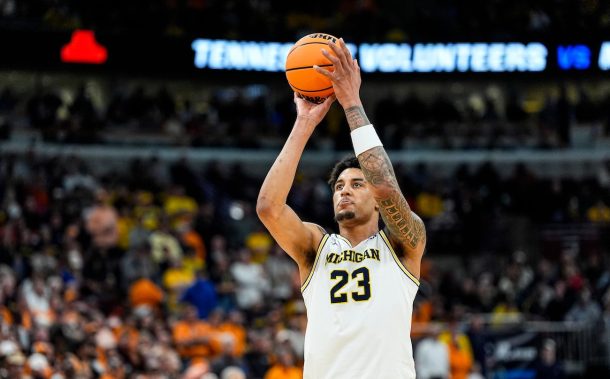

INDIANAPOLIS — The stage is set for the Final Four on Saturday and the question most folks in the hoops mecca that is Indianapolis keep asking is simple: Is Saturday’s national semifinal between Arizona and Michigan the functional national championship game? If so, does a healthier Arizona have the edge? What about the “other” semifinal? Did UConn save any magic for Indianapolis, or was every ounce of March UConn magic used in the Elite 8 rally against Duke? As a 3-seed, Illinois is hardly a Cinderella, but can Brad Underwood’s international roster continue to guard well enough to turn 4 consecutive wins into 6 consecutive wins?
These are among the biggest questions waiting to be answered on college basketball’s biggest stage this weekend.
Here are the 5 stories SDS is watching as the eyes of the sporting world descend on Lucas Oil Stadium this Saturday night.
No, Arizona-Michigan isn’t the “real” national championship
The narrative is that the winner of Saturday’s second semifinal, between Arizona and Michigan, will be crowned national champion in a 40-minute coronation on Monday night.
The basis for the narrative is enticing. After all, with fellow 1-seeds Duke and defending national champion Florida out of the way, the Wildcats and Wolverines are the best teams standing. They were also consistently 2 of the top teams all season, and enter the Final Four ranked first (Michigan) and second (Arizona) in KenPom and Torvik.
Before you buy into the notion it is, consider a host of Final Fours where the “real” national championship game turned out to not be that at all, with surprise outcomes and even better basketball games coming on Monday night. At The Pit in Albuquerque in 1983, for example, the buzz around the Final Four was that the titanic showdown between Houston’s Phi Slama Jamma and Louisville’s Doctors of Dunk was for a championship. The semifinal was memorable for the incredible level of pace and athleticism on the floor, but someone forgot to tell Jim Valvano and NC State that Houston won the title by defeating Louisville on Saturday night. The Wolfpack upset heavily favored Houston, winning the national championship on one of the most famous plays in college basketball history.
That scenario is the most famous rebuttal to “the real national championship is on Saturday night” arguments we’ve heard all week surrounding Arizona and Michigan, but there are other compelling retorts and interestingly, both occurred in Indianapolis.
Take 2010, when the overwhelming betting favorites to win the national title, Duke and West Virginia, squared off in one semifinal while the other semifinal featured a Cinderella story in Butler and an overachieving Tom Izzo Michigan State team. Duke hammered Bob Huggins and the Mountaineers, but the game Monday night against Butler proved far more difficult. With Duke clinging to a 2-point lead with 3.6 seconds to go, this Gordon Hayward shot nearly won Butler the national championship. Nearly.
The other stunner came in 1991, when the expectation was unbeaten UNLV would meet Dean Smith’s UNC in title game tilt for the ages on Monday night. Mike Krzyzewski’s Duke, an 8-point underdog, somehow upset UNLV in the Final Four, ruining everyone’s Monday night plans. While the Duke-UNLV game was a rematch of the national championship game a year prior (won handily by UNLV), making it a spotlight game in its own right, the 2 highest seeds at that Final Four were Smith’s Tar Heels and Jerry Tarkanian’s Runnin’ Rebels. When Roy Williams’ Kansas team upset North Carolina to reach the championship game, the door opened for Krzyzewski to win his first national title at Duke.
In other words, narratives are fun, but the games get played. Indianapolis has seen some storied upsets hosting this event (another came in 2006, when underdog Florida upset UCLA to win the Gators their first national championship) and this weekend may end up looking no different.
Sure, but who has the edge? Arizona or Michigan?
Your faithful basketball bard believes Dusty May might be the best tactical coach in the sport right now, a masterful offensive mind and, as we saw at FAU and now at Michigan, a thoughtful roster builder. Tommy Lloyd’s no slouch, of course, and here’s the thing: Arizona is healthier.
There’s an argument, I suppose, that the Wolverines haven’t missed their best shooting guard, LJ Cason (40% from 3 this season) that much since his season-ending injury. The data supports this line of thinking, at least in part, as Michigan connected on a staggeringly good 45 of its 101 shots from beyond the arc in winning its regional and advancing to Indianapolis.
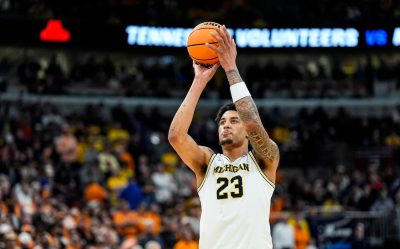
The flip side is that in its lone NCAA Tournament game against a top 25 defense (the Elite 8 vs. Tennessee), Michigan shot just 10-of-27 from distance, and even that was far better than the collective 30% (20-for-66) Michigan shot without Cason at the B1G Tournament, where the Wolverines lost the final to Purdue.
Is it possible that Michigan continues to shoot the lights out, even in a football stadium with its strange shooting backdrops, against a tremendous Arizona defense (2nd in KenPom defensive efficiency). It is absolutely possible!
It just doesn’t seem likely, and that’s likely to cause Michigan problems against an Arizona team that thrives at taking away your post presence and makes you hit shots to beat them. The Wolverines do all that, too, of course, and arguably better than Arizona, thanks to the incredible interior defense of Aday Mara, Morez Johnson Jr., and Yaxel Lendeborg. But Tommy Lloyd’s team has the more explosive guard play, with 2 guys in Jaden Bradley and Brayden Burries, who can get you a late shot clock bucket when your sets and actions break down, and another player, Koa Peat, who creates mismatch problems against even elite bigs (see his opening night masterpiece against National Defensive Player of the Year Rueben Chinyelu to get an idea of what I mean).
In March and April, in games decided by a possession or 2, give me the team with more playmakers almost every time. That favors Arizona Saturday evening.
Here’s a look at the Kalshi market for Saturday’s Arizona-Michigan game:

Which Solo Ball shows up for UConn?
Danny Hurley is undoubtedly looking at a Final Four rematch with Illinois, who UConn hammered 74-61 in November, as a decidedly winnable game. That confidence is well placed, too, as long as Tarris Reed Jr. continues to shine the way he has throughout the NCAA Tournament. The senior has averaged 21.5 points and 13.5 rebounds per game in the NCAA Tournament, earning 3 KenPom game MVPs and shooting an extremely efficient 60% from the field. A few more gems from Braylon Mullins would help, too, and yes, I’m going to post this in anything I write about UConn this week.
But the real wildcard for the Huskies and their hopes to win a third national championship in 4 seasons is Solo Ball. It’s been a tough year for the junior guard, who has shot a career worst 29% from beyond the arc on high volume (243 attempts), a nearly 12 percentage point drop off from a season ago. But Ball has shown signs of life in some of UConn’s biggest wins. He was brilliant in a win over Florida in the Jimmy V Classic in December (19 points, 3-8 from 3), excellent in a road win at Kansas in December (17 points, 3-7 from 3), and led UConn in scoring with 15 in the aforementioned comfortable win over Illinois. Ball has made just 3 of 21 attempts from deep in the NCAA Tournament, but his ability to get hot keeps him on the forefront of most scouting reports.
Hurley knows what he’ll get from Reed, Mullins, and program legend Alex Karaban. What he coaxes out of Ball this weekend will define this 2-game tournament for the Huskies.
Can Illinois guard actions again for 40 minutes?
It’s no secret where Brad Underwood’s team was limited all season. The Illini didn’t just take a few possessions off defensively. They had entire nights where they refused to guard a soul. The Illini surrendered 1.2 points per possession or more in February losses to Michigan State, Wisconsin, UCLA, and Michigan, all of which contributed to a team in the 1-seed conversation much of the year falling to the 3 line come Selection Sunday.
The good news for Ilini fans is that the team saved its best defense for March. In the South Regional in Houston, the Illini held Houston and its brilliant backcourt to just .94 points per possession, overwhelming the smaller Cougars with their size and length. Then they guarded an Iowa team that runs better actions than almost anyone in America to just 1 point per possession in a 71-59 comeback victory in the Elite 8.
It was the kind of defensive display that many did not believe Illinois had in it, regardless of its immense size.
Saturday night against UConn, the Illini will need to do it again. Like Iowa, the Huskies run actions on nearly every possession, punishing switches and aggressively attacking mismatches. Unlike Iowa, UConn has the skill from position 1-5 to punish all manner of Illinois mistakes. The Huskies also have a point guard in Silas Demary Jr. who can scrap with the physicality of Illinois while exploiting the defensive inadequacy of the Illini’s star guards, who are dynamic offensively but have been beaten consistently off the bounce by bigger, stronger guards this season.
The way Illinois can score, it’ll never be out of a basketball game. The championship ceiling will be determined by whether the Illini guard.
Who are the 5 best players at the Final Four?
When you get to the final weekend, there are elite players everywhere. Last season, the Final Four saw 3 Consensus First Team All-Americans play on semifinal Saturday (Cooper Flagg, Walter Clayton Jr., Johni Broome).
This year only 1 survived (Michigan’s Yaxel Lendeborg), but both Keaton Wagler of Illinois and Jaden Bradley of Arizona earned consensus honors, albeit not First-Team. Those 3 players are all engines for their squads in different but vital ways.
Lendeborg might be the best player at the Final Four, with the size and speed to play anywhere on the floor, a vexing problem for opposing coaches all season. Lendeborg averaged 25 points, 8.3 rebounds and 4.3 assists, shooting 61.4% from the field and 52.6% from 3-point range in winning Most Outstanding Player in the Midwest Region. If he plays like that in Indianapolis, Michigan will hang a second national championship banner.
Wagler can create space for himself and score at will, and he’s saved his best basketball for last, posting a double-double against Houston and then taking the Iowa game over late (25 points) to send Illinois to the Final Four for the first time in 20 years.
Bradley, the Big 12 Player of the Year, is a tenacious perimeter defender who keeps Arizona organized offensively and doesn’t try to be anything he is not. For example, Bradley will drive and look to shoot midrange, where he’s clinical, rather than force perimeter shots (he attempted just 66 3s this season), because he knows he’s masterful at drawing contact in the lane and getting to the free-throw line, where he hits on 80% of his free-throw attempts. He also does not turn the ball over (2.7-1 assist-to-turnover ratio), a vital thing for an Arizona team that controls the offensive glass (5th in offensive rebounding percentage) and as such, is dominant simply by getting shots up at the rim.
The other 2 spots go to big men. Tarris Reed Jr. of UConn has been arguably the best player in the NCAA Tournament to date, and given UConn’s lack of size comparative to the monstrous teams in the Final Four with the Huskies, he might be the most vital player to any team in Indianapolis. Koa Peat has played his best basketball for Arizona during the final month of the season, and after dominating Arkansas with 21 points on a tidy 8-of-11 from the field in the Sweet 16, he dazzled with 20 points and 7 rebounds and tremendous interior defense in Arizona’s comeback win over Purdue in the Elite 8. Along with Wagler, he’s been one of the nation’s best freshmen all season, and it is fitting to see both players in the spotlight on the season’s final weekend.

Neil Blackmon covers SEC football and basketball for SaturdayDownSouth.com. An attorney, he is also a member of the Football and Basketball Writers Associations of America. He also coaches basketball.