Michigan’s 2-year title turnaround under Dusty May a reminder of what the right hire and portal make possible

Published:

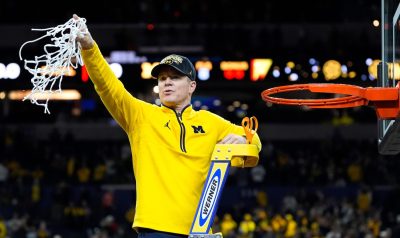
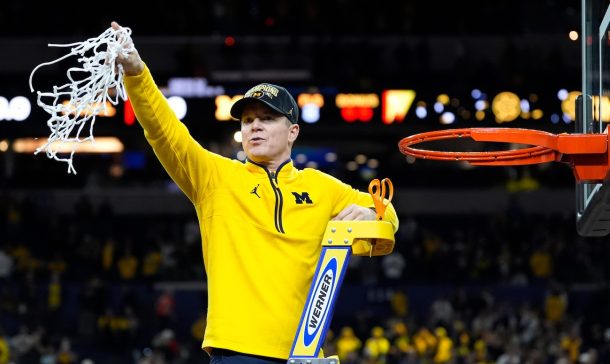
INDIANAPOLIS — The maize and blue confetti fell softly to the floor of Lucas Oil Stadium, “One Shining Moment” blared, and under a basket without a net, far removed from his celebrating players, Michigan head coach Dusty May stood with his hand in his pocket, watching and smiling.
In 2 whirlwind years, May had taken Michigan from the depths of despair to the sport’s summit, winning the proud program’s second national championship. The championship snaps a 26-year title drought for the B1G, with the Wolverines’ dominant 6-game romp through March Madness firmly cementing Michigan’s meteoric return the nation’s basketball elite in Ann Arbor.
The scene playing out on the confetti-strewn Lucas Oil Stadium floor was almost unthinkable just 2 years ago.
Michigan was coming off a disastrous, injury-plagued 8-win season and had fired program legend Juwan Howard, a brutal blow at a program that finally felt at peace with the stormy, complicated history of the the Fab Five.
Michigan needed a spark, a jolt of energy to drag the dust off the B1G Championship banners and of course, to put Michigan in position to make the lone national championship banner, hanging since 1989, feel less lonely.
There was certainly hope when the Wolverines won a coaching hire battle for May, then a coveted mid-major head coach who reached the Final Four at Florida Atlantic in 2023. If May could turn a beach town college basketball backwater into a consistent winner, surely he could win at a place with the resources and institutional commitment of Michigan, athletic director Warde Manuel thought at the time. But hardly anyone felt May would pull this type of turnaround off in just 2 years.
In another era, a 2-year turnaround from 8-win team with a threadbare roster to national champion would feel like too heavy a lift, the stuff of fan fiction.
In the current era of college sports, with NIL packages, unprecedented television dollars driving record-setting administrative spending on athletics, and a transfer portal overflowing with talent looking for their next best opportunity, a quick flip from the poor house to the penthouse is firmly within reach. All that’s required is an influx of cash, coaching, and roster building savvy.
May is the latest example, joining Indiana’s Curt Cignetti in orchestrating B1G basement to championship turnarounds in just 2 seasons. He did it with smart roster building, first and foremost, a skill that’s easier said than done.
“Every Power 5 program in America mines the portal to elevate their talent level, fix perceived roster deficiencies, get older, better,” former Power 5 head coach and current ESPN analyst Seth Greenberg told SDS earlier this season. “It’s the programs with staffs that still understand the portal isn’t about throwing money at a problem who excel. You have to get the right guys. That requires thought.”
Does money help? Of course. It’s essential. But even $22 million rosters fail when they aren’t put together thoughtfully.
To build a Final Four roster, you need at least 2 other things. First, you need an idea of how you want to play. Second, you better spend time on your evaluations and make sure you get the right fit.
The first part has never been an issue with May.
His high-tempo style helped him outwit more-talented rosters at Florida Atlantic, but in his mind, he always hoped to play bigger, to control the glass and add rim pressure to a style that already pressured opponents by pushing tempo and trying to score before defenses got set.
“We want to play fast, but we know if we rebound the ball well, we can push and get up the floor before those physical, tough defenses in our league and the ones you see in March get set,” May said this week. “And we knew coming in if we had the size and physicality to rebound, to protect the paint, and the speed to get up the floor, we felt like our chances of scoring would be greater.”
Contrary to the prevailing narrative this week, Michigan wasn’t a wholly portal driven roster. The best rosters in college basketball usually are not, and Michigan’s championship team proved the rule.
Blending program veterans like Nimari Burnett, LJ Cason (who came with May from Florida Atlantic and understood May’s culture and style) and Will Tschetter, May integrated specifically targeted recruiting (freshman Trey McKenney, who buried a dagger to all but seal the championship game on Monday night) and portal pieces to complement the no-nonsense defense and toughness of the guys already on the roster.
“If you are worried about what portal player rankings say, as opposed to whether a player fits what your program needs, you’ve already lost,” Florida head coach Todd Golden, who won the 2025 national championship by assembling a roster brimming with talent other teams passed over but Golden and assistant Jonathan Safir, the program’s functional general manager, felt fit Florida’s high-tempo, 2-big man style of play. The Gators didn’t have a top 100 player on their team, but won 36 games en route to the national championship. “You get the evaluations right, and fit and style are 2 big parts of that process,” Golden told SDS.
May and his staff understood that blueprint entirely. The players Michigan added were players May felt fit, irrespective of their portal ranking or reputation elsewhere.
“We took 4 guys out of the portal,” May said Sunday. “If you listen to the college basketball gospel, we took 17 of them, and that’s all we have.”
Only Yaxel Lendeborg, an elite rebounder and 3-level scorer who transferred from UAB and blossomed into a Consensus First-Team All-American this year in Ann Arbor, was coveted by every program in the portal.
Every other take had “questions” within the narrative.
Take Elliot Cadeau, a castaway disappointment at blueblood North Carolina, lamented for low 3-point shooting percentages and the cardinal Carolina sin of not being Marcus Paige or Kendall Marshall. Could he shoot? Could he contribute defensively? Asked and answered.
All Cadeau did in Year 1 in Ann Arbor is shoot a career-best 38% from 3, average 10.6 points and 5.9 assists per game, and help run one of the sport’s most efficient offenses (4th, per KenPom). Cadeau saved his best for last, scoring 19 points in the national championship game on a night when Lendeborg was limited by an injury.
Morez Johnson Jr. was a raw talent, the kind of guy whose athleticism jumped off film but whose limitations offensively made analysts and coaches alike wonder about his high level impact. Johnson nearly doubled his scoring average this season after transferring from Illinois and blossomed into the B1G’s leader in effective field goal percentage, a testament to his intelligence and willingness to take the smart shot, not every open one.
May’s masterpiece, though, may have been Aday Mara. The 7-foot-3 center’s potential went unrealized at UCLA under Mick Cronin, but this season, the Spaniard nearly tripled his career production, averaging 12.2 points, 6.8 rebounds, 2.6 blocks and 2.5 assists and anchoring the best defense in the nation.
May, a former student manager at Indiana who credits Bobby Knight’s meticulous approach to recruiting and preparation as a key influence on his approach to everything from talent evaluations to coaching, deflected credit this week.
“When you bring a group this talented together and they decide from the beginning that they’re going to do it this way and they never waver and they never change, that’s probably the most uncommon thing in athletics now,” May said.
Michigan’s coach, though, deserves plenty of the credit for building the first team in NCAA Men’s Tournament history to score 90 or more points in 5 straight games, including work-of-art romps over Tennessee in the Elite 8 and a mighty Arizona team in the Final Four.
There’s time to lament the portal, the death of Cinderella, the lack of high level drama at this Final Four, which never really featured a truly nip-and-tuck back-and-forth game.
That can wait for another day.
Right now, the mood is Hail to the Victors, played to the beat of one of the most impressive roster-building projects and 2-year turnarounds in the history of college basketball.
A championship story and a coach in May who, at 49, might just be getting started.
Neil Blackmon covers SEC football and basketball for SaturdayDownSouth.com. An attorney, he is also a member of the Football and Basketball Writers Associations of America. He also coaches basketball.