10 things I’m absolutely overreacting to in SEC hoops: This is March edition

Published:

Welcome to March.
It’s the land of Cinderella storylines and smashed slippers. It’s where a little college called Florida Gulf Coast becomes Dunk City, where UMBC slays a Virginia Goliath, where Saint Peter’s stands high and mighty above Kentucky and where George Mason and VCU follow the back roads to the Final Four, where all roads hope to end. It’s the lush, legacy-defining landscape that’s home to Lorenzo Charles’s dunk heard round the world, Christian F*#!# Laettner, Kemba Walker’s run to immortality, and Anthony Davis, Michael Kidd-Gilchrist and the boys making John Calipari a champion once and for all.
It’s the month we fell in love with Shabazz Napier, the month a kid from Wilmington named Michael hit that shot, and the month some say should be named after Tom Izzo. It’s the month of indelible moments seared into memory, from Jimmy Valvano looking for someone to hug to Gordon Hayward’s halfcourt heave rattling in and then out to a country kid from Lake Wales, Florida, named Walter Clayton Jr. helping the Gator Boys stay hot.
It’s the most wonderful time of the college basketball year and without question, one of the few sacred, perfect things left in college sports.
And yes, that’s a reason not to expand. March Madness doesn’t need a facelift. It’s perfect as is.
As the SEC storms towards March, we have a league champion (Congratulations, Florida!), at least 7 NCAA Tournament “locks” (Florida, Alabama, Arkansas, Tennessee, Vanderbilt, Georgia, and Kentucky), 4 and maybe 5 (is that Oklahoma’s music I hear?) SEC teams are still dreaming of dancing, and plenty of basketball left to sort out before college basketball’s holiest of days, Selection Sunday.
With that framing in mind, here are 10 things I’m absolutely overreacting to as SEC basketball opens the month of March.
Opening Tip: March Madness is Perfect. We don’t need expansion.
Could this be the final NCAA Tournament with 68 teams? More critically, should it be?
There’s a license to print money somewhere that will explain why NCAA President Charlie Baker and the power brokers in collegiate sports want to expand the NCAA Tournament from 68 teams to 72, 76 or something beyond.
There’s plenty of data, however, that debunks any argument that expansion is something more than a cash grab.
The 68-team format is perfection.
It’s a grid the office secretary can pick easily on her coffee break, a perfect 6-round (plus a First Four that doesn’t count) shape you can print on a piece of paper and play out over the course of 3 beautiful spring weekends.
It rewards difficult scheduling and power conferences while also remaining inclusive enough for Cinderella stories to thrive.
If you like Power Conference basketball, look no further than last year, when 14 of the 16 SEC member institutions went dancing. Mike Slive, Greg Sankey, and folks like SEC Associate Commissioner Garth Glissman have worked immensely hard to raise the profile of the SEC as a basketball league, and after years of prodding member institutions to invest, the administrative commitment in the SEC is unmatched. For the second consecutive season, the SEC appears poised to receive the most NCAA Tournament berths and will again rank at the top of predictive analytical databases such as KenPom and Bart Torvik, both of which are used as selection metrics by the NCAA Selection Committee.
In other words, power conferences are served equitably and justly in the current system.
Mid-majors and the so called “low major” programs are, too. Yes, there are over 350 teams in Division I basketball. But there’s no “access” issue. Nearly 20% of all college basketball programs make the NCAA Tournament, and automatic berths assure teams like Bethune-Cookman, a power this year in the low major SWAC, have their shot in March. And before you cry foul on automatic bids, remember that only 2 of the beloved Cinderellas that have advanced to the Final Four in the last 20 years (George Mason in 2006 and VCU in 2011) were “at-large” teams, anyway. Others, like FAU and San Diego State in 2023, earned automatic berths. The automatic bid process works and the Committee, believe it or not, tends to get it right.
The evidence is clear: power conferences are treated fairly in the status quo, earning 304 of the available 362 at-large bids since 2015. There’s no reason to change that process if you are a Power 5 team, and no evidence suggesting that more at-larges will mean more mid-majors will find bids in an expanded field. If you don’t believe me, look no further than the current debate, magnified by former Auburn head coach and loving father Bruce Pearl about a mythologized vacuum where 16-14 Auburn, having played one of the nation’s most difficult schedules, either earns a berth or loses one to undefeated MAC Champion Miami of Ohio. “Expand to 72 and both get in,” is the refrain from the expansionists, but given the huge number of power conference teams already receiving bids in the 68-team format, there’s 0 reason to trust the Redhawks are assured inclusion in an expanded field. Instead, the evidence suggests another middling Power 5 team (Cal, Stanford, Seton Hall, anyone?) swipe that bid instead.
College basketball has room enough for both types of programs in the status quo.
The system isn’t broken. On the contrary, it’s memorable and perfect. Leave it alone!
There’s plenty to play for on the final Saturday of the regular season
The SEC bubble doesn’t lack drama entering the final weekend of the regular season. While we believe there are 4 teams fighting for 3 spots, it’s certainly possible that Oklahoma reinserts itself into the bubble conversation with a win Saturday at Texas. That would shake up the current expectation that the Longhorns are “safe” and give the Sooners at least a puncher’s chance to play their way into the field with a couple of quality wins at the SEC Tournament in Nashville next week.
The biggest story, though, remains Auburn. Will the Tigers miss the field entirely a season after reaching the Final Four?
Barring an upset win at Alabama on Saturday, that seems likely.
Presently, Bart Torvik gives Auburn a 17% chance of reaching the field, but that number improves to 50% with a win at Alabama and rises to over 60% should Auburn beat Alabama and win its first game at the SEC Tournament. Steven Pearl’s first Auburn team has notched some high-quality wins, including the best win in the SEC this season in a 9-point victory and reigning national champion Florida. Auburn’s played 21 games in the first 2 quadrants, as well, the most in America for any team other than Michigan (23). Until a week ago, when Auburn lost on its home floor to Ole Miss, the Tigers also didn’t have a single “bad loss.” Unfortunately for the Tigers, Ole Miss is miserable, and a home loss to a Rebels team that had lost 10 in a row is résumé poison. The “Last 10 games played” metric is no longer considered by the Committee, which could help Auburn, considering the Tigers are just 3-7 in their last 10 games. But the real issue is loss volume, which will balloon to 15 losses should Auburn lost at Alabama this weekend. There will be no recovering from that fate, even with reasonably positive metrics (top 42 in KenPom and Torvik) and higher quality wins (at Florida, Arkansas, NC State, St. John’s).
Beyond Auburn, the teams with the most to play for on the final Saturday of the regular season are:
- Florida, who is still fighting for a 1 seed, and could take a huge step in that direction with a Quad 1A win at Rupp Arena
- Texas A&M, who cannot afford a bad loss at LSU that would spoil the ground it made up after beating Kentucky mid-week
- Mizzou, who can eliminate all NCAA Tournament doubt and avoid a potential quarterfinal rematch with Florida (maybe it wants that smoke?) by defeating Arkansas on Senior Day in CoMo on Saturday
All told, we should have a weekend filled with great basketball, especially considering only 1 seed (Florida) is fully determined for the SEC Tournament heading into the final weekend.
SEC Awards: Part 1 — First and Second Team All-SEC
SDS will continue the tradition of publishing its All-SEC ballot. Shout out to the SEC for limiting its ballot to a 5-man team selection. We don’t need 8 players for a First-Team All-SEC ballot. To quote the late, great Gene Hackman, our “team is on the floor.” We did take the liberty of choosing a first and second team All-SEC, though, and have explained our choices below.
First Team All-SEC
Darius Acuff Jr., Guard, Arkansas
Labaron Philon Jr., Guard, Alabama
Tyler Tanner, Guard, Vanderbilt
Thomas Haugh, Forward, Florida
Alex Condon, Forward, Florida
The Skinny: Three of these choices (Acuff, Philon, and Haugh) were simple and should appear on every ballot. Alex Condon’s been the SEC’s best player over the last month, and he’s up to third in the SEC in KenPom efficiency while leading the SEC in defensive win shares and ranking in the top 10 in offensive and defensive rebounding percentage. He merits a first-team selection. The decision between Rueben Chinyelu and Tyler Tanner was the most difficult to evaluate. Florida is going to win the SEC by at least 3 games. Does that warrant inclusion of their entire frontcourt on the All-SEC first team, especially when Rueben Chinyelu may be the National Defensive Player of the Year? In the end, Tyler Tanner ranks second in KenPom player efficiency in the SEC and plays with less talent around him than Chinyelu. Tanner is a great shooter, elite creator (second in the SEC in assist rate at 32.2%), and a tenacious defender who anchors a quality Commodores defense with a steal rate of 4.2%. Production on both ends matters immensely. It isn’t that Chinyelu (18 double-doubles, tying a Florida school record) lacks it. It’s just that we can’t figure out how to justify leaving Tanner, who is arguably more valuable and certainly as important to Vanderbilt’s success as Chinyelu is to Florida’s, off the first team.
Second Team All-SEC
Rueben Chinyelu, Center, Florida
Ja’Kobi Gillespie, Guard, Tennessee
Josh Hubbard, Guard, Mississippi State State
Mark Mitchell, Forward, Missouri
Dailyn Swain, Wing, Texas
The Skinny: Chinyelu is slotted here as the “Last Man Out” from the First Team. Hubbard is an instant bucket and creator who had the misfortune of playing for the worst team Chris Jans has ever coached. He will finish third in the league in scoring despite being the focus of every opponent scout. Mark Mitchell does everything for Missouri, averaging 17 points, 5.2 rebounds, and 3.6 assists per game while ranking in the top 10 in the SEC in win shares (4.3). He might be the most underrated player in the conference. Dailyn Swain quietly put together one of the more underrated and efficient seasons in the SEC, averaging 17.7 points per game, 7.5 rebounds, and 3.2 assists and ranking top 20 in the SEC in effective field goal percentage (7th), total shooting percentage (4th), defensive rebounding (3rd), steal percentage (13th), fouls drawn per 40 minutes (8th), free throw rate (11th), and free throw and 2-point field goal percentage (17th and 18th, respectively). Ja’Kobi Gillespie has led Tennessee to yet another top 5 SEC finish and ranks first in Evan Miya’s SEC Player Ratings and 5th in KenPom. He was a no brainer and, in a world where Acuff, Tanner, and Philon don’t exist, probably warrants First-Team consideration.
SEC Awards: Part 2 — Individual Awards
Player of the Year: Thomas Haugh, Florida
Freshman of the Year:: Darius Acuff Jr., Arkansas
Defensive Player of the Year: Rueben Chinyelu, Florida
Sixth Man of the Year: Smurf Millender, Georgia
Coach of the Year: Todd Golden, Florida
The Skinny: Chinyelu, who may win National Defensive Player of the Year, was the easiest vote here. What an extraordinary story the big man has been anchoring the middle of one of college basketball’s most imposing defenses.
The biggest vote here was for Player of the Year. Acuff will probably win, and you’ll hear little criticism from me when/if that happens. That said, there’s a statistical and data-driven argument for Haugh, who at this stage in his career is a better 2-way player than Acuff.
In addition to his advantage over Acuff in every meaningful defensive metric (Haugh even has a higher steal percentage), Haugh outpaces Acuff Jr. in Evan Miya’s player ratings and ties him in overall win shares (5.1).The 2 also played a game. They didn’t guard one another, of course, but Haugh was the best 2-way player on the floor (22 points, 5 rebounds, 2 assists, a block, a steal, KenPom game MVP) while Acuff played his least-efficient collegiate game (6-19 FG, 3 turnovers) and lost by 34 points. If you think the SEC POY award is an offensive award only, then consider this data point, too: Haugh is 1 of 4 players in America (Cam Boozer, Aday Mara, Yaxel Lendeborg are the others) who is shooting a true FG percentage of 60% or higher and averaging 20 points or more per 40 minutes in Quad 1 games. In other words, Haugh is the best 2-way and big-game player in the SEC. That’s enough to earn our Player of the Year vote.
As for the other awards…Acuff as freshmen of the year is a no-brainer. He’s a top 3 freshman in America, in my view, along with AJ Dybantsa of BYU and Duke’s Cam Boozer. If you had to play 1 game with Acuff or Kansas star Darryn Peterson, there’s no reasonable argument for Peterson right now that doesn’t rest on future upside. That’s how good Acuff has been.
Max Barr of Southeastern 16 says the “Sixth Man of the Year” race is the toughest to call and we agree.
Smurf Millender of Georgia has averaged 11 points, 4 assists, and 1.2 steals coming primarily off the bench for the 21-win Dawgs. He gives Georgia a third playmaking guard to complement Jeremiah Wilkinson and Blue Cain, and he’s saved his best for league play, shooting 42% from 3 in conference play while ranking top 10 in the SEC in effective field goal percentage and top 15 in assist rate. That’s enough for him to edge out Urban Klavžar of Florda, though the Slovenian sniper has certainly changed how you have to guard the Gators by shooting 44% from 3 (with 42 makes!) in SEC play while ranking third in the SEC in offensive rating this season. In the end, Millender’s ability to attract help and make plays off the bounce for others gives him a slight edge. Both would be worthy winners.
SEC Awards: Part 3 — All Defensive Team
Rueben Chinyelu, Florida
Tyler Tanner, Vanderbilt
Felix Okpara, Tennessee
Somto Cyril, Georgia
Boogie Fland, Florida
The Skinny: Chinyelu is the anchor of a top 5 defense, and Fland is the best perimeter defender in the SEC, an absolute pest who can quickly turn defense into transition offense. Tanner edges out teammate Devin McGlockton for a spot after playing the steal merchant role for a top 3 SEC defense. Okpara is a dominant force inside for the Vols, who rank 14th nationally in defensive efficiency, per KenPom. Somto Cyril ranks 10th nationally in block rate and is the linchpin of a Georgia interior defense that blocks more shots than any team in the league and uses those blocks to create transition opportunities.
Team of the Week: The SEC Champion Florida Gators
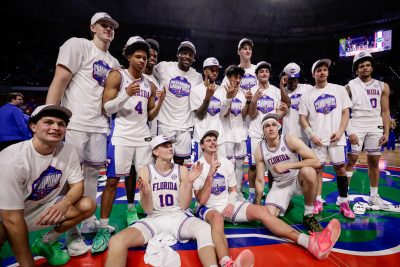
Florida steamrolled Arkansas 111-77 with College GameDay in the building on Saturday night in Gainesville and followed that up with a 34-point win over hapless Mississippi State. In the process, the Gators clinched the SEC championship outright and became the first program since the SEC fully integrated in 1973 to score over 100 points and win by 30+ points in back-to-back conference games. Only Kentucky had accomplished the feat previously, doing so in the pre-integration era of SEC basketball.
Florida’s remarkable turnaround is a testament to the coaching staff’s roster-building acumen and development.
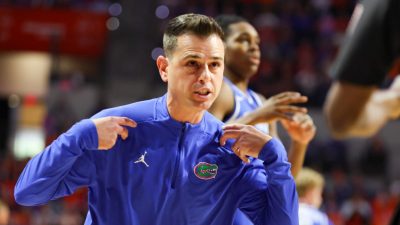
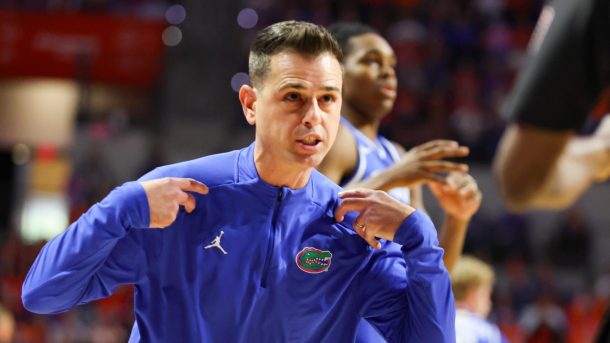
That begins with head coach Todd Golden, who should easily win the SEC Coach of the Year award. Golden lost 3 starters and a key role player from arguably the best backcourt in the history of the SEC and rebuilt the roster into a top 5 KenPom and Torvik outfit and runaway SEC champion. Golden didn’t lose faith when the team fell to 5-4, either. He just kept competing and instilling belief in his team, which has come together to win 10 consecutive games and rank 2nd in efficiency since January 1 (Duke), per Torvik.
Earlier this week, after Florida clinched an outright SEC championship, I asked Golden what changed to help Florida transition from a team nationally characterized as a disappointment in November and December to a Final Four contender in March.
“I mean, I think it probably took me a little longer than I expected to kind of figure out what the best way for us to play was,” Golden told me. “We have a lot of talented guys that were trying to figure each other out. You know, they were alphas in other places and they come in and you know, they are trying to figure out who should be the big shot guy and who should be finishing possessions, and what guys should be shooting 3s, what guys shouldn’t be shooting 3s. It just takes a while, especially when you have some new pieces and returning guys in new roles.”
Golden’s resilience and his ability to get his players to buy in as they adapted to who they needed to be is great coaching.
Golden’s staff warrants praise, too. Golden’s roster construction skills are built on a foundation of good evaluations, buoyed by the early tenure evaluations of Thomas Haugh by former assistant and now Columbia head coach Kevin Hovde and Alex Condon by current assistant Jonathan Safir, have helped build one ofc the best frontcourts in SEC history. And Carlin Hartman, Korey McCray, and Taurean Green are 3 of the better development-focused assistants in America. Throw in new assistant Dave Klatsky, who has produced a top 5 defense nationally in his first season as a Power 5 defensive coordinator, and you get an idea of how Florida won the SEC and has a chance to have a memorable March.
Will Florida go on to win the national championship for a second year in a row? Here’s what Kalshi has to say about the Gators:

Player of the Week: Xzayvier Brown, Oklahoma
The Sooners’ postseason pulse isn’t dead thanks to tremendous guard play, with Brown front and center. The Saint Joseph’s transfer scored 20 points on an efficient 6-of-10 in Oklahoma’s rout of LSU last weekend and followed that performance up with a 12-point, 5-assist, 2-rebound, 1-steal, 1-block stat sheet stuffing party in Oklahoma’s upset of Missouri. Quietly, Brown has put together a terrific junior season for the Sooners, scoring in double figures in all but 2 of Oklahoma’s SEC games while shooting 39% from deep in league play on high volume. If the Sooners make enough noise to get an NCAA or NIT invitation over the next week-plus, Brown’s consistency will be a huge factor.
Stat of the Week: 13 Turnovers
That’s the magic number for Kentucky. The Wildcats are 2-7 when they commit 13 turnovers or more in SEC play. They are 8-0 when they commit 12 or fewer turnovers. The Cats’ turnover percentage of 15.4% on the season ranks in the top 100 nationally, a quality number. But Kentucky needs to limit turnovers and outscore teams in transition, where they score 16.2 points per game, per CBB Analytics. When they turn it over themselves and give up transition opportunities, they are far less effective on both ends of the floor. For Kentucky to be its best this March, the turnover number must remain below unlucky 13.
Where to Eat on a SEC Hoops Weekend in: Tuscaloosa, Alabama
If you head on over to the Capstone for the Iron Bowl of Basketball, it’s tough to beat the food at Nick’s Original Filet House, a place not named for Nick Saban but affectionately known on a first name basis like Saban, who was found in the legendary spot from time to time. Known to locals as “Nick’s in the Sticks,” Nick’s has served locally sourced, perfectly seasoned and cooked steaks for over 50 years. Grab the steak of your liking, a loaded baked potato with signature blue-cheese ranch dressing, and, if you are so inclined, the Nicodemus, a fruit punch, rum, vodka, and tequila concoction served in a Styrofoam cup and worth every savory drop.
The SEC’s 10 NCAA Tournament teams will be:
Florida, Alabama, Arkansas, Vanderbilt, Tennessee, Georgia, Kentucky, Missouri, Texas A&M, and Texas.
Neil Blackmon covers SEC football and basketball for SaturdayDownSouth.com. An attorney, he is also a member of the Football and Basketball Writers Associations of America. He also coaches basketball.