College basketball efficiency is at historic highs. The 2-point shot is why

Published:
College basketball’s 3-point revolution has been underway for years, but it’s peaking now. The 2026 season is on pace to be the first year where 3-point attempt rate is north of 40%.
And yet, it’s the 2-point shot that’s driving one of the biggest explosions in offensive efficiency that this sport has seen.
At all levels, basketball has undergone massive analytical changes over the past decade. It started at the highest level in the NBA, where figures such as Daryl Morey and Steph Curry ushered in a drastic shift in basketball strategy almost overnight.
Since the heyday of Morey Ball, the 3-point shot has been increasing in popularity among teams for a simple reason: Math. Some prefer to blame (or credit, depending on who is talking) “analytics,” but it’s just simple math. If you make 50% of your 2s, it’s worth 1 point per shot. If you make 40% of your 3s, it’s worth 1.2 points per shot. Math. Nothing fancy.
Thus, basketball decision-makers began to bang the table for more 3-point shots. They were objectively correct, supported by the math explained above so long as their team had even mediocre shooting talent. Every year from 2003 through 2024, 3-point attempts yielded more on a per-shot basis than 2-point shots, sometimes by as much as .074 points per shot. Magnified over an entire season, that’s an enormous difference in offensive efficiency.
That trend began to flip in 2025. Last season, the average 2-point shot was worth 1.059 points while long-range efforts dipped to 1.032 points per shot. It was the first time since at least 1997 — and likely ever — that expected value from a 2-point shot was higher than the EV a 3-pointer.
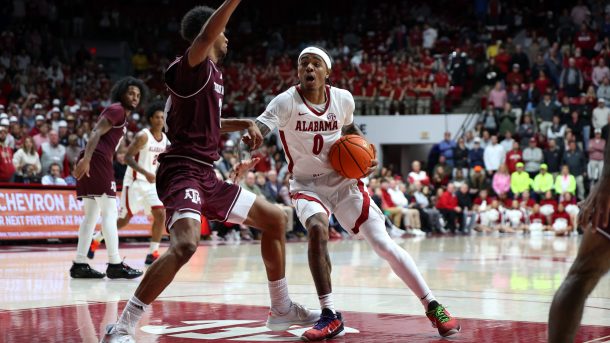
In 2026, it’s happening again, but to an even-more-drastic degree. Entering Wednesday’s games, P5 teams are averaging a staggering 1.082 points per shot inside the arc. As recently as the 2019-20 season, 2-point efficiency was under 1 point per shot.
It’s worth noting that 3-point efficiency is up from last season, although it’s lower than it was for much of the past 2 decades. The 3-point revolution has mostly been about volume. Per-shot efficiency has largely been flat or even down relative to what it was 10 or 20 seasons ago.
But 2-point efficiency? It’s booming. Points per 2-point shot is on pace to increase for the 6th year in a row.
So what’s actually happening to cause this? Are players actually just that much better at shooting from 2 than they used to be?
Maybe a little bit. But I’d posit other factors are more impactful. The rise in 3-point attempt rate has changed where defenders are positioned on the floor in a very real way. Defenses are forced to guard more space on the floor, specifically on the perimeter, leaving gaps in the shallow-to-mid-range of the floor.
Efficiency data on shallow-range 2s does a lot of work to confirm that hypothesis. In 2026, players are scoring .96 points per shot on attempts that occur in the paint but outside the restricted area (3 feet). Radar360 shot-tracking data only goes back to 2016, but that’s easily the highest efficiency for those shots over that span. Shallow-range efficiency has been trending up drastically since 2020 while the data shows conversion rates for other types of field goals are relatively flat over the last decade:
No, this does not mean that old-school mid-range shooting is “back” in any way that would satisfy the average color commentator. A shallow-range shot is still less-efficient overall on average than something at the rim or a 3-pointer (although that gap is narrowing). Non-paint 2-pointers remain absolutely dreadful shots from an expected value standpoint, netting just over half of what an attempt inside the restricted area is worth in 2025-26.
Instead, I believe this is the effect of coaches being more selective about which players are allowed to consistently shoot shots that don’t come from beyond the arc or at the rim. Players with good touch and a high level of skill are excelling from that area. What’s been purged are the non-paint 2-point attempts. So far in 2026, only 19 players (in P5 leagues) have taken 75+ shots that fit that description. Even with a few weeks left in the regular season, that is a stark decrease from the kinds of numbers we were seeing at the P5 level even just a few years ago:
Regardless of the reasoning behind this surge in efficiency, it has had a tremendous impact on offenses overall — and not just for the top teams in the country. The 100th best offense in the country is now averaging almost 112 points per 100 possessions. That’s more than a 5-point increase over what was happening a decade ago:
| Season | Team | Conference | Pts/100 |
|---|
The very best shots in college basketball, shots at the rim and from beyond the arc, have not had any increase in efficiency during the sport’s analytics revolution. But volume has increased drastically, forcing defenses to respond. Winning more games requires ferocious defense of the 3-point line and the restricted area.
But defenses have to give something up. They’d love to concede non-paint 2s — the shot that is worth just .695 points per shot in 2026. But offenses aren’t taking the bait. Frequency for those shots is down to 11.3% on the year, an absolute nadir (down more than 5 points compared to 2017). Instead, offenses are taking the volume to the 3-point line (attempt rate is up 3 points compared to 2024) while taking advantage of all the extra space in the paint. That’s the sacrifice defenses are being forced to make in modern college basketball.
Sports analytics are more fluid than they’re given credit for. Optimal strategy is not codified. At some point, if current trends continue in college basketball, the math will force coaches to amend the defensive game plans that are currently conceding high-value shots in the paint. We may already be at that point.
Will a highly efficient offensive team win the NCAA Tournament this year? Here are the latest markets on Kalshi:
Spenser is a news editor for Saturday Down South and covers college football across all Saturday Football brands.