Can Trinidad Chambliss handle this Miami defense? Why he’s got a better shot than Marcel Reed and Julian Sayin

Published:
If anybody can do it, it’s Trinidad Chambliss.
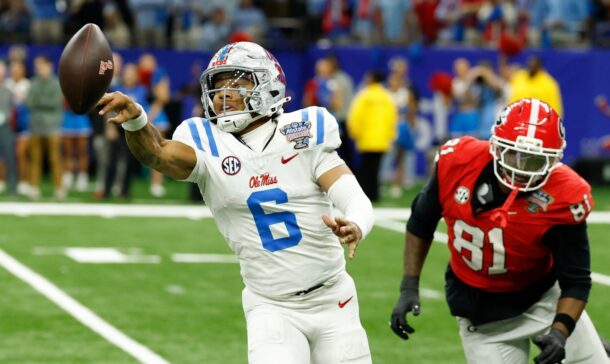
After what the Ole Miss quarterback did in a stunning victory against Georgia in the Sugar Bowl, you can probably apply that thought to a variety of situations.
Play an entire game without an offensive line? If anybody can do it, it’s Chambliss. Win a Playoff game without the use of his right hand? If anybody can do it, it’s Chambliss. Lead his team to a semifinal berth without his offensive-minded head coach? Strange as it was, Chambliss somehow already showed that he can do it. At this point, to doubt Chambliss is to scoff at his well-documented meteoric rise from post-spring Division II transfer to now “biggest thing standing in Miami’s way of playing in its first national championship in 23 years.”
The big question heading into Thursday night’s showdown is an obvious, albeit once unforeseen one – can Chambliss handle this surging Miami defense?
That remains to be seen as a slight underdog, but again, if anybody can do it, it’s Chambliss. As we’ve seen, pass rushes haven’t exactly fazed him:
Call me crazy, but yeah, that guy won’t panic.
The guy who has taken 1 sack in the last 3 games is capable of making things happen when the play breaks down
That’s not to disrespect the likes of Marcel Reed and Julian Sayin, both of whom were considered late-season Heisman Trophy candidates who’ll return as 2 of the most decorated quarterbacks in the sport in 2026. But those guys were sacked a combined 12 times. They scored a combined 2 touchdowns, both of which came from Ohio State. It felt like the Buckeyes delivered a good third quarter against the Miami defense, but outside of that, the other 7 quarters have been all about the Canes.
The defense known as “ESV” for excitement, swarm, violence has been all of that. Rueben Bain Jr. and Akheem Mesidor have led that unit to one of the most drastic year-to-year turnarounds of the Playoff era. That’s been painfully obvious in the first 2 rounds. In addition to pressuring those quarterbacks, Miami’s top-5 run defense has been on display with a combined 134 rushing yards allowed in the first 2 Playoff games.
If you’re wondering how Miami has gotten to this point while only scoring 3 offensive touchdowns in those 2 games, well, there’s your answer.
One could look at Reed and Sayin and wonder why neither one could truly settle in. After all, Reed’s mobility has been an asset all season with 50 scrambles for 391 yards (No. 9 among FBS quarterbacks) while Sayin finished his first year as a starter with a 74.3% adjusted completion percentage under pressure (No. 6 in the FBS).
What gave then? With the level that Miami is playing at up front, it’s not enough to just be 1 of those things; you have to be both of those things.
Reed only had a 61.4% adjusted completion percentage under pressure (No. 54 in the FBS) on 6.1 yards/attempt (No. 65 in the FBS) with 8 turnover-worthy plays, while Sayin had just 11 scrambles all season (No. 139 in the FBS), and they went for 48 yards (No. 167 in the FBS). It showed against Miami.
Compare that to Chambliss, who ranks No. 19 in the FBS with a 69.4% adjusted completion percentage under pressure with just 1 turnover-worthy play in those spots. And while he’s more of a designed runner than a true scrambler — he had 23 scrambles compared to 79 designed runs — he’s avoided mistakes in those pressure-packed moments in a variety of ways in ways that those 2 previous Miami opposing quarterbacks didn’t.
To be fair, Chambliss has also been pressured at the second-lowest rate on his drop-backs (21.2%) among all FBS quarterbacks
Go figure that the only FBS quarterback who has been pressured less often is his Fiesta Bowl counterpart, Carson Beck (15.8%). Why has it been so difficult to pressure Chambliss? Outside of simply holding up in pass protection, the 2 best ways to combat an elite pass rush are executing an up-tempo offense and having a dominant run game. Ole Miss does both of those things well. The latter is a key difference between this year’s team and last year’s team with Kewan Lacy. As long as his shoulder is intact, you can bet on him still being featured prominently in this offense so that the Miami pass rushers aren’t just pinning their ears back all night.
In an ideal world, Ole Miss would stay on schedule with Lacy — something that won’t be a given with Miami’s aforementioned top-5 ground game defense — and the quick-hitting passing game. Ole Miss has 6 different guys with at least 24 catches within 9 yards of the line of scrimmage (that’s as many as A&M and Ohio State combined).
Then again, go look at the most important play of Miami’s win against Ohio State. Sayin, who had just 24 incompletions all season on passes that were within 9 yards of the line of scrimmage, had one taken the other way by Miami Swiss Army Knife Keionte Scott.
The former Auburn transfer was a menace in the Texas A&M game, too, both in coverage and hunting down Reed. He’s exactly why this Miami defense is much more than just a lethal defensive line. You could argue that Scott will be the toughest guy for Chambliss to navigate because of how successful he’s been at preventing mobile quarterbacks from scrambling and moving the chains.
But as wild as it sounds, Chambliss didn’t register a single scramble against Georgia when he played the game of his life. That game and The Citadel were the only 2 starts at Ole Miss in which that happened.
Of course, Miami’s pass rush has been more consistent than Georgia’s. That could change the approach with Chambliss, who completed 5 of 8 passes for 87 yards (10.9 yards attempt) and 3 first downs when he was pressured in the Sugar Bowl. Sayin never scrambled against Miami because he took as many sacks (5) as he had completed passes on the 12 drop-backs in which he was pressured (he averaged 2.5 yards/attempt under pressure). Reed actually had fewer completions under pressure (6) than he had sacks taken (7), and while he scrambled 6 times for 46 yards, getting pressured on 34.6% of his drop-backs was too much to overcome.
Add it all up and it’s fair to say that 2 things are true at the same time. One is that Miami’s defense will be the toughest task to date for Chambliss. The other is that Chambliss will be tougher for Miami than Sayin, Reed or any other quarterback it faced in 2025.
It’s a true strength-on-strength matchup. Good. That’s what it should be with a spot in the College Football Playoff National Championship Game on the line. Anybody who points to these teams being in a 6-10 matchup as a reason why this isn’t a headliner semifinal simply hasn’t been paying attention. Chambliss against the Miami defense could end up being the premier battle of the Playoff. For all we know, the winner of that chess match will go on to take home a national title.
Is that too much pressure on a guy who was playing in front of 2,521 people the last time a championship berth was on the line?
Time will tell, but if anyone can do it, it’s Chambliss.
Connor O'Gara is the senior national columnist for Saturday Down South. He's a member of the Football Writers Association of America. After spending his entire life living in B1G country, he moved to the South in 2015.