Has Curt Cignetti overtaken Kirby Smart as the best coach in the sport?

Published:

The question gets asked on seemingly an annual basis because every year, we crown a national champion. In a sport in which there are exactly 2 active coaches with multiple national championships, it’s not that it’s easy to make up ground on them, but it’s a question that’s seemingly there for the taking when a new coach gets on the board.
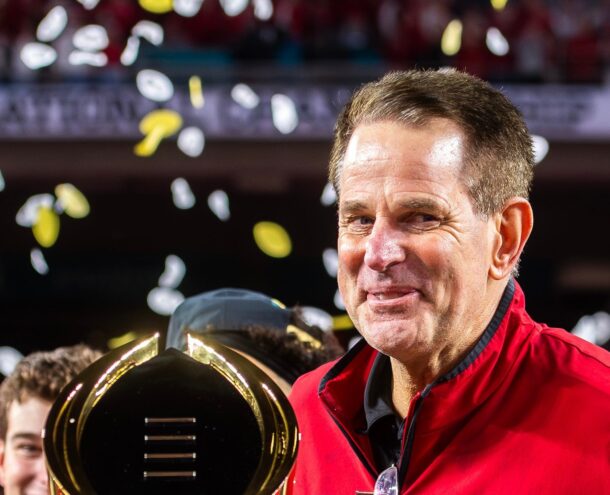
So naturally, after Curt Cignetti just pulled off a historic season to give Indiana its first national championship ever, the question has already circulated — has he overtaken Kirby Smart as the best coach in the sport?
Smart, of course, been the consensus answer to that question since Nick Saban retired. Maybe there were some folks who argued for Dabo Swinney, AKA the other active coach with multiple rings, but it’s hard to make that case when someone has 5 consecutive seasons of finishing outside of the top 10. Fellow 2-time national champion Smart, on the other hand, has 9 consecutive top-7 finishes, but he also has 3 consecutive seasons of failing to reach the semifinals.
So again, let’s ask the question: Cignetti or Smart?
That depends on your interpretation of the question. If you interpret that question as “who I’d want for the next 5 years,” Cignetti has a legitimate case. Yes, even at age 64, you could argue that going 27-2 in his first 2 years with victories away from home against Ohio State, Alabama, Oregon (2) and Miami is the type of thing that suggests there’s nothing that’s going to stand in his way in the immediate future. That’s different than someone like Smart, who went into December just trying to improve on his 1-7 record vs. Alabama. He did that in decisive fashion en route to his 4th conference title.
It’s hard to come up with a reason as to why Cignetti could face a hurdle that would limit his success for the rest of the 2020s
This isn’t someone who refused to adapt like the aforementioned Swinney, and at a time in which financial backing has never been more crucial, Cignetti has it in the form of the largest alumni base in the country. Could collective bargaining and enforceable NIL earnings — I’m old enough to remember when the College Sports Commission was going to do that — be the hurdle that stands in Cignetti’s way? That’s not impossible, but what would suddenly make that more of a challenge for him than Smart?
And alternatively, is it fair to ask if the relaxed transfer portal/NIL has hurt Smart’s team? It’s an entirely different challenge to retain blue-chip depth now compared to when Smart successfully stockpiled talent in the latter half of the 2010s and in the first part of the 2020s.
There could be questions about what it will look like after not only Fernando Mendoza’s 2025 portal class and the original James Madison transfers leave, but also when the James Madison assistants have all gone their separate ways. After all, coordinators Bryant Haines and Mike Shanahan have both been with Cignetti at 4 different stops. What’s to say their departures won’t result in a step-back for the program?
Their eventual departures could yield that, but only hindsight will tell us that. Hindsight told us that Smart’s X-factor wasn’t just Stetson Bennett IV. It was Todd Monken. Smart’s 3 consecutive seasons without Monken have all failed to produce a semifinal berth for Georgia. Does that mean Smart was only as good as his offensive coordinator? Of course not, but it’s a reminder that even the best coach in the sport could have personnel moves that prove to be tougher to overcome than others. Not everyone rolls with assistant turnover like Saban.
He’s not at the center of this argument, though. It’s 2 of his former assistants.
If your “best coach” is simply the “most accomplished,” it’s obviously Smart, but that needs context
Why does it need context? Because if you’re arguing that the “best coach” is simply the “most accomplished” coach, you’re also saying that Swinney should be higher on that list than Cignetti. That’s flawed logic. That’s the type of lazy rationalizing that’s only used to fit a narrative because no sensible college football fan is taking Swinney over Cignetti right now. And if they’re doing so based on games that happened 5-10 years ago, why stop there? Why not take it a step further and argue that Bob Stoops would be considered a better coach than Cignetti if he got back in the game?
That’s not how this works. The “best coach in the sport” argument has to take résumé into account, but comparing total wins doesn’t provide full context. In that sense, Mack Brown was fired at UNC as a top-3 active coach in the sport.
That argument obviously won’t favor Cignetti over Smart. While Smart was repeating as national champs after losing a record 15 players to the NFL Draft, Cignetti was just making the jump from FCS to FBS. While Smart was attempting to 3-peat, Cignetti was just attempting to get a Power Conference job.
None of those side-by-side arguments will favor Cignetti, unless you conveniently make it a 2-year sample size. Yes, you can Google Cignetti and see that he wins, but to be considered the best coach in the sport, you probably need more than 2 years of Power Conference head coaching experience.
Unofficially, nobody has ever earned that title with such a small sample size at this level. Cignetti earned the right to be the first by going 27-2 with a national championship that happened with a completely overhauled roster compared to the one he inherited. He just might not have earned the right to surpass someone who has been as consistently in the hunt as Smart has been for nearly a decade.
That’s probably the key distinction here. It’s not that Cignetti can’t overtake Smart. A historic season like this at least gets the wheels in motion for that, perhaps as soon as next year. But in order for that to become a more universal answer under all interpretations of that question, Cignetti probably needs at least 1 more national championship appearance.
And for the sake of his argument, it probably can’t result in a loss to Smart.
Connor O'Gara is the senior national columnist for Saturday Down South. He's a member of the Football Writers Association of America. After spending his entire life living in B1G country, he moved to the South in 2015.