Indiana, Leicester City and the greatest rags-to-riches champions of the 21st century

Published:

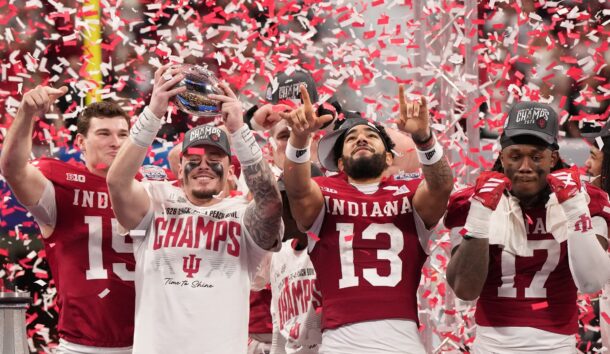
In the context of 2025, Indiana is no Cinderella story. The Hoosiers were the No. 1 overall seed in this year’s College Football Playoff and posted the best point differential of the CFP era over 16 games.
In this way, Indiana does not really compare with some of the most unlikely champions in sports history that may come to mind — such as the 2007 New York Giants, the 2011 St. Louis Cardinals or even the 2010-11 Dallas Mavericks. Those teams all overcame astronomical odds, but also had experienced success in prior years and had all-time great players to lean on.
This year’s Hoosiers are something entirely different, something so rare that it will be talked about for generations. Rags-to-riches champions of this magnitude are once-in-a-lifetime events. By definition, the deck is stacked against them — financially and otherwise.
Prior to Curt Cignetti’s arrival in 2024, Indiana had not won 9 games in a single campaign since 1967. That year, the price of a gallon of gas in the United States was about 32 cents on average.
Over the past 2 seasons, Indiana has won 27 games. Seventeen of those wins have come in Big Ten play. Do you know how many Big Ten games Indiana won in the entirety of the 2010s? Twenty-two. And that was a pretty good decade for IU. The Hoosiers only won 12 conference games in the 2000s. In the 1970s, when many of today’s blue bloods were flexing their muscles, Indiana went 28-70-1 with a whopping 14 conference victories.
A new era, indeed.
Unlikely sports champions
Here are some of the most comparable examples of the 21st century to what Indiana just accomplished:
Leicester City, 2015-16 Premier League Champions
This is the most-cited example as the closest cross-sport comparison for Indiana, and for good reason. It’s by far the most applicable. Leicester had very little previous history in the sport’s top flight and was famously a gargantuan preseason underdog that turned out to be an unstoppable force. Leicester won the league by 10 points, losing just 3 games the entire 38-match season.
It wasn’t totally a fluke, either. Leicester, it turned out, had world-class players like Jamie Vardy, N’Golo Kanté and Riyad Mahrez. Kante went on to win a Champions League with Chelsea and was one of the best defensive midfielders of his generation. Mahrez was a key player on 4 title-winning Manchester City squads. Vardy didn’t leave Leicester until he was 38 years old.
Leicester wasn’t just an underdog in a financial sense — though like Indiana, its payroll was dwarfed by the likes of Manchester United and Arsenal. Like Indiana, Leicester’s best players were diamonds-in-the-rough. Kanté was toiling in France’s second division for years before Leicester acquired him. Vardy was playing in England’s fifth tier until his mid-20s. Mahrez had 6 goals in 3 seasons for a second-division French side before his career exploded at Leicester.
These stories resonate with that of Indiana. Fernando Mendoza was an afterthought in the Miami area and ended up starting his career at Cal. D’Angelo Ponds ended up at James Madison as he was ranked the No. 1,966 player in his high school class, per the 247Sports composite rankings. He became one of the most feared cornerbacks in college football at Indiana. Omar Cooper was a Tom Allen-era recruit who stuck around in Bloomington during the Curt Cignetti transition and developed into a legit NFL prospect over 4 years. The list could go on and on.
Leicester is the best global example of an Indiana-esque championship run, but there are a couple of recent American sports analogues that come to mind.
Kansas City Royals, 2015 World Series Champions
The Royals are not a perfect allegory to Indiana, but they’re pretty darn close. Like the Hoosiers, the Royals also won the title in their second year of contention. Kansas City made the World Series in 2014 but lost in 7 games to the San Francisco Giants. And like Indiana, Kansas City was coming off of decades of irrelevance. Prior to 2014, Kansas City hadn’t made the playoffs since 1985 (when they won arguably the most controversial World Series of all-time against the St. Louis Cardinals). In nearly 6 decades of history, the Royals have won 90 games — a relatively modest benchmark — just 9 times.
That Royals team had zero players with any hope of making the Hall-of-Fame (with apologies to Salvador Perez). No one hit more than 22 homers and only Lorenzo Cain hit better than .300. Kansas City’s starting rotation included zero All-Stars that season, although a few had a strong case. The Royals’ best relief arm was Wade Davis, a journeyman pitcher who didn’t start pitching out of the bullpen until his age-28 season.
The Royals were built from a core of talented players who mostly all had career years at the exact right time. They were a relatively inexpensive roster — per FanGraphs, KC’s payroll was 10th in the American League that season and third in its own division. Baseball often produces small-market champions, but even the Royals stand out from the recent bunch as being one-of-a-kind.
St. Louis Rams, 1999-2000 Super Bowl Champions
The Greatest Show on Turf won the Super Bowl in 2000 by a yard. The then-St. Louis Rams just barely edged out the Tennessee Titans to complete one of the greatest single-season turnarounds in sports history. The year prior, the Rams went just 4-12 as they missed the playoffs for the ninth straight season.
The Rams were led by quarterback Kurt Warner, who was famously bagging groceries before turning to Arena League Football. He eventually caught on with the Rams and won 2 NFL MVP awards during his career — including 1999. Isaac Bruce was a second-round pick by the Rams who turned into a Hall-of-Famer who spent 14 years with the organization. Marshall Faulk was a top pick in his draft, but he went to college at San Diego State because most top programs saw him as a defensive prospect. He became one of the best running backs of all time after he joined the Rams. Mike Jones, the linebacker who stopped the Titans short on the 1-yard line in the Super Bowl, joined the Rams as an undrafted free agent in 1991. Despite his lack of prospect pedigree, he played in every game but 1 over the first 10 seasons of his career.
Cautionary tales
Led by Warner, the Rams would go on to make the playoffs a few more times and even reached the Super Bowl again 2 years later. But then ushered in more than 15 years of irrelevance and a relocation to Los Angeles.
The Royals did not continue their run of dominance either. After the 2015 title, Kansas City slipped quickly back into irrelevance, failing to win more than half its games in any of the next 8 seasons. In 2024, the Royals finally made it back to the postseason for the first time since their World Series win. They were unceremoniously eliminated by the New York Yankees, who had nearly a $190 million payroll advantage over Kansas City.
Sadly, the biggest cautionary tale lies with Leicester City. Although a club of that stature can technically win it all, doing so doesn’t make long-term sustainability any easier. In the decade since Leicester City’s legendary Premier League title, it has been relegated twice. The Foxes are currently in the Championship, England’s second division.
Indiana doesn’t have to worry about relegation in college football’s current model, but Leicester’s fate remains a reminder about how easy it is to get kicked off the mountaintop when you’re an underdog among giants.
Spenser is a news editor for Saturday Down South and covers college football across all Saturday Football brands.