SDS’ Ultimate CFP Championship Preview: Miami is back, but Indiana is better

By Matt Hinton
Published:
Everything – and we mean everything — you need to know about Monday night’s CFP Championship Game between No. 1 Indiana (-8.5 at Bet365) and No. 10 Miami. Kickoff: 7:30 pm, ET (ESPN), Hard Rock Stadium, Miami Gardens
You know, you hang around long enough, and you start to feel like you’ve seen it all. Really, how much more chaotic and unpredictable can this sport get? But then, every so often, you always seem to find yourself writing a sentence you never could have imagined writing. Like this one one: Indiana is playing for the national championship.
Has that sunk in yet? Sure, you’ve watched the Hoosiers ascend the mountain over the past 2 years – amused at first, then incredulous, maybe even a little suspicious, eventually in awe. They didn’t come out of nowhere. Nobody picked them at random out of a hat. But let’s be honest: How much different would it feel if they had? Even at this late date, I think it still bears repeating for emphasis: Indiana. Is playing. For the national championship. In football!
And not just playing for it: They arrive on the big stage with juice to spare, momentum bordering on a feeling of inevitability. Any lingering notion of the Hoosiers as a bunch of fluky, overachieving interlopers reached its expiration date on Dec. 6, in a 13-10 upset over Ohio State in the Big Ten Championship Game, which might go down as the last IU win that qualifies as an upset for the foreseeable future. In the meantime, they’ve looked every inch the frontrunners. Now 15-0, they’re so heavily favored in the wake of lopsided CFP romps over Alabama and Oregon that the final step has the makings of a coronation.
Unprecedented doesn’t quite do this turn of events justice. Impossible probably comes closer to the truth. Win or lose on Monday night, Curt Cignetti could announce his retirement on Tuesday and advance directly to the Hall of Fame, less than 2 years after all but the most hardcore college football knowers first heard his name. The Indiana Miracle is going to be studied in clinics, documented in books, and copied everywhere and entrenched underdog imagines a glimmer of hope. Indiana’s roster ranks 72nd according to 247Sports’ Team Talent Composite, dead last in the Big Ten, and is not even within a hundred miles of qualifying for the Blue-Chip Ratio. How did he do it?
Here’s the thing about the big secret to Cignetti’s success: There is no secret. Nothing about the man, the team, or its style of play is revolutionary. While the scribes are at work teasing some kind of narrative thread out of his impeccable record that will play on a book jacket, the actual process has been far more, well, by the book. He’s not playing Moneyball. He didn’t stumble upon One Weird Trick to building a championship program overnight. There’s no magic bullet. There’s no innovative scheme, unique strategic genius, or dynamic motivational mastery. Cignetti is, by all accounts and appearances, a standard-issue Taciturn Midwestern Dad of a coach, a persona who projects an emphasis on fundamentals and a bare minimum of charisma.
That is, the “blueprint” is the same as most everyone else’s. Identify talent, develop it, and put in the work. Cignetti, in his exacting, glowering way, has just proven to be better at implementing every phase of the plan than the competition.
Everybody is in the market for an unflappable veteran quarterback; Indiana’s, once considered an obscure, 2-star project out of high school, just happened to win the Heisman. Everybody is desperate to hit on a few undervalued, diamond-in-the-rough types via the portal; Indiana assembled an entire two-deep out of them and hit on them all. Everybody preaches balance on offense and physicality in the trenches; Indiana was arguably the most balanced team in the country, and certainly among the most physical. Everybody wants a disciplined team that avoids mistakes and doesn’t beat itself; Indiana ranked 2nd in the FBS in penalties and No. 1 in turnover margin. Every head coach in America would sell his soul for a loyal, competent staff that’s in it for the long haul; Indiana’s top deputies, offensive coordinator Mike Shanahan and defensive coordinator Bryant Haines, have both been under Cignetti’s wing since they were fledgling 20-something assistants in the D-II ranks.
In fact, most all of the above can also be said for Cignetti’s counterpart on Monday night, Mario Cristobal, who has rebuilt his alma mater into a contender along the same lines. (Albeit at significantly greater expense, roster-wise, and with significantly less credit in Coach of the Year voting.) After two decades in the wilderness, the Hurricanes also invested heavily in the portal; also went all-in on a proven veteran quarterback; made improving the talent level along the line of scrimmage a top priority; and built a team that’s most at home in a rock fight. Every element of that plan has paid off in the postseason, from defensively-driven slugfests against Texas A&M and Ohio State in the first two rounds to Carson Beck’s come-from-behind heroics in a semifinal win over Ole Miss.
True to form, Miam’s path to this point has often felt more gritty than gilded. Unlike Indiana, which has no relevant past, these ‘Canes have suffered in comparison to the vaunted outfits that routinely competed for national championships in the ’80s and ’90s. Those teams were swaggery, dominant, indelible – the kinds of teams that spawn ubiquitous alumni and inspire multiple documentaries years after the fact. The current team barely squeaked into the Playoff field in controversial fashion after suffering a pair of random October losses to Louisville and SMU and failing to qualify for the championship game in a watered-down ACC. Despite a lofty ranking early in the season, The U was not really back in any meaningful sense until its CFP quarterfinal upset over the Buckeyes, by that point an even bigger stunner than Indiana’s win over OSU a few weeks earlier.
All of which, in the end, amounts to a collision of two teams that are a lot more alike than their respective histories, trajectories or reputations might suggest. In their own way, both stand to reinvent the idea of what a championship team looks like. In Miami’s case, after all but falling off the Playoff radar at midseason, it stands to reinvent what a championship campaign looks like. No team has ever come from quite as far back in the field as late in the season to win it all, which, historically speaking, makes the Hurricanes interlopers on the championship stage, too. One way or the other, the last chapter in the 2025 college football season is going to be one no one saw coming.
• • •
When Indiana Has the Ball …
BEST PLAYERS ON THE FIELD
1. Indiana QB Fernando Mendoza (91.6 PFF grade | 90.2 QBR | 188.0 efficiency | 41 TDs • 6 INTs)
2. Miami DE Rueben Bain Jr. (93.1 PFF | 80 QB pressures | Consensus All-American | ACC DPOY)
3. Miami DE Akheem Mesidor (92.1 PFF | 15.5 TFLs | 4 fumbles forced | All-ACC/1st)
4. Indiana OL Carter Smith (87.8 PFF | 0 sacks allowed | Consensus All-American | All-B1G/1st)
5. Miami DB Keionte Scott (90.1 PFF | 13 TFLs | 2 INTs | All-ACC/2nd)
6. Miami DB Jakobe Thomas (86.4 PFF | 70 tackles | 5 INTs | All-ACC/2nd)
7. Indiana WR Elijah Sarratt (87.6 PFF | 62 recs | 802 yds | 15 TDs | All-B1G/2nd)
8. Indiana WR Omar Cooper Jr. (87.0 PFF | 64 recs | 866 yds | 13 TDs | All-B1G/2nd)
9. Indiana WR Charlie Becker (87.7 PFF | 30 recs | 614 yds | 20.5 yds/catch | 4 TDs)
10. Miami DL Ahmad Moten Sr. (78.0 PFF | 8 TFLs | All-ACC/2nd)
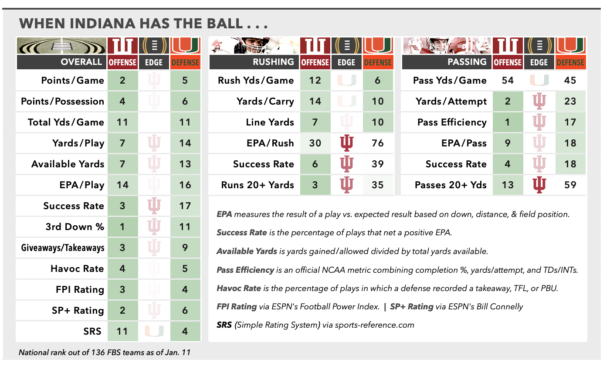
Indiana has been inspiring some pretty bold historical comparisons lately, including from the broadcast crew in the Peach Bowl. Fortunately for this preview, I don’t have dead air to fill in the 4th quarter of a blowout, and I don’t feel the need (yet) to contemplate the Hoosiers’ place among the great attacks of the modern era. There will be plenty of time for that after Monday night. Professionally speaking, however, I am obligated to use the words ruthless efficiency no later than the first paragraph. The offense is not a juggernaut, statistically, but at its best it regularly leaves audiences alike feeling like they’ve just watched a school of piranhas rapidly skeletonize a cow, and opponents feeling like the cow.
And it has been at its best over the past couple weeks. If all you’ve seen of the Hoosiers is their blowout wins over Alabama and Oregon, it’s easy to come away with the impression they’re borderline unstoppable. Across both games, they’ve scored on 13-of-18 possessions, converted 20-of-28 attempts on 3rd down, and hit paydirt on all 8 trips in the red zone. They’ve controlled time of possession handily and haven’t committed a turnover. Production in both games has been split evenly between rushing (400 yards) and passing (369 yards). Fernando Mendoza has thrown more touchdowns (8) than incompletions (5), yielding an astronomical 245.5 passer rating while coming in below 200 yards passing in both games.
His receivers have come down with everything in their vicinity, including 6 contested catches on 8 opportunities, per PFF. Whatever doubt existed in either game was extinguished by halftime: According to ESPN’s real-time win probability metric, Indiana’s odds stood at 95.9% at the half against Bama and 99.6% against the Ducks, and never wavered at any point thereafter. That’s a lot of garbage time for the mind to wander over this team’s place in history.
If you are absolutely determined to find a nit to pick in those performances, you might point out that the offense benefited enormously from plus field position, especially in the win over Oregon. Three of Indiana’s 7 touchdown drives against the Ducks covered less than 20 yards thanks to the defense, which forced 3 takeaways in the first half, and special teams, which set up an easy TD following a blocked punt in the second. Two of those “drives” started inside the Oregon 5-yard line. Along with a pick-6 to open the game, that’s 28 points – half of Indiana’s total – directly via the other phases.
In context, though, the lesson was not that the offense needs any help to put points on the board: The Hoosiers’ other 4 touchdown drives all covered 60+ yards. It was that any mistake their opponent makes will be prosecuted to the fullest extent.
In fact, it was in the offense’s least productive turns — competitive road wins over Iowa, Oregon and Penn State in the regular season — that its opportunistic streak really paid off. In those games, Indiana took advantage of short fields to punch in touchdowns against the Hawkeyes and Nittany Lions, and to covert a pair of field goals in their win in Eugene. That amounts to 20 points off turnovers in games decided by a grand total of 18. The Hoosiers also combined to go 11-for-11 on red-zone opportunities in those 3 games, and (not for nothing) put points on the board at the end of the first half in all three on hurry-up possessions that took just seconds off the clock.
Every-down efficiency notwithstanding, their perfect record could not have survived without their knack for squeezing the juice out of those opportunities, each of which put Mendoza in position later on to orchestrate the 4th-quarter heroics that helped propel him to the Heisman.
The other common thread in Indiana’s 60-minute outings is a slight uptick in pressure rates. Iowa, Oregon (in the first meeting), and Penn State all recorded at least a dozen QB pressures, per PFF, as did Ohio State in a down-to-the-wire finish in the Big Ten Championship Game. No one else on the schedule cracked double digits in the pressure column, or (with the exception of Old Dominion in a sleepy season-opener) came within 24 points on the scoreboard. Not coincidentally, 4 of Mendoza’s 6 interceptions on the year came in those 4 games, including a pick-6 at Oregon and an unforced error against Ohio State that set up the Buckeyes’ only touchdown. On a less dramatic note, those 4 defenses also forced 9 of Mendoza’s 12 throwaways — which is, again, nearly twice as many incomplete passes as he has thrown so far in a couple of very well-protected outings in the Playoff.
Which brings us to the one position in the lineup that might qualify as a weak link: Right tackle. The primary starter at that spot, 6th-year senior Kahlil Benson, spent the first 4 years of his career at Indiana under the previous coaching staff before transferring to Colorado in 2024; he returned to IU for Year 6, and enters his final game with 31 career starts and 2,634 snaps. When the opposing pass rush has managed any kind of sustained impact, it has often come at his expense: In addition to saddling Benson with a team-worst 56.2 pass-blocking grade for the season, PFF cited him for at least 4 pressures allowed in each of the regular-season nail-biters against Iowa, Oregon and Penn State, as well as in the rematch against Oregon, when he was singled out for giving up the Ducks’ only sack. You might recall that sequence as the slapstick play in the second quarter on which Mendoza had the ball knocked out of his hand, recovered his own fumble and made a vain attempt to ad-lib before being swarmed over for a 20-yard loss; it was the last moment that Oregon actually seemed to have a shot.
Notably, the Peach Bowl was Benson’s first game back in the starting lineup following a 3-game benching against Purdue, Ohio State and Alabama. In his place, Indiana turned to OSU transfer Zen Michalski against his former team in the Big Ten title game, then to redshirt freshman Adedamola Ajani against the Crimson Tide. Neither passed the audition.
Regardless of who mans the job on Monday night (Benson is the best bet), if there’s one guy in the college game you don’t want to see lined up across from a struggling tackle right now, it’s Rueben Bain Jr. If there are 2 guys, the other is Akheem Mesidor. Together, Bain and Mesidor formed the nation’s most disruptive d-line tandem throughout the season, and have taken their game to another level in the Playoff. They were the driving force of Miami’s early-round wins over Texas A&M and Ohio State, generating a combined 33 QB pressures and 7.5 sacks in those games alone.
They were relatively quiet in the semifinal win over Ole Miss — emphasis on relatively — finishing with “only” 7 pressures and no sacks, due in part to Mesidor’s early exit from the game with an arm injury. (Mesidor is “in great condition” and expected to be full speed, according to Cristobal.) Instead, defensive coordinator Corey Hetherman broke out the blitz packages in an effort to heat up Rebels QB Trinidad Chambliss, sending extra rushers on 22 of his 42 drop-backs. Results were mixed: Although the ‘Canes succeeded in pressuring Chambliss on nearly half of his non-screen attempts, they recorded a single sack while giving up 6 completions that gained 20+ yards.
Miami’s secondary is on the hot seat again opposite Indiana’s sticky-fingered wideouts. As a unit, the DBs took a lot of flak the last time out for dropping at least 3 would-be interceptions, but the bigger concern by the end of the night was a depleted depth chart at cornerback. One starting corner, Wisconsin transfer Xavier Lucas, was ejected for targeting, which will also sideline him for the first half against the Hoosiers. The other, sophomore OJ Frederique Jr., played just five snaps due to a lingering injury that had previously sidelined him for the entire month of November. Another regular, Damari Brown, has yet to see the field in the CFP and remains “day-to-day” with a lower leg injury. With Frederique and Brown in limbo, Lucas’ ejection forced a true freshman, Ja’Boree Antoine, into the fire in the 4th quarter, where he promptly found himself on the wrong end of a costly pass interference penalty and the go-ahead touchdown on Ole Miss’ penultimate drive.
Of the 4 players with starting experience at outside corner, that leaves only sophomore Ethan O’Connor with no asterisk next to his name on Monday night. The other starting spot will fall to Frederique or Brown, if they’re available, or to Antoine if they’re not. (Cristobal sounds confident that Frederique will be “good to go,” for what it’s worth.) The hope is that whoever winds up opposite O’Connor can keep the damage to a minimum until Lucas returns in the second half. As we’ve seen, though, surviving 2 quarters against the Hoosiers can feel like an eternity.
Wild card: Miami DB Keionte Scott. Scott spent 3 years at Auburn gradually falling out of favor. A JUCO All-American, he made immediate impact in 2022, only to see his snap counts decline each of the next 2 years under a coaching staff that didn’t recruit him. He was demoted from starting lineup in 2024, and if not for the legal challenge (still ongoing) that resulted in an extra year of eligibility for former JUCO players last winter, that might have been the end of his story.
Instead, Scott took advantage of the waiver and resuscitated his career. A Day 1 starter at Miami, he has emerged as a perfect fit for the nickel role in Hetherman’s scheme and the Hurricanes’ most versatile defender. He boasts the best individual PFF coverage grade in the ACC (89.5), finishing with zero touchdowns allowed, zero penalties and 2 INTs returned for touchdowns the other way. Scott’s pick-6 against Ohio State in the Cotton Bowl was the biggest swing play of the CFP to date and a defining moment in the ‘Canes’ postseason run. Meanwhile, he’s also been a menace as a blitzer, crashing in from the nickel roughly a half-dozen times per game and ranking 3rd on the team (behind only Bain and Mesdior) with 5 sacks.
While the big guys command the offense’s attention in protection, Scott is the chess piece who gives Hetherman the ability to attack from just about anywhere on any given play. And as he’s proven before, it only takes one to change the course of the game.
• • •
When Miami Has the Ball …
BEST PLAYERS ON THE FIELD
1. Miami OL Francis Mauigoa (83.1 PFF | 2 sacks allowed | Consensus All-American | All-ACC/1st)
2. Indiana CB D’Angelo Ponds (87.7 PFF | 2 INTs | 8 PBUs career | All-B1G/1st in ’24 and ’25)
3. Miami WR Malachi Toney (86.4 PFF | 99 recs | 1,089 yds | 9 TDs | All-ACC/1st)
4. Indiana LB Aiden Fisher (68.7 PFF | 93 tckls | 9.5 TFLs | 2 INTs | All-B1G/1st in ’24 and ’25)
5. Indiana DE Mikail Kamara (73.7 PFF | 57 QB pressures | 45 TFLs career | All-B1G/1st in ’24)
6. Miami RB Mark Fletcher Jr. (86.8 PFF | 1,080 rush yds | 12 total TDs | All-ACC/3rd)
7. Miami QB Carson Beck (75.3 PFF | 81.4 QBR | 159.4 efficiency | 29 TDs • 11 INTs)
8. Indiana DB Louis Moore (73.7 PFF | 81 tckls | 6 INTs | All-B1G/1st)
9. Indiana DL Tyrique Tucker (79.7 PFF | 12 TFLs | All-B1G/1st)
10. Indiana LB Rolijah Hardy (73.6 PFF | 98 tckls | 15 TFLs | All-B1G/2nd)
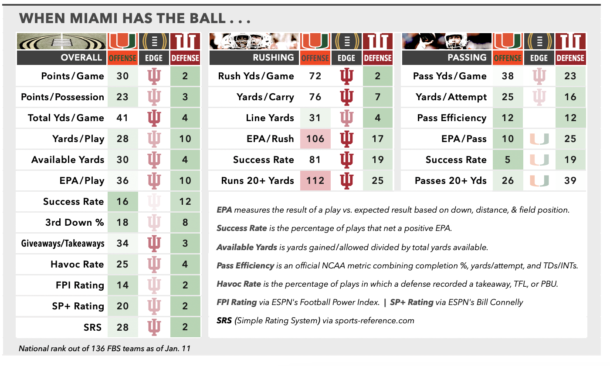
There were two ways to process Miami’s 31-27 semifinal win over Ole Miss: Enormously satisfying on one hand, and enormously frustrating on the other.
The satisfying part (other than the final score) was the way the Hurricanes imposed their will between the tackles. Together, running backs Mark Fletcher Jr. and CharMar Brown logged 37 carries for 179 yards, roughly two-thirds of that total coming after contact, per PFF. The ‘Canes ground out long, sustained drives, finishing with a season-high 11 3rd-down conversions and a nearly 23-minute advantage in time of possession.
The frustrating part was how little their success in the trenches ultimately amounted to on the scoreboard. Of Miami’s 4 touchdown drives vs. Ole Miss, only 1 — a 15-play, 75-yard march in the 2nd quarter — unfolded primarily on the ground. Instead, for every run that moved the chains, there was a setback: A penalty, a sack, an incomplete pass that felt like a gift to a defense struggling (literally) to gain traction. Despite getting shoved around up front, the Rebels managed to keep the lid on, to good effect; the ‘Canes’ longest run netted just 19 yards, forcing them to string together first downs. Four extended possessions stalled out on Ole Miss’ side of the 50, resulting in 2 field-goal attempts (1 good, 1 missed), a punt and an interception.
One lesson from that outing is that offensive coordinator Shannon Dawson cannot get bored with the grind. Yes, churning out a living against Indiana’s defense, one of the best in the country against the run, is a much steeper assignment than bullying Ole Miss. For the offense to stay on the field Monday night, though, churn it must, with the 225-pound Fletcher in particular shouldering as much of the load as he can handle. It’s no coincidence that Miami’s postseason run also represents the best stretch of Fletcher’s injury-plagued career. In 3 CFP games, he has averaged 131.7 yards per game — nearly twice his per-game average in the regular season — on a robust 6.8 yards per carry. Per PFF, the vast majority of that output has come between the tackles.
The other lesson: The Hurricanes cannot live by the grind alone. While Fletcher and Brown chewed up clock, the money plays against the Rebels came mostly via the beleaguered right arm of Carson Beck. His first touchdown pass, a 52-yard strike to a wide-open Keelan Marion in the 2nd quarter, was Beck’s first (and still only) completion of 20+ air yards in the postseason. Beck’s 2nd touchdown, a 36-yard screen pass to electric freshman Malachi Toney, was Toney’s first big play of the CFP, having been limited to nibbles up to that point. And the 2 biggest plays of the game-winning drive came via 1) a pass interference penalty vs. the Rebels that moved the sticks on 3rd-and-8; and 2) a clutch 17-yard strike from Beck to Marion on 3rd-and-10 as the clock ticked under a minute to play. Four plays later, Beck was in the end zone for the go-ahead touchdown and Miami was on its way home for the title round.
Beck is not exactly ready for the rocking chair at 23 years old, but he is the rare college quarterback who has been playing in high-profile games for so long now that he frankly gives off the whiff of an over-the-hill NFL vet gutting it out for one last shot at a ring. Monday night will mark his 43rd career start. He hasn’t improved since his first season as a starter at Georgia in 2023, back when he was considered a future first-rounder, and has arguably regressed.
He has benefited enormously this season from his protection, facing pressure on an FBS-low 16.9% of his total drop-backs, per PFF. If Indiana stakes out a lead and it falls on Beck to keep pace with Mendoza for any extended period of time, he’s not likely to fare much better than the long list of opposing quarterbacks who have found themselves in the same position. Then again, Miami didn’t make the guy the highest-paid player on the transfer market for nothing. If the ground game and defense hold up their end of the bargain in a 60-minute game, Beck is on the short list of college QBs who has earned the benefit of the doubt with the season in his hands.
Wild card: Indiana Edge Daniel Ndukwe. Indiana will be playing for the 3rd straight game without its most productive defensive lineman, senior Stephen Daley, the Big Ten leader in tackles for loss. Daley suffered a freak knee injury while celebrating with fans in the immediate aftermath of the B1G Championship win over Ohio State. He has not been missed, thanks to Ndukwe. An unknown before the postseason, Ndukwe has leveled up in Daley’s absence, breaking out in the Peach Bowl with 5 QB pressures, 2 sacks and a forced fumble on a season-high 42 snaps, plus a blocked punt in garbage time, for good measure. The degree of difficulty goes way up on Monday opposite the nation’s most decorated offensive lineman, Francis Mauigoa, who is almost certainly bound for a top-10 pick in April’s NFL Draft. If Ndukwe makes his presence felt again, consider his “next big thing” status officially confirmed.
• • •
Injuries, special teams and other vagaries
The kickers are reliable enough, up to a point. Indiana’s Nico Radicic has connected on 153 consecutive PATs and 26-of-28 field goal attempts over the past 2 years, but has zero career attempts from 50+ yards or with the game on the line. His counterpart, Miami’s Carter Davis, was a solid 14-of-16 on field goals in the regular season, but hit just once from long range, and has subsequently missed 4 of his 7 attempts in the Playoff. In Davis’ defense, 3 of those misses came amid heavy winds at Texas A&M in the first round, with the 4th sailing wide from 51 yards out in the Peach Bowl. The elements won’t be an issue on Monday night; lining up from distance remains a dicey proposition, on both sides.
Feel free to linger a few extra seconds at the fridge during kickoffs. You’re not going to miss anything. Neither team has even attempted to return a kickoff in the postseason. (Although Miami’s Keelan Marion did take a couple to the house in 2024 at BYU, for the record.) On that note, it’s worth mentioning that Carter Davis ranked No. 2 nationally with a 94.1 PFF grade on kickoffs, blasting 82 of his 90 attempts for touchbacks — a big reason that Miami’s defense led the nation in average starting field position, per gameonpaper.com. Considering Indiana enjoyed luxurious field position in its semifinal romp over Oregon, “hidden yards” will be crucial in the ‘Canes’ bid to keep it close.
Malachi Toney is a weapon on punt returns, with 3 returns of 40+ yards on the year; he hasn’t scored in that capacity (yet), but he has come close enough to land on the “Don’t Give Him a Chance” list for the rest of this career. Indiana’s Jonathan Brady scored the Hoosiers’ first touchdown of the season on a 91-yard punt return against Old Dominion in the opener, but hasn’t moved the needle since.
Little news on the injury front. As mentioned, Indiana’s defensive front has not missed a beat in the absence of the highly disruptive Daley. Still, 19 TFLs in street clothes is difficult to dismiss as a mere footnote. As for Miami, we’ve covered the concerns in the secondary. The question mark on offense is the status of sophomore tight end Elija Lofton, who was carted off the field in the Fiesta Bowl after taking a shot to the chest in the 2nd quarter and remains in limbo. Lofton was a frequent target in 2-tight sets alongside senior Alex Bauman, outpacing Bauman in receptions (23), yards (218) and touchdowns (3) despite playing significantly fewer snaps. The next man up against Ole Miss was little-used freshman Luka Gilbert, who hasn’t been targeted on a pass since Week 3.
How much is home-field advantage worth to Miami? Financially, about $3 million: That’s the amount the program will receive in travel reimbursements that it doesn’t actually have to spend on travel, part of a $23 million windfall for its full postseason run. (Unlike other conferences, the ACC distributes its entire share of the Playoff payout to the program that played the games while the rest of the league gets zilch.)
Competitively: TBD. The Hurricanes are the first team to host a CFP Championship Game in their home stadium – they’re the first team that has had the opportunity – which ought to count for something, even in a game where Indiana will be designated the “home” team and the very large IU fan base that turned the Peach Bowl into a de facto home game will have equal access to tickets. The venue, Hard Rock Stadium, has never been known as a particularly hostile environment, and certainly has none of the nostalgic cache of the old Orange Bowl, the venerated dump where the original version of The U clinched national championships in 1983, 1987, and 1991 under 3 different head coaches. It’s nowhere near campus, it has a corporate NFL vibe, and the Hurricanes have always been lesser tenants to the Dolphins.
More important, the product on the field throughout the Hard Rock years has been mediocre. The locals have responded accordingly, earning a reputation for fair-weather support. For a championship game, rest assured they’ll be willing to show up and show out. With ticket prices through the roof, the question is how many of them can get in the gates.
• • •
Bottom line … and a prediction
Conventional wisdom throughout the season (the past 2 seasons, really) held that that the championship race is wide open, there are no more dominant teams at the top, and any team good enough to crack the top 10 in this particular CFP field is plausibly good enough to win it all. Miami’s long-shot run to the title game fits neatly in that narrative. Indiana’s does, too, in the broadest sense of expanding the idea of what a potential champion looks like in the NIL/portal era. In the end, though, the part about the end of dominance turns out to have been wrong. Plainly, the Hoosiers were the dominant team in college football in 2025 all along.
It took watching them wipe the floor with Ohio State, Alabama and Oregon (twice) to believe it, but here they are: No. 1 by cushy margins not only in the traditional polls, but in every metric from FPI to SP+ to FEI to SRS to Jeff Sagarin to Ken Massey to Ed Feng to anyone else with even a flicker of credibility.
They’re so far ahead, they might have already secured the top spot in most or all of those systems even with a loss on Monday night. They’re elite on offense and defense. They’ve outscored opponents by 473 points, or 31.5 ppg, easily the best in the nation and in line with some of the most revered outfits of the past few decades. (For comparison, that’s an edge of more than 200 points overall and 2 touchdowns per game over the margins for Miami.) By sheer volume, a win on Monday night would make Indiana the first team in modern college football history to go 16-0, a feat last accomplished by the 1894 Yale Bulldogs against a schedule padded by local high schools and YMCA clubs. They were still a decade away from legalizing the forward pass in 1894. Even in the era of postseason bloat, no team has ever finished a season by dispatching 4 consecutive top-10 opponents.
If the Hurricanes have a chance to derail that train as it rolls into the final station, it’s by being the best version of who they are: A physical team with a run-first mentality, a top-shelf pass rush, and a veteran quarterback who has seen it all. You can imagine a game where Miami controls the clock, pressures Mendoza into an uncharacteristic mistake or two, and gives Beck a chance to reenact his clutch heroics at the end of the Fiesta Bowl. But when even the best-case, any-given-Saturday scenario leaves that little margin for error, the imagination is no match for reality.
Prediction: • Indiana 30 | Miami 13

Scoreboard
- Semifinals Record: 2-0 straight-up | 2-0 vs. spread
- Playoff Record: 8-2 straight-up | 7-3 vs. spread
- Season Record: 114–25 straight-up | 66–63 vs. spread
Matt Hinton, author of 'Monday Down South' and our resident QB guru, has previously written for Dr. Saturday, CBS and Grantland.