Hayes: Upon further review, these are the rules college football should change

By Matt Hayes
Published:
You may not want to hear it, but you better get ready for it.
Month after month, year after year, college football is morphing into the NFL. And that may not be such a bad thing.
If you’re going to model your game after something, why not the most successful live sport in the history of television?
The NCAA may argue in court that it’s not the NFL. It may plead to protect its long gone amateur model.
But with every realignment move made by Power 5 conferences, with every NCAA bylaw changed to protect and advance a player’s ability to earn and move freely among schools, college football is becoming the NFL.
The latest potential step is simply the next move toward assimilation — albeit the wrong move.
Changing clocks rules won’t shorten college football games. Changing replay rules will.
More specifically, changing replay rules to mimic the NFL’s replay rules.
Sports Illustrated reported Monday that an FBS executive committee is considering clock rules changes to speed up games and improve player safety.
The underlying theme: Games are too long, and the players are more at risk with an increased number of potential games when the new Playoff beings in 2024. But this isn’t a fix, it’s simply delaying — pun intended — the inevitable.
So like most things college football rules changes, they’ll start with baby steps that don’t really work. This time it’s clock management, the 1 thing the NFL does better than any other sport.
NFL games start at 1 p.m. on Sundays, and by 4-4:05ish, the game is over and the next television window opens. The only thing that interrupts this symphonic flow is overtime — which also has a specific (10 minutes) time frame.
Now, we give you college football. A noon kick could last until 3:15, or 3:30 — or heaven forbid, if we get into a 2-point conversion overtime thing (if you don’t know, don’t ask, it’s inane), 3:45 or later.
Don’t get me started on the Saturday night kicks, which begin at 8 and you’re dozing off after yet another stoppage for targeting — which no one, to this very day, knows the definition. They just know it when they see it.
Here, everyone, is where the timing problem lies.
The latest proposals by the FBS executive committee — running clock after incompletions, running clock after first downs unless the last 2 minutes of the 1st and 2nd halves — will only change the few, beautiful procedural quirks college football has over the NFL.
Then there’s this brilliant (that’s sarcasm) idea: shorten halftime. Good luck telling the good folks at Ohio State (and every Big Ten locale) that the bands don’t mean as much as they used to.
Good luck traveling to Tallahassee and telling The Marching 100 to shave 10-15 minutes off the show, everyone. The game is lagging.
These ideas won’t shorten the game enough to make a difference, they’ll just eliminate the last pieces unique to college football. The FBS executive committee is overthinking it, and in the process, stripping the college game of personality and appeal.
The game needs to be streamlined, not desensitized and homogenized.
Look, we’ve traveled what seems like a lifetime in college football over the past 3 years. Mega brands changing conferences, players earning money off their name, image and likeness, free player movement, SCOTUS weighing in on the pay-for-play debate (that’s the next huge move on the horizon), and so much more.
If you’re going to move closer to the NFL game — closer to the one property in all of live television that is utterly bulletproof — you may as well use their replay rules, too. Because the 1 thing that extends games more than anything else is instant replay.
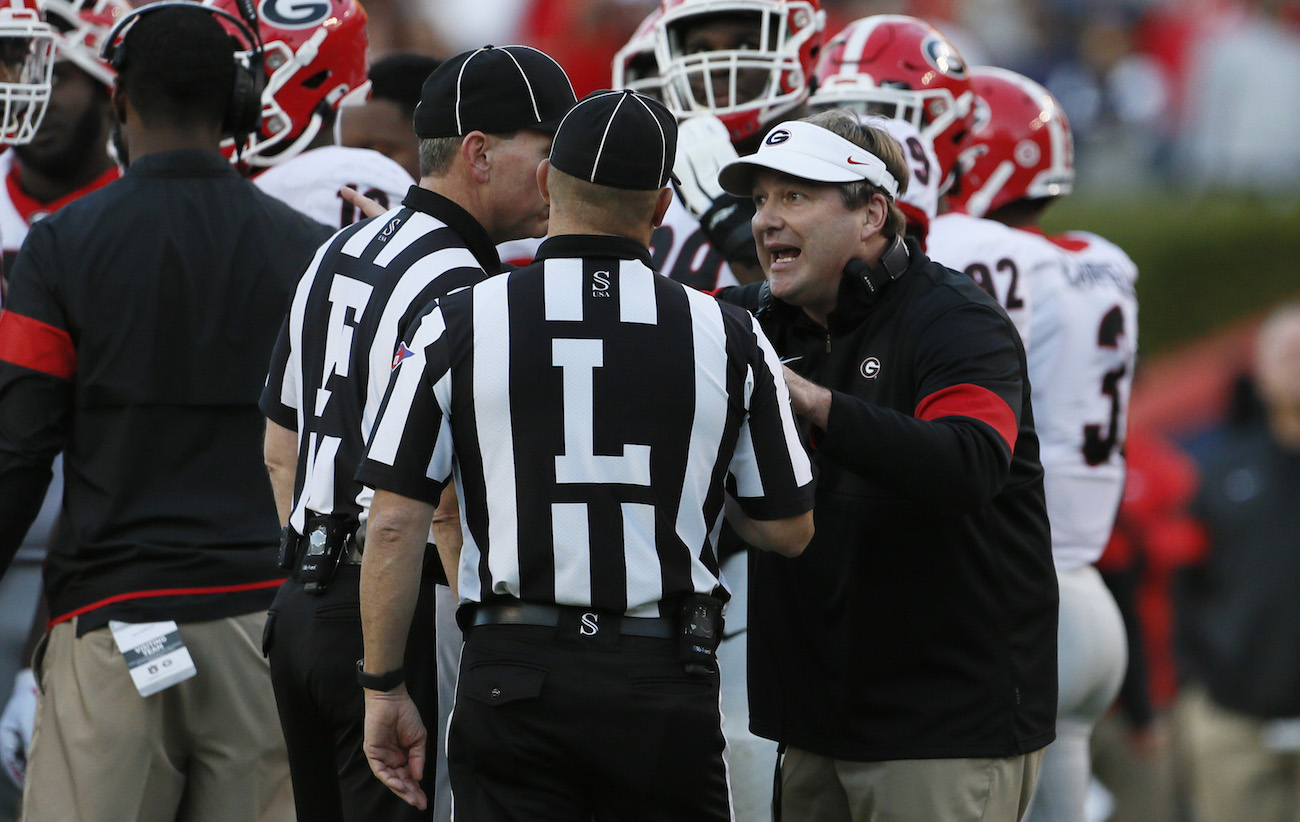
NFL replay is not only quicker, there’s less of it. Every play is available for review in college football, and replay booths can stop play at any point after the previous play — and sometimes after the ball is snapped — to look at the previous play.
The NFL smartly decided to use what it calls Replay Assist, where booth officials can provide assistance when “clear and obvious video evidence” is available to assist on rulings outside of coaches’ challenges.
In other words, an obvious mistake must be staring officials in the face to stop play. So obvious, in fact, that the booth tells officials on the field the correct call and spot and time in seconds. There’s no debate.
Other than that, it’s up to coaches to use 1 of the 2 challenges afforded them.
Then there’s the targeting ordeal, where minutes are used to determine if a hit was illegal. Why does it take college football much longer than the NFL, you ask?
Because targeting in college football includes immediate player disqualification and disqualification for the next 2 quarters of the following game. The decisions have a significant impact on the game and future games.
An easy fix: eliminate the disqualification. It’s a 15-yard penalty, and the game continues.
Just another smart step toward the NFL model, another move to streamline a sport that only needs a few more tweaks to find the sweet spot.
Not a bastardization of the rules by overthinking it.
Matt Hayes is a national college football writer for Saturday Down South. You can hear him daily from 12-3 p.m. on 1010XL in Jacksonville. Follow on Twitter @MattHayesCFB