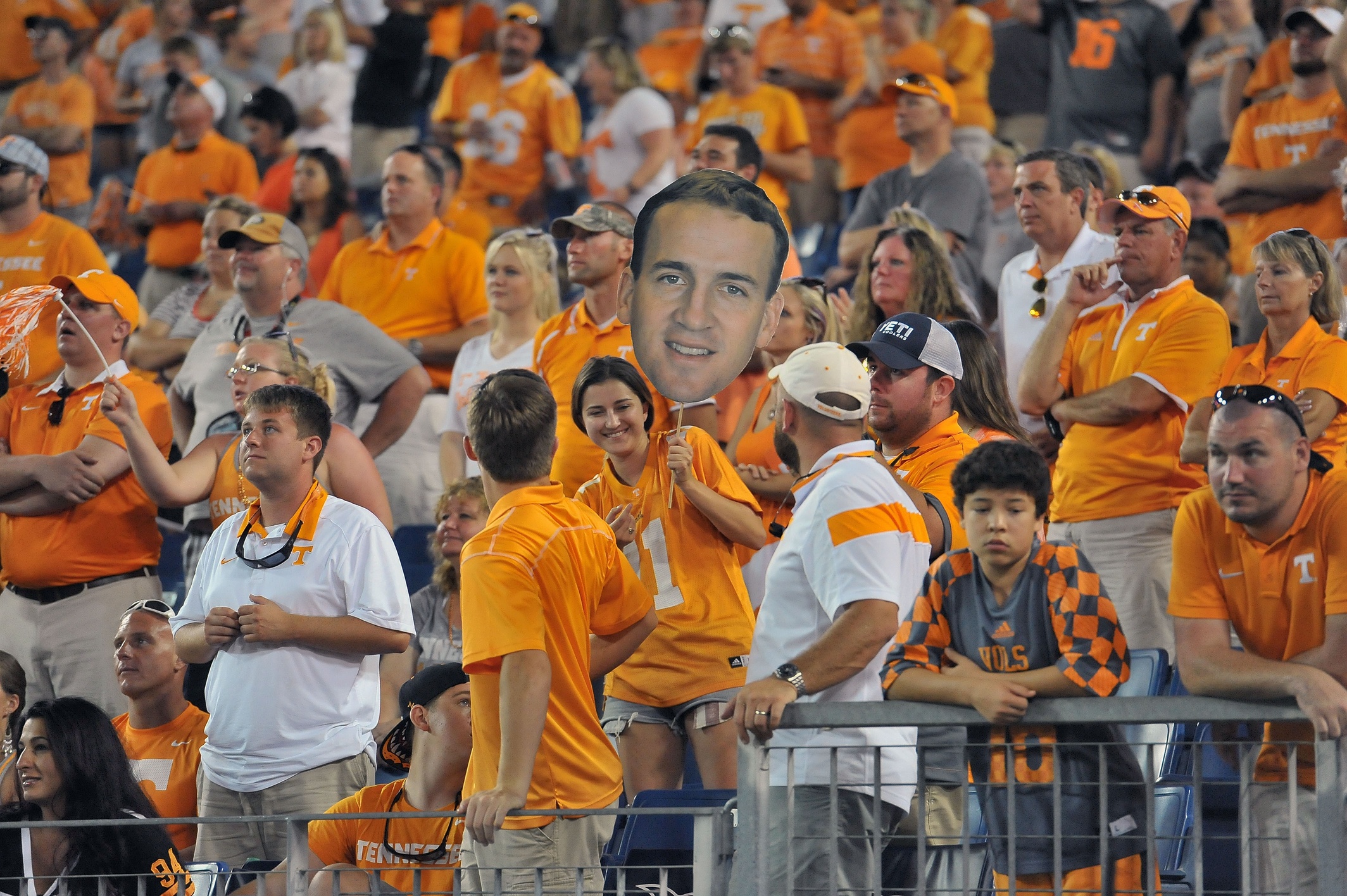

The most popular living figure in the history of University of Tennessee football is easily Peyton Manning.
Volunteers fans first felt amazement and a natural sense of liking when the son of former Ole Miss legend Archie Manning spurned the Rebels for the Vols. It was as if any remaining pain from Archie’s 38-0 victory against Tennessee in 1969, perhaps the most embarrassing loss in program history, had been washed away with Peyton’s decision to come to Knoxville.
Thrust into his first game as a collegian due to an injury to senior quarterback Jerry Colquitt in 1994, Peyton Manning became the starting quarterback by midseason thanks to another injury to Todd Helton, resurrecting the Vols from 1-3 ineptitude to going 7-1 the rest of the year. That culminated in a Gator Bowl victory against Virginia Tech after five straight victories.
From there, Manning never looked back. Yes, he never beat Florida, but so what? Bear Bryant never beat Notre Dame, either.
However, Manning did end the Vols’ nine-year winless streak against Alabama. Throwing for 301 yards and 3 touchdowns, including an 80-yard touchdown strike to Joey Kent on the first play, the Vols beat Alabama 41-14, tied for their most lopsided victory in the rivalry (UT won by an identical score in 1969).
Additionally, it started Tennessee’s own seven-year winning streak against the Crimson Tide, the longest losing streak Alabama has ever had to any one opponent.
All in all, Manning posted a 39-6 record as a starting quarterback at Tennessee, even turning down the chance to be the first pick in the NFL Draft in 1997 to play for the Vols for one more year.
If that wasn’t enough, his 18-year NFL career set 18 career passing records. He became the first quarterback to win Super Bowls with two different teams, and Manning’s sense of humor allowed himself to become football’s leading pitchman and the face of the sport for a generation.
The question of who the greatest quarterback of all-time is will always be subjective, but you’ll be hard pressed to find anyone in Knoxville who doesn’t think it’s Manning.
But is he the greatest living Vol of all-time?
There have been plenty of Heisman Trophy controversies throughout the years, and Manning’s second-place finish to Charles Woodson in the 1997 race is no exception.
But to an older generation, the bigger outrage was when Johnny Majors lost the 1956 Heisman race to Paul Hornung.
It has been nearly a quarter of a century since Majors had a role with the Tennessee football program. There are now graduates at UT who had not yet been conceived when he coached his last game for the Vols, and with the passing of time, the Majors legacy in Knoxville is not as prevalent as it once was.
Everyone has seen Peyton Manning play, and even if a fan is too young to remember him as a college football player, there are hosts of YouTube videos and online stories of him to check out.
In contrast, to really discover Majors’ playing career, one must make a trip to a microfilm room in a Knoxville library.
Furthermore, to some, Majors is a polarizing figure in Big Orange Country. His 1992 departure was controversial, leaving Vols fans to believe he was either leaving because he had been condescending to boosters at a private function or with his blood on Phil Fulmer’s hands.
Majors’ final season in Knoxville started with two victories before he was hospitalized to undergo quadruple bypass surgery. Fulmer became the interim coach, and Tennessee promptly reeled off three fantastic victories; 31-14 against defending SEC champion Florida, 40-0 to Cincinnati and 20-0 at LSU.
Ranked fourth and 5-0 for the first time in 19 years, and with Heath Shuler behind center, Tennessee had the look of a national championship contender.
But upon Majors’ return, the Vols lost their first three games: 25-24 to 1-4 Arkansas on a last-second field goal, 17-10 to Alabama in Knoxville, and 24-23 to 2-5 South Carolina in a game that propelled Gamecocks freshman quarterback Steve Taneyhill to legend status.
Fans began to clamor for Fulmer to replace Majors. Promises of contract extensions were forgotten. The Knoxville News-Sentinel reported Fulmer made 26 telephone calls to Bill Johnson, a member of the Tennessee Athletics Board, during Majors’ absence. Three victories against weak opponents down the stretch were not enough for the longtime coach to return.
For years afterwards, Majors would not mention Fulmer, his assistant for 13 seasons, by name. Majors referred to Fulmer only as “my successor” in a 2000 interview.
But whatever one makes of his departure, it doesn’t erase what Majors accomplished as a player or coach in Knoxville.
Playing in the offensive and defensive backfield and even performing punting duties, as a sophomore Majors shared carries with future NFL star Tom Tracy in 1954, took Southeastern Conference Most Valuable Player honors as a junior and nearly became the first Vol to win a Heisman Trophy in 1956.
The award would go to Paul Hornung, who did collect more total yards as the quarterback of Notre Dame than Majors did as a single-wing back in 1956.
But Notre Dame suffered through arguably its worst season in history with a 2-8 record. Hornung threw for 335 more yards than Majors did that year (917-552), but that number had to be inflated by the fact that the Irish were trailing so often, whereas the Vols were undefeated in the 1956 regular season.
Majors rushed for more yards (549-420), for more touchdowns (seven to six), for a higher yards per carry average (5.1 to 4.5) and higher yards per passing attempt average (9.4 to 8.3) than Hornung. Majors’ touchdown-to-interception ratio was 5-3 in 1956. Hornung’s was 3-13.
As time has passed, it has become fashionable to wonder if Syracuse’s Jim Brown, who led the nation with 13 touchdowns and rushed for 986 yards, was the player slighted in the ’56 Heisman race (he finished fifth in the balloting).
But in Majors’ defense, he was more versatile than the player many feel is the greatest running back ever. Additionally, Tennessee was 10-1 and finished ranked second, while eighth-ranked Syracuse finished 7-2.
Despite Majors’ playing diplomat in later years about the Heisman race, it seems a stronger historical argument can be made for a Majors’ Heisman Trophy in 1956 than a Manning Heisman in 1997.
Furthermore, the Majors name at Tennessee is as large as the Manning name is at Ole Miss. Younger brothers Billy and Bobby starred at UT from 1958-60 and 1969-71, respectively.
After Bill’s career as a star safety and back for the Vols, he would become an assistant coach under Doug Dickey, tragically losing his life in an automobile accident with fellow assistants Charlie Rash and Bob Jones.
It has often been speculated Billy would have eventually succeeded Dickey as Tennessee’s head coach. The Majors name was so big that by the time Bobby played his final game in Knoxville, following a season in which he recorded 10 interceptions, the Pride of the Southland Band went into an “M” formation instead of a “T” on national television to honor his family’s legacy at the school.
Bobby responded by returning a punt 40 yards for a touchdown in the game to clinch a 31-11 victory against Penn State.
Several years before, a young actor named Harvey Lee Yeary from Middlesboro, Ky. decided to honor the Majors name himself. And though Lee Majors made a name for himself in the ’60s by starring as Heath Barkley on the TV western “The Big Valley,” he would become television’s biggest name actor in the following decade as Steve Austin on The Six Million Dollar Man.
When examining Manning’s and Johnny Majors’ careers at Tennessee, it becomes apparent everything Manning did in Knoxville Majors seemed to match, if not exceed. Modern offenses allowed Manning to put up more impressive passing statistics, but both ultimately were Heisman runners-up on the field.
But Majors led the Vols to an undefeated regular season, something Manning never did.
True, Manning isn’t associated with any other university than Tennessee. Johnny Majors, whose professional career ended early after suffering a shoulder injury while playing for the Canadian Football League’s Montreal Alouettes in 1957, also coached as an assistant at Arkansas and Mississippi State before becoming a head coach at Iowa State and Pittsburgh, where he coached his greatest team, the 1976 national champions.
But just as Manning is beloved in Knoxville for choosing the Vols instead of Ole Miss, Majors was leaving a good thing at Pitt to return home in 1977. Yes, one can be critical of a few too many draw plays and losses to the likes of Rutgers and Army (Majors’ favorite team as a boy), but no coach lasts 16 years without being upset.
Majors replenished the facilities in Knoxville, eventually leading to a stadium of more than 100,000 seats, and put the program in position where it could once again return to the Sugar Bowl and the top five. While a conversation with him reveals the personality that demanded performance, former players rave about his loyalty to them.
Put them side-by-side and Manning’s line of autograph seekers will be longer.
But by excelling both as a player and a coach, it is Majors who is the Tennessee Volunteers’ greatest living figure.