As the SEC is left out of another national championship, the new plucky underdog narrative is there for the taking

Published:

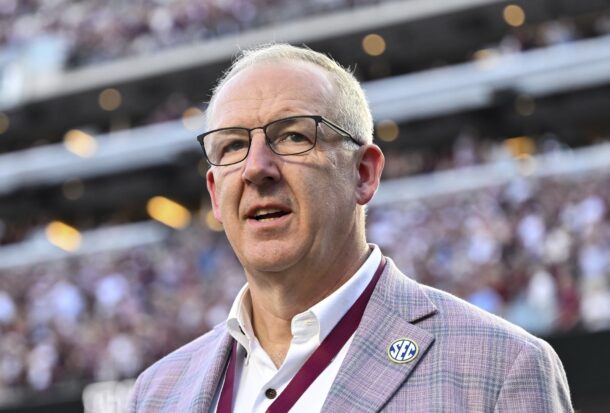
If 3 is a pattern, we can officially say the SEC has one. It’s not a pattern that you’ll see Greg Sankey mention in any future 7-page document that outlines the SEC’s gauntlet.
It’s not just that Ole Miss‘s loss to Miami in a thrilling Fiesta Bowl clinched the 3rd consecutive year without an SEC team in the College Football Playoff National Championship Game; it’s that in that stretch, the conference is 3-7 vs. other conferences in the Playoff. Alabama (0-2), Georgia (0-1 including Notre Dame), Ole Miss (1-1), Tennessee (0-1), Texas (2-1) and Texas A&M (0-1).
(Texas losing to Washington in the 2023 semifinals didn’t count against the conference’s record because the Longhorns were still in the Big 12.)
Even worse, those wins came against 3 multi-loss conference champs (2024 Clemson, 2024 Arizona State and 2025 Tulane) who wouldn’t have qualified for the 12-team field as at-large teams.
A new era is here. The era of dominance that saw the SEC put a team in the national championship all but once from 2006-22 died once Georgia finished polishing off chicken wings in the 4th quarter against TCU. That feels like a lifetime ago.
With this new era comes a new arc. Dare I say, it’s an underdog arc. On the heels of a 2-8 postseason showing, wherein the SEC’s lone bowl victories came against a Group of 5 program on an SEC campus and a team who replaced its head coach after he went to jail, there’s no 7-page document that can spin this 3-year stretch. No NFL Draft streak, recruiting rankings or Playoff appearances will cover up the fact that when the lights have been brightest, the SEC has not shined in this new era.
Sure, Sankey can point out that the SEC wasn’t the worst league by virtue of going 12-6 vs. Power Conference foes in nonconference play, but combine that with the 1-8 mark in those games this postseason and a 13-14 record tells a tale of mediocrity.
At a time when the SEC was hoping to secure as many automatic Playoff bids as possible, the timing couldn’t be worse
After having 2 decades of data that showed not all conferences were created equal, the SEC’s 3-year pattern suggests that it really is a Power 4, and not a Power 2 in the NIL/transfer portal era. For a conference that wants to puff its chest out at the rest of the world, that’s not the development it hoped to see. For a college football world that grew tired of the regional dominance, you could argue the SEC’s era of dominance ending benefits the greater good.
You could also argue that for the first time since an undefeated 2004 Auburn squad wasn’t included in the BCS National Championship, the SEC can sell an underdog, “nobody believes in us” narrative. Granted, plenty of AP Top 25 voters will still probably believe in the SEC enough to have the conference all over the preseason polls, and if you close your eyes, you can picture no shortage of SEC representation in the first Playoff Poll of 2026.
But here’s where this SEC plot differs from the previous era — if and when an SEC team makes a postseason run, you’ll hear “team X is trying to become the first SEC team to play for a national title since 2022 Georgia.”
You heard it in 2022 when TCU became the first Big 12 team to win a Playoff game, even though it was followed by 65-7. You heard it in 2023 when Michigan became the first Big Ten team to win a national title since 2014, and it became the first non-Ohio State Big Ten team to win a national title in the 21st century. You heard it in 2025 when Miami’s end-zone interception at Texas A&M gave the ACC its first Playoff victory of the 2020s.
In some ways, Miami’s arc coincided with the SEC’s. While the SEC had its run of dominance for nearly 2 decades, Miami faded from a traditional power into obscurity. Mario Cristobal cringed at every mention of “‘The U’ being back” because he didn’t want to focus on the past. Why? Getting back to Miami’s late-20th century dominance was never his vision in this new era of the sport. Winning 5 national championships in a 2-decade stretch like Miami did from 1983-2001 would be ideal, but it wasn’t going to be realistic for Cristobal (it’s wild that Miami could win a national title before claiming its first ACC title after 21 years in the conference).
Perhaps Cristobal’s approach should be applied to SEC thinking moving forward
It’s a different era of the sport. It’s unrealistic to think that the 12-team Playoff era will ever produce anything like what we saw from 2006-22, wherein the SEC’s conference champ played for a national title all but once. Consistently having a seat at the table and being relevant is all the SEC should expect.
It’s not that the standard needs to be universally lowered, but it does need to be tweaked. Can the SEC move forward instead of flexing about the past? Will Sankey and other prominent SEC figures accept this new reality? Or will this be a point of contention?
On multiple occurrences, Sankey has publicly referenced Bob Dylan’s song “The Times, They Are A-Changin.'” He often makes quips about all the movement going on in college athletics, which is usually followed by data points that shows how the SEC is at the forefront of adapting to these new times. What if, in this changing college football world, Sankey offered up a different song and followed it with a wry smile. “I Ain’t As Good As I Once Was,” by late Oklahoma fan Toby Keith seems more appropriate for the current SEC, though perhaps a bit too self-deprecating for an alpha personality like Sankey. If he wanted, he could cheekily slip in the words that closed out the chorus.
“… but I’m as good once as I ever was.”
The SEC used to be hell on wheels. It has since faded back into the middle of the pack. That doesn’t mean it has faded into obscurity. It does mean it must accept reality.
A new era is here.
Connor O'Gara is the senior national columnist for Saturday Down South. He's a member of the Football Writers Association of America. After spending his entire life living in B1G country, he moved to the South in 2015.