Did the ACC just miss its last opportunity to win a title during this all-important juncture?

Published:
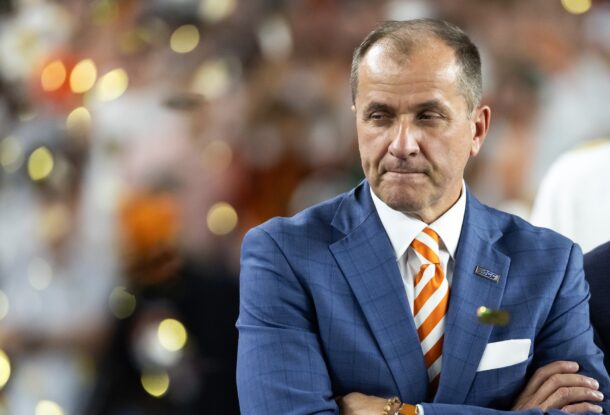
As I stood in the back of Miami’s press conference after Monday night’s national championship loss to Indiana, I couldn’t help but notice a straight-faced Jim Phillips standing alone a few steps to my right. The ACC commissioner had the look of someone who was coming to grips with something he hadn’t experienced during his 5 seasons in that role.
Close, but no cigar.
Miami gave the ACC a chance to do something it hadn’t done in the 2020s. That is, win a national title. While the Hurricanes fell short of becoming the first ACC team since 2018 Clemson to be the last team standing, they did at least end an embarrassing drought for the conference. Before Miami beat Texas A&M in the first round of the College Football Playoff, the ACC had yet to win a New Year’s 6/Playoff game in the 2020s. Even worse, the conference had yet to even keep it within single digits in those games.
The ACC had not been close until Miami went on a run that seemed doomed in late-November when Notre Dame was inexplicably ranked ahead of the Canes in 5 Playoff Polls even though Mario Cristobal’s squad had the head-to-head advantage against the fellow 2-loss Irish. Not only did Miami have to sweat out Selection Sunday, but Phillips and the entire ACC did after 5-loss Duke stunningly won the conference championship.
“Close, but no cigar” would’ve been a devastating blow to the ACC that day. That, however, was avoided.
But there’s a new reality that faces Phillips and the ACC in this all-important juncture.
Did the ACC just watch its lone opportunity for a 2020s title slip away?
As much as I’d love to spend this digging into future ACC rosters like Miami’s (Malachi Toney and Mark Fletcher Jr.’s return will be worth the price of admission), roster/coaching fluidity has made that too challenging to speak on with certainty one way or the other. And while the ACC earned some respect for a 9-5 postseason that included a 4-0 record vs. the SEC, post-bowl momentum isn’t a thing in this era of the sport.
We don’t have a crystal ball to answer that question, but we do know that this is a key stretch for the conference because of what awaits in 2030-31. With exit fees dropping to $75 million at that time — it starts at $165 million in 2025-26 and drops $18 million per year until leveling out at $75 million in 2030-31 — we know that it will be more affordable for ACC powers to look elsewhere if more lucrative opportunities await. The Grant of Rights deal that locked the ACC into that 2-decade agreement to rectify the realignment that happened in the first part of the 2010s was tweaked.
One of the things that happened as a result of that Florida State lawsuit against the ACC was that Playoff teams from the conference kept all of that revenue as opposed to having it spread among the other members. That meant Miami pocked all $20 million of that Playoff revenue. Perhaps that funds the next championship-contending team. Certainly the “funds” at Miami don’t appear to be lacking, and seeing a run that ended a touchdown short of a national title will only allow those to grow.
What the ACC needs in the final 4 years of the 2020s decade is for other ACC teams to have deep Playoff runs and to see the financial benefits of $20 million worth of conference bonuses. Like, imagine what it would look like if the ACC pulled off what the SEC and Big Ten have both done in the last decade. That is, have 3 different conference teams with a national title in as many seasons. If you’re Phillips, you wouldn’t have to do any selling with the monetary value associated with that.
But again, let’s come back to the original point
Miami was the first ACC team in the 2020s who was even close to a single Playoff win. In the ACC, that’s currently valued at $8 million ($4 million for a CFP appearance and $4 million for a quarterfinal appearance). While it’s difficult to project what each ACC school should expect to be making under the amended revenue distribution model — it’s now tiered to reward teams with a larger viewing audience — Big Ten schools will each get a cut of the $1 billion annual TV revenue check through the rest of the decade. That’s an equal revenue distribution, which could make it all the more attractive for non-competing ACC schools to get a cut of that once the exit fees drop to $75 million.
Phillips can see the writing on the wall. The entire complexion of the ACC could change at the end of the decade. There’s real urgency.
Of course, some would counter that by saying the Big 12 was able to roll with the punches of losing Texas and Oklahoma. Also of note, the Big 12 has exactly 1 Playoff victory in 12 years of the system (2022 TCU), and it was followed by a 65-7 loss to Georgia in the College Football Playoff National Championship. We can both respect the Big 12’s pivot while acknowledging that’s not an ideal place to be for a Power Conference.
Power Conferences are defined by championships won. The SEC was defined by a run from 2006-22 that saw the conference take home 13 titles with representation in all but 1 of those national championships. The Big Ten is currently being defined by having 3 different teams take home national championships in as many seasons.
What will define the ACC during this all-important stretch? Before Miami went on this run, Phillips has stood up at ACC Media Days and flexed about things like “Preseason Dodd Trophy Watch List representation” and the completely subjective claim that the conference had “the most exciting collection of college football teams in America.” In Phillips’ defense, his conference hadn’t exactly given him much to brag about during his time in that role. At least not in football, AKA the sport that finances college athletics.
For a month, Miami did more heavy lifting for the ACC than it did in the previous 20 years in the conference. Go figure that the Canes have yet to win the ACC, yet they were 1 play away from winning a national championship on Monday. Miami was the lone ACC team to finish in the final top 10 of the AP Poll, which wasn’t necessarily a surprise for a conference that crowned a 5-loss team as its champion. It’s alarming to think that in the last 5 years, 2025 Miami and 2023 Florida State were the lone ACC teams to finish in the top 10 of the AP Poll.
“Close, but no cigar” isn’t the mantra that will preserve the ACC deep into the 2030s. But at the very least, Miami’s run put “close” back into the ACC’s range of outcomes.
Soon, we’ll find out if “straight-faced and alone in the back of the room” will define the next chapter of the ACC.
Connor O'Gara is the senior national columnist for Saturday Down South. He's a member of the Football Writers Association of America. After spending his entire life living in B1G country, he moved to the South in 2015.