Indiana just handed Alabama a taste of its own Nick Saban era medicine with a Rose Bowl beatdown

Published:
If you traveled in time, you would’ve thought that you drifted into another universe than the one that was on full display in the Rose Bowl. Specifically, if you came from the 2010s and got a glimpse of what transpired between Alabama and Indiana on Thursday, you would’ve thought that the 2 teams had agreed to trade uniforms beforehand in this new, bizarro world of college football wherein that’s somehow a thing that happens.
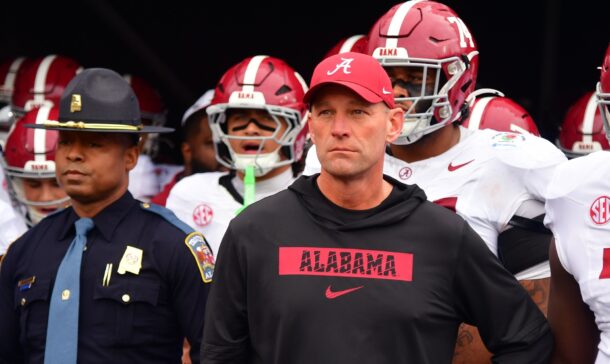
One team had the “joyless murderball” approach while the other didn’t hit 100 total yards until the backup quarterback entered the game halfway through the third quarter. One team didn’t take its foot off the gas for 60 minutes while the other seemed content just to kick a field goal and avoid a shutout. One team had a coach who refused to crack a smile amidst a blowout victory to keep national title hopes alive while the other stared off into the Pasadena sky in search of answers that never came.
Yeah, that’s the real world that we’re living in. Indiana looks like the new Alabama. It has certainly felt like it in 2025 … and at least on the first day of 2026.
That 38-3 Rose Bowl beatdown in the College Football Playoff quarterfinals was straight out of the Nick Saban playbook. The fact that Alabama was on the receiving end of that with its most lopsided postseason loss in program history (H/T Creg Stephenson) and its worst loss in any game since 1998 made it all the more surreal.
It’s one thing to get beat by Clemson in the midst of a historic run to a title. It was another beast entirely to get beat like that by a program who hadn’t won a single bowl game since 1991.
Before Thursday, Alabama had 7 national titles since Indiana’s last bowl victory
None of what transpired on Thursday suggested that was reality. Role reversal? Nah, that was an out-of-body experience for Alabama to get beat like that by a team that didn’t have some stockpiled roster of former 5-star recruits. Of course, one could point out that Cignetti came from Saban’s original Alabama staff before taking backroads on his head coaching journey. Certainly he had a front-row seat to many an Alabama beatdown. Perhaps that’s why he had as many smiles on the Indiana sideline as Alabama had touchdowns.
The Tide watched its season come to an end at the hands of a buzzsaw. One could argue that the game was over when Indiana blew up an odd 4th-and-1 sequence in which Germie Bernard was stuffed on Alabama’s own 34-yard line.
That felt … significant. It felt desperate for Alabama. Better yet, it felt like the type of play that vintage Alabama defenses used to blow up and flip fields en route to blowout victories.
But this wasn’t a vintage Alabama team in any way. Alabama’s 215-23 rushing yards disadvantage meant that the Tide will finish with its worst rushing yards/game average since 1955, AKA 3 years before the Paul “Bear” Bryant era began in Tuscaloosa. No team with a ground game as ineffective as Alabama’s had won a national title since rushing stats became readily available in 1936, so it wasn’t necessarily a surprise to see that as a weakness in the game that ended the national title path.
Still, though. This was a flawed team that got an up-close look at a 14-0 Indiana team who has yet to find its flaw.
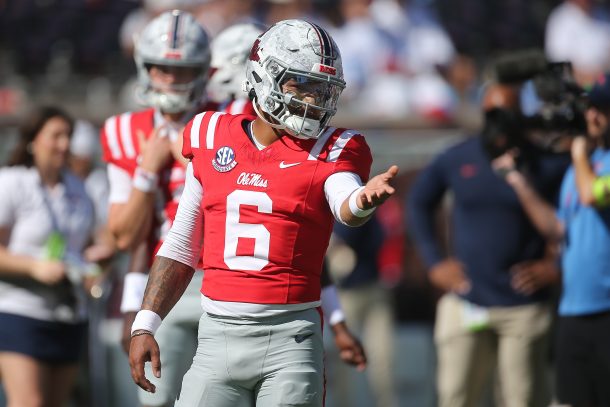
It didn’t even matter that Kane Wommack’s plan to dial up extra pressure worked early on Heisman Trophy winner Fernando Mendoza, who had fewer incompletions (2) than sacks taken (3) with an AJ McCarron-like performance. Mendoza’s counterpart, Ty Simpson, was knocked out of the lopsided game when his costly fumble gave Indiana the ball in a 10-0 game. It halted the Tide’s only real chance at staying relevant, but it was also the anticlimactic end to Simpson’s 2025 season. Time will tell if it’s the anticlimactic end to his Alabama career.
Regardless of what that decision is, Kalen DeBoer got his own painful dose of reality. It would’ve been a different story if Alabama had been left out of the Playoff after its Georgia loss in the SEC Championship, which was humbling in its own right. But instead, he can’t sell the notion that his program was an unlucky break or a 50-50 play from winning a title. Alabama isn’t on that level.
The irony is that Cignetti got to Bloomington just a couple months before DeBoer got to Tuscaloosa. Both of them had notable public comments about one another in the offseason as it related to scheduling and making the Playoff. We didn’t get to see them battle on the field last year. We saw it this year, and it couldn’t have been more decisive.
It’s far too reactionary to say that Thursday’s script will lead to a sour ending to DeBoer’s story at Alabama. It was indeed an improvement in Year 2. A Rose Bowl nightmare shouldn’t erase winning at Georgia, getting to an SEC Championship and roaring back to erase a 17-point deficit at Oklahoma to become the first team to win a road Playoff game. Anyone who treats Alabama’s performance as a sign that DeBoer’s days are numbered is missing the plot.
But at the same place where Saban coached his final game at Alabama, this time, the Tide didn’t have a chance. Perhaps it’s Indiana who’s the best example for why a Playoff qualifier but non-national championship contender isn’t as far away as it might feel.
Alabama couldn’t have felt further away from the Saban era on Thursday. It would’ve been fascinating to get Saban’s unfiltered thoughts from wherever his vantage point was inside the Rose Bowl. Surely he couldn’t have seen that coming. After all, he picked Alabama to win on College GameDay.
Hard truths await this era of Alabama football. It couldn’t have come from a less likely source for that reality to sink in.
Connor O'Gara is the senior national columnist for Saturday Down South. He's a member of the Football Writers Association of America. After spending his entire life living in B1G country, he moved to the South in 2015.