Monday Down South: Lane Kiffin … and the aftermath of the craziest coaching carousel in SEC history

By Matt Hinton
Published:

Takeaways, trends and technicalities from Week 14 in the SEC.
So you’ve bought yourself a coach …
Four SEC teams entered the weekend with a vacancy in thr big chair. By Sunday afternoon, 5 teams had a new head coach. Caveat emptor:
LSU: Lane Kiffin
Lane Kiffin spent the hours following Ole Miss’ Egg Bowl win over Mississippi State consulting with Nick Saban and God. They told him to take the money and run.
Let’s not mince words here. Kiffin’s decision to bail on his team for a hated rival barely 24 hours after the Rebels secured their first Playoff berth was an insult to his players, a middle finger to everyone who invested in his success in Oxford, and a mockery of college football’s postseason. No, it’s worse. It’s a mockery of the idea that the point of the game is to win, rather than to get rich.
Sure, Kiffin has always had a reputation as a mercenary. But even by the low, low standards of journeyman coaches always in search of the next bag, abandoning a team that just punched its ticket to compete for a national championship might be new rock-bottom for the profession. Ole Miss embraced him despite his sketchy past, raised its game to attract next-level talent, dug deep to give him everything he needed to build a winner in the NIL/portal era, and actually succeeded. Ole Miss, for the first time in college football’s modern era, has a puncher’s chance to win big.
Kiffin’s response? Thanks, but no thanks. Not worth finishing, not worth seeing through to the end, y’all go ahead without me. Good luck with all that. I’ll just be over here, counting my money and making the same old speech about all the hypothetical championships I intend to win at some indeterminate point in the future, while ignoring the actual championship that is within sight of a program I’ve spent the past 6 years building toward this exact moment. Now that the time has come, sorry guys, it turns out I really don’t think you’ve got what it takes to go all the way. To everyone who wrote a check to turn this pipe dream into a reality, wow, I didn’t actually think it would work! But now that it has, well, the checks over here are marginally larger. So. I’ll be seeing you.
I admit, I kinda fell for the maturity bit. You can talk yourself into believing almost anything about a guy who’s winning. He’s lost weight, he’s doing yoga, he has a dog. Healthier and happier than ever. Just loving life in the Sip. Underneath that thin veneer of Hallmark Channel Marty Smith schmaltz, though, Lane was just Lane, a little older but still entitled, his antennae always tuned still toward the next opportunity. The same Lane who once skipped out on Tennessee in the middle of the night. Who, even before the midnight flight from Knoxville, was fired as head coach of the Oakland Raiders for “disgrac(ing) the organization” in his year-and-a-half on the job. “He conned me like he conned all you people,” his boss, then-Raiders owner Al Davis, said at the time, in what might have been the most lucid moment in the last decade of his life. Almost every job Kiffin has held has ended with someone saying more or less the same thing.
I wonder amid the triumph of Getting Their Guy if any LSU fans look at the situation at Ole Miss and imagine themselves on the other side. Kiffin is a fine coach, obviously. Respected offensive mind. Aggressive recruiter. Proven winner (except when he’s not). All things considered, probably the best coach LSU could have realistically hired in this cycle. He has never done anything at this stage of his career that the last guy hadn’t done before he accepted a king’s ransom to leave his well-appointed position for Baton Rouge, visions of a national championship dancing in his head. We know what happened to him. But that was the last cycle. If you’re setting out to break spending records in December 2025, Kiffin is certainly at the top of the list of guys who might actually say yes.
On some level, though, Kiffin’s messy exit from Oxford — the latest in his pattern of messy exits across nearly 2 decades — has to raise a pang or two of doubt. Could that be us in a few years? His only rings are as an assistant. Is he really as committed as he says to winning a national championship? If that was true, wouldn’t he still be where he was, where his now-former team is in the midst of playing for a championship as we speak? Kiffin is easy to like, as long as he’s winning. But when the music stops, he has never left anywhere he’s been satisfied or wishing he’d stuck around a little longer. Who knows? Maybe LSU, finally, is that special place where he finds whatever it is he hasn’t been able to find elsewhere, whether it’s a ring or something else. If it’s not in Baton Rouge, where would he even begin to look next?
Ole Miss: Pete Golding
Under the circumstances, promoting Pete Golding from defensive coordinator to permanent head coach was the best decision Ole Miss could have made. Not necessarily because of any overriding faith in his long-term potential in the job — the 41-year-old Golding is a wild card who has never been a head coach at any level. But the Rebels are not really thinking about how it might end in a year or 2, or 3, or whenever. Right now, his promotion accomplished 2 immediate goals for the upcoming Playoff run: It represents continuity, and by avoiding the interim tag it reassures players that Golding himself doesn’t have one foot out the door. That might not amount to stability, but it’s a start.
First order of business, after talking players off the ledge and out of the portal: Filling out the staff ASAP. Kiffin’s exit some significant gaps, none more so than at play-caller; offensive coordinator Charlie Weis Jr. was among the assistants who followed Kiffin to LSU. Whoever fills that role has some very big shoes to fill. But the important thing at this point is getting past the initial drama, getting back to whatever now qualifies as normal, and getting into CFP prep as soon as possible. Once the players are back in their comfort zone on the field, everything else becomes background noise.
Florida: Jon Sumrall
Did Florida fire Billy Napier just to hire the 2025 version of Billy Napier? On paper, kinda: Like Napier, Sumrall (currently head coach at Tulane) is straight from a successful run at a G5 school in Louisiana, and also has some experience as an SEC assistant. Sumrall’s record over 4 years as a head coach at Troy and Tulane (42-11) is nearly identical to Napier’s in his 4-year tenure at Louisiana (40-12) when he made the move to Gainesville 4 years ago. There are distinct Napier vibes.
Can anyone promise that Sumrall is not the next Napier? Of course not. But such superficial comparisons don’t amount to much. The bottom line is that Sumrall has won as big at Troy and Tulane as it’s possible to win at those schools. His 2 years at Troy yielded the best winning percentage there since the program moved up to the FBS level at the turn of the century. His winning percentage at Tulane ranks there No. 2 since World War II, behind only Tommy Bowden in 1997-98. The Green Wave are the only Group of 5 team ranked in the latest CFP rankings, and are on the cusp of a likely Playoff berth with a win on Saturday in the American Championship Game against North Texas. (Sumrall has already committed to coach the Wave through the Playoff, if they make it, a choice Florida supported.) It’s the 4th time in as many seasons his team has played in its conference championship game.
The list of coaches who have successfully made the transition from mid-major ranks to the SEC in the past 25 years is short. The name at the top: Urban Meyer, who came to Gainesville from Utah in 2005. (The Utes were obscure upstarts in the Mountain West at the time.) Is that a more exciting comparison? “Somewhere between the next Billy Napier and the next Urban Meyer” might be the most honest projection for a first-time SEC head coach you will ever read.
Auburn: Alex Golesh
Alex Golesh, a Russian immigrant who moved to the U.S. as a child, has taken the time-tested route from successful SEC assistant to successful rebuilding job and back to the SEC as a head coach. Tennessee fans remember him well as the Vols’ offensive coordinator in 2021-22, Josh Heupel‘s first 2 seasons in Knoxville, which yielded 2 of the most productive attacks in school history. The 2022 team led the nation in total and scoring offense, ended a 15-year losing streak vs. Alabama, and made a sustained Playoff push before QB Hendon Hooker tore his ACL late in the season. He imported the fast-paced Tennessee system to USF, where the ’25 Bulls rank No. 2 nationally in total offense and No. 4 in scoring.
One of the big questions following the announcement of Golesh’s hire at Auburn was whether he would be accompanied by his star quarterback, Byrum Brown, who has a 5th season of eligibility available in 2026. A 6-3, 230-pound specimen, Brown is among the most productive dual-threats in the country — he leads all G5 quarterbacks in Total QBR, and all FBS quarterbacks in rushing yards (not including sacks). The caveat: His skill set overlaps with that of dynamic freshman Deuce Knight, the gem of Auburn’s 2025 recruiting class and heir apparent for the starting job after going ham on an FCS defense in his first career start a couple weeks back. Either guy atop the depth chart projects as an upgrade over Auburn’s quarterback situation at any point since Bo Nix transferred to Oregon. Managing to keep both would be a major coup, although not as big a coup as keeping Cam Coleman.
Arkansas: Ryan Silverfield
At one point last week, the Hogs thought they were getting Golesh. After those reports fell through, they settled for Ryan Silverfield, another “I dunno, seems fine” hire from the G5 ranks coming off a 6-year stint at Memphis. Silverfield’s record won’t inspire parades greeting his arrival. Both of his predecessors, Justin Fuente and Mike Norvell, parlayed winning records at Memphis (a historical rarity) into plum jobs in the ACC, at Virginia Tech and Florida State, respectively. Silverfield inherited a stable program from Norvell, his former boss, and posted a slightly lower winning percentage. His teams finished .500 or better every year, including 10-win seasons in 2023 and ’24, but didn’t claim a conference championship or seriously contend for the G5 slot in a major bowl game. This year, the Tigers started 7-1 — beating Arkansas along the way — climbing as high No. 22 in the AP poll with an American title and potential Playoff bid in its sights, then lost 3 straight to end the regular season.
Silverfield began his coaching career as a high school senior and has coached at every level from high school to the NFL. Appropriately for Arkansas, he’s spent most of his career coaching the o-line. He’s respected as a pro who’s not going to say anything out of pocket. In other words, he’s about as nondescript as they come. TBD whether his tenure in Fayetteville moves the needle.
Salute to Stoops
Kentucky pulled the plug Sunday on the most successful coach in school history, Mark Stoops, on the heels of a 41-0 embarrassment at Louisville. Frankly, it was overdue after years of steadily diminishing returns. The loss on Saturday clinched back-to-back losing seasons in Lexington for the first time since 2014-15, days the Wildcats hoped were long behind them. After a brief upswing in early November, they were blown out in their last 2 games against Louisville and Vanderbilt by a combined score of 86-17.
As a rule, most coaching tenures end badly, even the good ones. In Stoops’ case, although he’d earned the right to go out on his own terms, those terms were onerous: The school owed him a $37 million buyout, to be paid in full within 60 days of termination. (He adjusted the timing after the fact, by the way.) Asked about the possibility he would resign following Saturday’s loss, Stoops responded “zero chance,” a final act of defiance before the curtain came down. He will get his money, but in payouts spread out over years, not as a lump sum.
It was hard to watch at the end, but then, Stoops’ teams were usually hard to watch at their best, too. That was by design: A defensive coach with limited access to top-shelf skill players, the Wildcats forged an identity in the spread era by being resolutely anti-spread, building around the line of scrimmage and embracing a slow, grinding style of play that attempted to drag every game into the mud. The best quarterback he ever had was a converted wide receiver, Lynn Bowden Jr., who started taking direct snaps as an emergency Wildcat QB in 2019 and went on to break rushing records despite rarely putting the ball in the air. That suited the Stoops ethos. He won 10 games in 2018, a miracle, and again in 2021, a mark only 2 other coaches in UK history had hit before him. (One of whom was Bear Bryant.) Over 13 years, he coached in and won more games in Lexington than anyone else. He goes out 2 games over .500 for his tenure, making him the first Kentucky coach to leave with a winning overall record in more than 6 decades.
At some point, people stopped asking, “when does basketball season start?” and started showing up. For at least a little while there, going to Kentucky was a legitimately hostile SEC road trip, especially after dark. (Ask Dan Mullen and Ed Orgeron.)
Stoops never beat Georgia or Alabama, or came close to winning the old East Division. With rising expectations and resources, he relented post-pandemic to modernizing the offense in an effort to take the next step, bringing in an NFL coordinator to update the passing game and splurging on pro-style quarterbacks in the portal. Both the coordinator (Liam Cohen) and the quarterbacks (Will Levis and Devin Leary) went on to the next level, but the offense never took off. Stoops’ last 4 teams were a combined 9-23 in SEC play, nearly as bad as the listless program he inherited in 2013. The next coach will have significantly more money, better facilities, and a more engaged fan base at his disposal, but face just as steep a climb relative to the rest of the conference. The search is getting off to a late start, too.
With Stoops out, the new dean of SEC coaches is Kirby Smart, now in year 10 at Georgia. No other active coach was in his job prior to the pandemic. Not a lot of guys in this profession last 13 years in the same place. The Stoops era got stale, but when it was good, Kentucky has rarely been better.
Overpriced Drink
Meanwhile, amid the comings and goings, Missouri extended Eli Drinkwitz‘s contract (again), raising his salary to an eye-watering $10.75 million a year through 2031. If you just choked over that number, join the club.
No offense to Drinkwitz, who seems like a normal guy with a perfectly cromulent record at Mizzou, including a couple of 10-win seasons in 2023 and ’24. But let’s be real here, folks. You’re shelling out close to $11 million a year for a coach who’s 26-24 in SEC play, has not sniffed a Playoff berth – much less a championship – and cannot count a single needle-moving victory over one of the conference’s heavy hitters in 6 years? What are we doing here? The closest Mizzou has come to a “big” win in Drink’s tenure is a 14-3 decision over a demoralized, shorthanded version of Ohio State in the ’23 Cotton Bowl. The ’25 team got off to an encouraging start, but was quickly reminded of its place in the pecking order with an 0-4 record vs. ranked opponents. The ’24 team was 0-3 against ranked opponents. Since when does reliably winning the ones you’re supposed to en route to the Music City Bowl fetch 8 figures? Am I losing my mind?
Granted, Drinkwitz was a recurring name in the coaching carousel, and his bosses felt compelled to do whatever it took to keep him happy and in the fold. OK. At some point, though, if a rival is willing to write a blank check to a guy who has been (let’s face it) a slightly-above-replacement-level coach and saddle him with the championship-or-bust expectations that come with it, maybe it’s time to wish him well and let that be their problem. Programs who pay exorbitant salaries to meet those kinds of expectations don’t give coaches contract extensions for hovering around the fringes of the top 25. They fire them. Missouri obviously isn’t holding Drinkwitz to anything like a championship-or-bust standard. So what is it paying for?
Then again, take that for what it’s worth coming from a humble blogger who still naively toils in a world where money is real. Based on the Monopoly-money contracts we’ve seen doled out over the past few cycles, most of the guys in charge of spending it left that kind of poverty mindset behind long ago. The numbers just go up, that’s what numbers do.
The inevitability of Georgia vs. Alabama
Alright, on to the actual games. A full preview of the SEC Championship rematch between Alabama and Georgia is on the way later in the week. In the meantime, a few initial thoughts:
First, in a season defined by unprecedented parity, razor-thin margins, and the rapidly shrinking gap between the league’s traditional heavyweights and the nouveau riche, who’s left standing? Of course, it’s Bama and Georgia. Did you really think it was going to break any other way? Are you new around these parts? The era when the Tide or Dawgs (or both) could confidently book their trip to Atlanta in mid-October might be firmly in the past. But they still boast 2 of the deepest, most stacked rosters in the college game, and if the results these days occasionally feel more like a lucky roll of the dice than outright dominance, well, the dice are still weighted toward top-end talent. That is one aspect of this matchup you can rest assured has not changed.
Twelve games in, Georgia is a bit of an enigma. In fact, you might as well extend that timeline back to last year, when a decidedly mortal UGA outfit managed to claim its 3rd conference title under Kirby Smart despite 2 regular-season losses and a litany of close calls along the way. The ’25 team is similarly nondescript. Again, the Bulldogs are solid across the board, but not elite or necessarily even all that consistent in any particular area.
If they have a defining quality, it’s their ability to absorb an initial blow and adjust to the type of game they find themselves in on any given Saturday. They’ve trailed in 7 of their 8 wins vs. Power 4 opponents, and in the 4th quarter in 3 of them. The offense has risen to the occasion in shootouts (Tennessee, Ole Miss), and the defense has held up its end in slugfests (Auburn, Georgia Tech). Their most complete outing against a worthy opponent, a 35-10 win over Texas in Week 12, was a 14-10 game at the end of 3 quarters before Georgia pulled away. QB Gunner Stockton has delivered when they’ve really needed him to, and been content to putter along in game-manager mode the rest of the time; no individual skill player ranks in the top 10 in the SEC in yards from scrimmage, with only 1 (RB Nate Frazier) cracking the top 30; the once-formidable pass rush, strangely dormant over the first 2 months of the season, only began to flash its potential in November. While the rest of us have waiting for a glimpse of the finished product, the Dawgs have made a living of figuring it out as they’ve gone along.
Lord knows Alabama hasn’t been living any less dangerously. At least Crimson Tide games have followed a more or less identifiable script. In SEC play, Bama is outscoring opponents by exactly a touchdown per game, 26.1-19.1, and every conference game has fallen roughly within the margin of error of that exact score. Excluding a pick-6 touchdown against Tennessee, the offense has accounted for somewhere between 20 and 30 points in all 8 SEC games, while the defense has allowed between 14 and 24 points in every game except a 20-9 win over LSU in Week 11.
Specifically, the Tide have specialized in the 4th-quarter dagger from QB Ty Simpson. If you were surprised by the decision to forego a go-ahead field goal at the end of Saturday’s 27-20 win at Auburn, Bama fans were not – or shouldn’t have been. Simpson’s 4th-down touchdown pass to Isaiah Horton was only the latest in a series of clutch conversions that clinched each of the their previous road wins at Georgia, Missouri and South Carolina.
Not coincidentally, the only blemish on the conference slate, 23-21 loss to Oklahoma in Week 12, is the only one in which the biggest swing plays swung against them. Alabama was minus-3 in turnover margin against the Sooners, the giveaways leading directly to 17 of OU’s 23 points. In every other SEC game they’ve been even or in the black.
Unlike Georgia, whose CFP status is secure either way, Alabama is squarely on the bubble with a loss. The committee demonstrated last year that it is not inclined to punish the loser of a conference championship game to the benefit of a team that was watching from home: Texas and Penn State dropped just 1 slot apiece in the weekly CFP rankings following competitive losses in the SEC and Big Ten title games, respectively, and SMU dropped only 2 spots after its last-second loss in the ACC Championship, preserving the Mustangs’ place as the final at-large team in the field. This year, however, Bama has no margin for error.
As it stands, the Crimson Tide have landed at No. 10 in each of the past 2 CFP rankings, 1 spot behind Notre Dame. If the updated AP and Coaches polls are any indication, they’re likely to remain there again this week. The way the bracket is shaping up (see below), 10 is the cutoff: With 2 slots reserved for lower-ranked conference champs, the team that occupies that position in the final rankings will claim the last at-large ticket.
What will it take for Alabama to hold it? If the Tide win, of course, they’ll claim the SEC’s automatic bid, relegating Georgia to an at-large. On the other hand, a loss that drops then to 10-3 would give the committee cover to make any move it felt justified to make. Bama’s opening-day flop at Florida State only looks worse in hindsight and remains the worst loss of any team on the bubble. BYU, currently ranked No. 11 at 11-1, can punch its ticket with an upset over Texas Tech in the Big 12 Championship Game, knocking the Red Raiders into the at-large pool and the Tide out. If Bama and BYU both lose Saturday, it would leave the lane wide open for the committee to elevate No. 12 Miami to No. 10, thereby avoiding the looming controversy between the Hurricanes and Notre Dame altogether by ushering them both in.
Point being, the committee is under no obligation to defer to Alabama, as a brand or as the ostensible top seed in the SEC Championship Game. They still might – it’s a powerful brand, and a convincing enough performance even in defeat against the Dawgs could be enough to hold off the teams nipping at their heels. The prospect of bouncing one half of the SEC title game from the field at the 11th hour is a can of worms they’d surely be reluctant to open. But, just like last year, at the end of the day the Tide have no one to blame for their predicament but themselves. Their résumé includes an albatross of a loss at FSU; another loss in a game that, on paper, they had no business losing; and a string of competitive, occasionally sloppy wins. At no point have they inspired visions of a vintage Bama outfit at its inevitable best.
Still, here they are, all of their goals intact and in control of their fate. Nobody what the committee is inclined to do, but there is still one sure-fire way to erase all doubt: Beat Georgia, and take it out of heir hands.
CFP Realpolitik
It’s that time of year, when the fog begins to lift and the outlines of the postseason picture begin to come into view. Each week down the home stretch, CFP Realpolitik will size up the pecking order from a strictly practical perspective.
Rivalry Week! Throw the records out! Or not! Chalk held in Week 14, which brought the bare minimum of chaos: The top 18 teams in the CFP’s committee rankings went 16-2, with the only 2 losses — Michigan and Texas A&M — coming at the hands of a ranked rival. Four teams effectively sewed up at-large bids without qualifying for their respective conference championship games: Oklahoma, Ole Miss, Oregon and Texas A&M. Another of the 3 remaining at-large bids will go to the loser of the Indiana-Ohio State collision in the Big Ten title game. The fate of the final 2 is very much up for grabs entering the final weekend.
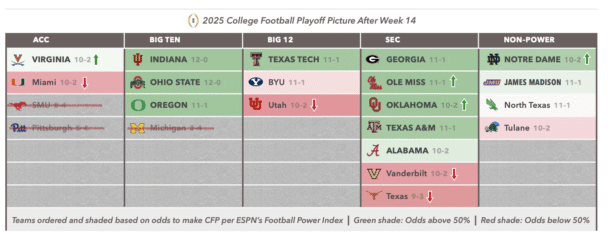
Hurricane watch: The CFP committee signaled in its initial rankings on Nov. 4 that it had no intention of taking Miami’s head-to-head win over Notre Dame in Week 1 as a mandate for The U. At that point, the Fighting Irish ranked 8 spots ahead of the Hurricanes, a wide enough cushion that the score of a close game from 2 months earlier didn’t really register. With each week, Miami has narrowed the gap: From 8 spots in the first set of rankings to 6 a week later, to 4 the following week, and to just 3 spots last week — close enough to raise some eyebrows and the blood pressure of ‘Canes fans. Both teams won big on Saturday, clinching 10-2 records and setting up what is probably going to be the most heated argument of the final hours before the field is set.
Only 2 teams still stand between them: No. 10 Alabama and No. 11 BYU. As outlined above, the committee can still avoid settling the ND-Miami question if Bama and BYU both lose, clearing the way for the Hurricanes to join the Irish in the field, or (less likely) if Bama and BYU both win. In that case, they’d claim their respective conference championships, bumping Georgia and Texas Tech into the final 2 at-large slots, and bumping Notre Dame out. Otherwise, if Bama and BYU split, the committee could be forced to bang the gavel for the Irish or ‘Canes.
Miami, of course, would love to get close enough to make head-to-head the most salient point of comparison. Why do we even play the games if the committee is just going to ignore the results, right? Notre Dame’s case rests on everything that’s happened since. The Irish have won 10 in a row, only one of which, a 34-24 decision over USC in mid-October, was even remotely in doubt at any point. (It helps that they set a precedent last year for rebounding from an early loss, going on to win 13 in a row en route to the CFP title game.) Their response to the charge that they’ve beaten up on a relatively marginal schedule is that they’ve dominated that schedule, which is largely true. But then, outside of a a couple of midseason glitches against Louisville and SMU, Miami has handled its business with relative ease, as well. On paper, the gap is marginal. I don’t know to what extent if any the committee pays attention to the assorted advanced metrics available to us common folk. But according to basically all of those metrics — SP+, FPI, SRS, FEI, Jeff Sagarin — there is very little daylight between them:
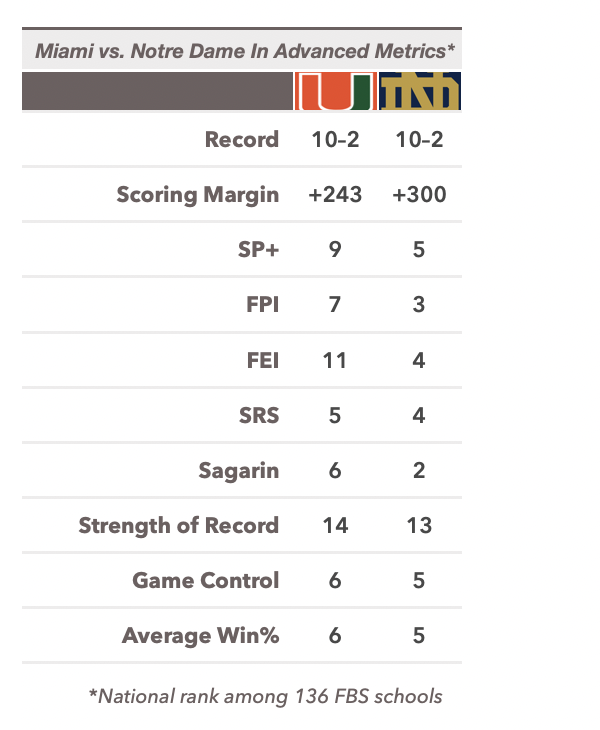
It would be one thing if the numbers were lopsided enough to be irrefutable. As it is, the Hurricanes have beef: With so little separating them (including the loss column), defaulting to the head-to-head result is the only fair way of settling the question. Why do they play the games, only for the result to be buried under a thin layer of statistical arcana, or subjected to an “eye test” whose main criteria come do to a) Notre Dame is drawing on the credibility it banked during last year’s run to the CFP title game; and b) Miami’s losses are more recent? If I had a voice in the committee, I’d advise seriously reconsidering the status quo before it’s too late.
ACC: All-Consuming Chaos. For reasons no one can quite comprehend, losses by SMU and Pittsburgh over the weekend combined with the ACC’s convoluted tiebreaker procedures to produce the worst possible outcome: An ACC Championship Game featuring 7-5 Duke. The Blue Devils emerged from a 5-way tie for second place in the league standings to take on first-place Virginia (!) in what might be the most unlikely conference championship matchup on record. What is this, the basketball tournament? UVA has never won an outright conference championship in football, and Duke hasn’t claimed one since 1962. The closest either has come since was a shared title in 1989, when the Devils were coached by an up-and-coming Steve Spurrier.
Duke’s presence in the title game is a nightmare scenario for the ACC, which if nothing else in this chaotic season was at least counting on an automatic spot in the Playoff for its eventual champion. If it’s Virginia, it will get it, however little respect the Cavaliers command from the rest of the country. If it’s Duke, the league can probably forget it. The 5 automatic bids are reserved for the 5 highest-ranked conference champions in the final rankings, a bar the Devils almost certainly will not clear after going 1-3 in nonconference play. They’re so far off the CFP radar, FPI lists their chances of crashing the field at 0.0% even if they win on Saturday. Highly doubtful the rest of the league ever expected to be banking on Virginia to salvage whatever remains of its national reputation, but here they are.
Here’s a sentence no one ever could have imagined writing in August: A potential Duke win opens up an opportunity for a 2nd Group of 5 team to claim a seat as the 5th conference champ. The first team in the G5 pecking will be the winner of the American Athletic Championship Game between 10-2 Tulane and 11-1 North Texas. The Green Wave were the only G5 team to make the cut in last week’s rankings, checking in at No. 24; UNT, finishing up the best season in school history, would surely take their place with a win. Next in line: 11-1 James Madison, far and away the class of the Sun Belt. The Dukes have yet to appear in the CFP rankings, but remain the top G5 team in the traditional polls ahead of what should be a routine dispatching of Troy for the SBC title. The wailing and gnashing of teeth across the sport if an obscure outfit in just its 4th season as an FBS program (and 2nd without Curt Cignetti) is ushered into the bracket while some combination of Alabama, Miami and/or Texas is left in the cold will set some kind of record. This is what you get for nuking the Pac-12!
Better luck next year: Steve Sarkisian turned his postgame interview after Texas‘ 27-17 win over Texas A&M into a full-blown infomercial for his team’s CFP case, pitching his team’s bona fides and at one point suggesting it would be “a disservice to the sport” to keep the Longhorns out of the field. Not to completely dismiss his argument about how the committee weighs nonconference losses like Texas’ opening-day trip to Ohio State, but realistically, he can consider the sport disserved because there is no realistic path for Texas to crash the top 10. It’s just too far a climb in too little time.
The ‘Horns came in at 16th in last week’s CFP rankings, meaning they’d have to leap 6 teams immediately in front of them in just 2 weeks to sneak into the bracket as the last at-large. Only 1 of those teams lost: Michigan, which was just 1 spot ahead of Texas at No. 15. Texas could conceivably jump No. 14 Vanderbilt this week based on the combination of a spoiling the Aggies’ perfect season and a head-to-head win over Vandy in Week 10. They could even nudge past No. 13 Utah, which has eked out a couple of sketchy wins the past 2 weeks. But that is where any hypothetical ascent ends. And that’s if the committee is buying what Sark is selling.
Sarkisian wants to talk about who the Longhorns have played, but not how they’ve played. A Week 6 loss at Florida, of course, sticks out on their résumé like a sore thumb. So do subsequent overtime escapes at Kentucky and Mississippi State, for anyone who’s willing to look past the W. Along with losses at OSU and Georgia, Texas underwhelmed every single time it left the state. A quick scan of the metrics reveals the ‘Horns at 13th according to FPI, 20th in SRS, 21st in FEI, and 22nd in SP+. That’s significantly behind Vanderbilt in all of the above, for the record, refuting Texas’ case for jumping the Commodores. Again, metrics might not have much predictive value where the committee is concerned, but the case for the Longhorns sounds a lot more convincing coming out of their coach’s mouth in the immediate aftermath of an emotional win than it does in the light of day.
Dude of the Week: Florida RB Jadan Baugh
On every bad team, there’s a guy who plays his way into the diehards’ hearts just by consistently looking like he wants to be there. For Florida, it’s Baugh, a 230-pound sophomore grinder who never stopped grinding throughout a hopeless slog of a season that gave him every possible excuse to check out. His perseverance paid off Saturday in 40-21 win over Florida State, a game the locals will remember fondly as the Jadan Baugh Game. He put an injury-plagued offense on his back, running 38 times for 266 yards – both career highs by a mile – and scoring twice. In the process, he forced 13 missed tackles, per PFF, and led all FBS rushers in Week 14 with 8 runs of 10+ yards.
Baugh’s closing effort made him Florida’s first 1,000-yard rusher in a decade, one of the few goals his beleaguered team still had to rally around at the end. He cradled the game ball during his postgame press conference. The new administration has its own priorities, but if the fans got to vote for one guy they’d want to keep in the fold, here’s guessing his name would come in at the top of the list.
Dud of the Week: Auburn’s Bad Hands
Receivers, running backs, tight ends, return men: Just about everybody tasked with catching a ball in the Tigers’ loss to Alabama in the Iron Bowl was afflicted at some point by a contagious case of the dropsies. Per PFF, 6 different players combined to drop 7 passes, tied for the most drops by any team in any FBS game this season in the PFF database. Auburn also fumbled 4 times, culminating in the drive-killing fumble by Cam Coleman that effectively ended the Tigers’ season in the final minute. (Until that, the Tigers had recovered the other 3.) Tack on a muffed punt in the dying seconds, for good measure. If it could be dropped, bobbled, booted, or flubbed, they found a way to do it, and it may have cost them what would have been their most satisfying win in ages.
Notebook
1.) I’ve been on the Diego Pavia for Heisman bandwagon for several weeks now, so it was satisfying to watch the rest of the country climb aboard in unison in the wake of Vanderbilt’s 45-24 romp at Tennessee. Pavia all but clinched his ticket to New York, rising to No. 3 in the updated Heisman odds after accounting for 433 total yards and a couple of touchdowns in yet another milestone win on his watch. He is still a dark-horse compared to the winner of Saturday’s showdown between frontrunners Fernando Mendoza and Julian Sayin in the Big Ten Championship Game, a stage Pavia will have no opportunity to match. But he’s not going to take a backseat to anyone statistically. After a rocket-fueled November, Pavia ends the regular season ranked in the top 4 nationally in total offense, total touchdowns, yards per attempt, efficiency, passing success rate, EPA, Total QBR and overall PFF grade. He also led Vandy to its first 10-win season while vaulting to the top of Vandy’s single-season passing list.
2.) There are 2 ways to look at Oklahoma’s ugly, down-to-the-wire win over LSU. One is alarm: QB John Mateer was picked off 3 times in a must-win game for the Sooners’ Playoff hopes, a losing proposition for a team that is only in the race in the first place due to a +6 turnover margin in its previous 3 November wins. The other is patience: Mateer was picked off 3 times and the Sooners still won, 17-13, on another stellar afternoon for the defense. In one way or another, all 4 entries in Oklahoma’s ongoing, 4-game winning streak have been ugly or unsustainable, yet they have sustained it all the way to a Playoff bid. If they hold at No. 8 in the final committee rankings — there is no reason to think they won’t — they’ll host a first-round CFP game. They can’t go on surviving multiple giveaways a game against a Playoff-caliber opponent, but short of that there is no mandate for Mateer to revive his injury-shortened September Heisman campaign. If he’s less than perfect, well, that’s par for the course.
3.) Their team lost, but Mississippi State fans were vindicated in the Egg Bowl by the emergence of touted freshman quarterback Kamario Taylor in his first career start. A local product with all the tools, Taylor gradually became the focus of a base with not much else to look forward to other than the highest-rated QB recruit in school history finally supplanting 6th-year vet Blake Shapen. Saturday was the day, and Taylor seized it, accounting for 178 yards passing, 173 rushing, 2 rushing TDs, and a handful of highlight-reel runs that left no doubt about his status as a rising star in 2026.
It should have been Taylor’s offense the moment Shapen threw a game-losing pick to a defensive tackle within range of the winning field goal at Florida in Week 8. The Bulldogs might not have won any more games with the rookie, but at least the slog to the finish line would have been a lot more exciting.
Moment of Zen of the Week
Matt Hinton, author of 'Monday Down South' and our resident QB guru, has previously written for Dr. Saturday, CBS and Grantland.