Unprecedented, chaotic and overstimulating.
That’s how I’d describe 6 SEC programs filling vacancies in a 36-hour stretch. Six new coaches in the conference, all of whom are in different situations, has brought us to a new era in the SEC.
Don’t believe that? Kirby Smart is the only current SEC coach who was with his team during the 2010s. Eli Drinkwitz is now your second-longest tenured coach while Clark Lea, Shane Beamer, Steve Sarkisian and Josh Heupel would all share a spot on the podium as coaches who just concluded Year 5.
It took a rare, intra-conference move in order for that to be the case, though just like the last time the SEC endured an intra-conference move, it was a coach leaving the state of Mississippi for a team with multiple 21st century national titles. Whether Lane Kiffin lasts longer than Dan Mullen remains to be seen.
What’s obvious is that these moves will be dissected for years to come. This coaching carousel will define the latter half of the decade in the SEC.
So with that in mind, let’s look into the crystal ball and do the impossible task of ranking these hires:
6. Pete Golding, Ole Miss
Anyone can understand why Ole Miss quickly pivoted to Golding in the wake of the dramatic Kiffin departure. Continuity matters a whole lot more for a team set to play in the College Football Playoff as opposed to a team with 5 consecutive losing seasons like Auburn. Golding, as the leader of that defense, gives Ole Miss short-term continuity that could allow it to navigate a 1-for-1 set of circumstances in the Playoff.
But as we saw with another stunning coaching change in the Magnolia State in the wake of Mike Leach’s death, a short-term move to the defensive coordinator still has long-term questions. It’s not just that Golding is running a program for the first time. It’s that he has to find someone who can establish an entirely new offensive identity after one of the most decorated offensive minds in the sport just walked out that door. Even if you’re a defense that handles its business like Ole Miss likely will with Golding, you’re recruiting to an entirely new era of offensive football in Oxford.
It’ll be interesting to see if Golding is able to make a big-time OC hire because it could define his tenure, much like how Zach Arnett’s whiffed OC hire in his attempt to transition away from the Leach Air Raid defined his brief tenure as a head coach. That’s the danger with that move, especially knowing that it’s been an 8-win floor the last 5 years.
5. Ryan Silverfield, Arkansas
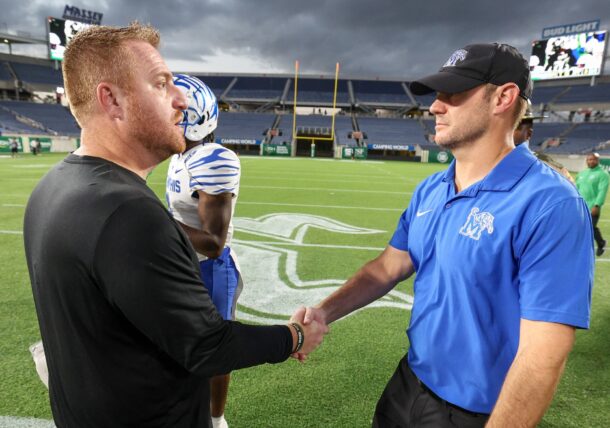
Arkansas hired someone for a rebuild who has never had to rebuild. That’s why this is at No. 5 and not No. 2-3. Silverfield spent the last decade at Memphis and took over the program that multiple head coaches before him rebuilt (Justin Fuente never seems to get enough credit for setting Mike Norvell up). In this era, a rebuild includes replacing half the scholarship players in the transfer portal. Even if Silverfield continues a solid track record of evaluating in the portal, doing that in the toughest conference after failing to win a single SEC game could make Year 1 feel more like a Year 0.
On top of that, Silverfield is 12-22 vs. FBS teams who finished .500 or better. That’s not exactly correcting Sam Pittman’s 6-25 mark vs. AP Top 25 competition. The idea of having a limited ceiling probably won’t sit well with Hog fans who have had to watch Arkansas record 1 winning season in SEC play in the post-Bobby Petrino era (post-neckbrace).
But there is a bit of comfort that should come with Silverfield if he gets the alignment needed from those pockets in Fayetteville. Arkansas was doomed in 1-score games during the Pittman era. His 7-19 mark in those games was ultimately his undoing. Chalk that up to being a first-time head coach. Silverfield, on the other hand, was 19-15 in those spots. Only 2 FBS coaches have had more experience in 1-score games in the 2020s than Silverfield. Arkansas knows that all too well because Silverfield pulled off a 3-score comeback against the Hogs, wherein Memphis was much more poised down the stretch.
Silverfield getting early alignment will depend on his Year 1 ability to flip the script in that all-important area and move past the looming, snake-bitten culture.
4. Will Stein, Kentucky
If I’m a quarterback right now, I’m trying to find a way to play for Stein. Period. At a place that had 4 consecutive disappointing years of quarterback play from transfers who entered in as QB1, Stein immediately gives Kentucky an opportunity to right that wrong.
His track record at Oregon is remarkable. He helped turn Bo Nix and Dillon Gabriel into Heisman Trophy finalists after both were expected to have somewhat limited ceilings. But if you’re of the belief that both of those guys, who both got an opportunity to start as NFL rookies, were already established, look at the job he did with Dante Moore. The former 5-star recruit willingly left UCLA after he got starts as a true freshman so that he could redshirt a year behind Gabriel and learn under Stein. All Moore has done since becoming the starter in 2025 is become one of the best quarterbacks in the sport for an 11-1 Oregon team that’s been dealing with injuries galore on the offensive side of the ball. But Stein’s ability to adapt to his personnel is second to none.
Stein became an emerging name in the sport during his time in Eugene, but his ties to the Bluegrass State are deep. He’s a Louisville native who played quarterback for the Cardinals, and he’s the son of 2 parents who went to UK, including his dad, Matt, who played at Kentucky in the 1980s. A guy who grew up rooting for that program won’t have to be educated on the power dynamics at play in Lexington.
So why not put Stein even higher on this list? This is a 36-year-old head coach who was a high school coordinator as recently as 2019. Stein’s rise was meteoric, which means someone who has never run a program could have questions about in-game decision-making and assembling a staff. Granted, he had offensive autonomy under the defensive-minded Dan Lanning at Oregon, so he’s at least had a solid dose of that.
Stein had the benefit of working with top-5 recruiting classes and a healthy transfer portal budget during his 3 years building offenses in Eugene, which figures to be a different situation than what he has at Kentucky. Can Stein find the diamonds in the rough like that job might require? And will he have an eye for hiring the right defensive coaches in the way that his former boss, Lanning, seemed to have an eye for hiring the right offensive coaches? Those are unknowns.
After missing out on the Jon Sumrall window, though, Stein is as impressive of a hire as UK could’ve asked for. Speaking of Sumrall …
3. Jon Sumrall, Florida
Let’s get the negative out of the way with Sumrall because there’s a whole lot more to be excited about than disappointed about for Florida fans. He’s not Kiffin. Obviously. Not only is he not Kiffin, but in case you haven’t heard, he’s a Group of 5 coach from the state of Louisiana … just like a certain Billy Napier was. If Sumrall endures a slow start that leads to Florida athletic director Scott Stricklin’s firing, suddenly, alignment is a major question mark in Year 2-3. There’s no guarantee that the defensive-minded Sumrall will figure out the ever-dissected offensive woes in Gainesville, and if there’s even the slightest hint of — dare I say — Will Muschamp-ish offensive football, getting alignment will be that much tougher.
But with Sumrall, all of those potential risks were worth taking. Why? I tend to think Florida fans watched his opening press conference and realized how differently he’s wired from Napier, who let his ego get in the way of finding the right play caller, and he seemed too willing to hire his friends. Sumrall? He’s not here to make friends.
That’s the type of energy that Florida needs. Sumrall is the guy who was asked a couple weeks ago about Tulane getting into the Playoff Poll and potentially earning the Group of 5 bid, only to say “there must be a lot of bad football going on if we’re one of the top 25 teams” (H/T The Next Round). Refreshing. Honest. Direct. Florida hired someone who embraces all of those characteristics.
And yeah, a 42-11 overall record that’s never seen multiple losses in conference play doesn’t carry as much weight coming from the Group of 5 level. But you know who also had a background that included multiple impressive 2-year runs at Group of 5 programs? Urban Meyer, who was 39-8 at his 2 stops before arriving to Florida, and did so during a time when he didn’t have to worry about his 2 best players getting poached like Sumrall had after 2024. Don’t get it twisted. Nobody is holding Sumrall to the Meyer standard, even if that’s what Florida has been chasing for 15 years.
But Sumrall’s defensive acumen — he’s had 4 seasons allowing less than 21 points per game in conference play as a head coach — has some wondering if he’s the next Lanning. As our Neil Blackmon pointed out, Florida had 25 top-20 defenses from 1990-2019. In the 2020s, forget the top 20. Florida has had 5 of 6 defenses finish outside the top 60 in scoring defense. That has to turn around immediately with Sumrall.
Stricklin might’ve botched elements of this coaching search in ways that Florida fans won’t forgive him for. But if Sumrall is considered a consolation prize after he was linked to virtually every SEC opening, that’s a sign that the Gators got someone who is ready for this opportunity.
2. Alex Golesh, Auburn
I’ve thoroughly enjoyed watching Auburn fans learn about Golesh. It seemed like the former USF coach was completely off Auburn’s radar but on the radar of several other SEC programs until that announcement came on Sunday morning. Within hours, Auburn fans went from surprised to impressed.
What’s impressive about Golesh, you ask? Like, why praise someone with a 23-15 record at the Group of 5 level who will likely put pressure on his own defense with such an up-tempo offense?
For starters, USF was 4-29 in the 3 years before Golesh arrived for his first head coaching gig. All he did was completely rebuild that program and have them in Playoff contention deep into the 2025 season, thanks in part to a historic win at Florida.
Golesh, as you recall, was part of another key rebuild at Tennessee, where he was Heupel’s offensive play caller in 2021-22, and he helped the Vols finish with the No. 1 offense in America. The Golesh offense has a proven track record in the SEC, which bodes well for an Auburn program that hasn’t had a top-60 scoring offense in 5 losing seasons of the post-Gus Malzahn era. He’s also got 4 1,000-yard receivers in 6 seasons of running offenses, which matters at an Auburn program that’s stockpiled with receiver talent but is searching for its first 1,000-yard receiver since 1999. You can also go back a decade ago to when Golesh was Matt Campbell’s recruiting coordinator and tight ends coach at Iowa State, where he helped land Brock Purdy to jump-start that rebuild in Ames.
All of that stuff is impressive, but the most noteworthy detail about Golesh’s background goes well beyond the box score. It goes all the way to Moscow. That’s where he and his family left for Brooklyn, where as a first-generation American, he fell in love with college football while watching Michigan-Ohio State and Florida-Tennessee in their cable-less house. Golesh entered the coaching world 2 decades ago without family connections or long history as a player. He slept 4 hours a night when he got the USF job, and he’s vowed to work himself to the bone to get Auburn back at the level it aspires to be at. He’s a grinder in every possible way.
In other words, don’t think for a second that Golesh’s golf scores are ever going to be a topic of conversation on The Plains.
1. Lane Kiffin, LSU
Underneath all the drama with how Kiffin exited Ole Miss was the fact that LSU ended up with the top prize of this coaching carousel. It was a dream hire from that standpoint. There’s no denying that LSU pulled one of the best offensive minds in the sport. For an offense that couldn’t score more than 25 points vs. FBS competition this year, Kiffin is a godsend. His run-game success alone — his units averaged at least 175 yards in 6 seasons at Ole Miss — will be welcomed with open arms at a place that just had consecutive ground attacks finish outside the top 100 in the FBS.
But why this hire is so celebrated is because of Kiffin’s ability to adapt. He had a program that entered 2025 ranked last in the SEC in percentage of returning production after replacing top-5 units on both sides of the ball, and yet with a Division II transfer as his QB1, Kiffin led it to its first 11-win regular season in program history. Four seasons of double-digit wins at Ole Miss is no small feat at a place with 3 such seasons in the 50 years before his arrival.
You know all of that. You don’t know how Kiffin will handle that stage as a head coach. If there’s a knock on him, it’s that he’s never handled massive preseason expectations at an elite level. The 3 times in his career that his team started as a preseason top-15 team, he went a combined 25-14 with 2 unranked finishes and a minimum of 3 regular season losses. As a head coach, he’s never coached in a conference championship game — his 2011 USC squad would’ve made it if not for Pete Carroll era sanctions — or in the Playoff. The latter is ironic considering that many are speculating that Ole Miss will be a completely different team without Kiffin on that stage.
Whatever the case, now is Kiffin’s time to become a Tier 1 coach. At LSU, he sought the alignment he had at Ole Miss with even deeper resources for personnel. Kiffin should have the benefit of landing top portal targets — something that the “Portal King” isn’t ditching in his new digs — while maintaining LSU’s annual ability to land top-5 high school classes.
Kiffin said that he only left Ole Miss for LSU because “it’s just different.” Anything short of a national championship will be deemed a disappointment for one of the splashiest hires in college football history.

Connor O'Gara is the senior national columnist for Saturday Down South. He's a member of the Football Writers Association of America. After spending his entire life living in B1G country, he moved to the South in 2015.