The 7 most important underclassmen for new SEC head coaches to retain in 2026

Published:
Retention, retention, retention. It’s the name of the game if you’re a new coach.
Retaining key players from inherited rosters has never been more difficult. The second that a coach gets fired, we can assume that players are being tampered with to enter the portal and spend the following season elsewhere.
The good news for the 6 new SEC head coaches is that the 30-day window that used to open immediately after a head coach’s departure has changed. Now, players had to wait 5 days after a hire was announced, and they’ll only have a 15-day window to enter the portal as opposed to 30 days.
The other good news for the 6 new SEC head coaches is that at places like Auburn, LSU and Ole Miss, there were key assistants who stayed on board. That could make retaining those elite underclassmen an easier task. There could still be chaos before the 1-time portal window opens for everyone on Jan. 2-16.
For today’s discussion, I thought it’d be interesting to dig into the top SEC underclassmen that these new coaches will try to retain. Note that we’re talking about the guys who aren’t draft-eligible yet because that’s a different option to consider. Someone like Ole Miss quarterback Trinidad Chambliss reportedly filed a waiver earlier this season for another year of eligibility and is waiting to hear back. If he’s granted that waiver, he could stay at Ole Miss or leave for another school (like LSU). But that’s a bit more complex than trying to retain players who, in theory, have just the 2 options of staying or playing elsewhere.
Here or those top 7 SEC players:
7. Dallas Wilson, Florida WR
Yeah, let’s start with someone who played in just 4 games. Injuries bookended his true freshman season, so Wilson didn’t use up a year of eligibility. It’s rare to see someone flash like Wilson did vs. SEC competition — he had 12 catches for 174 yards and 3 touchdowns — who still has 4 years of eligibility remaining. His historic debut against Texas saw him rack up 111 receiving yards and 2 touchdowns against a decorated defense.
The former top-50 recruit in the 2025 class, who also took over Florida’s spring game as an early enrollee, figures to be a top priority for Jon Sumrall and new OC Buster Faulkner. Wilson has already made a notable vow that he’s on his way to becoming a household name in the sport. If he sticks in Gainesville and becomes the new go-to receiver in a resurgent Florida offense, he’ll have a prime opportunity to do just that.
6. Deuce Knight, Auburn QB
Yeah, it was Mercer. We get it. Knight (probably) wouldn’t have run away from a defense like Alabama in the way that he did in his first and only start at the college level. But the former 5-star recruit is a mesmerizing quarterback prospect for Alex Golesh in his up-tempo offense. The southpaw signal caller still has all of his eligibility left, but one would think that he’ll have options to be a starter in 2026. Does that mean Knight could stay at Auburn if another veteran transfer comes on board? That remains to be seen. Everyone has already connected the dots with USF starter Byrum Brown and his ability to follow Golesh to The Plains. That’s a pivotal Year 1 decision for Golesh.
The only reason why Knight isn’t even higher on this list is because he hasn’t played a down of football against Power Conference competition yet. At the same time, the consensus feeling was that Auburn started the wrong quarterback all season. Watching him find a new home would be a tough pill to swallow.
5. Jadan Baugh, Florida RB
Backs like Baugh don’t grow on trees. If you don’t believe that, tell me why he was the entire Florida offense in November. He had 103 carries in those 5 games, including a 38-carry, 266-yard showing in a blowout win vs. Florida State to close the season. Baugh had 65 missed tackles forced (No. 5 among Power Conference backs) and 766 yards after first contact (No. 7 among Power Conference backs). He’s a difference maker. There’s no question about that. The question is whether he’ll stay in the aforementioned Faulker offense, which averaged a minimum of 187 rushing yards per game during his 3 seasons on Brent Key’s staff at Georgia Tech.
There could be questions about scheme fit with Baugh being predominantly being a zone back, and in the gap-designed ground attack that Faulkner operated out of at Georgia Tech, that could be an adjustment. But what about Baugh’s game suggests that he would struggle in any scheme? Also, Baugh seems like he made a lasting impression on his new coach with his FSU performance.
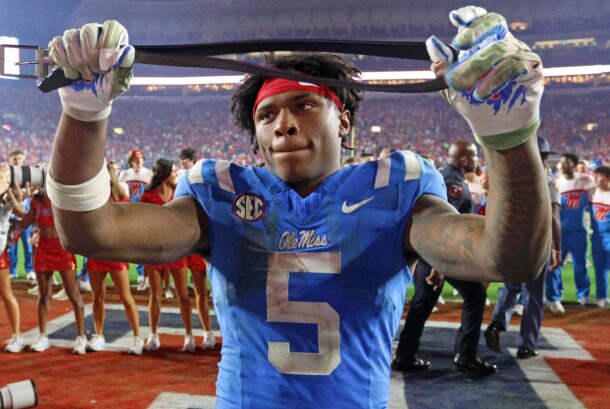
4. Kewan Lacy, Ole Miss RB
Here’s a fun trivia question. Can you list all the Power Conference players who forced more missed tackles than Lacy in 2025? This is what the list looks like:
- —
Yep. It’s a blank list. Lacy led Power Conference backs with a whopping 88 missed tackles forced, and he was No. 5 in that group with 858 yards after first contact. The former Mizzou transfer was a monster for Ole Miss. He not only broke the program’s single-season record with a Power Conference-best 20 rushing scores, but he was also the first Doak Walker Award finalist in team history. If you’re looking for a reason why the 2024 squad missed out on the Playoff but the 2025 squad found a way to make the field, look no further than Lacy. In the 2nd half/overtime, he and Ahmad Hardy led Power Conference backs with 113 carries. Better yet, Lacy had 92 carries when Ole Miss led by 1-7 points. No other FBS back had more than 76 such carries.
The question is whether Lane Kiffin will poach Lacy and bring him to Baton Rouge to turn around a lifeless LSU rushing attack. Early indications suggest that Lacy isn’t tied at the hip to Kiffin, but who knows? Ole Miss reportedly hired East Carolina OC John David Baker, who ran a zone rushing attack that averaged 43 rushing attempts per game (No. 13 in FBS) in 2025. The Pirates also finished No. 14 in FBS with 31 rushing touchdowns, which will also be a selling point. Selling a likely preseason All-American on sticking around could have a major impact on what Pete Golding‘s Year 1 expectations look like.
3. Xavier Atkins, Auburn LB
Lost in the shuffle of Auburn’s 5th consecutive losing season was how many studs emerged on that defense. Keldric Faulk was the household name entering the season, but Atkins was the best player on that group after transferring from LSU. The former 5-star recruit stuffed the stat sheet. He was 4th in the SEC with 84 tackles, he led the SEC with 17 tackles for loss, he was tied for No. 3 in the conference with 9 sacks and he added 2 forced fumbles and an interception. He was a do-it-all linebacker who thrived with his first opportunity as a college starter. In just about every way imaginable, Atkins showed that you can build an entire defense around him.
Much like another defensive star that we’ll get to in a second here, Atkins has a better shot of being retained because his defensive coordinator is staying on board. Alex Golesh keeping DJ Durkin could be the difference in keeping Atkins, who could be a fit in any defense in America after his breakout season in 2025. Before that move was even announced, Atkins gave the Auburn faithful a vote of confidence.
If Auburn is home in 2025, the Tigers might boast the best returning linebacker in America.
2. DJ Pickett, LSU CB
Why do I have Pickett higher on this list than more established players like Lacy and Baugh? Two reasons. One is that a 6-5 true freshman All-American who played outside corner in the SEC has immense positional value. That’s less dependent on surroundings, and I’d argue having someone who can take away half the field has game-changing impact. There’s also the fact that Pickett won’t be draft-eligible until after the 2027 season, so you’re talking about potentially 2 years of control instead of 1 for Baugh and Lacy. Pickett’s value is off the charts after a true freshman season in which he allowed just 15 catches for 188 yards and 1 touchdown in coverage. When Pickett was targeted, quarterbacks had an NFL QB rating of 38.8, which is slightly worse than the 39.6 NFL QB rating that one would get for spiking the football every play. Mind you, that’s for someone who played 382 snaps at outside corner in Year 1 in the SEC.
Fortunately for LSU, Kiffin pulled off the remarkable feat of retaining defensive coordinator Blake Baker and secondary coach Corey Raymond. At this point, it would be a stunning development if Pickett left LSU, but he has to be included on a list like this.
1. Cam Coleman, Auburn WR
Look. I know that the accolades weren’t at the level of the guys that I had in spots 2-5 on this list, but let’s not get it twisted. That wasn’t Coleman’s fault. Anybody who has watched the electric wideout play knows that his surroundings (both the QB and the head coach) were limiting factors in his performance. He had a quarterback who refused to throw downfield, yet he still was No. 2 in the SEC with 10 catches on passes 20+ yards beyond the line of scrimmage, and he tied for the SEC lead with 11 contested catches. You simply cannot teach the things that Coleman does on a football field.
That’s not the type of skill set that ever becomes available in the transfer portal. Having someone who has done the things that Coleman has done in 2 SEC seasons would make him a 7-figure value to any program in America, even in the likely event that he’s only got 1 more season in college before heading off to the NFL. The question is whether Golesh’s offense with a new QB1 will be Coleman’s choice in his potential pre-draft season. The USF offense was No. 3 in the FBS in touchdown passes (32), and it was No. 5 in FBS with 29 completions that went for 30+ yards. Golesh can sell the fact that he called plays for Biletnikoff Award winner Jalin Hyatt at Tennessee.
It remains to be seen if Coleman will finish his career on The Plains, but Auburn hired an ideal Hugh Freeze successor to make that happen.
Wait, no DJ Lagway?
Once upon a time, Lagway probably would’ve had the No. 1 spot on a list like this without much debate. But I didn’t include him because I can’t say with confidence that he’s got a future as a solid SEC quarterback. Health is a big part of that, but the decision-making was worrisome in his Year 2 in Gainesville. Lagway had 19 turnover-worthy plays in 2025, and a 63% completion rate for someone who averaged 6.7 yards per attempt was alarming. All of that upside that we saw from Lagway as a true freshman felt like an afterthought for the vast majority of the season. Sure, maybe it was the Billy Napier offense and play-calling that held him back. But for someone who dealt with multiple injuries throughout the year, I don’t think the possibility of losing Lagway is quite as devastating as it would be for other players on this list.
If Faulkner decides that he doesn’t want to sign up for the Lagway experience in Year 1, I won’t necessarily fault him for that.
Connor O'Gara is the senior national columnist for Saturday Down South. He's a member of the Football Writers Association of America. After spending his entire life living in B1G country, he moved to the South in 2015.