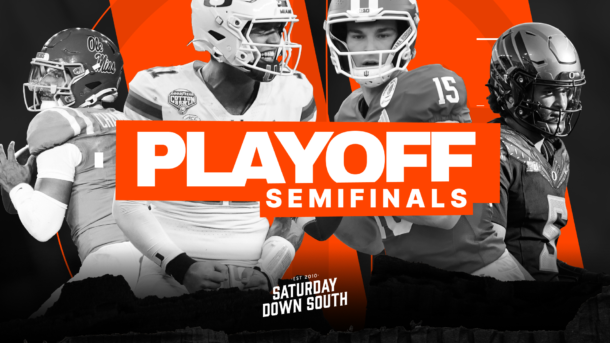
SDS’ Ultimate CFP Semifinals Preview: Everything you need to know about Miami vs Ole Miss, Oregon vs Indiana

By Matt Hinton
Published:
Breaking down the semifinal matchups in the College Football Playoff. Matt Hinton is 5-3 ATS in the Playoff. A bold • denotes his pick in the semifinals.
Everybody has their pet complaints about the College Football Playoff, from which teams are in the field, to how many of them are, to who picked them and how. We’ve heard ’em all, and surely will again this time next year. For now, though, you gotta hand it to them: The boys are absolutely settling this thing on the field, and nobody knows exactly what’s going to play out.
Consider how different this postseason would look in any previous era, and how meager by comparison.
Of the 4 teams left standing, only 1 — undefeated, top-ranked Indiana, still an incredible sequence of words to type — would have had any standing in any other format. In fact, with a Big Ten title, 14-0 record, and blowout victory in the Rose Bowl under their belt, the Hoosiers have already accomplished more than most of the teams that have ever laid claim to the “national championship” over the past century.
All that means in 2026 is that they still have the opportunity to win two more before they’re eligible to join the club.
As for the other 3, as recently as 2 years ago Miami, Ole Miss and Oregon all would have been left out of the championship equation entirely, relegated to a consolation bowl without even much of an argument.
No combination of polls, rigged algorithms, or committee deliberations could have ever delivered this exact set of circumstances, or would have aspired to. The only process that could is the one we should have had a long time ago, and they we’re blessed to have at last: Playing the damn games. …
Fiesta Bowl: Miami (-3.5) vs. Ole Miss
Kickoff: 7:30 pm ET, Thursday night, Jan. 8 (ESPN).
When Miami Has the Ball
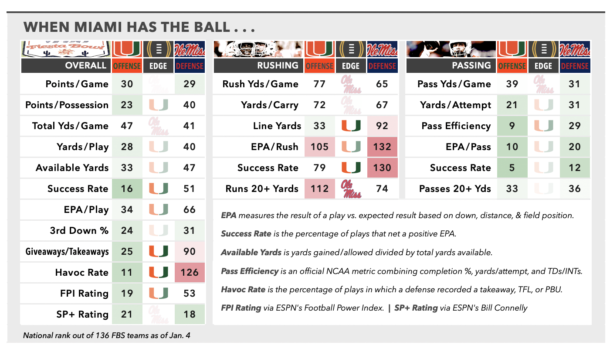
The last time Carson Beck faced an Ole Miss defense, he was beaten to a pulp. That was a little more than a year ago, in November 2024, on the worst afternoon of Beck’s tenure as QB1 at Georgia — a 28-10 mugging in which the Rebels sacked him 5 times, hounded him into a pair of turnovers, and announced their arrival as a Playoff-caliber program. In retrospect, it was also the beginning of the end of the Beck era in Athens. A month later, he was in the portal with a busted shoulder.
Eye-watering salary aside, Beck is essentially the same quarterback at Miami that SEC fans remember from his days at UGA: Highly efficient, not very mobile, and fully capable of going on a random interception spree without warning. The one thing he definitely is not this time around is a sitting duck. Per Pro Football Focus, he’s been the best protected quarterback in America, even more so than he ever was at Georgia, facing pressure on just 15.8% of his total drop-backs this season. That’s not just the lowest rate in the FBS in 2025; it’s tied for the lowest rate of any power conference quarterback over a full season in the PFF database dating to 2014, matched only by Oregon’s Bo Nix in 2023.
Like Nix at the end of his far-flung college career, at this point Beck is a well-seasoned, 5th-year vet with 41 career starts who is largely responsible for his own self-preservation. His average time to throw this season was just 2.35 seconds, 2nd-fastest in the FBS, and his attempts were twice as likely to land behind the line of scrimmage (25.8%) as they were 20+ yards downfield (12.8%). But he has also had the luxury of a surrounding cast that makes life in the pocket a lot easier. Massive junior tackle Francis Mauigoa, a consensus All-American, was on the short list of the best protectors in the country and is poised to be the first o-lineman off the board in April. Three of Miami’s other 4 starters up front have yet to allow a sack, per PFF. Meanwhile, the guy on the receiving end of most of those short throws, dynamic freshman Malachi Toney, is the rare YAC specialist who makes the horizontal stuff worth it; he forced more missed tackles (31) and accounted for more yards after catch (664) than any other Power 4 receiver.
The biggest difference between Thursday night and the ambush in Oxford 14 months ago is on the other side of the ball. Five of the top 6 pass rushers from Ole Miss’ dominant 2024 defensive front left for the NFL, resulting in a decline that was as steep as it was predictable. Last year, the Rebels averaged an FBS-best 4.0 sacks per game and had 4 starters with a PFF pass rush grade of 75 or higher. This year, they’ve averaged just 2.1 sacks per game, tied for 48th nationally, and don’t have a single player with a 75+ pass-rushing grade.
They plummeted from 3rd nationally in havoc rate to 126th. The only notable holdover, junior Suntarine Perkins, shifted into a more conventional linebacker role that has called on him to drop into coverage more than he’s rushed the passer. (Perkins did have a key sack late in the Rebels’ Sugar Bowl win over Georgia, taking advantage of evident confusion along the Bulldogs o-line to arrive free in the backfield on a crucial 4th-down attempt; that was just his 3rd sack of the year, down from a team-high 11 in 2024.) The most productive rusher off the edge, Nebraska transfer Princewill Umanmielen, has run hot and cold. And the most versatile, blue-chip sophomore Kam Franklin, was listed as questionable on the initial injury report.
Then again, even this late stage of his career, Beck doesn’t necessarily need to be under extreme duress to be baited into mistakes. Twenty of his 28 interceptions over the past 3 seasons have come from clean pockets, including 7 of his 10 INTs this year — and 3 of the 4 picks he threw in a midseason meltdown against Louisville. He was not picked in either of Miami’s previous CFP wins over Texas A&M and Ohio State, but didn’t do much to move the needle in those games, either, throwing for a combined 241 yards on just 5.4 yards per attempt. For his part, Ole Miss coach Pete Golding has been reluctant to dial up the aggression, with the blitz rate rarely eclipsing 20% in any game. (It was exactly 20% in the Sugar Bowl; in the 2024 romp that put Beck in the crosshairs, it was just over 15%.) As long as the Rebels can hold up against the run and keep the lid on in the secondary, there’s a decent chance the rest will continue to fall into place.
Key matchup: Miami OL James Brockermeyer vs. Ole Miss DL Will Echoles
Brockermeyer, an undersized, 5th-year journeyman with previous stops at Alabama (2021-23) and TCU (2024), might be the least-heralded member of Miami’s o-line, at least as far as the scouts are concerned. As the starting center, though, he’s been pivotal to the unit’s success — literally and figuratively. As a pass blocker, he hasn’t allowed a sack all year, or so much as a pressure in the past 4 games. As a run blocker, he’s been one of the unsung grunts of the Playoff run: Per PFF’s charting, the lion’s share of workhorse RB Mark Fletcher Jr.‘s output in the wins over Texas A&M and Miami came on runs between the guards in both games. Cue up Fletcher’s sizzle reel, and you’ll find No. 52 putting in work.
Brockermeyer will have his hands full with Echoles, a 310-pound sophomore who came on strong over the second half of the season as a classic B-gap plugger. In the end, he led all SEC interior d-linemen in sacks (5), tackles for loss (11) and stops (33), earning a first-team all-conference nod from the media in his first season as a starter. (As well as from me.) Between Echoles and the massive Zxavian Harris, size in the middle of the line is certainly not an issue. Consistency, on the other hand, remains a work in progress. The dirty work in the trenches will go a long way toward dictating how much of the offense winds up on Beck’s plate.
When Ole Miss Has the Ball
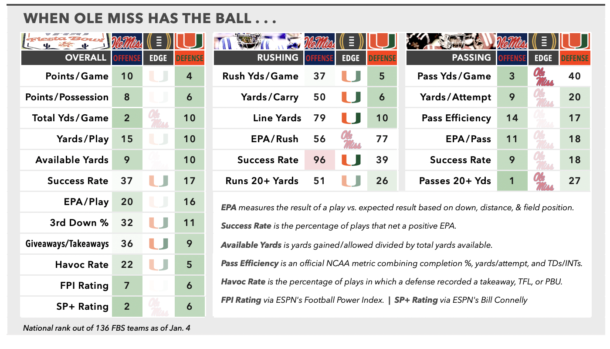
Speculation in the lead-up to this game has mainly concerned Ole Miss’ coaches — specifically, which members of the staff who followed Lane Kiffin to LSU are going to be oh-so-graciously allowed to pull double duty while the Rebels’ Playoff run remains a going concern. And sure, it’s nice to know that offensive coordinator Charlie Weis Jr. remains on the headset. But let’s be real here. There is only question that matters when Ole Miss has the ball, and it has nothing to do with who’s in the press box or standing on the sideline: Can the Rebels block Rueben Bain Jr. and Akheem Mesidor?
Can anyone in college football? So far, the answer is a definitive NOPE.
Ohio State couldn’t block them in the quarterfinals. Texas A&M couldn’t block them in Round 1. The ACC couldn’t block them throughout the regular season. Florida most definitely couldn’t block them when the Gators visited Miami in September. Notre Dame couldn’t block them all the way back in the season-opener, the ghost of which haunted the Irish all the way to the end. More than any other factor, the combination of Bain and Mesidor is the reason the Hurricanes are in the bracket to begin with, the reason they have advanced despite a couple of thoroughly mediocre outings on offense in the first 2 rounds, and the reason they have a fighting chance to win it all.
Let’s just focus on the Playoff wins over the Buckeyes and Aggies. Between them, Bain and Mesidor combined for an outrageous 33 QB pressures, 8 sacks and 9 tackles for loss, thoroughly wrecking 2 of the most explosive offenses in the country in the process. (Bain also blocked a field goal attempt in College Station, for good measure.) Texas A&M never found the end zone, finishing with season-lows for points (3), yards (326) and yards per play (4.4) while committing 3 turnovers. Ohio State didn’t fare much better, managing just 14 points to go with a season-low 129.7 passer rating for QB prodigy Julian Sayin and the worst rushing total of Ryan Day’s tenure (45 yards, including negative yardage on sacks).
Ole Miss’ offensive line is a perfectly cromulent group, but there are no sleights of hand when it comes to winning 1-on-1 against a couple of future NFL first-rounders. One thing the Rebels do have going for them, of course, is the creativity of quarterback Trinidad Chambliss, whose instincts for self-preservation take a wildly different (and far more entertaining) form than Beck’s. Ole Miss’ offense is also designed around a lot of quick-hitters and RPOs that emphasize getting the ball out of the QB’s hands quickly. But Chambliss’ elusiveness under pressure is a wild card that’s difficult to account for. His MVP turn against Georgia in the Sugar Bowl was all the more compelling because he pulled it off largely in Backyard Mode, at one point effectively engineering a 75-yard touchdown drive in the 4th quarter by the seat of his pants.
It will not surprise you that Chambliss is PFF’s top-graded quarterback nationally on pressured drop-backs. The caveat is that there just weren’t that many of them: Ironically, only Beck was pressured at a lower rate this season. Although it seemed like more, Chambliss was under duress on just 8 of his 46 drop-backs in the Sugar Bowl, instead inflicting the vast majority of his damage from clean pockets. If there’s any QB in the college game you want ad-libbing with the likes of Bain and Mesidor are bearing down, Chambliss might be the pick in a pinch. But there are only so many rabbits in the hat.
Key matchup: Ole Miss WR De’Zhaun Stribling vs. Miami DB OJ Frederique Jr.
Facing a gotta-have-it situation with the clock ticking down at the end of the Sugar Bowl, Chambliss looked to Stribling, the most seasoned player on the team with 2,961 career D-I snaps at 3 different schools. He responded with a 40-yard reception against press man coverage, setting up the game-winning field goal. That capped Stribling’s best night as a Rebel, establishing season highs for both catches (7) and yards (122) at the biggest possible moment.
Although he lined up in the slot on that play, the 6-2, 210-pound Stribling spends most of his time on the outside, where Frederique, a Freshman All-American in 2024, has only recently returned to the lineup after missing the back half of the regular season with an undisclosed injury. Miami’s first-round win at Texas A&M was Frederique’s first game back since late October, and looked like it: The Aggies completed 4-of-4 targets at his expense for 86 yards, including their only big play of the day, a 59-yard strike from Marcel Reed to Mario Craver. Frederique fared slightly better against Ohio State, giving up a couple of first-down completions to Jeremiah Smith and Carnell Tate but nothing egregious. If you can survive opposite Smith and Tate, you can survive anything. And against an Ole Miss offense that is never shy about testing opposing corners, “anything” is exactly what he should be prepared for.
Special teams, injuries and other vagaries
When Ole Miss swiped kicker Lucas Carneiro in the portal last winter, it was primarily for his range: At his last stop, Western Kentucky, he was a perfect 6-for-6 on attempts of 50+ yards in 2024. As of midnight on Jan. 1, he’d hit just once from long range as a Rebel, on 2 tries. But the investment in his leg paid off when they needed it most. Against Georgia, Carneiro broke the Sugar Bowl record for distance twice in the span of a few minutes, following up a 55-yarder with a 56-yarder on consecutive possessions in the first quarter. (Both would have good from well beyond 60, easily.) Later, he capped a career night by burying the game-winner from 47 yards out in the waning seconds, cementing one of the outstanding kicking performances of the season. With that, Carneiro improved to 27-for-30 for the year, tied for the FBS lead in successful kicks.
Miami kicker Carter Davis had the opposite experience in the ‘Canes’ first-round win at Texas A&M, missing 3-of-4 field-goal attempts in heavy winds. Indoors, he should be fine. Davis hit his only attempt against Ohio State from 49 yards, improving to 15-for-17 on the year when not being mocked by the trickster wind god Aeolus.
Miami’s Malachi Toney might be the most dangerous punt returner in the country who somehow didn’t actually return one for a touchdown. He came close, breaking off 3 returns of 40+ yards, including a 55-yarder at Texas A&M that looked like a house call until he tripped himself in the process of high-stepping out of a tackle in the open field. Anytime he’s back there, Toney is designated “Do Not Kick It to Him Under Any Circumstances” for the rest of his career, regardless of whether he ever manages to take one back in that capacity.
The respective depth charts are about as healthy and intact as it gets this time of year. Only 1 starter on either side appeared on the initial injury report: Ole Miss DL Kam Franklin, who was listed as “questionable” with an undisclosed injury. That would be a significant loss, given Franklin’s inside/out versatility; he’s 2nd on the team in QB pressures (45) and sacks (5) while splitting reps between the edge and the interior, a dual role the Rebels don’t really ask anyone else on the front to play on a regular basis. Meanwhile, of the dozen or so players on both teams who have already entered their names in the portal, the most recognizable, Ole Miss QB1-turned-backup Austin Simmons, will remain available for the rest of the Rebels’ Playoff run before shipping out to compete for the starting job at Missouri.
Bottom line … and prediction
At this point, the ongoing drama surrounding the comings and goings of Ole Miss’ coaching staff probably has more impact in the headlines than it does on the field. By Game 15, the hay is in the barn, as they say. Golding represents stability at the top, Charlie Weis Jr. supplies continuity as the offensive play-caller, and Joe Judge is on hand to do whatever it is he does. As for the players, though, they’ve been together for a full year now. They know the schemes, they know each other, they know the drill. They didn’t beat Georgia because Golding is a motivational genius. Get them to the stadium on time, and they should be able to handle most of the rest themselves.
If only handling Bain and Mesidor along the line of scrimmage was that simple.
One name I haven’t mentioned yet is All-SEC running back Kewan Lacy, who had a significant role in the Sugar Bowl despite some doubts about his availability due to a shoulder injury he suffered in the Rebels’ first-round win over Tulane; if nothing else, a viable ground game can prevent Miami’s pass rush from pinning its ears back. At some point, though, Ole Miss is going to have to actually block those guys when they know Chambliss is going to put the ball in the air, and based on how the Canes’ past 2 games have unfolded, that is strictly a “believe it when you see it” proposition.
Prediction: • Miami 29 | Ole Miss 24

• • •
Peach Bowl: Indiana (-3.5) vs. Oregon
Kickoff: 7:30 pm ET, Friday night, Jan. 9 (ESPN).
When Indiana Has the Ball
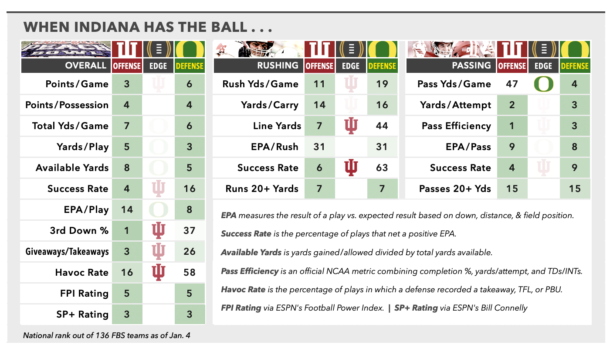
If you hadn’t seen much of Indiana prior to the Rose Bowl, you could be forgiven for assuming the offense was the Fernando Mendoza Show. Not anymore. Instead, the Hoosiers took advantage of their biggest stage ever to make a statement in the trenches, bullying Bama in exactly the kind of old-school, line-of-scrimmage romp the Crimson Tide used to inflict rather than endure. Indiana kept the ball on the ground on 43 of its 66 offensive snaps (excluding sacks and scrambles); interchangeable backs Roman Hemby and Kaelon Black combined for 188 yards on 5.7 per carry; and an offensive lineman, 5th-year center Pat Coogan, repped the entire unit as the game’s MVP, a fitting distinction. Visibly demoralized, the Tide waved the white flag at the end of the 3rd quarter, settling for the saddest field goal in Alabama history to cut a 24-0 margin to 24-3, and spent the 4th getting shoved around at will.
The Hoosiers’ success up front meant ideal conditions for Mendoza, the Heisman winner whose role in Pasadena was less leading man than designated sniper. Although he only attempted 16 passes, the results were ruthlessly efficient, yielding 14 completions, 12.0 yards per attempt, 10 first downs, 3 touchdowns to 3 different receivers, and an astronomical 250.2 passer rating. He was 4-for-4 passing on attempts of 20+ air yards, 9-for-10 when blitzed, and 5-for-6 on 3rd down, all of which moved the sticks. He converted 2 more 3rd downs on scrambles. Pound for pound, it was as convincing a vindication for Mendoza’s surging stock as he could have mustered while still coming in a tick under 200 yards passing.
“Force the Heisman Trophy winner to beat you with his arm” is not exactly a foolproof key to victory, but at a bare minimum Oregon cannot allow Mendoza to operate with that much cushion again. If there is a blueprint to beating Indiana, making the offense one-dimensional is as good a place as any to start. And it can be done, more or less.
Only 4 of the Hoosiers’ 14 wins this season have been decided by 10 points or less, but 1 thing the close ones had in common was tough sledding on the ground: The Hoosiers ended all 4 of those games — nail-biters against Iowa, Oregon, Penn State, and Ohio State — with less than 120 yards rushing (including sacks) on less than 3.5 yards per carry. By contrast, when they’ve run for 200+ yards, their average margin of victory is a staggering 41 points, and start-to-finish blowouts over Bama and then-ranked Illinois back in September are evidence enough that that trend was not confined to the bottom half of the schedule.
On paper, the Ducks match up as well as any defense Indiana has faced other than Ohio State’s. They’re coming off a shutout win over Texas Tech in the Orange Bowl, and the tale of the tape reflects a couple of units that are virtually dead even over the course of the season, both in the conventional stats as well as in advanced metrics like SP+, FPI, and FEI. The first time these teams met, a 30-20 Indiana win in Eugene in mid-October, Oregon more than held its own, limiting the Hoosiers to season-lows for total yards (326), yards per play (4.8), and 3rd-down conversions (35.7%). Memorably, the Ducks also harassed Mendoza into his only really costly mistake all year, a pick-6 interception under duress that briefly evened the score at 20 early in the 4th quarter.
Of course, even when they’ve succeeded in making him look average for the better part of 60 minutes or painting him into a corner, the one thing no one has managed to do yet is get Mendoza off the field with the game on the line. Following the pick-6 at Oregon, he responded on the ensuing drive by connecting on 6-of-8 passes for 62 yards, including the go-ahead touchdown to his go-to target in the red zone, Elijah Sarratt. That was a re-run from the previous Saturday at Iowa, when Mendoza rebounded from a late, potentially crippling INT in a tie game against the Hawkeyes to find Sarratt for the game-winner in the final 2 minutes. And it foreshadowed the pivotal moment of the Hoosiers’ regular season, a 10-play, 80-yard drive (actually 87 yards, factoring in a sack on the first play) to fend off an upset bid at Penn State, all of it coming via Mendoza’s arm.
Still, Mendoza with his back against the wall in a do-or-die situation is vastly preferable to the alternative, which up to now has been Mendoza casually putting the torch to defenses that have been softened up by the ground game, if not outright pounded into submission.
From Indiana’s perspective, the fewer balls he puts in the air, the better. It doesn’t always work out quite that neatly for the other side — see Mendoza’s near-flawless outings against Michigan State and Wisconsin without his usual run support in either game — but when the Hoosiers win the line of scrimmage they have been unstoppable.
Key matchup: Indiana WR Charlie Becker vs. Oregon CB Brandon Finney Jr.
Becker spent the first half of the season as just another random sophomore relegated to garbage time. When his number came up down the stretch, he seized the opportunity. Since the calendar turned to November, he’s hauled in 22 receptions (8 of which have fallen under the “contested catch” column, per PFF) for a team-high 461 yards, an average of nearly 21 yards per catch. That stretch includes 100-yard outings against Penn State, Wisconsin and Ohio State; Indiana’s first touchdown in the Rose Bowl; and at least 1 gain of 30+ yards in 5 of the past 6 games. It’s no exaggeration to say Becker has emerged as Mendoza’s favorite downfield target, which in the same rotation as a couple of second-team All-Big Ten picks, Sarratt and Omar Cooper Jr., is no minor feat.
Finney, a true freshman, has been a revelation in his first year on campus, although it didn’t take him nearly as long to appear on the radar. A Day 1 starter in August, he came in for second-team All-B1G honors after holding opposing QBs to a league-best 36.2% completion rate for the season, per PFF, which also cites him for zero touchdowns allowed in coverage. He made a splash in the first meeting against Indiana in Eugene, where he allowed just 1 reception on 4 targets and accounted for the pick-6 INT that kept the Ducks in the game in the second half (see above). More recently, Finney introduced himself to a national audience in the Orange Bowl win over Texas Tech, leading the highlight reel against the Red Raiders with 2 interceptions and a fumble recovery. Listed at a sturdy 6-2, 203 pounds, he’s ideally suited to post up opposite the lanky, 6-4 Becker, who barely saw the field on offense back in October. Whether Indiana bothers to put him to the test after the last time around is another story.
When Oregon Has the Ball
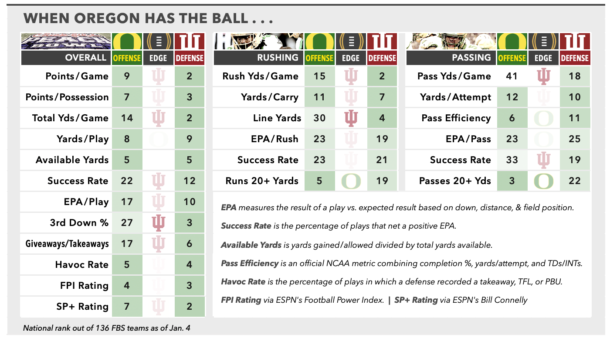
An essential part of mock draft season is settling on the pitch-perfect comparison between a rising prospect and a current pro. For Oregon QB Dante Moore, the go-to comp is former Ohio State/current Houston Texans quarterback CJ Stroud, for obvious reasons. They arrived on campus with similar hype, look similar in uniform and boast a similar skill set. Like Stroud, Moore is considered a “natural” passer with impeccably smooth mechanics when it all comes together. They throw a similarly graceful deep ball; Moore is PFF’s highest-graded passer nationally on attempts of 20+ air yards, with an FBS-best 14 touchdowns and a 62.7% adjusted completion percentage on downfield shots. (Adjusted completion percentage credits the quarterback for an accurate throw on dropped passes.) Also like Stroud, he’s proven to be a surprisingly reluctant runner with more dual-threat potential than his modest rushing stats let on.
In that vein, Moore reminds me of the college version of Stroud in another way: The alarming decline in his performance under pressure. When I wrote about Stroud ahead of his lone CFP appearance a few years back — also in the Peach Bowl, coincidentally — I compared him to a finely tuned sports car that’s not built to hold up in everyday traffic. The nagging doubts about Moore’s game fall along the same lines.
To be fair, no quarterback is immune from pressure. And in Moore’s case, the drop-off under duress is not as dramatic as Stroud’s at Ohio State. But it’s notable enough. From clean pockets, Moore ranks 3rd nationally with a 94.1 PFF grade (trailing only Heisman finalists Diego Pavia and Julian Sayin), and No. 1 with 27 “big time throws,” defined as “a pass with excellent ball location and timing, generally thrown further down the field and/or into a tighter window.” Under pressure, he falls to 51st nationally with a 53.5 grade, and with fewer BTTs (2) than INTs (3). For context, another guy with a roughly comparable gap on clean/pressured drop-backs is Alabama’s Ty Simpson, last seen wilting in the face of Indiana’s pass rush before bowing out of the Rose Bowl with a cracked rib.
The point is worth dwelling on in this matchup, specifically, because no defense has succeeded in heating up Moore more than the Hoosiers. In the first matchup, Indiana pressured Moore on 20 of his 42 drop-backs, per PFF, generating 6 sacks, 2 interceptions and a season-low 35.1 QBR rating. As a team, Oregon finished with season-lows for total yards (267), first downs (14) and points (20, including the pick-6), with its lone offensive touchdown of the game coming on a 44-yard strike from a well-protected Moore to his top wideout, Malik Benson, in the opening quarter.
That would turn out to be Moore’s only downfield completion of the game, as well as Benson’s only catch. Over the final 3 quarters, the Ducks looked increasingly like a team stuck in quicksand, until they finally stopped moving altogether.
At this point, that’s just the flat-rate Hoosier Experience.
The defense is not stocked with blue-chip specimen, future first-rounders or household names, but the week-in, week-out results speak for themselves. Like Oregon, Indiana’s other ranked opponents — Illinois, Ohio State and Alabama — also finished with season-lows on the scoreboard, managing a combined 23 points and 83 rushing yards between them. Only 1 offense to date, Penn State, reached the end zone more than once. Only Michigan State eclipsed its season average for total yards. At least the Ducks enjoyed a fleeting glimmer of success on the ground back in October before abandoning the run in the second half; now, even that seems like a long shot in the rematch with ascending freshman RB Jordon Davison on the shelf due to a broken collarbone. If there is any hope of breaking through on Friday night, it’s only by giving Moore the chance to set his feet and let it rip on a consistent basis.
Key matchup: Oregon OL Alex Harkey vs. Indiana DL Mikail Kamara
Kamara had a “disappointing” senior campaign in terms of his raw sack total, which declined from 10 sacks in 2024 to just 2 in ’25. The first came in a Week 2 blowout against Kennesaw State; it took another 4 months to record the 2nd, in the 4th quarter of the Rose Bowl. But the man did not forget how to get after the quarterback in the meantime: Per PFF, Kamara led the Big Ten for the 2nd year in a row with 54 QB pressures, despite a significant decline in pass-rushing reps as part of a deeper rotation.
He was a regular presence in the pocket in the first meeting against Oregon, leading the team-wide siege on Moore with 3 hits and 4 hurries; he also turned up the heat against Iowa (5 pressures), Penn State (8) and Alabama (6), among others. Frankly, if he were listed at 6-4 instead of 6-1, he would have already been a first-round pick, and would almost certainly still rank high in a crowded class of edge rushers coming out in 2026.
On the other side, there are no questions about the 6-6, 327-pound Harkey’s stature at right tackle. But the Texas State transfer has struggled at times with speed — most notably against Indiana, when he was singled out for a team-high 6 pressures allowed. More recently, he was also posterized on multiple occasions in the Orange Bowl by Texas Tech’s David Bailey, who picked up a sack and a holding penalty at Harkey’s expense. Of course, Bailey posterized virtually every opposing tackle he faced en route to being enshrined as a unanimous All-American. Still, as the Hoosiers are probing for weak links they know where to start. This time the onus will be on Harkey to prove he’s not it.
Special teams, injuries and other vagaries
Both teams trust their kickers, up to a point. Oregon’s spectacularly-named Atticus Sappington has connected on 33-of-39 field-goal attempts in 2 years as a Duck, including the game-winner at Iowa in wet, freezing conditions in early November. (Rest assured that even if he’d never put a single kick though the uprights, ol’ Atticus would still be bound for the All-Name Hall of Fame.) His Indiana counterpart, Nico Radicic, was a first-team All-Big Ten pick by the media after going 16-for-17 on field goals and an FBS-best 76-for-76 on PATs, but remains an unknown from long range or in the clutch; he’s yet to attempt a kick from 50+ yards or with the game on the line in his career.
Both teams have housed punts for touchdowns, although Malik Benson’s 85-yard return against USC in Week 13 is much fresher in Oregon’s mind than the Hoosiers’ entry in that column, a 91-yard house call by Jonathan Brady in the first quarter of the opener against Old Dominion. Both teams have recorded multiple blocked kicks, too, but again the Ducks have done it more recently: They rejected both a field goal and a punt in their first-round Playoff win over James Madison, returning the latter for a late, scoreboard-padding touchdown.
The injury list is short but notable. Indiana lost its most productive d-lineman, edge Stephen Daley, to a freak injury as he celebrated in the immediate aftermath of the Big Ten Championship win over Ohio State; he wasn’t missed against Alabama, but even on a front as disruptive as the Hoosiers’, there’s no magic bullet for replacing the conference leader in TFLs. As for Oregon, RB Jordon Davison’s absence comes at the worst possible time, with the depth chart having already been thinned out by the departure of 3 other scholarship backs via the portal. The Ducks still have a couple of productive options in veteran Noah Whittington and true freshman Dierre Hill Jr., but no one left behind them who has appeared in a college game.
Bottom line … and prediction
When Curt Cignetti said “it’s hard to beat a really good football team twice,” he was sending a message to his own team about complacency. But he’s right on the merits: In 6 postseason rematches involving Power 4 teams, the teams that won the first meeting are 2-4 in the second. (The exceptions: Texas Tech’s 34-7 win over BYU in the Big 12 Championship Game, and Ole Miss’ 41-10 win over Tulane in the opening round of the CFP. Notably, Ole Miss then beat Georgia in the quarterfinals after losing the regular-season game) Oregon itself was on the wrong end of a Playoff rematch last year, when it was run off the field in the Rose Bowl by the same Ohio State team the Ducks had dealt a regular-season L a few weeks before – another outcome that would have been inconceivable in any prior format. They’d love to find themselves on the right end of a revenge date this time around, and roll into the Jan. 19 championship game as favorites to win it all.
Too bad for them the team on the other side of the draw really is that good. If you’re one of the few people still looking for a reason to dismiss Indiana as some kind of fluky overachiever, it’s time to give up the ghost, man. It’s past time.
If anything, the Hoosiers’ win in Eugene in Week 7 was the opposite of a fluke: The big, momentum-altering swing play in that game, Brandon Finney’s pick-6 off Mendoza, went against them, momentarily breathing life into an Oregon comeback bid that neither the underlying stats nor the flow of the game could support. If there was ever going to be a moment when the spell was broken, that felt like it. Instead, Indiana brushed it off, cruised to a convincing road win, and has passed every subsequent test on its way to No. 1. The beatdown in the Rose Bowl only confirmed what should have already been obvious: The title is the Hoosiers’ to lose. If not for the logo on the helmet, there wouldn’t be anyone left to convince.
Prediction: • Indiana 27 | Oregon 21

• • •
Scoreboard
Quarterfinals Record: 2-2 straight-up | 1-3 vs. spread
- Playoff Record: 6-2 straight-up | 5-3 vs. spread
Season Record: 112-25 straight-up | 64-63 vs. spread
Matt Hinton, author of 'Monday Down South' and our resident QB guru, has previously written for Dr. Saturday, CBS and Grantland.