Ultimate SEC Championship Preview: Can Kirby Smart solve his Alabama curse?

By Matt Hinton
Published:
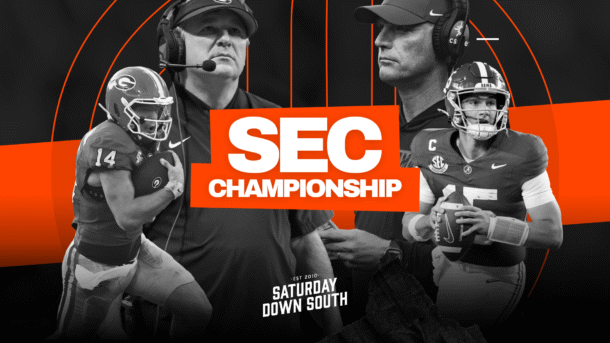
Everything — and we mean everything — you need to know about Saturday’s SEC Championship Game showdown between Alabama and Georgia.
It’s a little bit ironic, isn’t it? In a season defined by unprecedented parity, razor-thin margins, and the rapidly shrinking gap between the league’s traditional heavyweights and the nouveau riche, who’s left standing in the end? Of course, it’s Bama and Georgia.
Oh, did you really think it was going to break any other way? Texas A&M and Ole Miss were so close to crashing the party. Are you new around these parts? The days when the Tide or Dawgs (or both) could confidently book their trip to Atlanta in mid-October might be firmly in the past. But they still boast 2 of the deepest, most stacked rosters in the college game, and if the results these days occasionally feel more like a lucky roll of the dice than outright dominance, well, the dice are still weighted toward top-end talent. That is one aspect of this matchup you can rest assured has not changed.
Twelve games in, Georgia is a bit of an enigma. In fact, you might as well extend that timeline back to last year, when a decidedly mortal UGA outfit managed to claim its 3rd conference title under Kirby Smart despite 2 regular-season losses and a litany of close calls along the way. The ’25 team is similarly nondescript. Again, the Bulldogs are solid across the board, but not elite or necessarily even all that consistent in any particular area.
If they have a defining quality, it’s their ability to absorb an initial blow and adjust to the type of game they find themselves in on any given Saturday. They’ve trailed at some point in 7 of their 8 wins vs. Power 4 opponents, and in the 4th quarter in 3 of them. The offense has risen to the occasion in shootouts (Tennessee, Ole Miss), and the defense has held up its end in slugfests (Auburn, Georgia Tech). Their most complete outing against a worthy opponent, a 35-10 win over Texas in Week 12, was a 14-10 game at the end of 3 quarters before Georgia pulled away in the 4th. QB Gunner Stockton has delivered when they’ve really needed him to, and been content to putter along in game-manager mode the rest of the time; no individual skill player ranks in the top 10 in the SEC in yards from scrimmage, with only RB Nate Frazier cracking the top 30; the once-formidable pass rush, strangely dormant over the first 2 months of the season, only began to flash its potential in November. While the rest of us have waiting for a glimpse of the finished product, the Dawgs have made a living of figuring it out as they’ve gone along.
Lord knows Alabama hasn’t been living any less dangerously. At least Crimson Tide games have followed a more or less identifiable script. In SEC play, Bama is outscoring opponents by exactly a touchdown per game, 26.1 to 19.1, and every conference game has fallen roughly within the margin of error of that exact score. Excluding a pick-6 touchdown against Tennessee, the offense has accounted for somewhere between 20 and 30 points in all 8 SEC games, while the defense has allowed between 14 and 24 points in every game except a 20-9 win over LSU in Week 11.
Not coincidentally, the only blemish on the conference slate, a 23-21 loss to Oklahoma in Week 12, is the only one in which the biggest swing plays swung against them. Alabama was minus-3 in turnover margin against the Sooners, the giveaways leading directly to 17 of OU’s 23 points. In every other SEC game they’ve been even or in the black.
Unlike Georgia, whose Playoff status is secure either way, Alabama is squarely on the bubble with a loss. The committee demonstrated last year that it is not inclined to punish the loser of a conference championship game to the benefit of a team that was watching from home: Texas and Penn State dropped just 1 slot apiece in the weekly CFP rankings following competitive losses in the SEC and Big Ten title games, respectively, and SMU dropped only 2 spots after its last-second loss in the ACC Championship, preserving the Mustangs’ place as the final at-large team in the field over a gang of fuming 3-loss teams from the SEC. This year, however, Bama has no margin for error.
As it stands, the Crimson Tide are No. 9 in the latest CFP rankings, jumping Notre Dame for, uh, reasons this week after narrowly escaping their biennial upset bid at Auburn. The Tide had spent the previous 2 weeks behind the Irish (who have won 10 in a row) on the heels of the Oklahoma loss. The distinction is crucial, because the way the bracket is shaping up, the top 10 is the cutoff for at-large bids: With 2 slots reserved for lower-ranked conference champs, the team that occupies the No. 10 position in the final rankings will claim the last at-large ticket.
What will it take for Alabama to remain on the right side of that line? If the Tide win, of course, they’ll vault in the pecking order and claim the SEC’s automatic bid, relegating Georgia to an at-large. The only question then is whether they’ll rise high enough to secure a first-round bye. On the other hand, a loss that drops them to 10-3 would give the committee cover to make any move it felt justified to make. Bama’s opening-day flop at Florida State only looks worse in hindsight and remains arguably the worst loss of any team on the bubble. BYU, currently ranked No. 11 with an 11-1 record, can punch its ticket with an upset over Texas Tech in the Big 12 Championship Game, knocking the Red Raiders into the at-large pool and the Tide out. If Bama and BYU both lose on Saturday, it would leave the lane wide open for the committee to elevate No. 12 Miami to No. 10, thereby avoiding the looming controversy between the Hurricanes and Notre Dame altogether by ushering them both in.
Point being, the committee is under no obligation to defer to Alabama, as a brand or as the ostensible top seed in the SEC Championship Game. They still might – it’s a powerful brand, and a convincing enough performance even in defeat against Georgia could be enough to hold off the teams nipping at their heels. Given the contentious state of CFP politics at large, the prospect of bouncing one half of the SEC title game from the field at the eleventh hour is a can of worms they’d surely be reluctant to open. But, just like last year, at the end of the day the Tide have no one to blame for their predicament but themselves. Their résumé includes an albatross of a loss at FSU; another loss in a game that, on paper, they had no business losing against Oklahoma; and multiple close, sloppy wins over sub-.500 opponents. At no point have they inspired visions of a vintage Bama outfit at its inevitable best.
Still, here they are, all of their goals intact and in control of their fate. Nobody knows what the committee is inclined to do, but there is still one sure-fire way to erase all doubt: Win Saturday, and take the decision out of the committee’s hands.
When Alabama has the ball
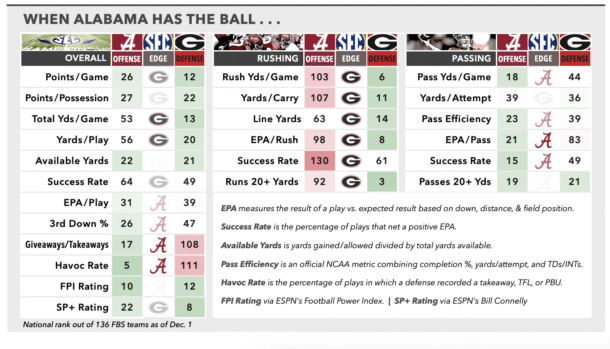
Can Ty Simpson thread the needle again? Simpson was the indisputable MVP of Bama’s September win in Athens. At that point, the Tide were still less than a month removed from the debacle in Tallahassee, and had yet to wash off the stink of that game despite a string of blowout wins over scrubbier opponents in the meantime. By halftime against the Bulldogs, Simpson had the whiff of a first-rounder. Operating from consistently clean pockets (see below), he put on an exhibition of precision passing, carving up UGA’s secondary for 192 yards, 6 3rd-down conversions and 2 touchdowns in the first half alone. He added a 3rd touchdown as a runner en route to a 24-14 halftime lead.
In hindsight, that pristine first half might have been the high-water mark of Simpson’s season. (At least, so far.) Alabama held on to win despite putting up a goose egg on the scoreboard in the second half, eventually converting an outrageous 13-of-19 3rd-down attempts in the process of draining the clock. Since, Simpson has lived just this side of the border between good and great while rarely crossing it. A Heisman frontrunner throughout October, his stock steadily declined in November along with his efficiency. He struggled with downfield accuracy in a defensively-driven win over LSU; committed two costly turnovers under duress in the loss to Oklahoma, including a pick-six; and averaged just 3.5 yards per attempt in a skin-of-the-teeth escape against Auburn, a season-low by a mile. Across all three games, he turned in a mediocre 128.0 passer rating and connected on just 5-of-17 on attempts on 20+ air yards.
Meanwhile, Georgia has not been nearly as vulnerable on the back end. The secondary was a pressing concern coming out of the first Bama game, especially coming on the heels of an even more flammable outing at Tennessee in Week 3. In 8 games since, the Bulldogs have allowed 5 touchdown passes and 6.0 yards per attempt, good for a 113.2 efficiency rating — a standard-issue number for a typical Kirby Smart defense. Opposing quarterbacks in those games (including Ole Miss’ Trinidad Chambliss, Texas’ Arch Manning and Georgia Tech’s Haynes King) are 7-for-34 on attempts on 20+ air yards.
Given time, Simpson has already proven his ability to keep the sticks moving against this defense once. If the Bulldogs can keep the lid on, though, it will be a serious test of his decision making and accuracy to do it twice. Without the benefit of an explosive play or two, that’s a lot of pressure for one arm to bear.
Can Georgia turn up the heat? Simpson owed much of his success in the first meeting to his protection. Per the film eaters at Pro Football Focus, he enjoyed pristine pockets more or less from start to finish, facing pressure on just 9 of his 41 drop-backs. The Bulldogs barely laid a hand on him, finishing with zero sacks and only 4 hits. (They were technically credited with a sack, but it came on a trick play that resulted in WR Germie Bernard getting dropped behind the line, not Simpson.) Bama’s o-line, much maligned after the opener, played about as well as it could play in one of the toughest environments in the sport.
But getting to the quarterback has been an issue for Georgia all season. The Bulldogs rank 111th nationally in havoc rate and 116th in sacks, dead last in the SEC and on pace for the lowest sack total in Smart’s tenure, by far. The team’s most productive pass rushers for the season — CJ Allen, Chris Cole and Raylen Wilson — are all off-ball linebackers who generate pressure primarily as blitzers and spies when the QB exits the pocket. Despite the usual abundance of blue-chip talent up front, no Georgia edge rusher or d-lineman has more than one sack to his credit.
The encouraging news (unless you’re an opposing quarterback) is a notable uptick in pressure rates over the past few weeks. The Bulldogs finished with 3 sacks in a Week 11 win at Mississippi State, a season high, and matched that number the following week against Texas, pressuring Manning on 41.3% of his drop-backs, per PFF. Last week, King was under duress of 44.8% of his attempts, going down once. Junior edge rusher Gabe Harris Jr., a nonentity for the first 2 months, had a dozen QB pressures in November; hyped freshman Elijah Griffin, a freakish interior DL in the Travon Walker mold, had 11 — 5 of them coming in a breakout game against Texas. Griffin recorded his first career sack in Week 13 against Charlotte.
Blitzing Simpson did not work in the first meeting: Georgia sent extra rushers on nearly 50% of his drop-backs, per PFF, with little to show for it except a couple of touchdown passes at their own expense. But beating the blitz has not necessarily been a strength throughout the season. Both of Simpson’s killer turnovers in the Oklahoma game were the result of a zone blitz look that he said later he failed to recognize pre-snap and his o-line failed to pick up. And Bama’s running backs have been sketchy in protection, with PFF citing them for a combined 16 pressures and 8 sacks allowed (!) as a group. One way or another, the Dawgs cannot allow Simpson the luxury of a clean pocket from which to pick them apart again.
Can Alabama run the ball at all? Bama’s ground game has been a sorry state of affairs. The Tide rank 100th or worse nationally in rushing yards per game (103), yards per carry (107), EPA per rush (98), and rushing success rate, where they come in a dismal 130th out of 136 FBS teams. (At least they’re not quite as bad as LSU, at No. 133.) Their longest “rushing” play in the first meeting against Georgia was a backward pass to an offensive lineman that gained 11 yards. We are a long, long way from the Nick Saban-era teams that built their offensive identity around running the ball at will.
They are coming off their best statistical outing against a real opponent in the Iron Bowl, where they ran for 177 yards (excluding sacks) on 5.1 per carry. Simpson played a bigger role than usual in that effort, running for a season-high 50 yards on seven carries. But the lion’s share of the output was courtesy of senior RB Jamarion Miller, who had one of his better games with 83 yards on 5.5 per carry. But Miller — who was already playing hurt since returning from a dislocated collarbone he suffered in August — went down in the 4th quarter and left on crutches, leaving his status for Saturday in doubt.
Backups Daniel Hill and Kevin Riley have averaged a combined 3.3 yards per carry in SEC play. Georgia’s defense has allowed 3.3 yards per carry in SEC play, 3rd-best in the league despite generating the fewest negative yards on sacks. Whatever kind of living the Tide manage to eke out to ease the burden on Simpson will go a long way.
Key matchup: Alabama WR Isaiah Horton vs. Georgia CB Daylen Everette. Horton has generally been relegated to third-wheel status in Bama’s receiving rotation behind Germie Bernard and Ryan Williams. At this point in the season, though, he might be the last fully functioning wheel left. Bernard has been less than 100% with a nagging injury; Williams was a no-show against Auburn, earning zero targets; and tight end Josh Cuevas is among the starters who will be on the shelf in Atlanta. Horton was the closest thing to a go-to receiver in the Iron Bowl, winding up on the receiving end of all three of Simpson’s touchdown passes, including the decisive score on 4th-and-game late in the 4thquarter.
Horton was also Simpson’s favorite target in the first meeting against Georgia, coming down with 5 catches for a team-high 65 yards and 1 TD. Most of that success came at the expense of Everette, whom PFF cited as the cover man on 3 of Horton’s 5 catches; all 3 went for first downs, including the touchdown, resulting in a season-low 48.0 coverage grade. That’s one of three scoring passes Everette has allowed in what has been a mildly disappointing senior campaign. A lockdown effort on Saturday would come at exactly the right time for both his team and his stock.
When Georgia has the ball
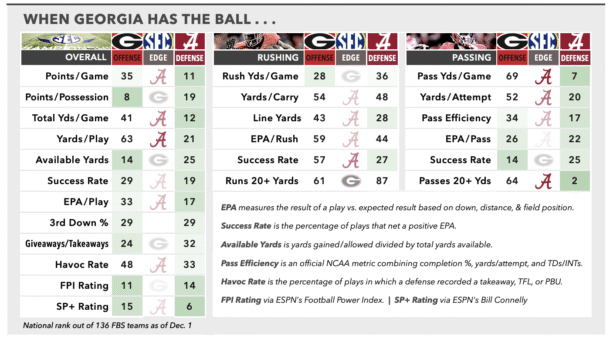
Can Georgia run the dang ball? The first time, the answer was yes. The Dawgs piled up 231 yards rushing (excluding sacks) on 7.5 per carry. Even subtracting the long gain, a 43-yard run by WR Dillon Bell on an end around, the Dawgs broadly won the matchup between the tackles. The headliner of that game was redshirt freshman Chauncey Bowens, a standard-issue, 225-pound Georgia thumper who popped off against the Tide for 119 yards on a dozen carries. If it hadn’t come in a losing effort, it was the kind of breakout night that might have briefly made him a household name across the league.
Bowens hasn’t disappeared from the rotation, but he has taken a backseat down the stretch to sophomore Nate Frazier, who spent most of the September meeting on the bench following a 2nd-quarter fumble that set up an Alabama field goal. Back in his coach’s good graces, Frazier had a big November, finishing as the team leader on the ground in each of the past 4 games; that included a career-high 181-yard outburst at Mississippi State and a 108-yard effort in last week’s win over Georgia Tech. The Bulldogs haven’t relied on a “feature back” since D’Andre Swift, but at this point it is safe to say Frazier has established himself as first among equals.
The question mark this weekend is in the middle of the offensive line. Starting center Drew Bobo (son of offensive coordinator Mike Bobo) has been ruled out for Saturday, and possibly for the rest of the season, due to a leg injury that sidelined him for the 2nd half against Tech. Prior to the injury, Bobo was the Dawgs’ highest-rated run blocker, per PFF. His replacement, redshirt freshman Malachi Oliver, struggled in relief, posting a 46.8 run-blocking grade and drawing murmurs for a number of errant snaps. (Although no disasters.) The offense immediately bogged down after Bobo’s exit, punting on 4 of its 5 2nd-half possessions and settling for a field goal on the 5th.
You can’t chalk that up entirely to the backup center. But the o-line had been enjoying a rare stretch of continuity since midseason with the return of veteran Earnest Greene III to the lineup at right tackle, and if Bobo wasn’t the most imposing member of the front, depth-wise he was probably the one the Bulldogs could least afford to lose. Oliver will be lined up on Saturday opposite Bama’s massive senior nose tackle, Tim Keenan III, who was limited in the first matchup by an ankle injury that had sidelined him up to that point. Keenan described the battle in the trenches this week as both “one for the centuries” and “the mismatch of the game.” Guess which quote got Georgia’s attention!
Can Gunner Stockton challenge Bama downfield? In 3 years since Bobo’s return as play-caller, Georgia’s offense has relied a little bit more on screen passes each season. This year, it’s among the most screen-heavy attacks in America, with nearly a 3rd of Stockton’s total attempts falling behind the line of scrimmage, per PFF. The intended receiver on most of those attempts is shifty USC transfer Zachariah Branch, who has more targets (78), receptions (68) and receiving yards (691) than any pair of teammates combined. Branch’s average depth of target: 3.3 yards.
Since we’ve never seen Stockton operating in any other system, it’s difficult to tell to what extent that’s a reflection of his skill set, as opposed to Bobo’s preference for “get it to my playmakers in space” gadgetry. Given the opportunity, though, he is certainly capable of making a defense pay for allowing one of his receivers to get a step. The week before the first meeting against Bama, with Georgia trailing at Tennessee and facing a gotta-have-it 4th down late in the game, Stockton connected with London Humphries for a touchdown on one of the prettiest throws of the year. Against Bama, he was 2-for-4 on attempts of 20+ air yards, including a 38-yard TD pass to a wide-open Colbie Young after Young cooked his defender on a slant-and-go. (The cover man on that play, Domani Jackson, has since been demoted to part-timer in favor of 5-star freshman Dijon Lee Jr.) And 1 of the 2 misses, memorably, was a downfield dime that freshman Talyn Taylor let slip through his hands late in the 3rd quarter:
Although Stockton is completing just 34% of his downfield shots on the year, per PFF, that rises to nearly 50% if you factor in a half-dozen drops. Georgia’s receivers have not been nearly as butterfingery as last year’s group, which led the nation in drops; in fact, Stockton enjoys one of the lowest drop rates (5.7%) among SEC starters. Then again, a large share of the passing game has been deliberately set to easy mode. Every now and then, it pays to remind the secondary that he’s willing and able to let it rip.
Key matchup: Georgia OT Earnest Greene III vs. Alabama Edge Yhonzae Pierre. Greene didn’t play in the first meeting due to injury. Pierre was a nonfactor. Since, both have lived up to the hype as future pros in the making. Greene, coming off a disappointing 2024, hasn’t allowed a sack or QB hit this season in 7 games in the lineup. Pierre, a former 5-star in his 3rd year on campus, hit a power-up around the start of October, going on a midseason tear in which he was credited with 25 pressures, 4 sacks and 3 forced fumbles in a span of 5 games.
He has been quieter since the LSU game, generating a combined 4 pressures against Oklahoma and Auburn. Bama badly needs him at his game-wrecking best on Saturday: The only other reliable pass rusher, LT Overton, is one of multiple players on the shelf due to “illnesses, medical issues, whatever you want to call it,” per Kalen DeBoer.
Special teams, injuries and other vagaries
Georgia’s Peyton Woodring is one of the most bankable kickers in the country, connecting on 15-of-16 field goal attempts on the season and 57-of-64 for his career. He has range, going 5-for-8 over the past 2 seasons on attempts of 50+ yards. This year, Woodring’s leg is responsible for the winning margins against Tennessee, Ole Miss and Georgia Tech, against whom he was a combined 9-for-9 in games decided by a combined 18 points. The Dawgs trust him as much as a college kicker can be trusted.
Alabama’s relationship with Conor Talty is, well, a little salty. In his first season as the primary kicker, Talty is just 13-for-20 on field goals, missing his only attempt from 50+ yards in the opener. He was memorably caught chewing out his long snapper following a costly miss in the eventual loss to Oklahoma — the snap was a little high, but the holder got it down cleanly, for the record — and a week later was briefly benched amid a chorus of boos following a chip-shot miss against Eastern Illinois. He was back against Auburn, connecting on both field goal attempts against the Tigers from 45 and 29 yards, respectively. The decision to go for it on 4th down with the game on the line late rather than send Talty out for what would have been an easy go-ahead field goal attempt probably had nothing to do with him. Probably. Given the Tide’s uneasy history with kickers in big games, they’re not taking anything for granted.
The punters: Boring. Georgia’s Brett Thorson, a 25-year-old Australian, is so boring he’s allowed a grand total of 12 returns on 109 punts over the past 3 years.
Zachariah Branch has not made as much impact in the return game as Georgia probably hoped for a guy who was an All-American return man at USC, where he took both a punt and a kickoff to the house as true freshman in 2023. Georgia is among the teams that has largely abandoned returning kickoffs as a concept, routinely conceding touchbacks. Branch has been taking more chances on punts lately after fair-catching everything for most of the season. At any rate, he remains a perennial “if you kick it to this guy your scholarship is revoked” guy regardless of how long it’s been since he actually took one to the house.
Most of the key injuries have already been covered, the most notable being Drew Bobo for Georgia and Jam Miller and LT Overton for Alabama. One more to keep an eye on: Alabama OL Kam Dewberry, who was listed a questionable with an undisclosed injury. Dewberry, a transfer from Texas A&M, has been a mainstay in his first season in Tuscaloosa at left guard; in his absence, that role will most likely fall to 5th-year utility man Geno VanDeMark, who has continued to play significantly since being demoted from starting right guard at midseason.
Bottom line …
Georgia is a 2.5-point favorite, but this is the part where I invoke Kirby Smart’s woeful head-to-head record vs. Alabama, now at 1-7 overall, 0-3 in the SEC Championship Game, and 0-2 vs. Kalen DeBoer. At this point, that’s a pretty halfhearted plot line: When the lone victory comes in the national championship game, the curse has been lifted. Every UGA/Bama game is a heavyweight fight that comes down to which side lands the last punch.
Georgia probably feels like it should have won the first game, one in which it pitched a shutout after halftime and significantly outgained the Tide on a per-play basis. The Bulldogs have made a habit over the past 2 seasons of absorbing their opponent’s best shot in the early going, then overcoming the deficit in such methodical fashion it seems routine. Alabama succeeded (barely) in staving of the surge largely by keeping the ball out of the Dawgs’ hands, converting 3rd downs at a historic clip and racking up an 11-minute advantage in time of possession; Georgia’s offense averaged 6.7 yards per play but ran just 53 plays. Despite putting up a goose egg in the second half, Bama’s offense still finished all 5 possessions in UGA territory, including the final clock-killing drive that involved a pair of 3rd-down conversions to prevent giving the Bulldogs the ball back. That, along with a pivotal 4th-down stop in the red zone earlier in the 4th quarter, is the reason the Tide still have a season to salvage.
These teams are much too evenly matched to pretend there’s some secret to divining the outcome beyond a coin flip. There’s no home-field advantage; both quarterbacks have been money at the end of close games; both defenses, if not quite the juggernauts they used to be, remain among the best in the conference. Both teams are consistent in their own not-always-reassuring way. The main thought that I have about the outcome of this game is the sense of absolute dread at the discourse that will follow if Alabama loses, throwing the Playoff bubble into even further chaos. Between Miami and Notre Dame, at least 1 worthy team is already virtually guaranteed to be left out in the cold. Adding the Crimson Tide to the pool of potential snubs — for losing on a weekend when Miami and Notre Dame didn’t even play — must be high on the committee’s list of worst-case scenarios.
I’ll take Ty Simpson in the clutch, if only to deliver us all from that terrible fate.
Prediction: • Alabama 29 | Georgia 27
Scoreboard
Week 14 record: 7-3 straight-up | 6-4 vs. spread
Season record: 106-22 straight-up | 59-59 vs. spread
Matt Hinton, author of 'Monday Down South' and our resident QB guru, has previously written for Dr. Saturday, CBS and Grantland.