First, he lifted a football program. Then he lifted the Heisman Trophy. Every step along his winding journey to the National Championship Game, Joe Burrow has lifted the humble, hard-working hometown that made him.
ATHENS, Ohio — The rain is misting the windshield of my rental car as I drive down Highway 682, a drab artery that meanders north of Athens. This morning, winter has spread its white blanket of gloom across the sky, as if Ohio is readying itself for some sort of noir film. Perhaps because it is Sunday, and raining, I am driving the only car on the road.
After a few miles, I pull into a village called The Plains. I am a stranger to this place, yet I feel an odd sense of attachment here as I chug by, slowly perusing the vestiges of forgotten Ohio. There is a sadness I feel as I view the derelict mobile homes, roofs flaking or unsteady, dotting the roadside. There is a melancholy in the aging mom-and-pops, perhaps that once flourished but are now hanging on by a thread. This is supposed to be Ohio, America’s heartland, and yet I silently wonder, “Where is anything new?”
The shape and complexion of many of the buildings give off the appearance that there might be life there, or there might not, and an old corroded truck serves as ample advertisement for a quicky lube place. There is a bakery surplus store, a Rite Aid, a Piggly Wiggly, and lots of FOR RENT signs. Yards are pocked with machinery and collapsed Christmas decorations and automobiles that might start. A hitchhiker stands on the side of the road, shooting a thumb into the sky.
These striking frames tell a story of disconsolateness that continues to permeate throughout the region. It’s the part of Ohio that quietly aches. It’s the place that people in their busy lives forgot. And it’s the place to which LSU quarterback Joe Burrow was referring as he clutched the Heisman Trophy and said, “Coming from southeast Ohio, it’s a very impoverished area and the poverty rate is almost two times the national average. There’s so many people there that don’t have a lot and I’m up here for all those kids in Athens and Athens County that go home to not a lot of food on the table, hungry after school. You guys can be up here, too.”
Purple Reign
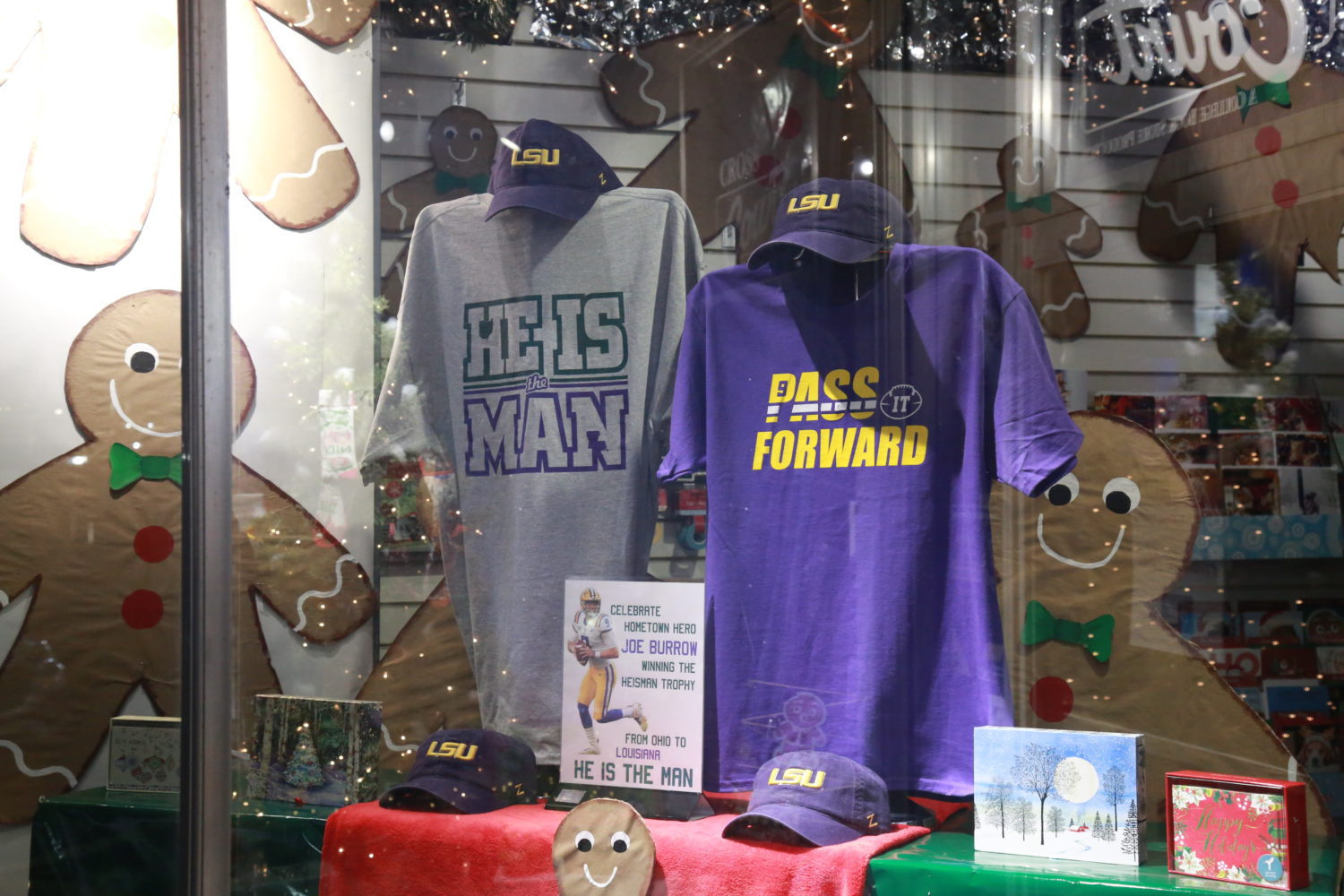
Over the past 2 years, Athens County, Ohio, has turned increasingly purple. That’s in direct conjunction with Burrow, the county’s favorite son, doing remarkable things at LSU. A sense of pride billows throughout Joe’s hometown community and you don’t have to look too far to find him: a billboard on Highway 33, sponsored by Athens Dental Depot, bears his image; two Burrow-themed T-shirts — one that says HE IS the MAN (Heisman), the other says “Pass it Forward” — hang in a storefront window display at a college bookstore; a marquee out in front of a local feed store reads “Let’s go Joe, Beat Oklahoma!” and one at a Beverage Drive-Thru (advertising the coldest beer in town) says “Go Jeaux!”; a banner outside of a local bar begs, “Come watch Heisman Joe & LSU Tigers, Dec 14th & Dec 28th”; a man wearing an LSU shirt saddles a stationary bike at a local gym; an LSU banner with the inscription “Love purple live gold” hangs in the window of a salon; and advertisements in The Athens News, a local newspaper, offer a Joe Burrow Collectable Poster Series and an opportunity to “Visit the Land of Eaux” (taken out by visitbatonrouge.com).
In many ways, this nascent fanaticism serves as a pleasant distraction from the pangs of a hardscrabble life. Burrow’s success has been a refresher, a reset button, something for the community to rally around as he marches toward a national championship and NFL dreams. There’s even hope he’ll land in Cincinnati, where the Bengals hold the No. 1 overall draft pick.
“It hit like a storm,” says Larry Lambert, a retiree who used to work in food services at Ohio University. “I’ve never heard such a thing as this. It just took over Athens County.”
So you see people sporting the LSU hats and T-shirts they ordered on Amazon as they sip coffee at the local dive. You hear stories of people traveling from Ohio to Louisiana, or Alabama, or Atlanta, or wherever Burrow plays. You see watch parties popping up in different parts of town when LSU has a game.
The tailgate has become anywhere you can see Joe Burrow. One particular fete was held at Christ Community Wesleyan, Joe’s hometown church in Albany, Ohio, where dozens of congregants gathered to view the semifinals of the College Football Playoff, a game in which their darling Joe faced Jalen Hurts and the Oklahoma Sooners. On this night, Burrow was more popular than a mime at a child’s birthday party, bringing awe to the congregation by making the scoreboard jingle for 7 touchdowns on 29-for-39 passing and 493 yards. Since LSU posted 49 at the end of the second quarter, a general sigh was let out and folks were free to mill about the purple-and-gold adorned foyer.
It’s safe to say that Burrow is the biggest thing that’s happened to the area in quite some time, possibly ever. From time to time, a local kid might go on to play for a Mid-American Conference (MAC) school or maybe even make an arena football roster. Folks might even recall the time Governor Kasich visited on a campaign stop. But the consensus is that there’s been nothing quite like the media tsunami for Joe Burrow (if you don’t believe that, simply start to think about what it would be like if your small town produced a Heisman Trophy winner), and the interest in his odyssey from the fields of Athens to Ohio State to LSU to the Heisman to the doorstep of a national title this Monday night.
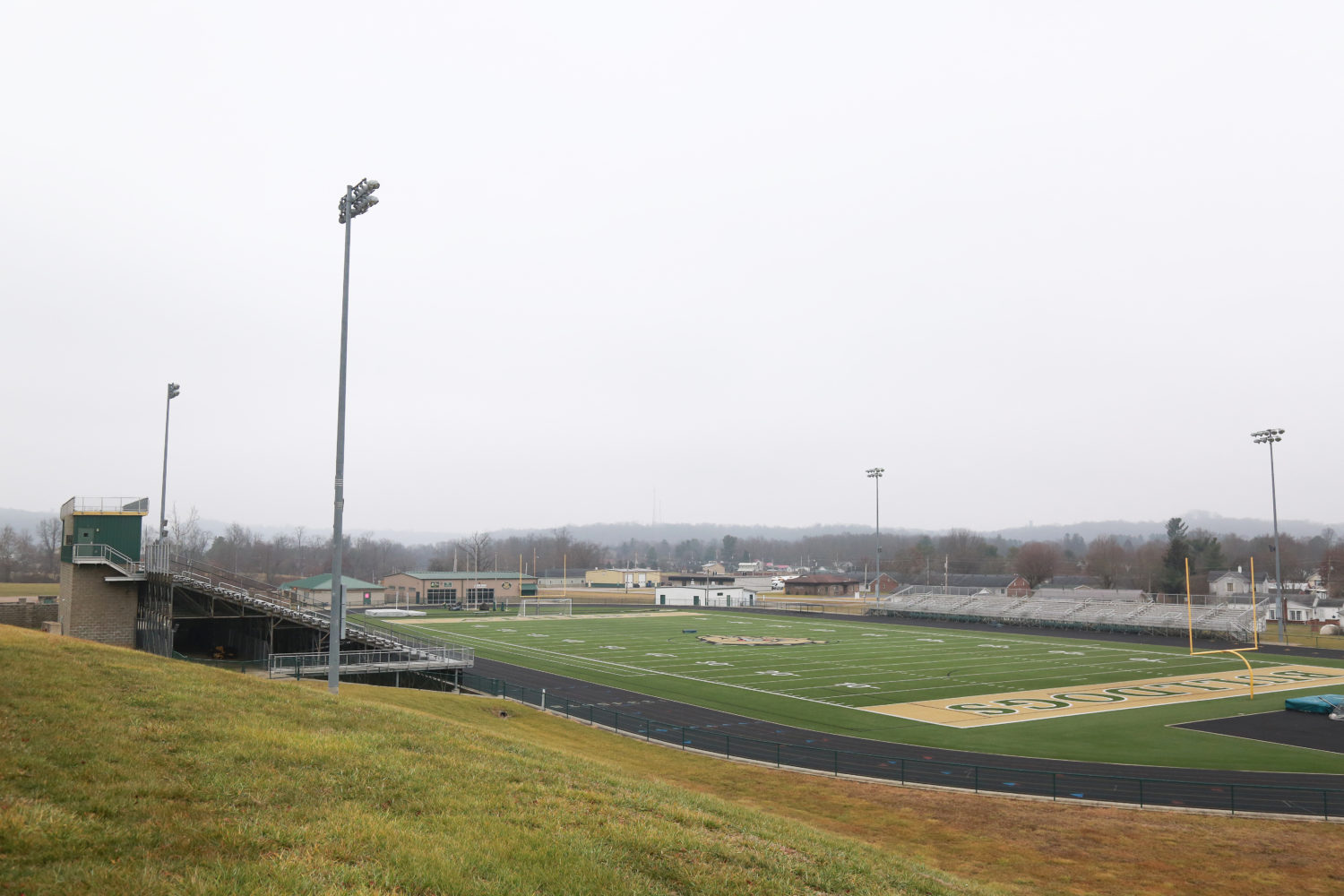
Like the remaining prisoners at Shawshank after Andy Dufresne makes his quiet escape, the Athens locals giddily tell Joe Burrow stories and are happy to roll out a stat or two (here’s one for you: Can you believe that Joe threw 63 touchdowns his senior year, and 157 total touchdowns in his high school career?). They talk about the what-ifs of a 56-52 state championship thriller at Ohio Stadium against Toledo Central Catholic, a game in which Burrow threw 6 touchdown passes — and his team lost.
They talk about how, if fate hadn’t intervened, he could have landed at places like West Virginia, Cincinnati, or even Ohio University. They don’t want you to forget how good an overall athlete he was, excelling in baseball and basketball in high school. They talk about his good Christian parents. They share rumors about Joe’s time at Ohio State (did Urban Meyer really say he threw like a girl?). They admit how they cried, or their wives cried, during Joe’s Heisman speech.
Terry Frost, a former police officer who, for many years, selflessly lent his unpaid services to the Athens High football team and was referred to affectionately as “Frosty,” remembers Burrow as “just a good young man.” “The thing I always remembered about him,” Frosty said, “was when he scored touchdowns, he got a drink of water then went to the lineman and always praised the lineman when he came back.”
Then there’s the testimony of Fred Gibson — “Gibby” — who wore many hats in the Athens public school system: coach, teacher, public address announcer and retired substitute. Across 40 years of an educational life there were many stories to tell, but the one Gibby remembers is the one about the fellas in the press box growing a bit spoiled the years Joe Burrow came through. “There would be like 3 minutes to go in the half, and we’d say, ‘OK, how many touchdowns can we get in this 3 minutes?’ And somebody would say, ‘Well, I think we can get one more after this one.’ And I’d say, “Ehh, maybe two.’ And somebody’d say, ‘I think maybe three.’ He scored 72 points against one team in a half — and he didn’t get to finish the first half!”
These are the type tales they’ll be telling until Kingdom come.
Still others want to know precisely how Joe likes his breakfast at a place called Gigi’s Country Kitchen in The Plains (as a matter of fact, he prefers the western omelet with a double side of hashbrowns, an order that, a waitress assures, soon will be referred to as “The Burrow”). Does he like it with hot sauce? Does he not like it with hot sauce? These are the important questions.
What’s really unique is that rivals have embraced the fervor as well. Residents are quick to point out how local schools, once adversarial to Athens High, possess the uncanny ability to drop the antagonism and support one another in times of success. One business owner was floored by the number of supporters from nearby Trimble who filled the stands when Burrow led Athens to the state championship game his senior year. Now that backing is amplified to a greater degree, for at some level, Joe stands for them, too. “They have come together and rallied around Joe’s quest,” said Rusty Thomas, a retired basketball coach who lives just outside of Athens. “The county schools rallied around when Athens went to the state championship. So we all come together as a large community to support that. Even though they might be bitter rivals, they support each other.”
Couple that with the fact that Joe is a genuinely good dude, and you’ve got a green felt to thrust all your chips onto. In all the interviews I conducted, no one from the area had a disparaging thing to say about Joe. You don’t hear murmurings about him going wild on Friday nights or tearing up the town. He is described in these words: confident, quiet, unassuming (Gibby); humble … just a pretty neat guy (Rhonda Hughes); cool (Courtney Hanning); a natural-born competitor (Travis Brand); a leader (Frosty); an unselfish person (Ryan Luehrman); really smart (Ken Cutwright); very talented but didn’t showboat … very good sport and didn’t talk trash to other teams … always a hard worker (Dennison West).
A tale of Joe’s benevolence has been floating around the local community for some time. As the story goes, the Athens football team would work out every Saturday morning after a Friday night game. This was a chance to get stronger and rehab sore muscles, if necessary. After the workout, several members of the team, including Joe, would descend on Bob Evans, a breakfast eatery located on East State Street. On one particular occasion, Joe intended to take his leftovers home, but as he was driving away, he spotted a homeless man underneath the Highway 33 exit ramp, pulled over, and handed him his food.
Joe also seems to remain level when he returns home from Baton Rouge, not letting his celebrity go to his head. Luerhman, a tight end at Ohio U who played with Joe in high school, was impressed with Joe’s attitude when he returned to Athens last year from being away at LSU. “He went to a high school game, we all went together, and he just took so much time to make sure every kid got an autograph or a picture,” Luerhman recalls. “Like, he could have been there until 4 a.m. at that stadium.”
Two Worlds
Just a few miles away from The Plains stands Ohio University in downtown Athens, a public institution framed by several handsome brick buildings that squat on a hill, the base of which empties into the slow-moving Hocking River. Almost as soon as cars climbing through campus feel the hum of the brick streets against tires below, their passengers behold the sights of downtown Athens, where, the night before, bearded men wearing toboggans sit and swap stories in her pubs as other patrons shoot pool and nurse longneck bottles of beer, where couples walk side-by-side in the streets, past the cute coffeehouses and the salons, past the brick buildings with their detailed cornices, past the old-timey Athena Cinema and the guitar shop, all the way to the end of the street at Broney’s bar and the Armory with the blue Christmas lights draped on the façade in the shape of a tree.
Make no mistake, Athens is a college town. And even though the turn-of-the-century rentals are shut off for the holidays, the student-tenants away at their respective hometowns, there is still a cultural verve and beating pulse amid the shadows of Athens and its darkly-lit streets. This a stark contrast with the depressed patches of The Plains and other outlying areas.
Traveling here, one may perceive a dichotomy between the university and surrounding areas, as if two separate, unfamiliar worlds coexist under one banner. Athens County may be the place where Greek-columned scholasticism collides with blue-collar Appalachia, but one has to wonder how much interaction between the two entities is there, truly? This is not to say that the college is indifferent to the poverty that encircles it, just … different.
As the largest employer, the University is the primary economic engine for, and the lifeblood of, the entire county. Take it out, and the area ceases to function. For many families, it has made a living — and a good one at that. Provosts, deans and other administrators boast six-figure salaries. So vital to the pecuniary interests of the citizenry is the college that the principal answer for the question, “How does one make money in Athens County?” is “work at the University.”
This reliance is more greatly pronounced now that the region can no longer hang its hat on certain resources for survival, and one cannot understate the crippling effect dried-up industry has had on the local economy. Throughout the years, coal was a major contributor to southeast Ohio — the large mural in downtown Athens depicting four coal miners and the words “Without Labor Nothing Prospers” is an ominous reminder — but at some point, coal production began to wane and companies ran out of places to dig. Brickmaking was another industry that provided a major shot in the arm, but that trade also made its exodus some years ago.
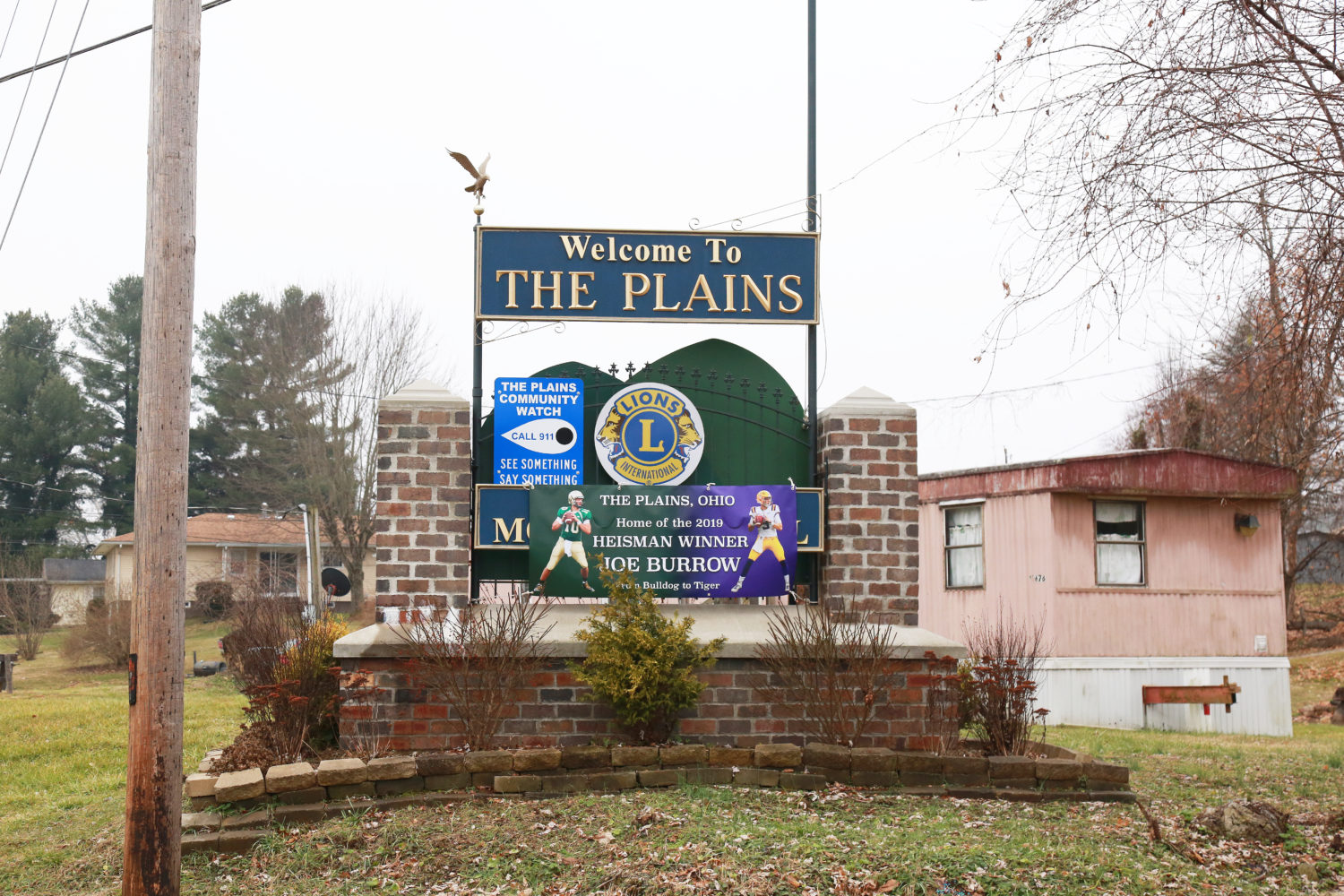
Since there is a dearth of large factories in the county and not much in the way of entrepreneurship, few appear to be living high on the hog. Even the city of Athens, as quaint as campus and its surrounding areas may be, does not teem with newness. Pockets of development do occur — a Kroger here, a Donatos Pizza there — but one does not drive through town remarking on the prevalence of new construction and booming industry.
Numbers bolster Joe’s argument of economic plight. In 2016 the Dayton Business Journal ranked Athens County as the poorest county in Ohio with a median household income of only $34,000. A recent article in Cleveland.com underscored the child poverty rate for Athens County, which stands at an alarming 31.5 percent (Welfareinfo.org puts the overall poverty rate in Athens at 51.6 percent). Another study ranking Ohio cities in per capita income showed The Plains coming in at No. 567.
The weather doesn’t help much, either. Sunless days, often strung together, seem to hang over creation, and it isn’t uncommon to behold only a few minutes of sun over the course of a weekend (that was certainly the case when I was there, gathered with Joe’s supporters to watch him blitz Oklahoma the Playoff semifinal). A few residents, looking for an inkling of joy, buy mood lamps to place in their homes. One local leader suggested that when there’s no employment or little employment and little resources, drugs become a problem, an aberrant coping mechanism. “And that’s no secret,” he said.
One of the few places in The Plains that seems to be thriving is Gigi’s, the local coffee shop/hangout and the “unofficial” hub of Joe Burrow mania, owned by the easygoing proprietor, Travis Brand. Pioneering the LSU spirit in The Plains, Brand has decorated Gigi’s with a variety of Tigers paraphernalia, including a wood carving in the shape of the state of Louisiana, the words “LSU” smack dab on the front of it, and a metal sign that reads “Reserved Parking, LSU Tiger Fans.” On the morning I visit Gigi’s, Travis is wearing a hoodie, around which are draped Mardi Gras beads with purple tiger paws, while he sips a beverage out of a Styrofoam cup. Cruising from table to table and entertaining customers, Brand slips easily into the role of restaurateur, and the good food, good service and good times have been a combination that’s helped Gigi’s to thrive for the past 8 years.
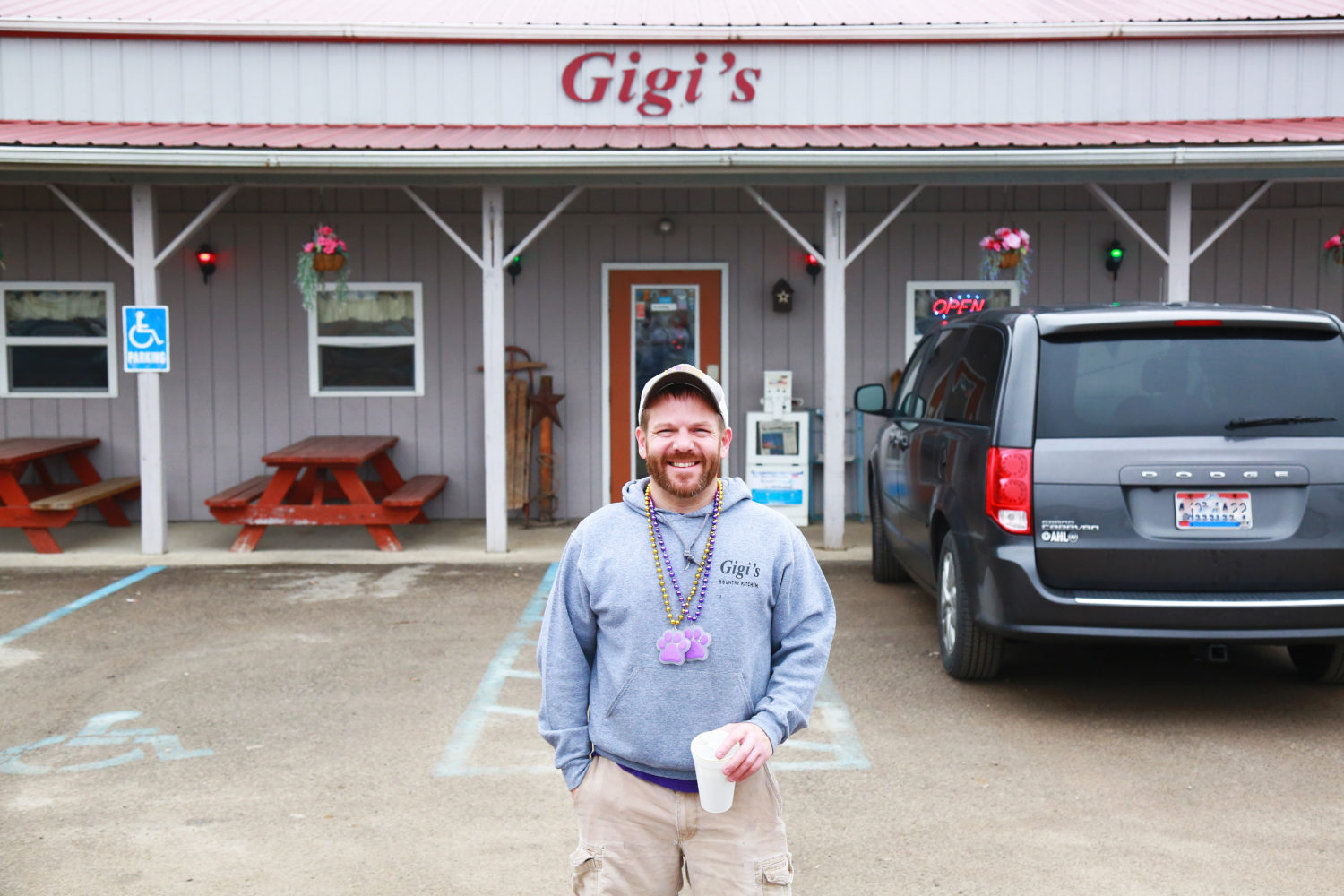
Brand will be the first to admit, however, that even though the community may be riding high and abuzz from all the Joe Burrow attention, more industry and more jobs are needed. “It’s tough (to make money),” Brand said. “I would say your more educated side look for university opportunity — that’s the best game in town. There are a handful of local companies that have done very well and grown … jobs are always a challenge and there’s hope that (this is the tipping point). You can only hope that we keep a spotlight on this area.”
More than a message
After Burrow wakened the nation to the plight of southeast Ohio in his Heisman speech, Will Drabold, a concerned citizen of Athens and chief of staff for a public relations firm, spearheaded a Facebook fundraiser for the food pantry. “Let’s answer Joey’s call to action by supporting a local nonprofit that serves food to more than 5,000 households in Athens County each year,” Drabold implored.
To date, the effort has received over 13,000 donations totaling more than a half a million dollars.
Because of Joe, the pantry board now had a good problem: trying to figure out how to best allocate these resources. Karin Olbers Bright, a volunteer and president of the pantry board, says that she doesn’t want this effort to be just a flash in the pan. “How do we use that money in ways that will be long-term and how do we define sustainable projects? We don’t want this to be a one-and-done,” she says.
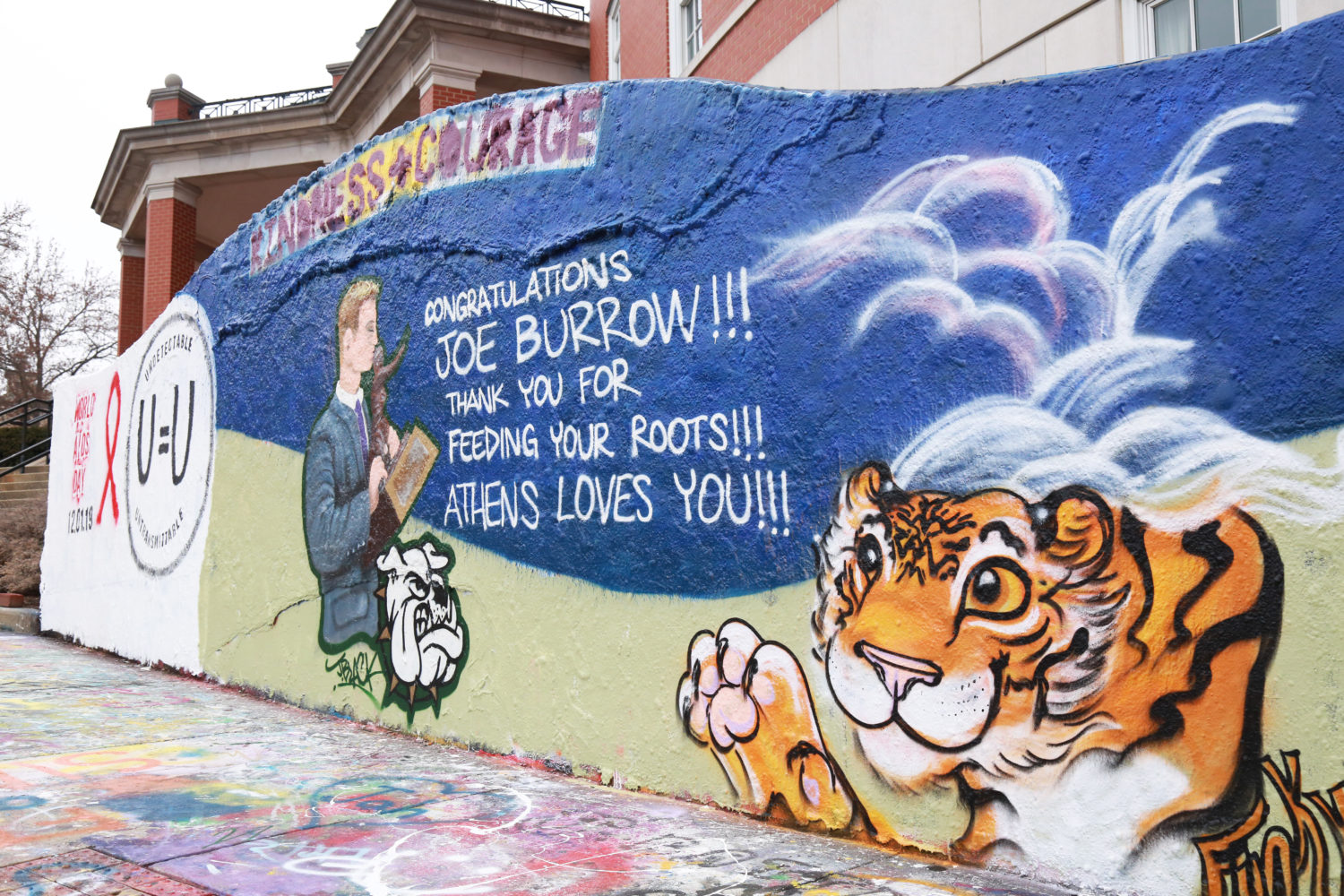
Part of the challenge is for volunteers and other able parties to see the effort as not just a singular, one-shot community service project, but rather something that occurs across a longer continuum. Bright assents to Ohio University’s potential for critical influence on the area and quickly points out how willing certain college students are to volunteer, but hopes that greater communication can exist between the pantry (and, more broadly, all organizations assisting individuals in need) and the university. “I believe the university community wants to be helpful and wants to be involved, but I think we need to work together to help them understand that this is an ongoing process and not just a series of projects. And that (the university) can get involved in a deeper way, a more ongoing way, more long-term.”
With respect to community, Steve Warner, Senior Pastor at Christ Community Wesleyan Church in nearby Albany, believes semantics could have an impact on how servants and volunteers approach the community. Admitting he doesn’t prefer the word “outreach,” Warner says, “Our focus is to become more missional and become better neighbors. Almost as if we give the community a wraparound hug in a neighborly way. We want to share the gospel and see real life transformation.” Warner says he is thankful for the national attention that Burrow has provided, but his focus is the slower play of investing in his congregation and becoming fully entrenched in the area at large. The challenge, Warner believes, is that the community doesn’t merely rest on Burrow’s words and the subsequent massive influx of donations — not that any of that is bad — but that real change begins to occur in response to Burrow’s call.
Yes, this is an area of tremendous need, but you don’t get the sense that residents necessarily want you to feel sorry for or pity them. Nearly every person I spoke to in my journey mentioned the pride of the people of southeast Ohio. This is not pride in an arrogant sense. This is the type of pride and internal sense of dignity that says, “sure we’ve got our issues, but I’m proud to be where I’m from.” It’s the type pride that reserves the right to complain about the area, but would defend her honor if an outsider were to utter anything disparaging.
And further, you get the sense that, for the most part, people are relatively happy. The good folks I met were warm, hospitable and made me feel like, if I ever came back, I wouldn’t have to get a hotel room. True, most of the people to whom I spoke are living comparatively comfortable, middle-class lives, but you don’t catch a vibe that they are somehow unsettled or burdened with despondency. They go to church, support the local sports teams, vacation in Myrtle Beach, and eat at Texas Roadhouse restaurant.
But pull back the curtain a little bit and notice the ones living on society’s edges. The fringe. These are the people that are a bit more inconspicuous, that you may have to work a little bit to find. Often, there is a tendency to pigeonhole these individuals suffering from a hard luck existence into the category of “lazy” and there is certainly some of that, but many have simply been sucked into a societal centrifuge that’s makes it difficult to climb out. These were the people for whom Joe Burrow was speaking.
“I think for so long we’ve been marginalized in southeast Ohio,” Bright says. “We don’t have industry … but people do survive here and they’re very proud of where they’re from. But I think it’s time that we who have the ability to speak out make some changes have that been addressed. What can we do economically for this area? What do we do to help bring jobs here? I don’t think people want a lot of sympathy. They want to work.”
A story by Fred Gibson is emblematic of society’s overall unawareness of the difficulties that these people on the edge face. Gibson says that back when he was teaching at the middle school, there was a young lady in his class who was “a real handful.” Gibson couldn’t understand why she was so angry all the time. “Then I had her in class later on when I was a substitute teacher at the high school,” Gibson said. “And she said, ‘Do you remember how bad I was in the eighth grade?’ I said, ‘Yeah, I didn’t think you were going to make it to this point.’ She said, ‘Well, I was living in a car with my mom all winter long.’ And I thought, ‘My God, who knew that was going on?’ She never let on that anything like that was happening. I didn’t really know what was going on in these kids’ lives. Kids that are having a lot of problems tend to act up.”
So the deeper questions are, “How does this area take a feel-good story and run with it? Is the attention given to this area just a flash in the pan, or can there be real, long-term effects of Burrow’s speech?”
Bright hopes for the latter. “I’m hoping that we can continue this very important conversation on how do we address hunger and food insecurity in this country,” Bright said. “The money is wonderful and it will allow us to do things that we wanted to do and thought and dreamt about. But we also need to have that conversation. We need to have it all across the country. Not just here. Because this problem exists everywhere. It’s time now that we figure out how to fix this problem. Using the voice that Joe has given us. This is national. This has been talked about across the country. Now we need to grab it and run with it.”
The cry of the needy is often faint, and for us to notice it often takes someone like Joe to stand on a platform and give the forgotten people a voice. But this effort is much more comprehensive than a speech given one time. It is something that will take time and commitment and compassion and, yes, money. Joe’s podium may be big, but the needs of everyday people across this nation are much bigger.
If we’ve seen anything over the last few years it’s that this country has its share of problems. Through the polarization of our political culture and the bickering that goes back and forth between people separated now by a great ideological divide, we’ve somehow become distracted to the real, visceral problems of America.
Hunger. Poverty. People don’t have adequate food and shelter.
It’s the kind of thing you might see as you drive up Highway 682 between Athens and The Plains on a misty Sunday. It’s also the kind of thing happening in Dothan, Alabama; Palestine, Texas; Laurel, Mississippi; and Detroit, Michigan.
It’s the kind of thing happening in your town, society slowly perishing from neglect.
Luckily, to help, we don’t have to flash our badges showing that we are “Republican” or “Democrat.” It doesn’t matter if we are white, black, straight or gay. All that is required is a heart that searches for others, to pause our busy lives for just a moment and notice.
In the end, Joe Burrow subtly reminded us that amid all the divisiveness and the political arguments that rage throughout a fractured nation, we’ve forgotten something.
We’ve forgotten people.

Al Blanton is the owner of Blanton Media Group, publishers of 78 Magazine and Hall & Arena.