
After Alabama shredded a top-20 opponent by 46 points, a natural question comes to mind: Which unit of the team was most successful?
To precede this question, a relevant question is: Which side of the ball was more successful?
The Alabama offense was obviously very successful. To score 52 points against any opponent is impressive, especially a top-20 team like USC. To put that in perspective, only three SEC teams on opening week even managed to score more than 30 (Georgia, Kentucky and Texas A&M).
Tennessee’s high-octane offense finished regulation Thursday night with just 13 points against a lowly Sun Belt opponent.
Still, Alabama’s defense was the most impressive part of Saturday’s win. Last season, with a very similar offense, USC’s lowest point total was 12 points in what was a huge upset loss on the road against Washington. The next-lowest total was against Dave Aranda’s Wisconsin bunch, the NCAA’s top scoring defense, which allowed 21 points.
Meanwhile, Alabama allowed just six on Saturday. For comparison, on the other side of the ball, USC’s 52 points allowed was the most surrendered by the Trojans since Sept. 28, 2013 (62 to Arizona State). Also, keep in mind the Alabama defense actually outscored the USC offense because of Marlon Humphrey’s pick-six.
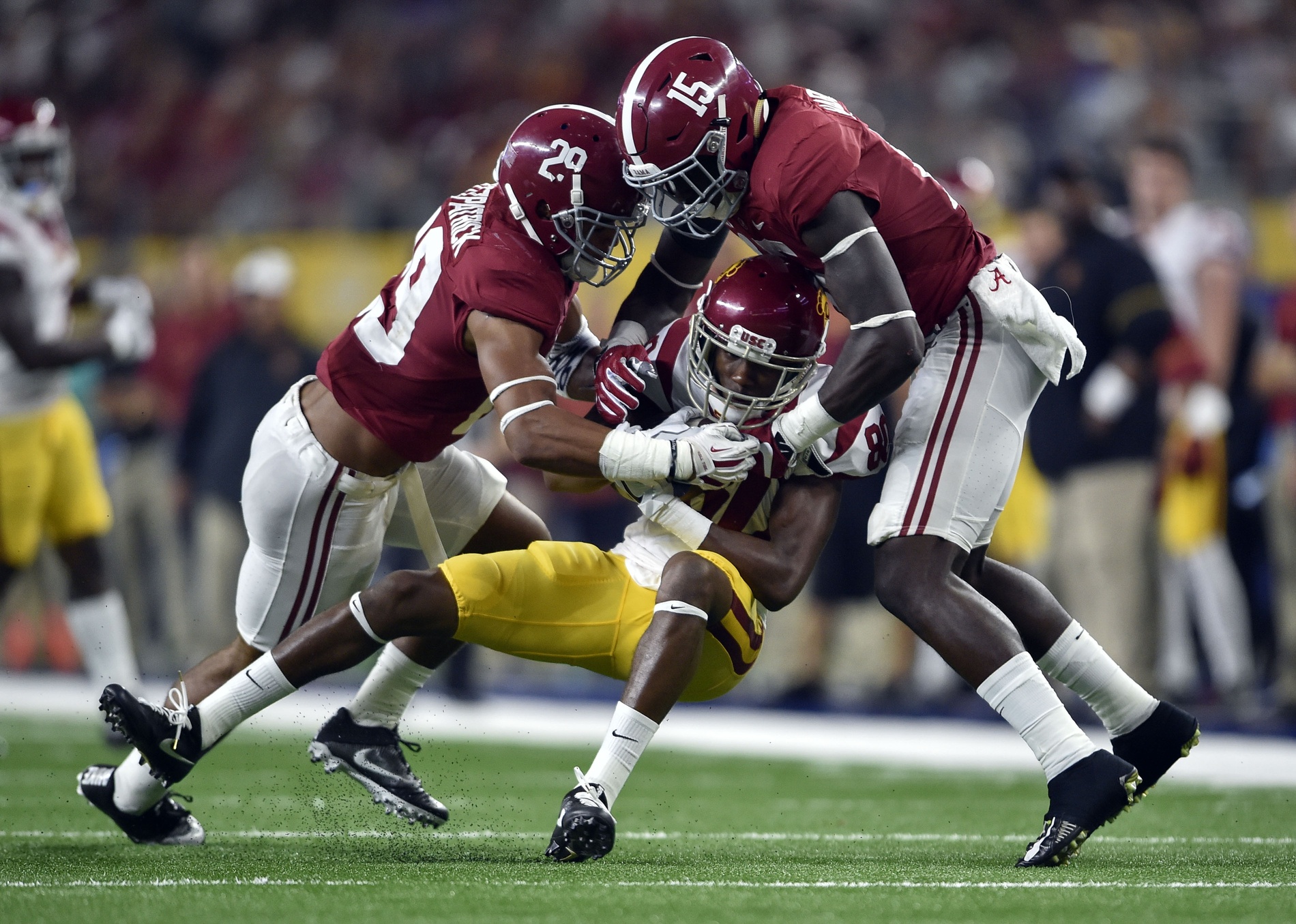
While it would be easy to say the run defense was the most impressive component of the defense as a whole, the secondary earns the nod. The Crimson Tide allowed just 130 yards passing by USC, its lowest output in 40 games.
Take away the second play of the game, a 36-yard passing strike in which Anthony Averett got caught out of position, and the total shrinks to just 94 yards. Meanwhile, Averett led the team with 8 total tackles, 7 of them solo tackles. Minkah Fitzpatrick had 6 tackles and 2 passes broken up. Then, there’s also the interception returned for a touchdown by Humphrey.
Perhaps what is so impressive about the secondary’s performance is USC clearly targeted the secondary by running the ball outside, throwing bubble screen passes and calling aggressive plays targeted at Averett specifically.
The team almost completely shut down speedy receiver JuJu Smith-Schuster. The dangerous junior wideout had just 1 reception for 9 yards. Take away the 36-yard reception by Rogers on the second play of the game and Alabama allowed him just 1 reception for 9 yards also. In fact, the longest reception aside from the 36-yarder was just 16 yards by junior receiver Steven Mitchell, Jr.
One of the biggest concerns heading into this game was USC’s big-play ability. It seems defensive coordinator Jeremy Pruitt’s background as a secondary coach could pay big dividends, although it’s only been one game.
Time will tell how strong this team’s defense, in particular the secondary, will be over the course of the season. For instance, Ole Miss presents an entirely different kind of challenge with a mobile, strong-armed quarterback in Chad Kelly, as well as an abundance of tall, imposing receivers and two big, physical backs.
Meanwhile, the pass rush looked similar to last season. Tim Williams was contained, although he did have a quarterback hit. Jonathan Allen appears to be the team’s top pass-rusher yet again after constantly disrupting USC quarterback Max Browne, recording 2 sacks and 2 passes broken up.
The linebackers also had a solid day. Reuben Foster tipped the pass Humphrey intercepted and had a tackle for a loss. Ryan Anderson finished with 5 tackles and had a key sack when USC elected to go for it on fourth down instead of attempting a field goal.
While the run defense was impressive, allowing just 64 yards rushing, the pass defense stood out. Comparing last season, Wisconsin allowed just 65 yards rushing against USC. While Wisconsin had a great defense, it more or less matched Alabama’s effort on Saturday. On the flip side, no team matched the passing defense of Alabama last season against USC.
Again, the Alabama offense was impressive, and the scary thing is the offense could be much better. The team had a number of false start penalties and two turnovers while not even fully utilizing its receiving arsenal. Robert Foster didn’t have a reception, and Calvin Ridley had 2 receptions for just 9 yards. Yes, the offense can be much better.
Can the defense be even better? Well, that is a tall task. Certainly, Western Kentucky offers a great opportunity as it will bring the fourth-ranked passing offense from last season (372.2 yards per game) and leader in pass TDs (50) and passer rating (177.4).
And a trip to Oxford looms after that.