Kalshi Fees and Funding: How to Deposit, Trade, and Cash Out

By Kevin Wolff
Last Updated:
Kalshi has quickly become one of the most popular prediction market trading platforms in the country, offering trading options across a variety of real world outcomes. The Kalshi platform is federally regulated by the Commodity Futures Trading Commission (CFTC) and classified as a Designated Contract Market. Read on to learn about all the details of Kalshi fees and funding, including Kalshi deposit methods, and how to cash out on Kalshi.

New users can claim the Kalshi promo code to score up to a $500 bonus after completing $25 in trades.
Kalshi Fees Explained
Kalshi charges small fees to sustain the platform and allow users to trade with no house edge. These Kalshi fees (maker and taker fees) depend on implied probability, order type, and the market.
How Does Kalshi Make Money?
The Kalshi platform operates as a CFTC-regulated, peer-to-peer trading exchange, with orders matched on the market for users trading on either side of an outcome. As such, trading prices (odds) are affected only by the market’s trading activity, allowing users to trade with no house edge. To put this in perspective, sportsbooks use oddsmakers to set prices for betting, with a built-in house edge (vig) paid by the user on every wager.
In order to keep the prediction markets exchange running without a house edge or “vig”, Kalshi fees are generated strictly through transparent, low-margin transaction fees on matching orders.
Understanding Kalshi Trading Fees: Makers vs. Takers
The Kalshi fee structure is tiered and determined based on the type of order (quick vs limit) and the market. There are two types of orders to consider for Kalshi trading fees. Maker orders (limit orders) are often fee-free to encourage market participation and increase liquidity, creating an incentive for strategic traders. Taker orders (quick orders) will be tagged with a Kalshi fee between $0.07 and $1.75 per 100 contracts.
Fees are determined by the implied market probability (price paid per contract), with the highest fees typically attached to trades at $0.50 (50% implied market probability). As the implied probability decreases, the associated trading fees will also decrease. Fees will only be charged on orders that are immediately matched on the orderbook.
Certain markets, such as the S&P 500 and Nasdaq-100 indicators, use alternative tiered fee tables.
How Deposits and Payouts Work on Kalshi
Now that we’ve covered the trading fees for various markets and order types, let’s go over funding, including deposits, payouts, and associated Kalshi fees. See where Kalshi is legal and know how it’s trading platform offers a variety of safe and trusted banking methods for users to fund their accounts and withdraw their winnings.
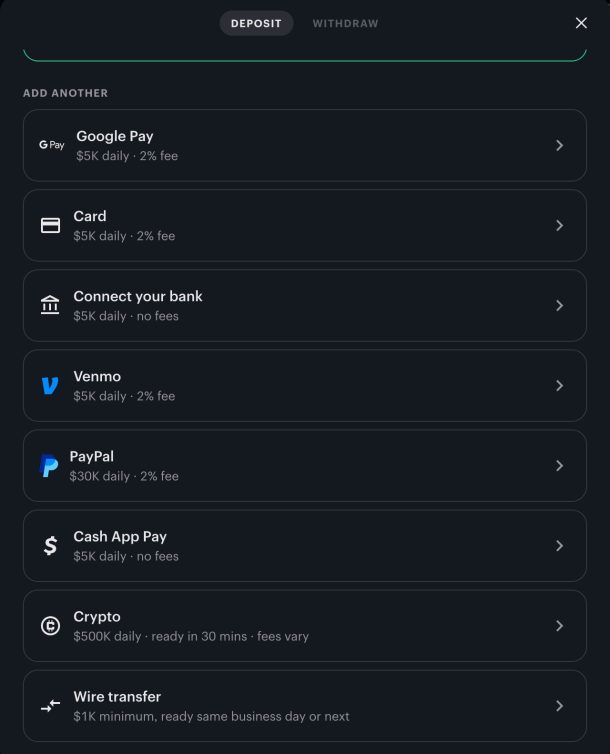
Kalshi Deposit Methods: Getting Capital Onto the Exchange
Kalshi provides users with a variety of deposit methods to fund their account. Each of the listed Kalshi payment methods is safe and secure, and the Kalshi platform will automatically provide a receipt to your email when you make a transaction.
Follow these simple steps to initiate a Kalshi deposit.
- Use the pop out menu in the top left corner of the screen on the home page
- Open the pop out menu and select the first option to Deposit to Kalshi
- Browse through the available payment methods and select your deposit option
- Enter the amount you wish to deposit
- Confirm the payment
Any associated Kalshi deposit fees will be displayed on the screen before you submit your payment.
Users can also execute a deposit by clicking the Portfolio tab at the bottom (middle) of the screen in the app. Then, in the top right corner, click the gren button to Deposit, and select from the available Kalshi funding options.
View the table below to see all the available Kalshi deposit methdos, as well as athe asoociated limits, processing times, and any fees.
It’s also worth pointing out that most electronic Kalshi payment methods require a standard $10 minimum deposit.
How to Cash Out on Kalshi: Every Withdrawal Method Explained
For users wondering how to cash out on Kalshi, it’s a simple process, and it’s very similar to making a deposit.
- On the home page of the Kalshi app, click the pop out menu in the top left corner
- Select the option to Manage funds
- When the new screen loads click the button to Withdraw
- Hrowse through the available Kalshi payout methods and select your withdrawal option
- Enter the amount you wish to withdraw
- Confirm the Kalshi payout
Any associated Kalshi withdrawal fees will be displayed on the screen for the user to review before confirming the payout.
Kalshi Withdrawal Method Comparison
See the comparison table below for all the Kalshi withdrawal methods, including processing time, fee structures, and other important rules.
Most of the popular Kalshi withdrawal methods have little to no processing times, and there are no Kalshi fees on payouts. Be sure to review all the terms and conditions when executing a withdrawal on Kalshi, as several methods are available for US traders only.
Key Takeaways for Kalshi Traders
Kalshi is, without question, one of the top options for US-based traders looking to buy and sell positions for real world outcomes. With a litany of trsuted payment methods, deposit options, and a CFTC-regulated platform, the Kalshi app provides everything users will need to get started trading event contracts.
Kalshi fees for trading, as well as funding your account, are straightforward and clearly specified, so there won’t be any surprises when you check your account.
Before you make your first trades, rememer some of these key factors:
- Always use limit orders (Makers) where possible to utilize free order types.
- Be mindful of deposit clearing holds before attempting a fast withdrawal.
- International users should lean toward Debit Cards or Crypto, as domestic US banking rails (ACH, Venmo) are restricted.
Now that you know the ins and outs of Kalshi fees, deposits, and withdrawals, you’re ready to start trading! Make sure to use the Kalshi promo code SOUTH15 to register for an account and unlock up to a $500 bonus after completing your first $25 in trades.
After years of writing as well as Data Analyst work for Pro Football Focus, Kevin Wolff is now a Sports Betting Writer for SportRadar. A graduate of Fordham University in NYC, Kevin is also a full-time dog dad when he's not writing. He can be reached at k.wolff@sportradar.com