Kalshi vs Polymarket (July 2026): Which is Better for US Traders?

By Kevin Wolff
Last Updated:
Prediction market apps are the best way to trade on outcomes of real world events like sports, politics, entertainment, financials, and many more exciting markets. With a pair of trading platforms commanding a large share of the trader base, many new users are comparing Kalshi vs Polymarket to get started with their preferred option.
Each platform offers its own strengths, conveniences, and market selection to serve users of various interests. First time users selecting between prediction market exchanges might also consider the promo code offered at sign up, as well as in-app liquidity rewards and payment methods.
On this page, we will break down all the specifics of each platform (Kalshi and Polymarket) to help you decide which prediction markets app is best for you.
Kalshi vs Polymarket: Quick Comparison (July 2026)
Kalshi and Polymarket are both available in a variety of states throughout the country, with markets for users to trade on sports, politics, economics, entertainment, crypto, weather, and many more options. The Kalshi and Polymarket apps can be downloaded for free from the Apple App Store (iOS) and Google Play (Android).
As prediction market exchanges, Kalshi and Polymarket are regulated by the Commodity Futures Trading Commission (CFTC). Each prediction markets platform uses event contracts as the unit of commerce, where users are buying and selling positions for yes/no outcomes of real world events.
When it comes to trading fees, Kalshi uses a tiered fee structure based on the price of the contract as well as the order type. Polymarket uses a dynamic, probability-based fee structure based on the category of the market and the price of the contract.
If you’re looking to get in and get out quickly, Kalshi is the best bet for US traders. Kalshi offers a variety of markets, an impressive list of payment methods, and easy mobile app access. For users more sensitive to fees, Polymarket will likely be the better option, as most trades priced between 30¢-70¢ will incur a lesser fee than they would on Kalshi.
US Access on Kalshi vs Polymarket
Both Kalshi and Polymarket are currently available in over 40 states throughout the country. While each platform is federally regulated by the CFTC, there are several states that have taken legal action to prohibit prediction market trading platforms.
There are some states, like Nevada, that have banned prediction markets altogether. Other states simply restrict certain markets, like sports, but allow users to trade on other events.
Kalshi vs Polymarket US Availability and State Access
See how US access differs on a state-by-state basis for Kalshi vs Polymarket. See more where Kalshi is available with our full state-by-state breakdown.
Kalshi vs Polymarket Promo Code and Invite Bonuses
Both Kalshi and Polymarket offer a new user welcome bonus at sign up that helps first time traders get started with a boost. Read through all the terms and conditions for prediction market bonus offers, as Kalshi and Polymarket require user action to activate the welcome rewards.
Kalshi Promo Code

New users can claim the Kalshi promo code SOUTH15 to score a $15 sign up bonus after they make at least $15 in trades. With trading options available across a variety of worldwide events, the Kalshi new user offer is a great way to get started trading on prediction markets. It only requires $15 in total trading volume to unlock the reward, and the $15 sign up bonus can be used to buy contracts across a wide range of categories.
Polymarket Promo Code

Deposit $20 & Get a $50 Bonus at Polymarket!
First time traders can sign up with the Polymarket promo code SOUTH to skip the US waitlist and unlock a welcome offer to deposit $20 and get a $50 bonus. Polymarket offers an impressive selection of trading markets, and the sign up bonus will help new users get started fast on the prediction markets platform. After using the linked promo code offer to sign up, make a deposit of at least $20 to unlock a $50 bonus to use for trading on a variety of options.
Kalshi vs Polymarket Fees: What Will You Pay in 2026?
Both Kalshi and Polymarket charge small fees that keep the exchange platforms running. Maker and taker fees for trades on Kalshi and Polymarket vary based on order type, implied probability, and even the market itself.
Trading Fees Compared: Maker, Taker, and Per-Contract Costs
Kalshi Trading Fees: Kalshi uses a tiered fee system depending on contract and order type. Limit orders (maker orders) are often fee-free to encourage market liquidity. Quick orders (taker orders) will incur a small transaction fee ranging from $0.07 to $1.75 per 100 contracts.
Trading fees on Kalshi are structured based on the price of the contract. Typically, the trading fee rate is the highest on 50% implied probability ($0.50) contracts. Trading fee rates will decrease as the implied probability increases.
On Kalshi, trading fees are only charged for orders that are matched immediately in the orderbook. Users will not incur trading fees on orders that are not matched immediately and become resting orders.
Polymarket Trading Fees: Polymarket uses a probability-based fee system depending on the market category and the price of the share. Trading fees on Polymarket are symmetric around 50% probability, meaning the fees decrease as the contract price (probability) nears $0.01.
Polymarket charges fees on select markets and trades. The fees collected by Polymarket are used to fund rewards for users who provide market liquidity to the trading platform. Polymarket trading fees are rounded to four decimal places, which results in very small trades with extreme probabilities (like 1%) often incurring no fee at all.
On Polymarket, maker fees apply to executed trades, including limit orders placed by market makers. Sell orders on Polymarket are not subject to taker fees.
Deposits and Withdrawals
Kalshi also charges fees on deposits and withdrawals to the prediction markets trading exchange when users make a payment or execute a payout. Polymarket does not charge deposit or withdrawal fees; however, third-party payment intermediaries (Coinbase, MoonPay, etc.) may charge separate fees on transactions.
Kalshi vs Polymarket Available Markets: What Can You Trade?
Compared with other prediction trading apps, Kalshi and Polymarket have established a clear position as industry leaders in market selection. Given that both platforms are federally regulated by the CFTC, there isn’t a drastic difference between the two in terms of available markets to trade on.
Both Kalshi and Polymarket offer an extremely impressive selection of prediction markets for users to trade on. Market availability and trading options are a massive pro for each platform when being evaluated by prospective traders. When comparing the two side-by-side, Kalshi offers a more diverse selection of markets, particularly with popular categories like geopolitics and crypto.
For users who are active on both Kalshi and Polymarket, this can be a great opportunity to trade with an edge. In many instances, traders will be able to search and find an exact market match between the two platforms. This presents an opportunity for users to “price shop” if there is a difference in implied market probabilities on Kalshi vs Polymarket.
User Experience on Kalshi vs Polymarket
The overall trading experience on Kalshi and Polymarkt is fairly similar, with both platforms operating as top-tier prediction market apps (available in the App Store and Google Play). It’s very easy to create an account on either platform, with each following a standard know your customer (KYC) process in which users verify their identity and eligibility during the registration process.
Kalshi User Experience
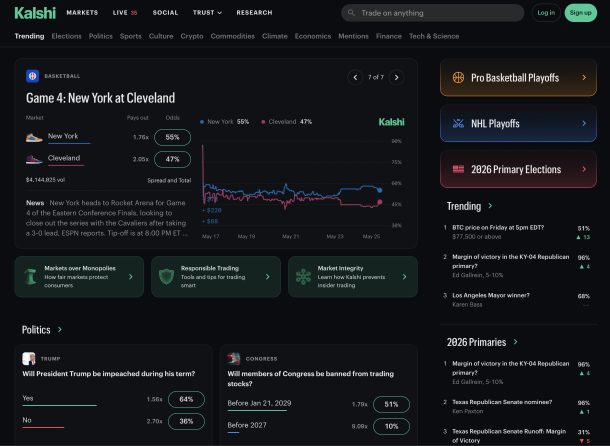
Kalshi is a terrific option for prediction market traders, offering a smooth-operating mobile app with a sleek interface and easy navigation. The platform is CFTC-regulated, ensuring safeguarded trading, and there are a variety of payment methods available to make fast deposits and withdrawals. Traders can earn interest on their positions in Kalshi, as the platform provides a variable annual percentage yield of 3.25% on both uninvested cash and open positions. The new user offer provides a $15 sign up bonus, and existing users can earn rewards when they refer friends to the Kalshi platform.
Polymarket User Experience
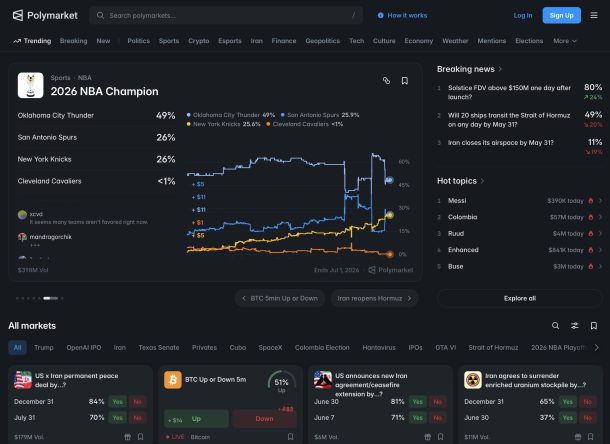
Polymarket is an impressive trading platform with an easy-to-use mobile app available for download on most devices. As a federally regulated (CFTC) platform, Polymarket ensures legitimate trading options for users to buy and sell contracts across a variety of categories. Polymarket users can deposit and withdraw funds fee-free, and they’ll earn Liquidity Rewards when they make competitive trades that help the marketplace. New users can claim a $50 deposit bonus at sign up, and existing users can earn fee rewards when they make referrals to Polymarket.
Comparing Liquidity on Kalshi and Polymarket
Liquidity is a major factor for many traders when determining whether to use either Kalshi or Polymarket. With prediction markets, liquidity is crucial, as it determines how easily traders can buy or sell contracts without significantly affecting the price (implied market probability).
When comparing Kalshi and Polymarket, Kalshi typically offers higher liquidity for US sports and economic markets, while Polymarket often leads in liquidity for geopolitical and crypto markets.
Kalshi: As one of the top trading platforms in the country, Kalshi has high market liquidity for sports events, particularly domestic (US-based) sports markets. Specifically, Kalshi offers higher liquidity for NFL, NBA, and MLB markets, which command a high trading volume. Kalshi spreads typically range from 3-8 cents, with a 5,000 contract order usually resulting in 2-4% slippage.
Polymarket: Given its status as an established global brand, Polymarket offers high market liquidity for politics, geopolitics, and crypto trading options. Polymarket has long been established as an international trading platform, bringing in high trading volume for geopolitical events all around the world. On Polymarket, spreads usually range from 2-5 cents, with a 5,000 contract order typically resulting in 1-2% slippage.
Kalshi vs Polymarket FAQs
Kalshi vs Polymarket which is better?
Depends on the intention of the user. Each platform offers its own strengths, with differences in pricing, liquidity, trading volume, fees, and other key factors.
Is Kalshi or Polymarket better for US traders?
For trading on US sports and economic markets, Kalshi is likely the better option. For trading on geopolitical and crypto markets, Polymarket is likely the better option.
Is there a new user bonus for Kalshi and Polymarket?
Yes, Kalshi offers a $15 sign up bonus, while Polymarket offers a $50 deposit bonus.
Is Polymarket legal in the US?
Yes, Polymarket is legal and available in over 40 states throughout the country.
Which platform has lower fees?
Typically, Polymarket has lower trading fees. Kalshi’s fees can be higher on balanced trades.
Are election markets allowed on Kalshi and Polymarket?
Yes, both Kalshi and Polymarket offer markets for users to trade on US elections, as well as elections in other countries.
After years of writing as well as Data Analyst work for Pro Football Focus, Kevin Wolff is now a Sports Betting Writer for SportRadar. A graduate of Fordham University in NYC, Kevin is also a full-time dog dad when he's not writing. He can be reached at k.wolff@sportradar.com