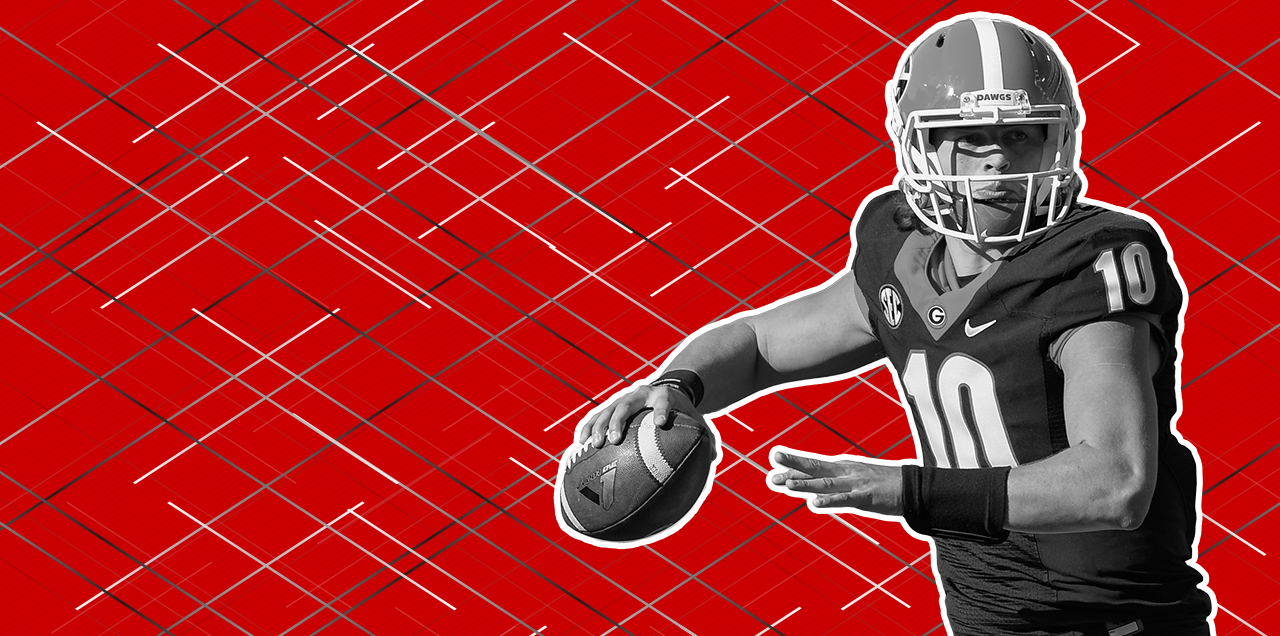

In many ways, the conversation surrounding Georgia’s passing game in 2017 centers around quarterback Jacob Eason. The former 5-star prospect captivated Bulldogs fans before he set foot on campus in Athens, and that attention has not dissipated in the least.
Eason’s performance in 2016 was on par with what many should have expected of the true freshman, but it became clear as the year progressed that his game needed plenty of refinement. With a full offseason of work at a major college program, and the added competition from Jake Fromm, there is reason to believe that Eason will be significantly better in his sophomore year.
There is much more to Georgia’s passing game than the quarterback position, however, no matter how important Eason might be.
RELATED: Best of Eason in 2016 | Worst of Eason in 2016
Isaiah McKenzie, the team’s leading receiver from 2016, is in the NFL and there are very few proven options at the position. Offensive coordinator Jim Chaney must also figure out how to use a versatile and talented tight end group as well as an incredibly deep stable of running backs.
Georgia has possibly more upside on offense than most teams in the SEC, but there is no guarantee that it will reach that potential.
After several years of below-average aerial attacks, can the Bulldogs take the next step?
Passing yards per game (SEC rank): 193.5 (10)
Passing TDs: 16 (10)
INTs: 9 (T-4)
Quarterback Play
Set aside the inconsistencies and rookie mistakes, Eason had several moments that showed the natural foundation he could build upon — the game-winning touchdown pass against Missouri and the miraculous, should-have-been-game-winning touchdown pass against Tennessee serve as the most prominent highlights.
Surrounding those moments, though, were examples of Eason’s struggles.
Before finding McKenzie in the end zone on fourth down against the Tigers, Eason threw three incompletions while trying to make the big play. After getting stripped in the end zone to give Tennessee the lead, Eason responded on the ensuing drive by throwing two incompletions before tossing an interception with barely two minutes remaining.
Georgia ranked 10th in the SEC in passing yards and touchdown passes in 2016. Both numbers should climb into the top 5 in 2017.
Those highs and lows marked Eason’s freshman season, and to a lesser extent, the team as a whole in 2016. The tumultuous moments combined to create a season that should be viewed as a positive initial campaign overall.
Eason completed 55.1 percent of his passes for 2,430 yards with 16 touchdowns – a true-freshman school record – and eight interceptions.
Georgia added some primary competition for Eason this season in the form of Fromm, one of the most accomplished high school quarterbacks in the state’s history. He has pushed the sophomore hard since arriving on campus in January and showed his ability in the G-Day Game.
Statistically, Fromm outdueled Eason.
It might not be to Eason's level, but Fromm's got plenty of arm strength makes this TD throw almost off his back foot. #UGAFilmReview pic.twitter.com/Gzhju9ownK
— Will McFadden (@willmcfadden) May 24, 2017
The newcomer completed 61 percent of his passes for 277 yards and two touchdowns, while Eason had a 44.4 completion percentage with 311 yards, two touchdowns and an interception. Those numbers come with this caveat, however: Eason worked against the starting defense.
Moving forward, it’s reasonable to expect Eason to show a greater understanding of the offense, more trust in those around him and a little more polish on his passes. There are still likely to be some head-scratching moments, but Georgia’s quarterback play should be improved in 2017.
Receivers/Running backs/Tight ends
McKenzie’s departure means that the Bulldogs will enter the fall without their leading receiver for the second year in a row. The agile jitterbug wasn’t expected to have a breakout campaign like he did, but Georgia might be better equipped to live without McKenzie than it was last season.
Terry Godwin will move inside and operate out of the slot, an important position in Chaney’s offense. He had a terrific spring and looks poised to produce in the way fans have hoped for. Alongside Godwin are some intriguing pieces who offer an array of skill sets.
Riley Ridley improved throughout his first season and should be an effective option on the outside. Javon Wims, who finished with four catches for 96 yards in the G-Day Game, should also play on the perimeter. Then there is a slew of unproven, yet exciting receivers. Mecole Hardman, Jeremiah Holloman and Tyler Simmons each flashed their potential and will round out the position.
It’s no secret that Georgia’s stable of running backs is as talented as it is deep. Nick Chubb and Sony Michel are both elite talents with a proven track record and something to prove in their senior seasons. Brian Herrien and Elijah Holyfield should each have roles in this offense to take advantage of their fresh legs in space, and D’Andre Swift is the latest highly-touted back to join the mix.
At tight end, the Bulldogs have a rising star in Isaac Nauta. The rising sophomore looked like a veteran during the second half of his first season in Athens, and he possesses elite talent. Although he didn’t see much action, the versatile Charlie Woerner should be a bigger part of the offense in his second year as well.

Play-calling
Although Georgia’s offensive line is rightfully viewed as the biggest area in need of improvement, play-calling isn’t far behind.
Chaney seemed to lack creativity in his first season with the Bulldogs, and he looked to be running an offense that reflected what the team hoped to be, not what it actually was. That will need to change in 2017 if Chaney is to take advantage of all of his weapons.
Fans lamented Georgia’s seemingly predictable approach to play-calling last season. The Bulldogs appeared to run on early downs and leave Eason to throw on third-and-medium or long. The numbers support that theory; below are the relevant stats from Georgia’s first-down pass plays against division opponents in 2016.
[table “” not found /]In the Bulldogs’ six division games, Eason threw 204 passes. Only one-third of those passes came on first down. Some would argue that shows a balance between all three downs, but balance isn’t always the best way to keep opponents on their toes.
With the lack of proven options at receiver, Georgia has said it would like to utilize the running backs more often in the passing game. This should add a new dynamic to the offense that was missing last season and expand the roster of usable players on any given play. Of Eason’s 36 completions on first down, only five went to a running back. For context, 21 were to wide receivers.
The offensive line might have hampered some Georgia’s potential on offense in 2016, but the right coordinator can minimize a unit’s weakness while playing to its strengths. Utilizing the running backs more often seems like the perfect way to help the offensive line and get the ball in the hands of some of the best playmakers on the roster. Chaney’s ability to do that will play as big a role in the Bulldogs’ success as anything.
One stat that must improve
For all of the natural arm strength that Eason possesses, Georgia had only 33 passes of 20 yards or more in 2016, which was tied for 11th with Auburn.
Many of those pass plays also came via catch-and-runs. The Bulldogs’ inability to consistently threaten opposing defenses over the top allowed them to stack the box and take away the run game. Georgia’s receivers should be better at making plays downfield than last year’s group, but that will need to be proven this fall.
Of course, Eason’s accuracy on deep passes wasn’t as sharp as it needed to be at times. If he is able to dial in and find receivers over the top, Georgia should be a much more dangerous offense.
Greatest concern
Georgia’s offense possesses a lot of potential in 2017; the pieces are in place for a quick rise. That being said, improvement is not guaranteed. The number of unproven players who will play big roles creates a big gray area between the best- and worst-case scenarios.
The position that would most likely hinder Georgia’s offense remains the offensive line, which was a major problem in 2016. There are ways to circumvent that weakness, however, making the Bulldogs’ biggest concern the inability of enough players taking the next step in their development and becoming reliable pieces.
A few stars can only carry a team so far.
Better or Worse in 2017?
Year 2 of the Smart Era for Georgia should yield better results. The mistakes made in 2016 are largely fixable, and the Bulldogs should be the most talented team in the SEC East.
Eason’s first season was by no means a failure, but it wasn’t the massive success that the most optimistic were hoping for. With an extremely talented set of running backs, a diverse group of wide receivers and more creative play calling, Georgia should have enough to help its 5-star quarterback take the next step.
The Bulldogs’ passing offense will be better in 2017.