CFP Quarterfinals Primer: Can the SEC’s best handle the heat?

By Matt Hinton
Published:
Sizing up and breaking down all 4 quarterfinal matchups in the 2025-26 College Football Playoff. We start with Wednesday night’s Cotton Bowl before moving to a full, SEC-heavy Jan. 1 slate. (A bold • indicates Matt Hinton’s pick ATS. Hinton went 4-0 ATS in the opening round.)
Cotton Bowl: No. 10 Miami vs. No. 2 Ohio State (-9.5)
Kickoff: 7:30 pm, ET, Wednesday night, Dec. 31 (ESPN).
Nearly 20 million people watched Ohio State’s loss to Indiana in the Big Ten Championship Game, the largest audience for any game this season and a record for the event. Apparently it didn’t shake their faith in the brand one iota. The Buckeyes remain clear betting favorites to go all the way, with virtually no change in their odds of winning it all in the major sportsbooks since the goose egg in the loss column was replaced by a 1. And with all due respect to Indiana, why shouldn’t they be? Memories are still fresh of last year’s title run in the wake of a season-ending flop against Michigan, which briefly felt like a crisis for the Ryan Day administration before it was hastily rewritten as a test of championship resolve. Nobody is lining up to make the same mistake twice, least of all the faction of the OSU base that was calling for Day’s scalp 12 months ago. In that sense, the Buckeyes are still the most bankable team in the field.
Then again, this year’s team is not last year’s — which, remember, lost a school-record 14 draft picks — and for an outfit that just spent 14 consecutive weeks atop the polls this group has quite a bit to prove in its own right on the big stage. Chalk up any lingering doubts up to the schedule, which prior to the Big Ten Championship offered little incentive to shift out of cruise control. Between the opener against Texas and the finale at Michigan, Ohio State faced just 1 ranked opponent as of kickoff (then-No. 17 Illinois in mid-October), and none that finished better than 8-4.
Unless you were under some kind of obligation as a fan or beat writer, there was rarely any reason to watch any of those games for any longer than it took for the Buckeyes to snuff out hopes for an upset, which usually did not take long. Their 27-9 win at Michigan was their 11th straight by 18+ points, and left the distinct impression that their real season was only just getting started. Then they went out and put 10 points on the board against the first Playoff-caliber opponent they’d faced.
Of course, as season-ending upsets go, the loss in Indy was not nearly the psychic blow/wakeup call that losing to Michigan in Columbus was a year ago. Still, the response should be revealing. If nothing else, the Hoosiers left at least a flicker of doubt that accelerating across the finish line for the second year in a row is going to be as routine as the 2024 team made it look.
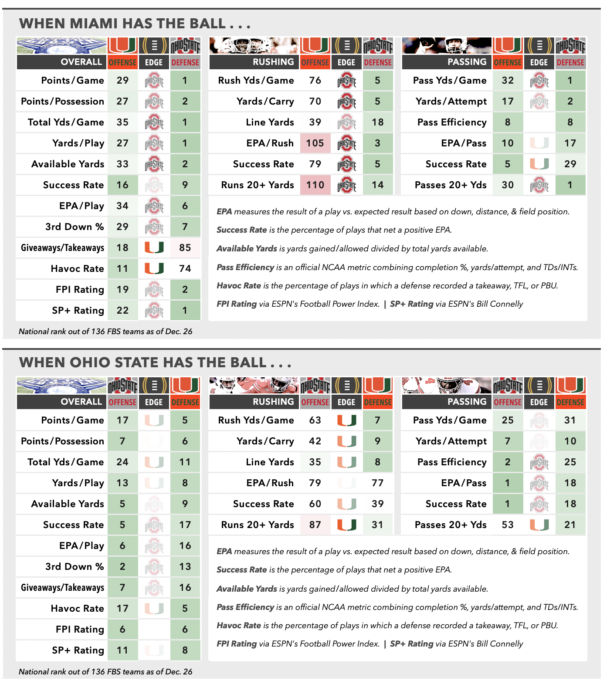
The most obvious concern coming out of the Indiana game was the offensive line. The OL was not “exposed,” or anything as dramatic as that, but IU’s defensive front seven gave Ohio State all it could handle, keeping a lid on the ground game while putting more pressure on QB Julian Sayin than any opposing pass rush this season. Keeping Sayin upright is a priority on Wednesday night opposite the most disruptive edge-rushing tandem in the college game, Rueben Bain Jr. and Akheem Mesidor, coming off a thoroughly dominant outing in Miami’s first-round win at Texas A&M. Per PFF, Bain and Mesidor combined for an astounding 19 QB pressures against the Aggies, including 5 of the Hurricanes’ 7 sacks. (Not to mention a blocked field goal by Bain.) Adding to the Buckeyes concerns up front, they’ll likely be without veteran guard Tegra Tshabola, who is listed as doubtful to play after leaving the Big Ten Championship Game in the first half. That matchup may be the only one on the tale of the tape that seems to clearly favor the ‘Canes, but as we’ve seen on both sides it’s one that can level the playing field all on its own.
Miami’s defense will have to grind the proceedings to a halt to give the offense a chance, and probably come up with a takeaway or 2 in the process. No opposing offense yet has inflicted more than incidental damage on Ohio State, and the ‘Canes almost certainly aren’t going to be the first in the wake of a 10-3 slugfest in College Station. Statistically, the Buckeyes lead the nation in total defense, scoring defense, yards per play allowed and defensive SP+, picking up right where last year’s defense left off atop each column. Athletically, they boast 6 first-team All-Big Ten picks, 3 consensus All-Americans, and at least 2 of the most coveted defenders in next year’s draft, LB Arvell Reese and DB Caleb Downs.
Meanwhile, Miami QB Carson Beck is coming off a dreadful outing in the first round despite being well-protected opposite an A&M defense that came into the game tied for the national lead in sacks – per PFF, Beck faced pressure on just 3 of his 24 drop-backs but averaged a meager 4.6 yards per attempt when kept clean. His overcame a lackluster effort in the game’s final 26 minutes with the late TD toss to dynamic freshman Malachi Toney.
The only touchdown drive in that game (by either team) was the culmination of a breakout game by Miami RB Mark Fletcher, who went off for a career-high 172 yards on 10.1 per carry. If he makes it halfway to that number against OSU, it will be the best game by an opposing back this season. The ‘Canes are going to need significantly more from Beck to make up the difference, and another heroic effort from the defense for it to even come close to being enough.
Prediction: • Ohio State 26 | Miami 13

• • •
Rose Bowl: No. 9 Alabama vs. No. 1 Indiana (-7.0)
Kickoff: 4 pm, ET, Thursday, Jan. 1 (ESPN).
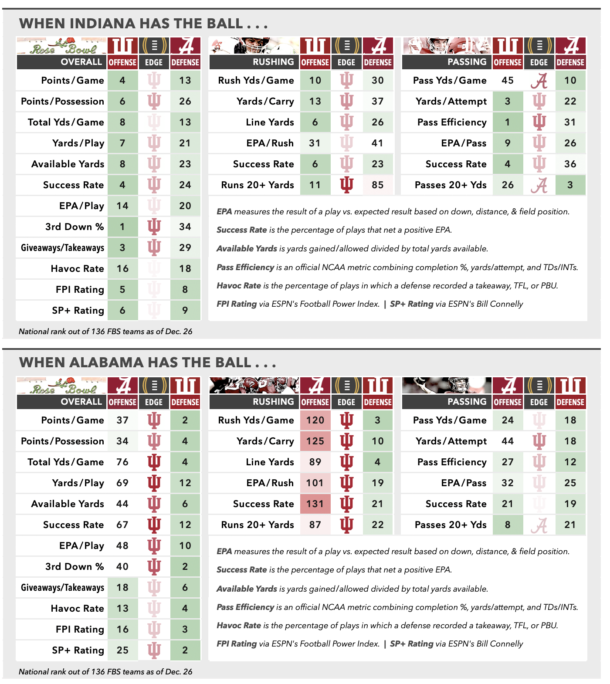
I’m not going to take up a lot of time here trying to convince a potentially skeptical SEC audience that Indiana is for real. Frankly, anyone who still needs convincing at this point is just going to have to see it on a big stage to believe it. Not that I can really blame them: Coming to grips with a confirmed basketball school as a touchdown favorite over Ala-freakin’-Bama with real stakes on the line is a little jarring for everybody, yours truly included. But the fact is, if not for the logos on the helmets, that 7-point spread would almost certainly be a lot wider.
The Hoosiers come by the No. 1 seed honestly. In 2 years under coach Curt Cignetti, they boast the best winning percentage in the FBS, their only losses coming last year against the teams that went on to play in the CFP Championship Game, Ohio State and Notre Dame. This year, they reloaded in the portal — including adding Heisman winner Fernando Mendoza — and ran the table. They beat Oregon on the road and the Buckeyes for the Big Ten title, arguably the 2 most impressive victories of the season. The rest of the schedule they demolished by an average margin of 5 touchdowns per game. They have a Heisman-winning quarterback, a top-10 defense, and no glaring weakness on either side of the ball. (Take another look at the tale of the tape: Green on every line.) Even their closest call, a Nov. 8 thriller at Penn State, was less a red flag than a confirmation of their clutch bona fides with a perfect season on the line in a hostile environment.
It is worth noting that the roster is very much an outlier in terms of baseline talent, if you define “talent” strictly by recruiting rankings. But it’s worth it mainly to marvel at the job Cignetti has done with a bunch of guys Alabama, Ohio State and Oregon never would have given the time of day. Indiana ranks 72nd according to 247Sports’ Team Talent Composite, lowest not just among the remaining Playoff teams but among nearly all Power 4 teams, period. Only Cincinnati and Wake Forest rank lower, at Nos. 73 and 74, respectively.
Unlike the lavishly-funded portal success stories at Miami, Ole Miss and Texas Tech, the transfers that make up the bulk of the Hoosiers’ 2-deep were almost all diamonds in the rough, many of whom were barely noticed by the recruiting sites out of high school. Mendoza, aspiring QB1 of the 2026 NFL Draft class, was a 2-star prospect from Miami with a single FBS offer. Among the transfer haul that followed Cignetti from his previous stop, James Madison, there are 5 former Dukes — WR Elijah Sarratt, DL Mikail Kamara, DL Tyrique Tucker, LB Aiden Fisher and CB D’Angelo Ponds — who have come in for first- or second-team All-Big Ten honors as Hoosiers; all of them except Ponds (a 3-star) started out as unranked recruits. Another All-B1G pick, safety Louis Moore, began at Indiana as a walk-on under the previous coaching staff, spent 2024 as a backup at Ole Miss, transferred back to IU, and broke out with 6 interceptions as a 5th-year senior. Another, TE Riley Nowakowski, was a former walk-on at Wisconsin. Senior DE Stephen Daley led the Power 4 in tackles for loss after transferring from MAC bottom-dweller Kent State. Leading tackler Rolijah Hardy portaled in from the Naval Academy Prep School. And so on and so forth. Even accounting for the upheaval of the portal era, it’s fair to say there has never been a motlier crew at the top of the sport.
As a result, it remains an essentially anonymous one, as well.
Unless you’ve tuned into Indiana on a regular basis, odds are the only name in the preceding paragraph you immediately recognized is Mendoza’s. As Heisman winners go, though, Mendoza belongs to the tradition of “Best Player on the Best Team” picks in a relatively forgettable race. His numbers are good but not historic; he’s not a high-wattage athlete with an elite arm or mobility; game-winner at Penn State aside, not much else on his highlight reel is going to take your breath away. He’s a reliable decision-maker with plus accuracy and a stellar track record in the few clutch situations he’s faced; he has not singlehandedly put the team on his back. Consider that Mendoza accounted for just 52.3% of the Hoosiers’ total offense for the season, a mediocre share for such a highly decorated quarterback. Compare that to fellow Heisman finalist Diego Pavia, who accounted for more than 71% of the total at Vanderbilt, or Alabama’s Ty Simpson, who accounted for more than 2/3 of all production for the Crimson Tide.
In fact, in Indiana’s biggest wins it has been the defense that has risen to the occasion. In the midseason win at Oregon, coordinator Bryant Haines‘ unit held the Ducks to 13 points on 267 total yards, both season lows by far for one of the nation’s most prolific offenses. (Oregon also scored on a pick-6 touchdown, Mendoza’s costliest mistake of the season.) Ohio State managed 10 points on 322 yards in the Big Ten title game, with OSU’s only touchdown coming as a result of a short field following another Mendoza INT in the first quarter. Even when the Buckeyes moved the chains, it was a battle. Their only other trips inside IU territory resulted in a field goal, a turnover on downs, and a missed field goal, respectively, on drives that consumed a combined 33 plays and 18 minutes off the clock.
Haines, a longtime Cignetti disciple, isn’t exactly a household name, either, but will be soon. His defenses at Indiana and JMU have especially excelled at turning up the heat on opposing passers, compensating for a lack of length up front with an effective array of slants, twists and blitzes. Take Oregon’s Dante Moore and Ohio State’s Julian Sayin, a couple of former blue-chips turned future first-rounders who were also the best-protected quarterbacks in the Big Ten this season, per Pro Football Focus — with the notable exception of the losses to the Hoosiers, where they suddenly found themselves in the crosshairs. In Oregon’s other 12 games, Moore faced pressure on just 20% of his total drop-backs, including 7 sacks; against IU, he faced pressure on nearly half of his 42 drop-backs and went down 6 times at the hands of 5 different IU defenders. In the regular season, Sayin took just 5 sacks in 9 conference games; Indiana sacked him 5 times in the Big Ten Championship alone, all 5 coming on blitzes.
Barring a couple of massive swing plays via turnovers or special teams, Alabama’s chances in Pasadena rest entirely on its ability to protect Ty Simpson, which is not a sentence that inspires confidence in anyone who has watched Bama this year. Like Moore and Sayin, Simpson is a former blue-chip with “future pro” written all over him when it all comes together. Unlike those two, keeping him clean has been a roll of the dice from one week to the next, going all the way back to the season-opening debacle at Florida State. It doesn’t help that the Tide cannot run the ball and have largely given up trying; they rank dead last in the SEC in rushing offense vs. FBS opponents, and barely managed to finish with positive yardage on the ground in their past 2 games against Georgia and Oklahoma after factoring in sacks. Statistically, Indiana is just as stiff against the run as the Dawgs and Sooners. That leaves the onus squarely on Simpson, his hot-and-cold receivers, and a maligned o-line — especially true freshman right tackle Michael Carroll — to hold up against the IU pass rush when the Hoosiers have the luxury of ignoring the ground game.
You can’t ask for a much clearer example of that dynamic than Alabama’s come-from-behind 34-24 win at Oklahoma in the first round of the Playoff. From a clean pocket, Simpson was 16-for-19 passing against the Sooners for 214 yards, 2 touchdowns and a stellar 92.9 PFF grade. (Notably, that part of his stat line included 4 completions on attempts of 20+ air yards, which had been a sore point in his game over the second half of the season.) Under pressure, he was 2-for-10 for 18 yards, 4 sacks and a grade of 50.2.
That was only a slight exaggeration of the gap between his clean/pressure performance over the course of the season.
If Simpson has time, he gives Bama a chance. If Indiana has him seeing ghosts, it could be a very long — and possibly very wet — afternoon for the Tide and old-school college football purists.
Prediction: Indiana 24 | • Alabama 19

SPORTSBOOK
• • •
Sugar Bowl: No. 6 Ole Miss vs. No. 3 Georgia (-6.5)
Kickoff: 8 pm, ET, Thursday night, Jan. 1 (ESPN).
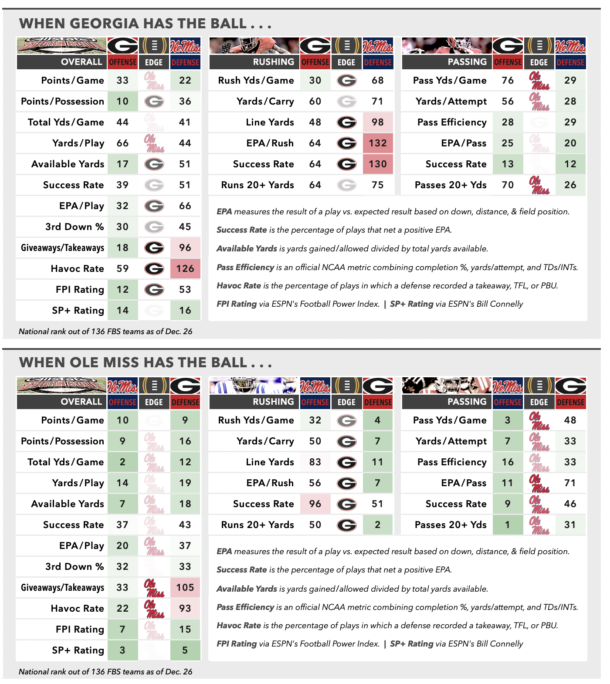
Rematches rarely follow the same script twice, especially when the teams involved are more or less evenly matched. But if any game on the SEC schedule was ripe for a sequel, it was Georgia’s come-from-behind, 43-35 win over Ole Miss in mid-October, a game that was as entertaining as it was consequential.
Ole Miss fans, of course, will object to the ending. Up to that point, though, the surrender cobras were on the Dawgs’ side. After 3 quarters, the Rebels led 35-26, having cashed in all 5 offensive possessions for touchdowns. Georgia’s offense also had scored on each of its first 5 possessions, but had to settle for a couple of field goals in the process, saddling the Bulldogs with a rare 4th-quarter deficit at home. You remember how it unfolded from there: 17 unanswered points by UGA’s offense, punctuated by 3 rapid-fire stops by the defense to secure what suddenly felt like an emphatic win.
Surely somewhere in the back of their minds Rebels fans must have imagined an alternate timeline in which they hang on to win that game, go on to finish 12-0, claim their first SEC championship since the Stone Age, and Lane Kiffin is still the coach of the No. 1 overall seed. On the actual timeline, Kiffin is long gone, Pete Golding is in charge, and nagging doubts persist about whether Ole Miss can actually hang for 60 minutes with one of the sport’s proven blue-chip contenders. The loss itself ultimately didn’t cost them much after they atoned with a convincing 34-26 win at Oklahoma the following Saturday, at which point the path to the Playoff was effectively cleared. But the suspicion that they didn’t have enough in the tank when it really counted might have cost them dearly.
For all the upheaval in Oxford, though, Georgia also comes into the rematch looking like a different team than the first time around. Before that first meeting, it had been quite a while since the Dawgs had looked like themselves — that is, like the kind of team whose week-in, week-out dominance you could afford to take for granted. By local standards, they were on an extended run of some seriously uninspired football, marked by early deficits, narrow escapes, and a handful of sobering losses. At the time, the fade-and-rally against Ole Miss was a familiar extension of that trend. In retrospect, it looks more like a turning point. The Bulldogs were in vintage form over the next 6 weeks, throttling Mississippi State by 20 points, Texas by 25, and Alabama by 21 in an unwatchable beatdown of an SEC Championship Game that very nearly knocked Bama out of the CFP field altogether. Enough drama: For a Kirby Smart team on its game, turning a highly anticipated matchup into a one-sided slog is peak performance.
After giving up 5 touchdowns in the first 3 quarters against Ole Miss, Georgia allowed a grand total of 7 touchdowns over its next 6 games, including a couple of meaningless garbage-time scores in a blowout win in Starkville. Texas’ offense found the end zone just once, as a result of a short field following a turnover; Georgia Tech didn’t find it at all in the regular-season finale; Alabama’s only touchdown in Atlanta was a too-little, too-late march aided by multiple UGA penalties that extended the drive. The ‘Horns, Jackets and Tide combined to go 9-for-37 on 3rd down. Georgia’s pass rush, a nonentity over the first 8 weeks of the season, stirred to life.
Meanwhile, Ole Miss has been posting some fairly lopsided scores of its own against second-class competition, which unfortunately included their first-round victim, Tulane. That game didn’t teach us anything we didn’t already know; even the 41-10 final score was nearly identical to the Rebels’ 45-10 win over the Green Wave in September. But it was important to establish continuity under Golding and offensive coordinator Charlie Weis Jr., who was already the primary play-caller for an attack that led the SEC in total offense each of the past 2 seasons. For the first time out, anyway, the post-Lane Rebels looked like the Rebels, too. Personnel-wise, the only significant difference on either sideline in the Superdome from the first meeting in October will be Kiffin’s absence. But between the lines, Georgia still has the dudes. Its defense will pick up where it left off against Trinidad Chambliss, ending the Rebels’ fairytale season.
Prediction: • Georgia 31 | Ole Miss 20

• • •
Orange Bowl: No. 5 Oregon (-2.5) vs. No. 4 Texas Tech
Kickoff: 12 pm, ET, Thursday, Jan. 1 (ESPN).
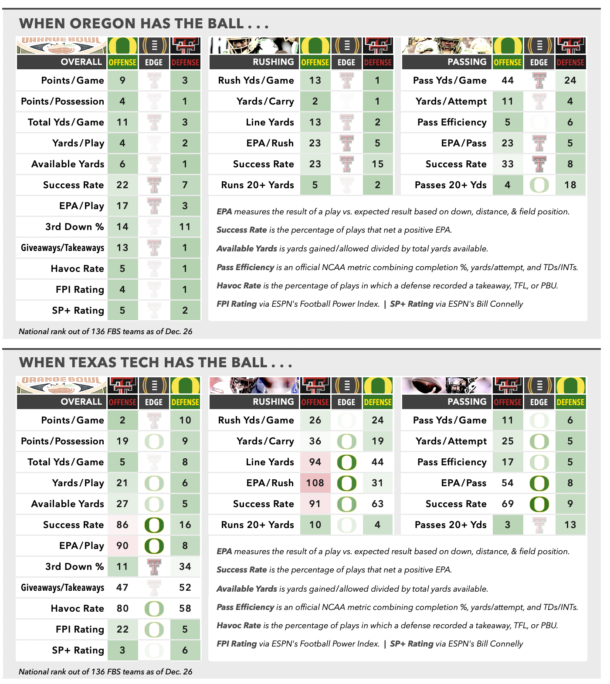
Look at all that green on the defensive side of the ledger for Texas Tech! What a time to be alive.
For most of this century, Texas Tech was in more or less open rebellion against the concept of defense, inventing a niche for itself as the Shootout Capital of College Football – an eccentric desert outpost defined by its commitment to pushing both sides of the scoreboard to the limit. There were years the gimmick achieved high comedy. Over Patrick Mahomes’ last 2 seasons on campus (2015-16), the Red Raiders went 12-13 while averaging 37.1 points in defeat, including 4 losses in which they scored at least 50. Imagine Mahomes opposite the nation’s No. 3 scoring defense. Inconceivable.
Well, through the portal all things are possible. Especially, it turns out, when a rich alum or two with more oil money than they know what to do with get the itch to invest in the trophy case. The Raiders’ well-documented offseason spending spree prioritized upgrading the talent level on defense – along the line of scrimmage, specifically – and they got what they paid for.
The headliners of the transfer haul, David Bailey (Stanford) and Romello Height (Georgia Tech), are PFF’s highest-graded edge rushers nationally, boasting a combined 135 QB pressures and 22 sacks. Bailey is a consensus All-American and future first-rounder. Inside, tackles AJ Holmes Jr. (Houston) and Lee Hunter (UCF) are the top-graded interior DL in the Big 12. In the secondary, DB Cole Wisniewski (North Dakota State) led the team in snaps, and CB Brice Pollock was a first-team All-Big 12 pick after tying for the conference lead with 5 interceptions. As a unit, Tech led the nation against the run, led the Big 12 in both sacks and TFLs, and forced more takeaways than any other FBS team.
But then, vital as the infusion of cash and talent has been to Tech’s ascent, the portal narrative only goes so far. The home-grown talent under 4th-year head coach Joey McGuire has held up its end of the bargain, too.
That includes the starting quarterback, senior Behren Morton, who was already on campus when McGuire was hired; the team leaders in all-purpose yards, sophomore RBs Cameron Dickey and J’Kobi Williams; and the other half the starting defense, including wildly productive senior LB Jacob Rodriguez, who was a dark-horse Heisman contender. Now in his 4th year in Lubbock, Rodriguez initially arrived as an afterthought after spending 1 season at Virginia as a walk-on. A late bloomer, he led the Big 12 in tackles for the second year in a row, picked off 4 passes, forced an FBS-best 7 fumbles, finished 5th in the Heisman vote, and claimed just about every other piece of hardware he was eligible to win. Along with fellow senior Ben Roberts, MVP of a 34-7 romp over BYU in the Big 12 Championship Game, the starting ‘backers bring a combined 68 career starts as Raiders to the middle of a defense that stacks up statistically against any in the country.
At full strength, the Raiders have not been challenged. Their narrowest margin of victory was 22 points, in a 29-7 win over BYU on Nov. 8. Their only loss, a 26-22 decision at Arizona State in mid-October, came with Morton sidelined by injury. Otherwise, they have been balanced, consistent, opportunistic and ultimately convincing as potential contenders.
The question, inevitably, is the schedule, which did not present Tech with anything like the kind of test it’s facing from this point on. The Raiders did dispatch 3 currently ranked opponents with ease, blowing out Utah and Houston in the early going and BYU (twice) down the stretch, for what it’s worth. The Big 12 ain’t the Sun Belt. But their other 5 conference wins all came against the bottom half of the conference standings, and the nonconference slate barely qualified as a tune-up. And while the offense was shorthanded in the lone defeat at Arizona State, the defense wasn’t; not coincidentally, an ASU attack featuring the best pass-catch combo on the schedule – Sam Leavitt and Jordyn Tyson, on the last occasion they were both healthy at the same time — was responsible for putting up more yards and points than any other opposing offense. The Sun Devils were also the only team on the schedule within 10 spots of Texas Tech in the Team Talent Composite.
As a program, Tech has never competed on a stage this big, and its ceiling with actual stakes on the line is a wild card.
For Oregon’s part, while the Ducks are obviously no strangers to the Playoff spotlight, they have some questions to answer about their own staying power. Last year, they entered the quarterfinal round as the No. 1 seed and limped out as victims of a 41-21 massacre at the hands of Ohio State, trailing 34-0 in the 2nd quarter. This year, they dropped their only date against a top-shelf opponent (Indiana), and only beat one other team that finished ranked (USC); their big, validating-at-the-time win at Penn State in double overtime doesn’t look like anything now in light of the Nittany Lions’ ensuing implosion, and their first-round blowout over James Madison might as well have been an early September snoozer on the Big Ten Network.
You know, it wasn’t all that long ago that Oregon was the nouveau riche interloper bankrolled by a free-spending alum. At this point, the Ducks have been idling at the top of the waiting list for their first national championship for so long that the idea of getting jumped in line by a freshly-minted dark horse like Texas Tech probably feels like an insult. But if they’re ever going to get off of that list and onto the podium, there’s no time like the present.
Prediction: • Oregon 28 | Texas Tech 23
Scoreboard
1st Round Record: 4-0 straight-up | 4-0 vs. spread
Season Record: 110-23 straight-up | 63-60 vs. spread
Matt Hinton, author of 'Monday Down South' and our resident QB guru, has previously written for Dr. Saturday, CBS and Grantland.