Monday Down South: More Alabama Playoff drama, plus 10th annual MDS Postseason Awards

By Matt Hinton
Published:

I’ve followed college football obsessively for 3 decades. If you count the notebooks in my childhood bedroom, I’ve been writing about it for about as long. And if there is one thing you can bank on throughout that period, it’s that there has never been a single moment’s peace about the way the sport crowns a national champion.
Across the long evolution of the postseason, as the old pell-mell bowl system begat the Bowl Coalition, which begat the Bowl Alliance, which begat the despised Bowl Championship Series, which begat the 4-team College Football Playoff, which begat the 12-team College Football Playoff, people have moaned and rebelled all the way. They have never stopped. When the current format expands again in the near future, they will go right on griping. The people who love the sport the most have usually griped the loudest. I’ve often been one of them.
Of course, some years are worse than others. Once in a blue moon you get, say, USC and Texas clearly distancing themselves from the pack. More often, though, the discourse mines the sport’s one truly inexhaustible resource: Chaos. The only thing that has changed over time is the border over which the battles are waged.
In fact, take a long enough view, and the annual gnashing of teeth each December begins to look like a time-honored tradition in its own right. From that perspective, the ultimate goal of the Format Wars is not really to create a perfect postseason model that settles all arguments and leaves everyone satisfied, but to vent the inevitable outrage a little further away from where it can really do any lasting damage.
Let me assure you, however upset anyone is over the CFP committee’s decision to include Alabama and Miami in this year’s field at the expense of Notre Dame, it could be a heck of a lot worse, and very frequently has been.
When you have lived through the conflagrations at the top of the polls in 1993, 1994 and 1997; when you have developed strong, unmovable opinions over undefeated teams that have no possibility of meeting on the field; when you have watched a combination of statistical algorithms run by amateurs override the verdict of the traditional pollsters to determine which teams will play in the National Championship Game not just once, but 3 times in a span of 4 years; when you have been confronted with the Gordian knots of 2004 and 2008; when when you have sat through an unwatchable rematch no one wanted with the title on the line; when you have seen head-to-head results and conference championships thrown out the window, and teams with perfect records snubbed at the eleventh hour, and legitimate contenders from outside the power conferences routinely turned away at the door, and spent years looking forward to the day when an actual bracket like they have in literally every other team sport on the planet would finally spare college football from its ritual humiliations … well, rushing to the barricades for the great debate over Who’s No. 10? doesn’t quite pack the same punch. Maybe I’m just getting soft.
I must be, to actually be willing to cut the beleaguered committee some slack. I admit, I’m a little bit sympathetic to the damned-if-you-do, damned-if-you-don’t nature of the job, despite its undeniable fumbling of the process along the way. The fact is, no matter where you draw the line or what process you use to do it, the team on the wrong side of that line is obligated to wage a holy war of recrimination. They raised hell when the line was between No. 2 and No. 3, they fumed when it was between No. 4 and No. 5, and they’re openly revolting now that it all comes down to deciding between No. 10 and No. 11. Eleven years ago, it was Baylor and TCU. Two years ago, it was Florida State. Last year, Alabama. This year, Notre Dame. Let the righteous fury commence. ND athletic director Pete Bevacqua wasted no time after Sunday’s bracket reveal deriding the decision as “a farce” and declaring the Irish would refuse all bowl invitations in protest.
Do they have a case? Of course. They always do. In Notre Dame’s case, the Fighting Irish have won 10 in a row, all by double digits, all but 2 of them vs. Power 4 opponents. Their 2 losses came in their first 2 games of the season against teams that eventually made the cut, Miami and Texas A&M, by a combined 4 points. They’re a top-5 team according to virtually every public-facing metric, including SP+, FPI, FEI and Jeff Sagarin. They were ranked in the top 10 in every edition of the Playoff committee’s weekly rankings until the final version on Sunday. (Not for nothing, the Irish were also ahead of Miami throughout that span in both the AP and Coaches’ polls, and still are.)
They remained at least 2 spots ahead of Miami throughout the process, and spent 2 weeks ranked ahead of Alabama before the committee’s bizarre decision to bump Bama back in front of the Irish following a narrow win at Auburn in Week 14. They remained behind Alabama on Sunday despite the Tide’s wipeout loss to Georgia in the SEC Championship Game, and fell to No. 11 behind Miami despite the fact that both the Irish and Hurricanes spent the weekend watching from the couch. I’d be telling the committee where they could shove it, too, if I had any investment in Notre Dame.
But let’s face it: Had Miami and Alabama been on the short end, both were bracing themselves to react in exactly the same way, and with equal justification. Besides ranking in the top 10 in every metric, the Hurricanes beat Notre Dame on the field, and who can argue with a head-to-head? In the end, despite its best efforts over the preceding month, the committee could not. And the Crimson Tide, in spite of their dismal closing argument in Atlanta, had earned their way into that game in the first place by surviving a significantly tougher gauntlet along the way than Miami or Notre Dame. In conference play, Bama became the first team in SEC history to beat 4 ranked opponents on 4 consecutive Saturdays, including arguably the single best résumé line of any team this season in its Week 5 win at Georgia. (It was the UGA win specifically that committee chairman Hunter Yurachek cited on Sunday to justify leaving Alabama at No. 9 while dropping No. 11 BYU following the Cougars’ equally lopsided loss to Texas Tech in the Big 12 Championship Game.)
The Tide’s only loss in conference play came against a Playoff-bound opponent, Oklahoma, by 2 points in a game Alabama dominated statistically. And what kind of precedent would the committee be setting if it punished a team that seemed safely in the field at the end of the regular season for losing a conference championship game, to the benefit of another team that didn’t even qualify for its own conference championship and another that’s not even in a conference? Greg Sankey might have one-upped Notre Dame’s bowl boycott by scrapping the SEC Championship Game as a going concern, if losing it means one of his teams could fall through a trap door as a result.
Three teams, 2 spots, zero possible outcomes that don’t leave heads exploding. I can criticize the committee’s inconsistent, nonsensical route to booting the Irish from the field, and even huff and puff a little bit against the conclusion itself. If I was in the room, I would have argued for excluding Bama on the basis of a) The advanced metrics, all of which rate the Crimson Tide slightly behind both Miami and Notre Dame; and b) The fact that the Tide bookended their season by laying of couple of massive eggs in front of the entire country. They opened by getting their butts kicked at Florida State — still the single worst loss of any bubble team — and closed by getting their butts kicked with the SEC title on the line. The team that got waylaid by Georgia on Saturday was indistinguishable from the one that fell flat on its face in Tallahassee back in August. In between, they made a living of surviving close calls, never dominating. And anyway, it’s not up to the committee to protect the dignity of the SEC Championship Game, or shouldn’t be. That’s on Bama. Losers of conference championship games have routinely dropped in the final rankings every single year of the CFP’s existence.
But that’s easy to say when I was not in the room, and I don’t envy the people who were for being tasked with a no-win dilemma. Nor do I feel the urge to bang the gavel, or declare the system “broken” because it ended up settling on a different flawed option than the flawed option I would have chosen if it were up to me. Notre Dame played 2 games vs. CFP-caliber opponents and lost them both. Beyond the head-to-head comparisons, the Irish won exactly 1 game vs. a team in the committee’s final top 25, a 34-24 win over USC in mid-October. Much of their success in the metrics owes to running up the score on the last-place team in the Big Ten (Purdue), the last-place team in the SEC (Arkansas), the tied-for-last-place teams in the ACC (Boston College and Syracuse), and a 4-8 version of Stanford. Those games accounted for half of Notre Dame’s wins. They ranked behind Alabama in strength of record, a perennial committee talking point, and lagged well behind in any version of strength of schedule. We can have these arguments till kingdom come. Irish fans certainly will be.
Notre Dame has honest beef with the way it was yo-yo’d around the rankings over the past few weeks. The committee can obviously do a lot better explaining its process, or implementing a process, since it’s not clear it really has one. Eliminating the weekly made-for-TV rankings show would be a good start, especially now that they’ve made it abundantly clear just how irrelevant the weekly pecking order is in the final evaluation. The show has never nurtured insight or transparency, only backed the committee into corners, driven conspiracies and lent credibility to cynics who deride the Playoff as the “ESPN Invitational.”
Much of the dire state of the discourse, frankly, has to be chalked up to the tenor of ESPN’s on-air talent, whose analysis is inconsistent, often dim and inescapable. That is out of the committee’s hands. But they don’t do themselves any favors by trotting out a representative 5 times a year who doesn’t seem have to the foggiest clue why the group arrived at many of the decisions it did. The more distance the CFP can put between its selection process and the network that airs and relentlessly promotes it, the better. It can also firm up its criteria, introduce clearer metrics and stick to them, and find a spokesman who is skilled at communicating how all this works to the public, all of which would go a long way toward reinforcing trust that at the very least they’re operating in good faith.
And then, after they’ve done all that, they can brace themselves for the next round of vitriol and angst to arrive right on schedule. An outbreak of cynicism and chaos is not a crisis: It’s the status quo from the moment some bored newspaperman dreamed up the idea of the “national championship” a hundred years ago. It’s the water this dumb, unruly, anachronistic sports swims in. No line has ever been drawn that will satisfy the teams that falls on the wrong side of it that they were treated fairly, and no system has ever been devised that will rank teams with wildly different strengths, weaknesses and schedules with anything like foolproof precision. Every stage of evolution, every quick fix, every tweak is an exercise in fending off the inevitable. Good faith will never be a defense against the next imbroglio. But if the best the powers-that-be can do is move the battle lines to fall between flawed teams whose inclusion is actually debatable, I will take that controversy over the ones it has replaced any day of the week.
Monday Down South Awards Show
The best of the year.
First, we begin with the official Monday Down South All-SEC teams:
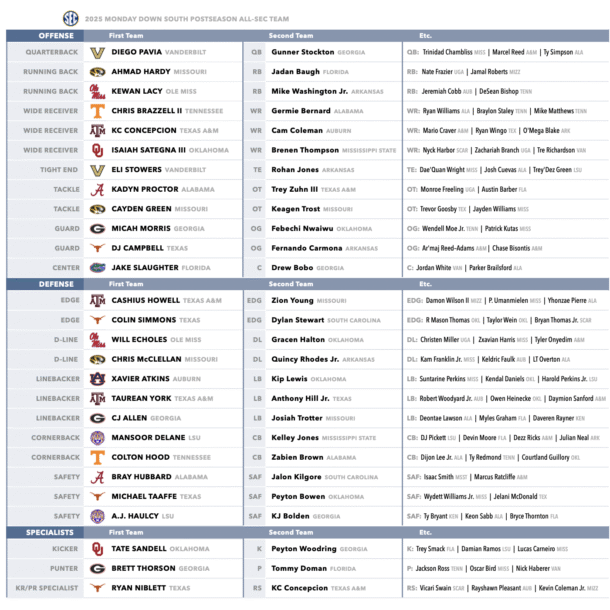
Most Valuable Player: Vanderbilt QB Diego Pavia
Valuable doesn’t quite do him justice, does it? Pavia is not just the most valuable player in Vandy history: He is arguably as valuable to the ‘Dores as any player has been to any team in the 21st Century, if not much longer. He is responsible for the biggest win in school history; the first 10-win season in school history; the first serious Heisman campaign in school history; and the dawning recognition for the first time in most of our lifetimes that it is possible for Vanderbilt to be at least momentarily relevant in football.
When he portaled into Nashville 2 years ago, he was joining a team coming off its 3rd winless season in SEC play in 4 years. At the time, it wasn’t even necessarily a given that he was going to be the starter. Now, he’s leading a ranked team that remained relevant in the Playoff discussion right up to the end to a traditional Jan. 1 bowl game. Four million people just tuned in to watch the ‘Dores blow out Tennessee in Knoxville. His head coach, squarely on the hot seat B.D. (Before Diego), just signed a 6-year contract extension. Vandy just flipped a 5-star quarterback recruit from Georgia on the eve of signing day. That is a true sentence that I just typed! Everything good that happens in Nashville for the foreseeable is downstream of the energy that Pavia brought to a completely lifeless program.
For all of those reasons, I’m already on the record endorsing Pavia to win the Heisman Trophy. At every stage, a campaign that started out as a lark gets a little closer to becoming a reality. Pavia put himself in the running with a prolific November, virtually locking up a trip to New York as a finalist. His numbers were already within spitting distance of frontrunners Fernando Mendoza and Julian Sayin before Indiana knocked off Ohio State in Saturday night’s Big Ten Championship Game — another incredible sentence to write — which shifted the Heisman betting markets sharply in favor of Mendoza. Sayin’s odds have virtually collapsed in the wake of the loss, leaving Pavia (with respect to Notre Dame’s Jeremiyah Love) as the only viable alternative to voters who weren’t convinced by Mendoza’s turn in a defensively-driven win over the Buckeyes.
If it’s a question of value, it’s no question. Pavia has accounted for more than 71% of Vanderbilt’s total offense this season, the highest individual share in the SEC. Mendoza has accounted for about 52% of Indiana’s offense. Pavia is the Commodores’ leading rusher, even after subtracting negative yardage on sacks; Mendoza has made little impact as a runner. Pavia almost singlehandedly rejuvenated a program at its nadir. Mendoza joined a stable outfit that, for all of Indiana’s historic suckitude, was clearly on the upswing after crashing the Playoff in 2024. Pavia has put Vanderbilt on the map. That alone makes him a singular figure of his era. If that doesn’t make him the most outstanding player, it’s hard to imagine much more he could have realistically done in his situation that would.
Offensive Player of the Year: Missouri RB Ahmad Hardy
Hardy started out as an overlooked recruit from a speck on the map in rural Mississippi. His only FBS offer was from Louisiana-Monroe. He didn’t fly under the radar for long.
After 1 year at ULM, he was a consensus Freshman All-American with his pick of destinations via the portal. After one year at Mizzou, he’s just a straight-up All-American, no qualifiers necessary. A compact, 210-pound thumper whose motor never stops, Hardy led the nation in rushing yards per game, generating more than 70% of his 1,560 yards after contact, per PFF. The first tackler had about as much chance of getting him on the ground unassisted as I have of getting Beyoncé’s phone number.
Again, imagine where Hardy would be if not for the portal: Toiling in obscurity in the Sun Belt, facing skepticism about his level of competition entering what will almost certainly be his final year on campus in 2026. Instead, he’s right where he belongs: Atop the list of the most decorated workhorses in America, on the verge of breaking Mizzou’s single-season rushing record.
Defensive Player of the Year: Texas edge Colin Simmons
Simmons’ breakout freshman campaign in 2024 didn’t leave a whole lot of room for growth in Year 2. But in another crowded class of productive SEC edge rushers, he rose to the top due in large part to his versatility. Of course he can get after the passer: Simmons led the league in QB pressures (53), finished a close 2nd in sacks (11) and forced 3 fumbles in opposing backfields, 2 of which led directly to Texas touchdowns. Although he lacks elite size/length at 6-3, 240, his combination of speed, technique, and motor is a scout’s dream, a quarterback’s nightmare, and a ticket to a single-digit draft pick as soon as he’s eligible.
But we knew that already after Year 1. Where Simmons has notably improved is against the run. He was the only SEC defender with PFF grades of 85+ as both a run defender and a pass rusher, and one of only four in the Power 4 ranks. No one on Texas’ roster is a threat to Arch Manning’s status as the Face of the Program, much less a d-lineman. But when the hype machine revs up for the Longhorns next year — and based on their impressive finish against Texas A&M, it’s revving as we speak — Simmons’ name on the other side of the ball deserves to carry just as much weight.
• Honorable mention: LSU CB Mansoor Delane; Texas A&M edge Cashius Howell
Special Teams Player of the Year: Oklahoma kicker Tate Sandell
Sandell, a transfer from UT-San Antonio, was as accurate as any kicker in America, hitting an impressive 23-of-24 field goal attempts in his first season as a Sooner. Only one other player, Hawaii’s Kansei Matsuzawa, finished in the top 5 nationally in field goals made and field goal percentage. For degree of difficulty, however, Standell stands alone. Fifteen of his 23 connections came from 40+ yards, including 7 from 50+ yards, best in the nation and 1 shy of the single-season D-I record from long range. He was also money for a team that would likely not be Playoff-bound without him — despite flashing a little too much thigh for Kirk Herbstreit’s taste, Sandell’s right leg accounted for the winning margins in single-digit OU wins over Auburn, Tennessee, Alabama and LSU. He’s a no-brainer All-American, and apparently a big help to have around the office:
• Honorable mention: Texas punt returner Ryan Niblett
Freak of the Year: Auburn WR Cam Coleman
Plenty of gifted college wideouts through the years have been cursed with mediocre quarterbacks. Few, though, have left the locals quite as frustrated as Auburn fans with Coleman’s failure to achieve orbit the past 2 years in an offense featuring the uninspiring likes of Payton Thorne and Jackson Arnold behind center. On paper, Coleman’s sophomore stat line (56 catches, 708 yards, 5 TDs) is indistinguishable from a run-of-the-mill possession type; none of those numbers ranked in the top 10 in the conference, although certainly not for lack of trying — his 85 targets ranked 4th. Catch him on the right Saturday, and there was no mistaking Coleman for anything less than the most uncoverable wideout in the conference, if not the country. Per PFF, no other SEC receiver had more contested-catch opportunities (20) or receptions (11), which often seemed like the only idea the Tigers had for getting their best player the ball.
Ironically, for an electric athlete known for his occasionally unreliable hands, Coleman’s last touch of the season was a fumble that effectively ended the game in the Tigers’ 27-20 Iron Bowl loss to Alabama. The question now for new coach Alex Golesh is whether it will be his last touch in an Auburn uniform.
One way or another, Coleman is set to make bank in 2026 on a team that, ideally, does not need him to make multiple epic video-game-glitch catches on a weekly basis just to register in the box score. Whether Auburn still has a chance to be that team is TBD. But if Golesh isn’t willing to do whatever it takes to keep him in the fold — up to and including soliciting Coleman’s input/approval in pursuit of a new starting QB — he’ll be well within his rights to find one who is.
Fat Guy of the Year: Alabama OL Kadyn Proctor
A fixture at left tackle from his first day on campus, Proctor entered his junior season as the sport’s resident Paul Bunyan — a specimen whose feats of athleticism at 6-7, 365-ish pounds (depending on the day and the diet) were already approaching mythical status. Once he actually got on the field, it only took a few hours for him to be humbled in a dismal Week 1 outing against Florida State. For that, I singled Proctor out as my first “Dud of the Week.” Slowly but surely, his stock rebounded, aided in no small part by a series of midseason cameos as a short-yardage back and receiver, reportedly as a reward for keeping his weight in check. You know, relatively speaking.
Proctor’s 5 touches on the season yielded 16 yards, 3 first downs, and roughly a couple million retweets, for the record. But his reputation hardly rests on gimmicks. By year’s end, he’d logged 12 consecutive games since the opener without allowing a sack or being flagged for a penalty, per PFF, which graded him as Alabama’s top run blocker and the SEC’s No. 2 overall offensive lineman for the season. Inconsistency notwithstanding, with his raw potential the door remains wide open for Proctor to play his way into the first round at the next level, where a long career has awaited since scouts first laid eyes on him as a recruit.
Most Valuable Transfer: LSU CB Mansoor Delane
A well-seasoned senior transfer from Virginia Tech, Delane made a big first impression as a Tiger, earning national Player of the Week honors in Week 1 after recording an interception, 2 passes broken up and a single reception allowed on 8 targets in LSU’s win at Clemson. After that, opposing quarterbacks had seen enough.
Delane faced just 27 targets the rest of the season, per PFF, allowing a dozen receptions, zero touchdowns and drawing zero flags for pass interference. Even when being ignored, his presence helped LSU lead the SEC in pass efficiency defense, one of the few bright spots in a mostly woeful season in Baton Rouge. Despite the lack of interest in testing him, Delane also tied for the SEC lead with 11 PBUs and 13 passes defensed, emerging as a no-brainer favorite on mock drafts in the process. Barring a stunning turn of events between now and April, he’s on track to be the first corner off the board, snapping a 4-year drought since LSU’s last first-round corner, Derek Stingley Jr., in 2022.
Breakout Player of the Year, Offense: Ole Miss RB Kewan Lacy
The Rebels were in the market for an every-down workhorse, a role they never managed to fill in 2024. Lacy was in the market for a fresh start after failing to crack the rotation as a freshman at Missouri. Another perfect portal match. A virtual unknown in August, he quickly emerged from the pack to lead the conference in touches, touchdowns and missed tackles forced, per PFF, supplying the missing piece of the offense in the process. If a postseason run is in the cards, by the end of it Lacy should be a household name. He enters the Playoff with 1,279 yards — just 289 shy of Quinshon Judkins’ single-season record.
• Honorable mention: Missouri OL Keagen Trost
Breakout Player of the Year, Defense: Auburn LB Xavier Atkins
Atkins started out at LSU, where the coaching staff managed to burn his redshirt in 2024 for the sake of just a handful of snaps. Still facing a crowded depth chart in Year 2, he transferred to Auburn with little fanfare last winter and quickly set about establishing himself as the most productive young ‘backer in the league.
Listed at just 6-0, 210 pounds, Atkins was a sideline-to-sideline presence for the Tigers, finishing as the SEC leader in solo tackles (60), tackles for loss (17) and stops, PFF’s metric for tackles that represent a “failure” for the offense (51). Among full-time linebackers, he also led the conference in QB pressures (25) and sacks (10) as a frequent blitzer. He forced 3 fumbles, and returned his lone interception of the year 73 yards against Texas A&M to set up Auburn’s only touchdown in a 16-10 loss in College Station. Undersized or not, he won’t be sneaking up on anyone in 2026, when he projects as a likely preseason All-American.
Honorable mention: Texas DB Michael Taaffe;
Rookie(s) of the Year: LSU CB DJ Pickett and Alabama CB Dijon Lee Jr.
Pickett and Lee represent the next stage in the evolution of the position: Fluid, full-service cornerbacks who can pass for wing players on the basketball team. Both were rated among the top incoming cornerbacks in the ’25 class; both boast a legitimate 6-4 frame with accompanying wingspan; neither wasted any time making their presence felt in their first year on campus. Pickett made immediate inroads in LSU’s rotation, holding his own opposite Mansoor Delane while holding opposing QBs to a 48.4% completion rate on passes in his direction, per PFF; he picked off 3 of those vs. 1 touchdown allowed at his expense. Lee arrived right on schedule in Tuscaloosa, as well, moving into a regular starting role at midseason and finishing with the top PFF coverage grade among Bama corners; he came down with 2 INTs while allowing a 46.2% completion rate. Get ready to get well-acquainted with their names over the next 2 years before they’re off to the next level.
Best position group: Oklahoma’s front 7
It took 4 years, but the transition from the high-scoring, shootout-friendly teams of the Lincoln Riley era to the defensively-driven, slug-it-out Sooners under Brent Venables is officially complete. The turnaround from basement dweller in 2024 to Playoff team in ’25 was built from the trenches up, primarily with Venables’ own recruits. In the absence of a headliner, the rotation came at opposing o-lines in waves. As a team, Oklahoma ranked among the top five nationally in rushing defense, yards per carry allowed, tackles for loss, sacks, havoc rate, and rushing success rate, holding 6 of 8 SEC opponents below 100 yards on the ground. Eleven Sooners recorded at least 5 TFLs on the year.
Down the stretch, the pass rush was also responsible for a couple of the season’s most dramatic swings plays in wins over Tennessee and Alabama, without which Venables might be entering another offseason on the hot seat. The first, a strip sack returned by R Mason Thomas for an early touchdown against the Vols, instantly reversed the momentum in that game and set the tone for an eventual 33-27 win in Neyland Stadium. The second, a 86-yard pick-6 against Bama, was forced by a blitz that short-circuited the Crimson Tide’s protection, forcing Ty Simpson to uncork an ill-advised throw into coverage with LB Kip Lewis bearing down. That was the first of 3 turnovers in Tuscaloosa (leading to a combined 17 OU points) that sparked a season-defining, 23-21 upset in a game in which the Sooners were outgained by nearly 200 yards. Now they’re due up to face the Tide again in the first round of the CFP, where they will only go as far as their capacity for harassing opposing QBs into game-changing mistakes can take them.
Overachiever of the Year: Ole Miss QB Trinidad Chambliss
A D-II All-American who portaled into Oxford as an afterthought in April, Chambliss was so obscure that, for the first few weeks after he seized the reins as Ole Miss’ starting quarterback, there seemed to be some minor confusion about whether he actually hailed from the Caribbean island nation of Trinidad and Tobago. (He’s from Grand Rapids, Michigan.) Wherever he came from, Chambliss was an instant hit, overcoming his humble origins and diminutive stature to lead the SEC’s No. 1 offense to the Playoff. The Rebels are still waiting to find out out if his appeal for a 5th year of eligibility in 2026 will be approved – and whether he’ll stick around if it is, with open speculation over the prospect of Chambliss following Lane Kiffin to LSU. But they still have at least couple more games to play before they have to worry about that. Which means, Chambliss still has an opportunity to climb into the top 5 on Ole Miss’ all-time single-season passing yards list.
Late Bloomer of the Year: Mississippi State WR Brenen Thompson
Thompson started out at Texas as a blue-chip recruit with track speed and a long queue in front of him for meaningful reps. He transferred to Oklahoma, where he spent 2 years battling a nagging ankle injury. Finally, he found his niche in his final year of eligibility as one of the league’s premier deep threats under his former OU offensive coordinator, Jeff Lebby. Thompson led the SEC in receiving yards vs. Power 4 opponents, averaging a robust 18.8 yards per catch. He also tied for the national lead (along with Ohio State’s Carnell Tate) with 7 receptions of 40+ yards, including the highlight of the Bulldogs’ season, a game-winning bomb against then-No. 12 Arizona State.
Altogether, Thompson’s 948 receiving yards for the year ranks 5th in MSU history, alongside a bunch of other names that have been mostly forgotten outside of Starkville. His might be, too. But he will not have to wonder “what might have been …”
Patrick Willis Award for Yeoman’s Work on a Bad Team: Florida RB Jadan Baugh
Every bad team needs a guy who endears himself to the diehards just by continuing to show up and looking like he wants to be there. For Florida, that was Baugh, a 230-pound sophomore grinder who kept grinding all the way to the end. He hit the century mark in all 4 of the Gators’ wins, including heavy-duty outings in October wins over Texas (27 carries for 107 yards) and Mississippi State (23 for 150), as well as a Herculean effort in the finale against Florida State: 39 carries, 264 yards, 2 touchdowns, and a fond place in local lore for delivering a satisfying end to an otherwise miserable slog of a season. With that, he became Florida’s first 1,000-yard rusher in a decade, and one of the first names on the list of guys the incoming coaching staff needs to make a serious effort to keep.
Moment of Zen of the Year
Thanks for reading another season of Monday Down South!
Matt Hinton, author of 'Monday Down South' and our resident QB guru, has previously written for Dr. Saturday, CBS and Grantland.