
By the time the dust settles, don’t be surprised if around half the conference turns to a transfer as its QB1 in 2026. If 2025 was any indication, we’re heading in that direction after 7 SEC programs did just that.
Adding quarterback transfers to start immediately has become the norm in college football. Predicting which guys will have success is next to impossible. Don’t believe that? Go back and read evaluations (or non-evaluations) of Diego Pavia and Trinidad Chambliss. Both thrived in what turned out to be ideal situations for their veteran skill sets.
Part of ranking quarterbacks (transfer or non-transfer) can be tricky because of how situation-dependent the position is. Go ask Bo Nix if he had the same surroundings at Oregon that he had at Auburn. Go ask Jayden Daniels if he had the same surroundings at LSU that he had at Arizona State. It’s often difficult to project these guys without factoring that into the equation.
With rankings, we’ll try to isolate some of that and focus mostly on who a player has been up to this point in their career. Surroundings will still come up, but it can’t be the only thing.
So, here’s how I’d rank the incoming SEC quarterback transfers (so far):
7. Landen Clark, LSU
Previous school — Elon
What’s promising — After Lane Kiffin helped turn a Division II transfer like Chambliss into one the best quarterbacks in the sport, it’s safe to say that an FCS transfer shouldn’t be seen as someone to ignore, even if he was brought in to be more of a long-term option. Mind you, Chambliss was a post-spring enrollee. Clark will get a full offseason to learn the Kiffin/Charlie Weis Jr. offense. He’s a true dual threat, having racked up double-digit TD passes (18) and rushing scores (11) in his redshirt freshman season. Accumulating nearly 3,000 yards of offense and 30 touchdowns is a promising start to a college career on any level. Arm strength isn’t going to be an issue for Clark as he transitions to the SEC.
What’s worth questioning — It’s not just that Clark did his damage against FCS competition. He also took a ton of sacks (35) and dealt with accuracy issues (67.5% adjusted completion percentage). For someone who was pressured on 38% of his drop-backs and sacked on 24.5% of those instances, he’s still learning about the mental clock needed to play the position. He knows how to buy time, but any comps to Chambliss end when you see that he had a 58.3 NFL QB rating when under pressure. Mind you, that was against mostly FCS defenses. In the SEC, that would’ve been No. 13 among qualified QBs, which would be magnified for someone who was listed at 186 pounds. Clark is a project who’ll need some key areas refined before he’s called upon to lead a Playoff contender.
6. AJ Hill, Arkansas
Previous school — Memphis
What’s promising — You’ll sense a theme with this list a bit later, but without spoiling the rest of it, know that play caller-quarterback continuity was coveted. Hill has that with Ryan Silverfield and offensive play caller Tim Cramsey. That’s an ideal positive for Hill, who played in 2 games at Memphis as a true freshman after he was a 4-star recruit. This is someone who had a vast high-level market after a high school career in which he threw for 10,651 yards and 123 passing touchdowns at Houston County High School in Warner Robins, Georgia, where he faced high-level competition. That’s extremely promising. He’s got 4 years of eligibility left, too. You can play the long game, though Hill’s size is already SEC-ready. He’s got a legitimate shot to be Silverfield’s first QB1 at Arkansas.
What’s worth questioning — It’s just a lack of experience. We got essentially 1 half of meaningful FBS football from Hill, and he was unable to lead Memphis back in a dreadful loss to a UAB team that had an interim coach. Make of that what you will. A true freshman who can’t overcome a double-digit deficit in his first career college appearance is hardly destined for failure. He’s just seen 2 career blitzes at the college level, and with surroundings that might not be built for Year 1 success, Hill has more questions than answers.
5. Kenny Minchey, Kentucky
Previous school — Notre Dame
What’s promising — Hey, there’s a reason why Kentucky poached him from Nebraska. Say what you will about missing out on the Sam Leavitt sweepstakes, but when Will Stein found his guy, he didn’t take “no” for an answer. Minchey’s appeal stems from him nearly winning the Notre Dame starting job, which ultimately went to CJ Carr who became one of the better quarterbacks in the sport in the latter half of the season. Once upon a time, that described Joe Burrow’s time at Ohio State before he hit the portal. Minchey’s skill set suggests that everything is on the table for Stein. Not only can he move, but he can throw on the move. He’s entering an offense that was bulletproof with 3 different transfer quarterbacks under Will Stein at Oregon, which is exactly why there’s more optimism than skepticism for someone who has minimal college reps.
What’s worth questioning — Minchey became to this 2026 cycle what Beau Pribula was to last year’s cycle. As in, he was talked about more nationally while he was in the portal and the issues with the system than his on-field play. Unlike Pribula, however, Minchey didn’t have a role in the offense during his time as a backup. This is someone with 32 career drop-backs through 3 years at the FBS level, and that aforementioned clip of him escaping the Navy pass-rush was 1 of 12 pressured drop-backs in his career. He’s got 2 career touchdowns, both of which were rushing scores in garbage time during Notre Dame blowouts. He’s far less experienced than Stein’s Oregon quarterback transfers, but entering Year 4 at the college level, the new Kentucky coach is clearly sold that he’s ready for the opportunity in 2026.
4. Austin Simmons, Mizzou
Previous school — Ole Miss
What’s promising — If you know Simmons’ story, you know he’s extremely unique. This is someone who graduated from Ole Miss at 19 years old. He learned to drive while he was at Ole Miss because he reclassified by 2 years and played multiple sports upon arrival. He represented Ole Miss at SEC Media Days as the heir apparent to Jaxson Dart, but then injuries and ball-security issues opened the door for the Chambliss story to unfold. The rest was history. Not being better than Chambliss was hardly an indictment of Simmons, who delivered the biggest drive of Ole Miss’s 2024 season when he relieved a briefly injured Dart against Georgia. The southpaw has been getting compared to Tua Tagovailoa since he was in middle school, and not just because they share a striking physical resemblance. He can stretch the field in ways that Mizzou couldn’t in 2025 with Pribula and Matt Zollers. That’ll be a huge asset for Doak Walker Award finalist Ahmad Hardy, who would prefer not to see 8-men boxes on every snap.
What’s worth questioning — Simmons might’ve gotten “Wally Pipped” by Chambliss, but let’s not forget that in both of his 2 favorable matchups to start the season, he had 2 first-quarter interceptions. That’s extremely atypical for a Kiffin-Charlie Weis Jr. offense. Typically, that opening script carves up opposing defenses. Simmons would’ve gotten his job back when he returned to the lineup if he had been better in those spots. At Mizzou, he’ll have an offensive coordinator in Chip Lindsey who didn’t produce a top-100 passing offense at Michigan with decorated true freshman Bryce Underwood. The Wolverines tied for dead last in the FBS with just 2 completions of 40 yards. Are we sure that Simmons, who didn’t look like a finished product in a limited sample size at Ole Miss, will have his downfield passing game maximized by Lindsey? That question will linger in Simmons’ second attempt to become an SEC starter.
3. Deuce Knight, Ole Miss
Previous school — Auburn
What’s promising — Yes, it’s promising that Knight is a former 5-star recruit. But recruiting rankings aside, we saw 1 game of him as a starter, and he got every blade of grass he wanted against FCS Mercer. His 9 rushes for 162 yards and 4 touchdowns didn’t exactly quiet the hype that the southpaw had upon arrival on The Plains. His run-game prowess, coupled with his 6-4 frame, is all sorts of promising. When he did throw against Mercer, he showed a willingness to work through his progressions and attack downfield. Given how frustrating Auburn’s quarterback situation was in 2025, many wondered if Knight being a 3rd-stringer was perhaps among the biggest missteps of the Hugh Freeze era. Needless to say, that won’t be an issue for Knight in Oxford, where he’ll work with John David Baker after he led a top-25 scoring offense at East Carolina with the mobile, but not as dynamic, Katin Houser.
What’s worth questioning — Knight has as many reps vs. Power Conference competition as you and I do, and in his lone game vs. FBS competition (Ball State was barely that), PFF charted him with 3 turnover-worthy plays on 8 drop-backs in relief. Make of that what you will. What’s clear is that we don’t know what that mental clock will look like in SEC situations yet. As promising as the Mercer game was, a year under Freeze doesn’t exactly guarantee that Knight got proper development to become a steady QB1 in 2026. Given the pending Chambliss eligibility situation, it remains to be seen if Knight will be called upon to be that guy in his new home. It’s worth noting that Knight did take his Ole Miss visit immediately after the news came out the Chambliss had his waiver for another year of eligibility denied by the NCAA, and it would now be up to an appeal process for him to return. Either way that shakes out, Knight’s development will be an intriguing topic of discussion in 2026.
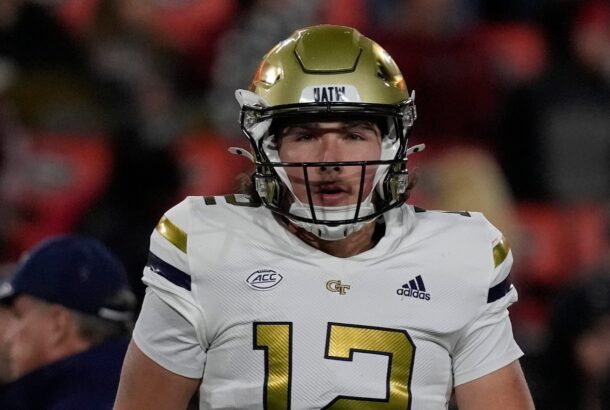
2. Aaron Philo, Florida
Previous school — Georgia Tech
What’s promising — The guy who broke Trevor Lawrence’s Georgia high school football record for passing yards (13,922) is going to be entering Year 3 with his offensive coordinator, and the only thing that prevented him from being a Power Conference starter was Haynes King, AKA one of the best quarterbacks in the sport during his time at Georgia Tech. New Florida offensive coordinator Buster Faulkner recruited Philo to join him in Gainesville, where we know he’ll look different than King did. That feels obvious, though Philo did flash promise with 5.8 yards per carry on 16 attempts in 2 years. He can scramble — he had the game-winning touchdown run on a scramble in the final minute against NC State in 2024 — but he’s more likely to use his mobility to extend plays and keep his eyes downfield. We saw Philo used in a 2-quarterback system as a true freshman in the Miami win in 2024 when King was banged up and unable to attack downfield. Philo was expected to be King’s replacement at Georgia Tech, and it was seen as a massive loss when he hit the portal.
What’s worth questioning — I sound like a broken record with these quarterbacks, but the biggest knock is experience, or lack thereof. Philo earned the backup job as a true freshman in 2024 and got reps because King was a human battering ram, but he also didn’t attempt a pass against FBS competition in 2025. He’s been sacked once, so we don’t know what he’ll look like in the 4th quarter of a game in which he’s taken 4-5 sacks. There could also be some mechanical things for Faulkner to figure out with Philo, like avoiding how to not drift and throw off his back foot. Fortunately for Florida, Faulkner already knows the areas where Philo can get better, but what’s a bit more of an unknown is how he reacts once there’s a true scouting report on him. Both of those things were an issue for his predecessor, DJ Lagway. Philo’s path to becoming an upgrade includes him checking those boxes in Year 1.
1. Byrum Brown, Auburn
Previous school — USF
What’s promising — Thirteen quarterbacks in FBS history have registered 3,000 passing yards and 1,000 rushing yards in the same season (H/T The Next Round). Brown is one of them. He finished 2025 with the most scrimmage yards/game (347.2) of anyone in the FBS. On top of that, he’s working with the same offensive-minded head coach/play caller that he’s had for the last 3 seasons, the most recent of which yielded a top-5 scoring offense in the country. You won’t find a quarterback transfer with more continuity than what Brown has with Alex Golesh, who also brought over a bunch of the USF skill players. Brown only took 15 sacks and, if you take away that yardage, he racked up 1,107 rushing yards, 702 of which came after first contact. That’s no small feat for someone who was also No. 6 in the FBS in QB rating. Brown is an established, dynamic dual-threat quarterback unlike any that Auburn has had in the last decade.
What’s worth questioning — It’s lazy to just say that the competition level is the biggest question mark with Brown. We watched quarterbacks like Pavia and Chambliss take the SEC by storm upon arrival, so surely playing in The American shouldn’t be seen as some barrier to entry for Brown. I do, however, wonder what his game will look like against defenses that are better at wrapping up in space. I mentioned those rushing yards after first contact as a positive, but I wonder if he can still be as effective of a player if he’s not breaking tackles and keeping plays alive as often as he did as USF. He only had an adjusted completion percentage of 52.8% under pressure, which would’ve ranked dead last among qualified SEC quarterbacks in 2025. Under pressure, he had an NFL QB rating of 68.5, which would’ve ranked No. 11 in the SEC between Jackson Arnold and LaNorris Sellers. That’s the area of his game that’ll need work if he wants to follow in the footsteps of Pavia and Chambliss.

Connor O'Gara is the senior national columnist for Saturday Down South. He's a member of the Football Writers Association of America. After spending his entire life living in B1G country, he moved to the South in 2015.