The SEC had perhaps its wildest-ever coaching carousel this season as (at least) 6 teams will have new head coaches in 2026.
That’s an all-time record for the league both in terms of number of new hires as well as turnover percentage. The previous highest turnover mark was set in 2018, when 5 of the SEC’s 14 schools changed coaches.
All the movement from this year’s cycle got me curious — what are the best coach hiring cycles in SEC history?
Before we can answer that, let me establish some ground rules. First, I’m only considering cycles since 1990. That’s somewhat of an arbitrary cut off for the modern era of SEC football, but it does give us 35 years of coaching cycles to analyze.
You’ll notice a couple of big names like Nick Saban and Kirby Smart are missing below. That’s because neither were a part of a great “class” of coach hires. Saban was the only SEC hire in 2007. Smart was 1 of 3 SEC coaches hired in 2016, but his counterparts (Will Muschamp and Barry Odom) both had regrettable tenures. For a “class” to make it on to this list, I’m requiring at least 2 successful coach tenures.
Best SEC head coach hiring classes (modern era)
With that in mind, let’s dive in. In chronological order, here are the 5 best SEC head coach hiring cycles since 1990:
1990
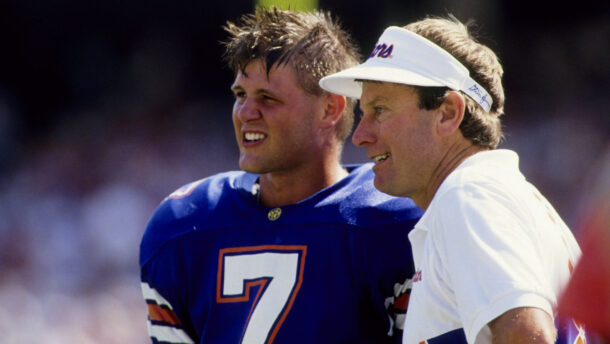
The 1990 class includes 3 names: Steve Spurrier (Florida), Gene Stallings (Alabama) and Bill Curry (Kentucky).
Spurrier makes this class notable all on his own. He led Florida to its first-ever national championship in 1996. Spurrier is also the only coach in program history to ever eclipse 75 total wins (he finished with 122).
Stallings was also one of the best coaches of the 1990s. He led Alabama to a national championship and a perfect 13-0 season in 1992. Stallings also won about 81% of his SEC games while in Tuscaloosa, which was a significant bump over what Alabama achieved in the prior decade.
Curry left Alabama for Kentucky, which is why the Tide hired Stallings. Curry was at Kentucky for 7 years and never posted a winning record in SEC play. However, his performance was average relative to what Kentucky had been accustomed to over the previous decade.
1993
It didn’t take long for another SEC hiring cycle to produce multiple national champions. In 1993, Tennessee hired Phillip Fulmer and Auburn hired Terry Bowden. Fulmer’s tenure in Knoxville was historic. He led the Vols to the 1998 national championship and a couple of SEC titles. Fulmer is the second-winningest coach in Tennessee football history behind the guy for whom its stadium is named (Robert Neyland).
I’ll also note here that Fulmer’s inclusion in the 1993 class is perhaps debatable. He was Tennessee’s interim head coach to start the 1992 season as head coach Johnny Majors dealt with significant health issues just weeks before the start of that campaign. Fulmer was named Tennessee’s next permanent head coach after the 1992 season, thus I’m classifying him as a 1993 hire.
Bowden’s Auburn tenure is also worth acknowledging. The Tigers went 11-0 in his first season in 1993 and claim a national championship from that season (although they finished No. 4 in the AP Poll and were ineligible for the postseason due to NCAA sanctions). Bowden’s first 2 seasons were excellent, but the Tigers fell off quickly after a hot start and he resigned midway through the 1998 season.
Danny Ford was the last member of the 1993 SEC hiring cycle as he was tapped by Arkansas to replace Jack Crowe. Ford’s tenure was highlighted by an 8-win season in 1995, but was otherwise unremarkable.
1999
The 1999 class was just solid. Tommy Tuberville (Auburn), Lou Holtz (South Carolina) and David Cutcliffe (Ole Miss) all exceeded expectations in one way or another.
Tuberville had a great run at Auburn that included a 13-0 season in 2004. The Tigers weren’t afforded a chance to play for the BCS Championship that season, but have since retroactively claimed a national title for their undefeated campaign. Auburn finished ranked in the top-25 in 6 of 10 seasons under Tuberville.
South Carolina was Holtz’s final head coaching job. Things didn’t get off to a great start as the Gamecocks went 0-11 in 1999. But Holtz turned things around and led South Carolina to a pair of postseason appearances in 2000 and 2001. By the time he turned the program over to Steve Spurrier, Holtz had won about 40% of his SEC games — a modest uptick over what the program accomplished over the prior decade.
David Cutcliffe took over for Tommy Tuberville at Ole Miss and had a solid tenure in Oxford. He led the Rebels to 5 consecutive bowl-eligible seasons and a 10-win campaign in 2003. That was Ole Miss’s first double-digit win season since 1971.
2005
The 2005 class has perhaps the most famous group of coaches to join the SEC in one cycle. Urban Meyer (Florida), Les Miles (LSU), Ed Orgeron (Ole Miss) and Steve Spurrier (South Carolina) were all hired during this cycle. All 4 of those coaches won a national championship at some point during their respective careers.
Meyer is one of the best coaches in college football history. He won 2 national championships at Florida and likely would have made a run at Steve Spurrier’s all-time program wins record, but he only spent 6 years in Gainesville before stepping down. Still, Meyer delivered 3 13-1 seasons during his abbreviated run with the Gators.
Miles succeeded Nick Saban at LSU and had a very successful tenure that was highlighted with a BCS National Championship in 2007. Miles registered 7 double-digit win seasons during his time in Baton Rouge, although a couple of those campaigns were later vacated by the NCAA.
While Orgeron would go on to have success at LSU later in his career, his first head coaching job at Ole Miss didn’t go very well. He was in Oxford for 3 seasons and didn’t qualify for a bowl in any of them. Orgeron won just 12.5% of his SEC games while at Ole Miss.
Spurrier had a successful stint as South Carolina’s head coach. He inherited a program that had only won 35.4% of its SEC games over the decade before he was hired. Spurrier led South Carolina to an above .500 record in conference play over his 10+ seasons in charge. Most notably, South Carolina won 11 games in 3 consecutive seasons (2011-13) under Spurrier. As of 2025, South Carolina still only has 4 double-digit win campaigns in program history (with the other coming in 1984). With 86 wins, Spurrier is the winningest South Carolina coach of all time.
2020
The 2020 class is the best recent SEC coach hiring cycle by a good margin. It includes Mike Leach (Mississippi State), Lane Kiffin (Ole Miss), Eli Drinkwitz (Missouri) and Sam Pittman (Arkansas).
Leach is one of the most influential coaches in college football history. His only SEC job was at Mississippi State — a post he held from 2020 until his tragic passing in late 2022. Leach won 8 games in his final season in Starkville and had the Bulldogs at No. 22 in the final CFP rankings that year.
Kiffin’s departure from Ole Miss has undone much of the goodwill he built up over 6 years in Oxford, but his tenure with the Rebels was undeniably successful. Kiffin won 10+ games in 4 of his final 5 seasons at the helm. That stretch included the program’s first-ever 11-win regular season in 2025.
Drinkwitz has turned Mizzou into a program that’s capable of competing for a spot in the 12-team Playoff each season. Mizzou won 10+ games in 2023 and 2024 before injuries caused an 8-4 campaign in 2025. Still, Mizzou seems to be in excellent shape moving forward thanks to Drinkwitz’s efforts.
Pittman was fired by Arkansas midway through 2025, but his tenure wasn’t a complete failure. He won 9 games with the Razorbacks in 2021 and helped guide Arkansas to 3 bowl games while he was at the helm.

Spenser is a news editor for Saturday Down South and covers college football across all Saturday Football brands.