Why Texas basketball should be considered a top 5 roster heading into 2026-27

By Ethan Stone
Published:
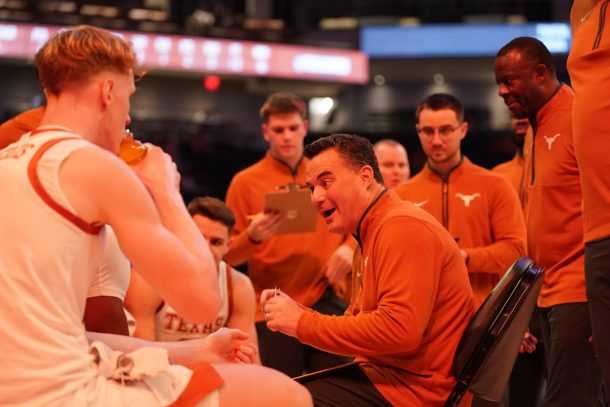
I’m already fascinated by the roster Sean Miller has put together over in Austin.
The Longhorns’ coaching staff wasted zero time following their surprise Sweet 16 run. With Tramon Mark and Jordan Pope out of eligibility and Dailyn Swain poised for a potential lottery selection in the upcoming NBA Draft, Miller and Co. secured star center Matas Vokietaitis — who led Texas’s charge in the NCAA Tournament — and put together what currently stands as the No. 2 transfer class in the country.
I’m not saying they’re locks to win the SEC or anything — that would be a silly thing to say on April 30 — but it’s tough not to allow myself to think this is a top 5 roster in the sport when taking a closer look at its construction and how the pieces appear to fit together. This Longhorns squad features a proven star returner, promising defensive potential, complementing play styles from high-quality transfers and intriguing young talent.
Let’s take a deeper dive.

Isaiah Johnson, David Punch and Matas Vokietaitis highlight a loaded top unit
While Texas is likely to add at least one more transfer, it’ll almost certainly be a depth piece. Apart from Florida and Duke, you’ll be pressed to find a better starting 5 than what Texas has in the boat so far.
It should look something like this:
- PG: Isaiah Johnson (Colorado transfer)
- SG: Austin Goosby (247Sports No. 19 prospect) OR Mikey Lewis (Saint Mary’s transfer)
- SF: Elyjah Freeman (Auburn transfer)
- PF: David Punch (TCU transfer)
- C: Matas Vokietaitis
Right away, the most dangerous aspect of this Texas team is its 1-2 punch (I’ll be here all week) in the frontcourt. Best of luck scoring in the paint against 7-foot Vokietaitis and power forward David Punch, who averaged 2.2 stocks (steals + blocks) per game last season for TCU as one of the 15-20 most impactful defenders in college basketball.
Punch is a physical marvel. He can jump straight out of the gym and possesses a smooth touch around the rim. He’s won’t shy from putting his shoulder down and going to work, but he also has an impressive bag for a player standing at 6-foot-7, 250 pounds.
The offensive potential of this duo is tantalizing. Vokietaitis was one of the most efficient scorers in the country last season (61.9 FG%, ranked 12th in CBB) and thrives through contact. He can put the ball on the deck but often uses his size to get to the free-throw line or work a bucket with his back to the basket.
If you’ve made it this far, I’d assume you’ve seen the guy play. He could be one of the 10 best players in the sport next season if his development continues on the path it’s on.
By the way, Punch and Vokietaitis combined to make 299 free throws last season at an average clip around 67%. So even if it isn’t quite their day around the basket, the duo’s sheer size and physicality are always weapons, too. It stands to reason those free-throw numbers could be bumped up to 70% or higher.
Isaiah Johnson is going to be tasked with feeding Punch and Vokietaitis down low as often as possible, but he’s perfectly capable of dropping 20 points in his own right. He broke Colorado’s all-time freshman scoring record and was considered one of the best scoring guards in the transfer portal when signed by the Longhorns.
Johnson fits in perfectly with both frontcourt stars in that he’s entirely unafraid to put his body on the line if it means getting to the basket. He boasts excellent shot selection, made 160 free throws and averaged 16.9 points per game in Year 1 against Big 12 competition.
Most importantly, Johnson is careful with the basketball — his 11.3% turnover rate ranked 339th among qualified players, per KenPom. Seeing as there were around 5,000 players in college basketball last year, that’s pretty damn good.
Notably, Johnson hit 58% of his shots within the 3-point arc, which is just a silly number for a 6-1 guard who weighs 170 pounds. He wasn’t an elite defender by any means, but a year of experience under his belt and the mere presence of Punch and Vokietaitis in the paint should provide a boon heading into Year 2.
Depth and Potential. Everywhere.
Johnson, Punch and Vokietaitis make up a lethal top 3, but true contenders 1) are deep and 2) can beat you in several different ways. We’ll have to wait and see on point 2, but this Longhorns unit is already deeper talent-wise than last year’s squad that made the Sweet 16.
Texas’s starting role at the 2-spot, in my opinion, should be Austin Goosby’s to lose. The top-20 prospect showed a great feel for the game at the high school level and is just too talented offensively to not start at some point in 2026-27. With his potential, why not let him loose Day 1 to give him as many early reps as possible before SEC play?
Especially considering Mikey Lewis is a perfect candidate to thrive as Texas’s first man off the bench…
Lewis’s best performances will have you thinking he’s a first-team All-American, though he had to settle for first-team All-WCC last season at Saint Mary’s. While a skilled offensive player, Lewis (39% FG%) is definitely streaky and was inefficient for a Gaels team that asked him to do much more than Sean Miller and Co. will in Austin. Nevertheless, Lewis off the bench should be a scary sight for opposing teams.
Defensively, there’s even more to like about Lewis. The former Gael, by nature of playing for Randy Bennett, was required to give maximum effort on defense and he did it without fouling, averaging just 2 fouls per 40 minutes. He picked up more than 3 personal fouls in a single game just once last season.
Finally, there’s Elyjah Freeman, who should snag the last starting spot thanks to his length, elite defense and fascinating potential to take a leap in Year 2 of Division I ball.
Freeman played for Auburn last season after a stint at DII Lincoln Memorial and his improvement from November to March was apparent. He started the final 10 games of the year, leaning on his athleticism to make a significant impact on defense while grabbing boards left and right (6.8 rebounds per game across those final 10 starts). He’s projected by EvanMiya to be the 2nd best defender on the team behind Punch.
“Explosive” doesn’t do Freeman’s bounce justice, and there’s so much to like about what he brings to the table for the Longhorns. If not Goosby, Freeman may be the X factor for this team.
Speaking of defense, Tennessee transfer Amari Evans figures to round out the top 3 defenders on the team alongside Punch and Freeman.
Evans posted a 2% block rate and 4% steal percentage at Tennessee as a freshman, but he’s more than just a physical defender. He was a capable scorer when turned loose in lieu of Vols 5-star freshman Nate Ament last season, scoring 16 points against Arkansas and 24 against Vanderbilt. There’s definitely another step for Evans’ offensive game to take.
We’ve named 7 solid players so far and top 40 freshman Bo Ogden is a good candidate to become the 8th member in the rotation. The freshman wing looks to be a better shooting option compared to Freeman, Goosby and Evans, with a confident 46% stroke from outside in the high school ranks. He’s also a next-level passer and shows toughness that Miller mentioned should translate to the next level sooner rather than later.
There are a few wild cards to note in passing. First, 6-foot-9, 240-pound forward John Clark did not play for Texas last season but fits the mold of the depth Miller is looking for behind Vokietaitis and Punch. The grouping of Clark, 7-footer Lewis Obiorah and incoming freshman Coleman Elkins should be able to produce at least one quality backup in the frontcourt.
Freshman shooting guard Joe Sterling is a name to keep in the back of your mind, too. Texas isn’t really built to fill it up from range this coming season, but Sterling is a knockdown 3-point shooter. I’m not sure he has the physical tools to see legitimate minutes in SEC play this season, but it helps to have a guy who averaged 22 points per game on 43% shooting from 3 on the roster.
A noteworthy concern and final thoughts
Every team has a flaw, and on paper these Longhorns are no exception.
The obvious downside to this roster is a lack of consistent shooting outside of Isaiah Johnson. Lewis was a fine shooter at Saint Mary’s — he hit 67 3-pointers at a 37% clips last season — but was all over the place in terms of game-to-game results. He ended 17 games last season under 30% from range compared to 10 such games from Johnson, for example.
As mentioned, Sterling and Ogden could help those numbers, but freshman production is never guaranteed in the SEC. Elyjah Freeman was a fine 3-point shooter at Auburn, but 35-for-102 on the season isn’t exactly filling it up. Punch, Vokietaitis, Evans and Goosby are all non-shooters.
For a few reasons, I’m perfectly fine overlooking this reality. Sean Miller’s teams would historically much rather work inside and punish you at the free-throw line and in the paint than wear you down from outside. Last year’s Sweet 16 team, Miller’s Elite 8 team at Arizona in 2015 and the final 2 teams of his first stint at Xavier (Elite 8, Sweet 16) all ranked within the top 30 in free-throw rate, and this team could end up within the top 5 when it’s all said and done.
Ethan Stone is a Tennessee graduate and loves all things college football and college basketball. Firm believer in fouling while up 3.