The AP Top 25 preseason poll was released on Monday, the surest sign yet that college football is right around the corner.
The AP Poll is often maligned as meaningless to the on-field product, especially in an era with committee ranking shows that take up a lot of oxygen on Tuesday nights in November.
Still, I find there to be plenty of utility in the AP Top 25 — particularly in the first and final editions of each campaign. The poll has been running for decades and is steeped in tradition. The data points we get each week may not be a perfect reflection of reality, but they are a consistent measure of perceived team strength that can be tracked across any college football season since 1936. There’s beauty in that. There are trends we can analyze, too.
To that end, I broke down preseason and postseason AP Polls dating back to the beginning of the BCS era in 1998. That’s a 28-season sample full of potential takeaways.
The average preseason ranking of eventual champion
The AP Top 25 does a pretty good job of identifying national title contenders. Since 1998, the mean preseason ranking of eventual national champions is 6.1. That’s already a pretty good starting place, but the median is even more impressive at 3.
The mean dips to 6.1 because there have been a few title teams to come from the back half of the ranking. That includes Indiana, which started last season at No. 20. However, in this 28-year sample size, only 3 teams have been ranked outside of the top 15 to start the year but went on to win the championship — 2000 Oklahoma and 2010 Auburn are the others.
Prior to 2025 Indiana, the preseason AP Poll had included the eventual national champion in its top 6 for 11 consecutive seasons.
One more tidbit — the No. 2 ranking has been the most predictive of national champs since the start of the BCS era, producing 9 eventual champions. This year, the preseason No. 2 team is Oregon. Teams with the No. 1 ranking have only won the title 3 times and none have done so since Alabama in 2017.

Biggest underachievers historically
There are a number of ways you can measure this, which we’ll get to below. The first method I like: How many times were you ranked in the preseason AP Top 25 but left out of the postseason poll?
By that metric, Wisconsin and Texas A&M take the cake. Both teams have been left out of the final AP Poll after starting the season ranked a whopping 10 times.
The Aggies have been particularly poor at living up to expectations — they’ve crashed out of the top 25 in 10 of their 15 seasons where they earned a preseason ranking. The 2025 season — which saw them start 19th and finish 8th — snapped a streak of 4 consecutive seasons where they fell out of the top 25 during the season.
Texas A&M isn’t the only SEC team with a significant record of underachieving. By another metric — what was your average ranking in years that you started in the top 25 but finished unranked? — LSU is at the bottom of the list. The Tigers have pulled an Aggie 8 times since 1998 with an average preseason ranking of 10.9.
Nebraska isn’t getting off scot-free, either. The Huskers hold the distinction of the biggest average drop in the AP Poll in seasons where they both started and finished ranked (minimum 5 such seasons since 1998). Nebraska’s delta under that criteria is 5.4, showing the Huskers consistently underachieved preseason expectations even in years where they finished ranked.

Subscribe to the Saturday Football Newsletter — Get the latest news and updates on your team, your conference, and the college football nation straight to your inbox.
Having trouble seeing the signup form? Some privacy or ad-blocking tools can prevent it from loading. You can subscribe directly here.
Biggest overachievers
By flipping this idea on its head, we can look at the AP Poll’s biggest risers over the past 3 decades or so.
Boise State has 9 seasons where it started the year unranked but finished in the top 25, leading all programs over that span. That’s not too surprising, though — mid-major teams are often unranked entering the year but will squeak into the back half of the top 25 late in the season. The Broncos have done that more than anyone else.
Much more surprising is that Mississippi State has finished in the top 25 7 times over that span and the Bulldogs weren’t ranked in the preseason poll of any of those campaigns. No high-major team has been discounted more than the Bulldogs. It’s worth noting, though, that Mississippi State hasn’t paid off the good faith from voters when it gets it — the Bulldogs are 0-for-3 on finishing in the top 25 when granted a preseason ranking.
The AP Poll is getting less predictive
The AP Poll is getting worse at predicting the sport’s best teams as time goes on, not better. Now, that’s probably not entirely the fault of the voters — college football is much tougher to predict in the transfer portal era. There’s less continuity at the top of the sport than ever before.
You can see this by looking at AP Poll performance over the past 5 seasons. The average number of teams to appear in both the preseason and postseason Top 25 over that span is 12.4. Put another way — the preseason AP Poll will correctly predict roughly half of the final top 25 in the transfer portal era.
But before 2021, the AP Poll was much more predictive. From 1998 through 2020, an average of 15.4 teams retained their place in the final AP Top 25. The lowest number of retained teams from 1998 through 2020 in any given season was 13 (2010), which is still more than the modern-era average.
As much as college football has changed, this year’s poll looks like the status quo
You can hardly have a conversation with someone about college football without the sport’s seismic changes coming up in the first 30 seconds. The transfer portal. NIL. Rule changes. Court orders. Scheduling formats. Twelve team playoffs. Bowl season.
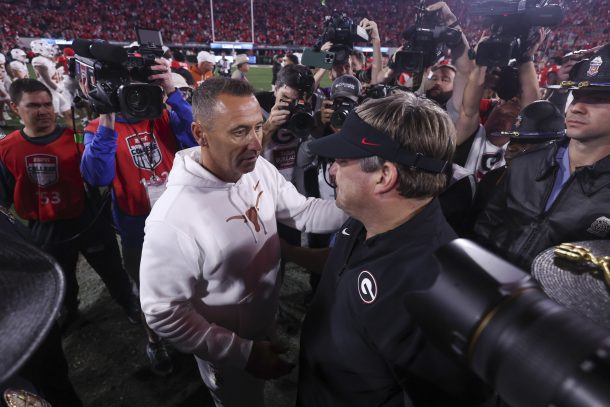
And yet, look at the top 5. Ohio State is in there for the 18th time since 1998, the most of any program. Georgia and Texas are in there too, for the 12th and 11th times, respectively. Oklahoma is in the top 10 for the 21st time, which is second most over this span to Ohio State’s 23.
Even as the sport comes to grips with the fact that a program like Indiana can win it all in this era, there are still slices of familiarity mixed in with the chaos.
Like our coverage? Make SDS a preferred source in your searches!

Spenser is a news editor for Saturday Down South and covers college football across all Saturday Football brands.