Alabama’s offense woes: Penalties, predictability show up at wrong times

By Will Heath
Published:
Two weeks ago I wrote that I sometimes feel like Lane Kiffin’s offense is specifically designed to drive people like me crazy. With Alabama now going into a bye week after a harrowing encounter with Tennessee, I feel compelled to clarify that statement.
Alabama fans, frankly, are used to the type of offense that is built around brutality. Dating back to the days of Mal Moore’s wishbone in the 1970s, Alabama developed a reputation and identity as a football team that physically dominates its opponent at the line of scrimmage, eventually wearing them out and breaking their will in the fourth quarter. It’s an offensive philosophy that has two missions: controlling the clock and not getting the home team beat.
And it often can be maddening to watch, as a fan. During the 1990s, Alabama fans watched most of the rest of the SEC modernize its offense – following the lead of Steve Spurrier’s Florida teams – while the Tide seemed stuck in the past. Alabama never lacked for talent, but it didn’t seem terribly interested in putting that talent in a position to succeed.
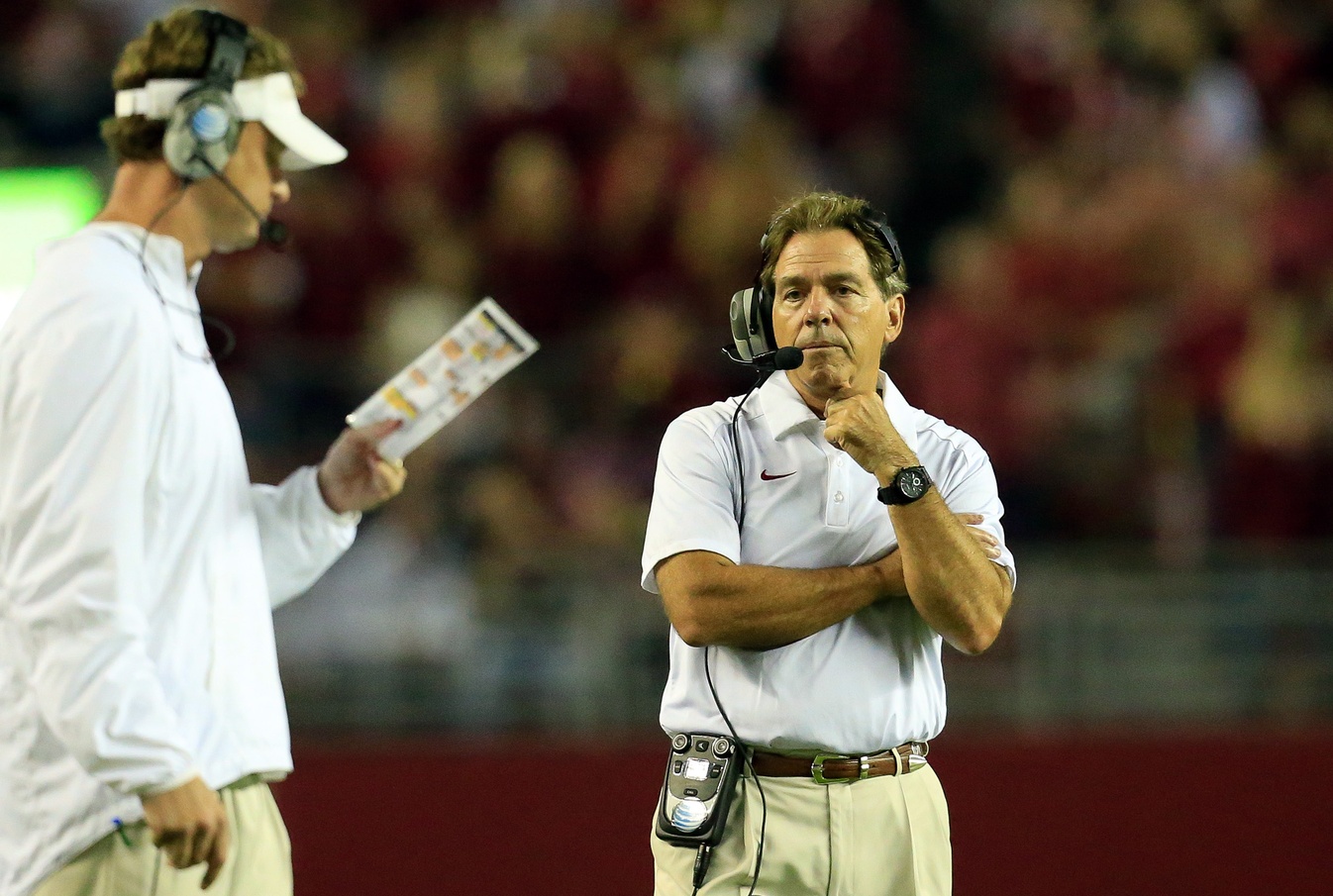
What’s interesting about the relationship between Nick Saban and offensive coordinator Lane Kiffin is that they seem to come from antithetical places on that spectrum. Kiffin’s reputation is a West Coast spread savant; Saban’s background is in defense, and it follows that a defensive guru would prefer an offense geared around making that defense shine.
This isn’t true, necessarily — Saban has made it clear on a number of occasions that he frequently pushed offensive coordinators Jim McElwain and Doug Nussmeier to take more shots in the vertical passing game, and essentially brought in Kiffin to create an offense that would do just that.
It’s hard to argue with results, right? Under Kiffin’s direction last year, Alabama rode the talents of wide receiver Amari Cooper (among others) to the ninth-best offense in the country, the best offense in the conference.
Results in 2015 have been, well, slightly less consistent. Alabama’s coaches were unable to settle on a quarterback until some point during the home game against Ole Miss, when senior transfer Jake Coker finally wrested the job for good in a performance that almost resulted in a victory. Since then, Bama’s offense appeared to have righted the ship with dominant performances at Georgia and Texas A&M, and performances that were just good enough vs. Arkansas and Tennessee. At the moment the Tide is the SEC’s third-rated offense in total yards, sixth in yards per game, fourth in rushing yards per game and seventh in passing yards per game.
It’s been a strange mishmash of an offense thus far. Here’s a brief list of problems that exist right now with the 2015 version of Lane Kiffin’s Alabama offense:
Too many penalties: Against Tennessee, Alabama’s penalty numbers were relatively unremarkable – only 7 for 64 yards – but all of them seemed to come at the most inopportune times. Every time the Tide did something positive – a big gain, two first downs in a row – they seemed to promptly negate that progress with a motion or a holding penalty (on its penultimate drive, Bama had to overcome both a holding and a blocking below the waist foul that happened within five snaps of one another.
There is statistical evidence that penalties don’t matter — at least not in the aggregate — but flags at the wrong time in a game can cost dearly. Kiffin isn’t to blame for the flags themselves (probably), but it often seems that Alabama’s tortuous pre-snap process of reading the defense and constant adjustments is as confusing to its own players as the defense.
Inconsistent offensive line play: Remember that bit at the beginning of this, discussing Alabama’s identity as a brutal football team? Kiffn’s offense – which (coaching cliche alert!) places more emphasis to “getting athletes the football in space” – is based less on drive blocking and more on angles and zone schemes. The apparent result is that Alabama is (however slightly) not as physical as it once was. Remember the third-quarter drive that ended in a 19-yard Adam Griffith field goal? The one where Alabama couldn’t score on second-and-goal at the 1, then threw the ball on 3rd-and-goal from the 2? Yeah.
Predictability: So, it’s important to note that predictability is not always the worst thing. In 2012, Alabama beat Georgia for the SEC Championship running what amounted to two plays for the entire second half.
The problem with Alabama in 2015 is that it is built on motions and fakes designed to fool a defense that (for the most part) appears to fool no one. Jake Coker’s third-quarter interception vs. Tennessee happened because the Vols knew exactly which pass route Alabama would run, then baited him into throwing it. Tennessee created multiple negative plays because it simply sat in the areas of the field it knew Alabama would try to exploit.
To be fair, this is all nitpicking with a 7-1 football team, one that was clearly feeling the effects of two months without an open date (and the effects of a much fresher, more motivated opponent). It is worth expecting Alabama to be a much better looking unit by 8 p.m. on Nov. 7 when it takes the field to face LSU.
But seriously, enough with the motion penalties.
Will Heath is a contributing writer for Saturday Down South. He covers SEC football.