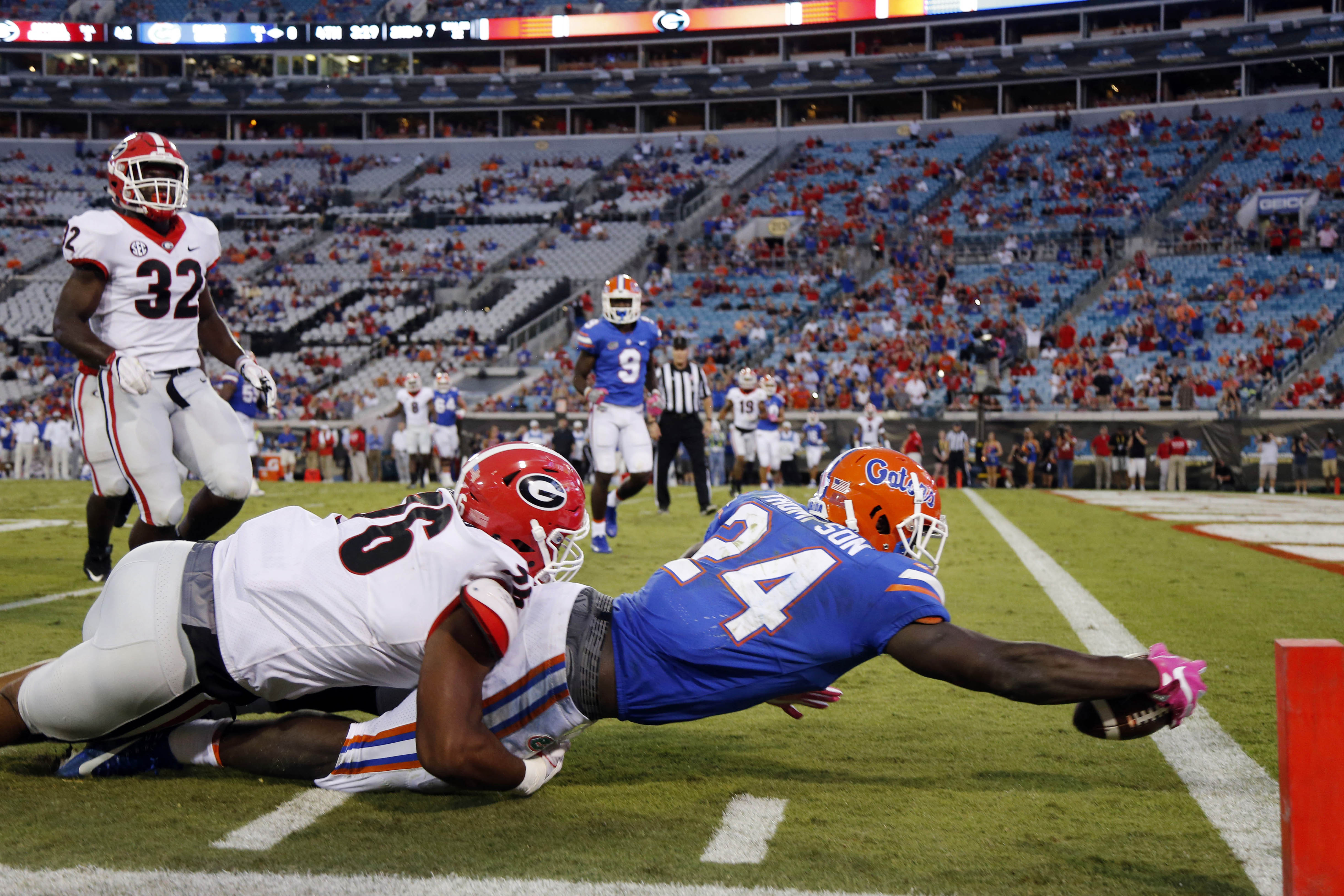
Florida vs. Georgia: An homage to the Cocktail Party, the South’s ‘other’ best rivalry game

Published:
Many stories will be written, published and broadcast on the Florida-Georgia game and rivalry in the coming days, and while they’ll likely focus on slightly different points and perspectives, all of them, including this one, will reflect one underlying understanding — even in a rivalry this old and grand, this edition is bigger than most.
It’s only Monday, but by now you know the stakes: A win for Georgia means the Bulldogs are in the driver’s seat in the SEC East, leaving only upstart Kentucky with a chance, and that chance a long odds opportunity, even at Kroger Field. A win also eliminates the stench of Georgia’s 20-point loss to LSU in Baton Rouge, hands the Bulldogs a signature win in 2018 and puts Kirby Smart’s evolving death star of a program back in the Playoff conversation as the committee meets for the first time Sunday.
A win for Florida, and Dan Mullen and the Gators are in the Playoff conversation instead, regardless of whether they get the help needed from Georgia (or Missouri or Tennessee) to win the East. A Florida win, and a season that began with a new coaching staff simply hoping to lay the foundation for a successful future suddenly becomes about seeking a Playoff berth and a championship, dream stuff for a program that has spent most of this decade as an afterthought lost in the college football wilderness. Only a year ago at this very game, Georgia blew Florida off the field 42-7, the final whimper from an in-over-its-head, never-felt-right Gators coaching staff in a game that was all but over after the opening five minutes.
For Florida, the home win over LSU earlier this month was about reclamation, of a program’s pride and of the vaunted Swamp. The Cocktail Party is about national respect and sea change.
The game isn’t officially called “The World’s Largest Outdoor Cocktail Party” anymore — that changed after the 2005 game, which ironically was the last time until Saturday that ESPN’s College GameDay was in town. Since, in a joint effort between the SEC and the City of Jacksonville to cut down on the riotous, drunken reputation of the weekend’s revelry, the rivalry has simply been the “Georgia-Florida” game or the “Florida-Georgia” game, on a rotating basis.
Ask anyone over 25 who goes, though, and they’ll tell you it’s still the Cocktail Party.
It’s what Ryland Grant, another 30-something I’ve called a friend since we met at the 2002 Florida-Georgia game, calls the game in a Sunday morning text I’m sure he sent from a church pew.
“You going to the Cocktail Party, man?” the first text reads, followed by the week’s first dig: “Figured after last year it would take y’all awhile to crawl out of your swamps but suddenly you Lizards think you’re good again.”
Ryland grew up in tiny Middleburg, Fla., just off U.S. 17 outside Jacksonville before making his way to the University of Georgia at 18. Ryland’s biography is my biography in reverse (grew up in Atlanta, went to Gainesville for college). Like me, he used to steal away to Jacksonville on Thursday night on Cocktail Party weeks. We liked to visit our moms and bring home laundry and go look for redfish in Black Creek and Doctors Inlet, where they congregate this time of year because of the warmer water. Like me, he’s a father of two girls now, and it isn’t as easy to jaunt off for four days.
But his Sunday text floods my memory with thoughts of Cocktail Parties past.
Take the 2002 game, where Ryland and I met at a tailgate.
In the only night game in Jacksonville in recent memory, a 4-3 Florida clipped an undefeated Georgia 20-13 behind a Guss Scott pick-six of D.J. Shockley and a tremendous performance from quarterback Rex Grossman, who led a game-winning drive in the fourth quarter and completed 36 passes while playing with and through the pain of a sprained knee. The legendary Larry Munson, who called so many of this rivalry’s epic moments, captured Georgia’s heartbreak after a late David Greene pass fluttered in and out of the hands of Terrence Edwards, halting a Georgia comeback.
“Florida’s broken our hearts. They’ve just ripped our hearts out of our chest and stomped on our heart and ruined our national title. They’ve broken our hearts in the dark of Jacksonville night and they don’t care.”
It was the only game UGA would lose all year, and it prevented them from playing for their first national championship since the Jimmy Carter administration. There are other examples of UGA underperforming in Jacksonville, including the bizarre 2014 Florida romp where the Gators ran for 418 yards and cost UGA a trip to Atlanta.
But for the rivalry’s first 70 years or so, mostly the game that became the South’s best rivalry outside of the Iron Bowl was a lengthy story about Georgia’s superiority and Florida’s pain.
Until the arrival of Steve Spurrier, Florida had won only 22 of the rivalry’s first 67 contests (or 68 if you ask Georgia, as the two schools can’t even agree on how often they’ve played the game). Whatever the number, Florida is 21-7 against the Bulldogs since Spurrier arrived in 1990, but old wounds die hard.
When Spurrier and Florida visited Athens for the first time in 60-plus years in 1995, the Gators lobbed a late touchdown pass over the top to pad a lead that was already four touchdowns. Asked why he had thrown deep up four touchdowns with 1:21 remaining in the game, Spurrier grinned and unapologetically remarked that he wanted Florida to be “the first team in history to hang half-a-hundred” on Georgia in Athens because “no one had done that before.”
Ryland had the audacity to sit near me on the Florida side in 2007, when the Bulldogs famously scored first and stormed the field to dance in Florida’s end zone. The move was stunning from the usually stoic Mark Richt and propelled the Dawgs to a dominant 42-30 victory over Tim Tebow and the Gators.
As the referees assessed the penalties after the Georgia touchdown, there was Ryland, storming up and down the row with his cell phone, snapping photos and jawing with fans. When I asked him what he was doing, he deadpanned: “Like Georgia, I’m kicking butt and taking names.”
These moments capture the spirit of a rivalry that involves heated passion, heartbreak and snobby dismissal of the opposing fan base on each side.
Some of the contempt is cultural, even if it is undergirded by a sullen, begrudging respect.
The state of Georgia was a colony, and the University of Georgia is one of the nation’s oldest public universities. There’s an air of southern elegance to Georgia and a sense of old-money belonging — what you might think of as an aristocratic air to the Bulldogs. Their most legendary coach in recent memory is Vince Dooley, the consummate southern gentleman; their most legendary player is Herschel Walker, the country boy from tiny Wrightsville turned college football Adonis, perhaps the greatest college player in history.
When the Dawgs were beating the Gators senseless for seven decades, it was easy to dismiss the land-grant university to the south. Florida is a land-grant university, founded in 1853, and unlike Georgia, it is young enough to where it hasn’t joined the SEC’s “old boys’ club.” Spurrier understood this, and losing to Georgia as a player helped form the chip on his shoulder that motivated his career and bravado, a stark contrast to Dooley. Florida’s greatest player, Tim Tebow, shared Walker’s sense of physical invincibility, even breaking some of Walker’s records and moving his name into the discussion of the greatest college football players ever. But even Tebow seemed to feed off the idea of being disrespected or counted out, hence the fame of “The Promise.”
These contrasts define the rivalry.
Like most of the ancient public university vs. land-grant rivalries in the sport — Texas-Texas A&M, Oklahoma-Oklahoma State, Ole Miss-Mississippi State and Auburn-Alabama are classics — the working motif for decades was that Georgia fans were entitled snobs and Florida was a backwater school in a state time forgot, not truly southern enough for the SEC and certainly not worthy of Georgia’s attention. In the old days, it was mostly assumed that Georgia would win, and mostly, they did.
Sometimes, the Dawgs would even win in the most baffling, confounding, impossible ways.
But even when Florida began to win and win big under Spurrier, the Georgia rank and file were reluctant to accept their rivals to the south as anything beyond nouveau riche imposters in the college football universe. Even as Florida captured championship after championship, Georgia fans retained their sense of place.
That’s probably good, Ryland thinks.
“It’s helped us through a lot of heartbreak,” he texts. “But Kirby changed all of that last year. For the first time in forever, it was 50,000 in red and black and 50 left in blue and orange by the end. Nothing I’d ever seen before- Hopefully again.”
I’m not sure a text message can have angst, but this one oozed it, a reminder that for Georgia, with a nod of disaffection to the nerds from North Avenue and the South’s oldest rivalry (Georgia-Auburn), Florida is public enemy No. 1.
That’s what happens when for what for nearly 70 years is an exercise in dominance becomes, over a quarter century, a frequent scene of horror and heartbreak, with only the last decade or so, with Florida struggling and lost, providing some respite.
Georgia fans arrive in Jacksonville early, and when they win, they bark and yell and party well past late. It will be no different Saturday.
For Florida, the game is often slotted by fans as second, behind the end-of-November clash with Florida State. That’s an assessment that makes older alumni (and often their children, second- and third-generation Gators) bristle, but it’s an understandable disagreement. When your school has won so often, your heart hasn’t been bruised and you have fewer battle scars to wear. Florida State is in-state, and Gator alumni who stay in the state work with more Seminoles, have more water cooler banter. And the Gators my age tend to remember the ’90’s, when Florida and FSU were influential in the national title picture almost every season. It’s understandable why a fan base may privilege one game over the other.
For me, though, as vital as Florida-Florida State is for recruiting, the Cocktail Party is a more special rivalry, with a richer history, divisional and conference ties and a neutral site atmosphere unique to southern football. Outside of the Iron Bowl, the only SEC rivalry that compares in both national prestige and history is probably Auburn-Georgia, and because Florida exists in the Georgia imagination and Alabama constantly occupies the Auburn imagination, there’s less palpable contempt at Georgia-Auburn, and the atmospheres can’t be compared.
The best rivalry games are this way, heavy with drama and meaning, ripe with history and biography waiting to be written. Florida and Georgia always has intrigue and meaning and often has drama. This season’s Cocktail Party has all of those things, and for that reason, the whole week ahead of the game will feel like an eternity, the winding back of an emotional slingshot that come Saturday will be drawn back, launching one fan base into the stratosphere and another into the pits of despair as the band breaks.
It’s the game you spend an offseason dreaming about, the one where the winner leaves Jacksonville with a season that still feels very much like a dream. Those types of years don’t happen often in our little sport. There are always losses — even for Alabama fans — always the seasons “between” the ones we never forget. We’re all into for college football, I think, for the shared connections and friendships and traditions but, most of all, for these games, which define what seasons are unforgettable.
That’s what we’ll get in Jacksonville Saturday, on the banks of the St. Johns River.
Neil Blackmon covers SEC football and basketball for SaturdayDownSouth.com. An attorney, he is also a member of the Football and Basketball Writers Associations of America. He also coaches basketball.