College football faces its own trade deadline when it comes to conference championships, CFP

By Andrew Olson
Published:
Monday is trade deadline day in the MLB. As a lifelong Atlanta Braves fan, I am prepared to be underwhelmed by Alex Anthopoulos’s moves, and I fully expect to continue to dread every non-Chris Sale start for the rest of the year.
College football is also facing its own deadline, as any change to the College Football Playoff, such as expansion for the 2027 season, must be agreed upon before Dec. 1. And there’s a trade to be made. A growing number of key figures in the CFB community are ready to do away with conference championship games in exchange for the creation of more spots in the CFP.
The past 2 weeks, the SEC and Big Ten held their annual Media Days events. If you feel that conference championship games are worthwhile and add to the season, the long-term outlook isn’t encouraging right now.
Big Ten commissioner Tony Petitti confirmed what has long been suspected. If the College Football Playoff expands from 12 to 24 teams, the B1G will pull the plug on its conference championship game.
B1G's Tony Petitti if playoff expands to 24: "We pretty much won't be playing a conference championship game"
— Brett McMurphy (@Brett_McMurphy) July 28, 2026
A week prior in Tampa, Greg Sankey was asked about the future of the SEC Championship Game. He had plenty to say, but offered little to inspire confidence about the game continuing in 2027 and beyond.
“I have to go back and figure out how many years we did it on our own when conference championship games were initiated,” Sankey said, referring to when the SEC Championship Game launched in 1992. “The majority didn’t flip in our direction for probably about a decade. I think even the move to 12 has created pressure around championship games. We’ve talked through the factors that support the pro list, and we’ve talked about some of the con list, the negatives that need to be considered.
“And we have some time. We will have a conference championship game the first Saturday in December of 2026. We have contracts and plans in place well beyond that. But we have time for consideration. One of the factors for us is what will happen with that College Football Playoff.”
Sorry, Commissioner, but “we have contracts and plans” isn’t much of a pushback on concerns about the SEC Championship Game’s future. Sankey mentioned that there was a time in the 1990s when the SEC was the only conference with a championship game, but he stopped well short of suggesting that could be the case in 2027 and beyond.
Coaches’ contracts are bought out all the time. Six years ago, we saw contracts for long-scheduled games tossed out at the last minute. In the COVID season, games that had been planned 8 years in advance were put on hold or canceled, while some new games were scheduled on stunningly short notice. The takeaway: when there’s a will, there’s a way.
The Big Ten is ready to move on from holding a conference championship game, and it feels like that conference is calling the shots in the college football world right now. The B1G repeatedly called on the SEC to add a 9th conference game to the schedule, and the SEC did so with no change to the College Football Playoff in return. The Big Ten has long led the charge for a 24-team Playoff, and even SEC coaches are getting on board.
Last year, the SEC was leading the charge for an expanded College Football Playoff that would keep conference championship games. In May 2025, word spread around college football that the SEC favored a 5+11 model of 5 conference champions and 11 at-large teams to make a 16-team Playoff field. At that time, the Big Ten was reported to be in favor of an expanded Playoff with automatic bids by conference.
Earlier this year, the Big Ten began pushing for a 24-team Playoff. Even SEC coaches appear to be receptive to the idea. Tennessee coach Josh Heupel, who has coached a CFP game in the current 12-team format, expressed support for expanding to 24 teams.
SEC coaches are naturally more concerned about the size of the Playoff with the move to the 9-game conference schedule. Finishing 11-1 or 10-2 just got more challenging with another conference game on the schedule, and the CFP remains at 12 spots (5 highest-ranked conference champions and 7 at-large bids).
Why is 24 so popular with coaches when many fans and media members vocally oppose doubling the Playoff field? Mike Elko knows exactly what’s going on.
“There’s self-preservation, right? If you really ask me, on the record, what does Mike Elko want (for the CFP)? I want 40 (teams) because then I’ll make it and then I won’t get fired,” Elko said in May at SEC spring meetings.
Coaches can’t help but hear “increased job security” whenever the 24-team Playoff is brought up. They start to think, “How hard can it be to finish the regular season as one of the top-24 teams in the country? And how many programs would fire a coach who can regularly make the CFP?”
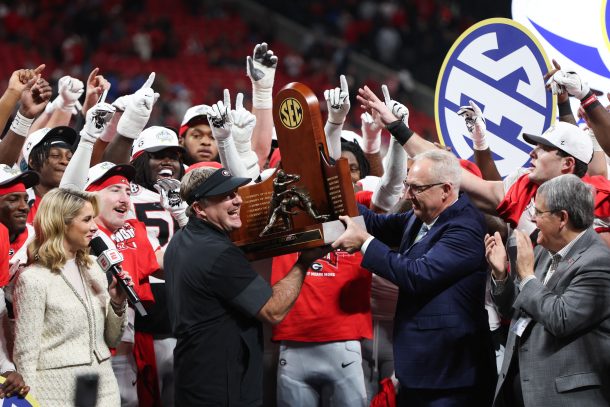
The SEC Championship Game, of course, does not offer the same kind of job security. In the 4-team Playoff era, Jim McElwain, Gus Malzahn, Dan Mullen and Brian Kelly all made it to Atlanta only to eventually be fired. (And, of course, there’s Ed Orgeron, who won an SEC championship and national title in 2019 but was fired by LSU in 2021.)
It’s no secret that many coaches in the SEC face Playoff-or-bust pressure. And they’ve seen that the 2-time defending SEC Championship Game winner has stumbled in the CFP quarterfinals after earning the opening-round bye.
It’s hard to fault coaches for wanting more opportunities to win a national championship. Commissioners like Petitti presumably see dollar signs. More conference teams making the CFP means more revenue as media partners have more games to broadcast.
Never mind that many fans aren’t so sure about the rapid expansion from a 4-team Playoff in 2023 to potentially 24 teams in 2027. After years of just meaning more, college football feels like it’s in danger of finding out when more might mean too much of a good thing.

Andrew writes about sports to fund his love of live music and collection of concert posters. He strongly endorses the Hall of Fame campaign of Fred Taylor.