First and 10: What happens this week in Destin could change college football forever

By Matt Hayes
Published:
1. I don’t want to get on a soapbox, but …
They’ve been on the white sand beaches of the Florida Gulf Coast for a couple of days now, soaking in the glory of yet another wildly successful season.
But here comes the heavy lifting.
It is here, at the annual SEC spring meetings in Destin, Fla., where we find out just how public and how adamant the 14 SEC presidents are about their game of chicken with the rest of college sports.
Stay, or go it alone?
“We’ve moved way past the ‘everything is on the table’ point,” an SEC athletic director told me. “There will be hard, real discussions.”
Or as one industry source told me: “We’re a lot closer than you think to monumental change. And I don’t use that word lightly.”
They’ll bounce around ideas about the football schedule, and whether change is dramatic or subtle. They’ll debate the idea of division format; is it still viable in the ever-growing college football world?
But it all revolves around the potential singular movement — a paradigm change never seen in college sports — that will, at the very least, begin to grow legs this week: Stay with the rest of their partners in college sports, or separate and evolve into a singular behemoth?
Everyone is in Destin, and everyone knows the enormity of the moment. Coaches, athletic directors, faculty representatives, and most important, all 14 university presidents.
Decisions made here could change the way we think about college sports.
“This has been brewing for a while now,” another SEC AD told me . “(The Alliance) made their move, and now we’ll make ours.”
Before we go further, understand this: The SEC doesn’t want to break away from the rest of college football. The 14 SEC presidents and commissioner Greg Sankey don’t want to be the impetus for reshaping college sports.
But they can — and that’s the key to this game of chicken with the rest of the FBS playing schools.
Right or wrong, fair or not, when the Alliance — the Big Ten, Pac-12 and ACC — scuttled College Football Playoff expansion as a response to the SEC adding Texas and Oklahoma, it was their last and only chance at exerting power in what they believed was the SEC creating a competitive imbalance.
The SEC already has dominated college football in the 2000s, winning 12 of the 16 national championships since 2006 and becoming the only conference to have 2 teams in the BCS National Championship Game, 2 teams in a non-COVID season Playoff, and 2 teams playing in the Playoff national championship game.
Now they’re adding the biggest brand in college sports (Texas), and a powerful all sports program (Oklahoma) that just happens to be one of the greatest football playing schools in the history of college sports.
Meanwhile, the Alliance’s first and only move took an estimated $1.2 billion annually off the table and left the sport with an obvious end game. The next Playoff contract will not need unanimous approval by all 10 FBS conferences, but a simply majority of the Power 5 conferences and Notre Dame.
As it currently stands, it’s a 3-3 deadlock: the Alliance vs. the SEC, Big 12 and Notre Dame. Don’t blame the 14 SEC presidents and Sankey for reading the room.
There is no guarantee of Playoff expansion. Sankey and the SEC presidents have made their intentions clear from the start: stay at 4 teams, or expand to 12.
They see more problems down the road — infighting among the Power 5, and more important, the need for another revenue stream for looming pay-for-play decisions — and the only safe landing spot is their own backyard.
“(Texas and Oklahoma) came to us, they wanted in. That’s where this begins and ends,” an SEC AD told me. “We’re seen as the wolf because we said yes. If they had asked to join the Big Ten, there is no Alliance and the Big Ten is pushing for (Playoff) expansion. It’s disingenuous and it’s deceitful.”
And it has led to a crossroads for college sports.
2. The format
No matter what happens with a longterm plan at 30,000 feet, the conference will this week take the first few big steps on a micro level with the scheduling model.
There are still a handful of schools that prefer the division setup, and they’ll need to be convinced of the advantages of no divisions (remember, the SEC doesn’t move forward unless everyone is on board — by agreement, or gentle nudging).
Those who want divisions see a simple move of Texas and Oklahoma to the West Division, and 1 current West team to the East. More than likely, that means Alabama.
That leaves the conference with 4 blue-blood programs on each side:
- East: Alabama, Florida, Georgia, Tennessee.
- West: LSU, Oklahoma, Texas, Texas A&M.
But that also means the SEC is stuck in a scheduling model that doesn’t translate to more games between divisions, something that doesn’t sit well with ESPN — which wants more games between the blue-bloods.
Even if the league moved to 9 conference games a season, the division format would leave 7 of those games committed to division opponents. In other words, the SEC would be in the same situation is stands now, with limited ability to rotate quickly through games.
The mandate from the presidents has been to give student athletes the ability to play at least once at every member institution over a 4- or 5-year career. That almost certainly means the end of divisions, and the implementation of a 3-6 model (3 permanent games, 6 rotating).
Unless, of course, the SEC goes alone. Then the format could be more straightforward: 4 divisions of 4 teams, and the division winner and runner-up play in the league’s 8-team Playoff.
A possible 4-division format:
- North: Alabama, Kentucky, Tennessee, Vanderbilt
- South: LSU, Auburn, Ole Miss, Mississippi State
- East: Florida, Georgia, Missouri, South Carolina
- West: Texas, Oklahoma, Texas A&M, Arkansas
3. The schedule
The argument of 8 games vs. 9 games has been around for more than a decade, and the sides have never changed.
Those programs with the largest budgets (see: blue-bloods) aren’t against 9 games. The remainder want 8 because another SEC game is another possible loss on the way to qualifying for not only a bowl game — but a New Year’s 6 bowl game.
Exhibit A: if Ole Miss had to play another SEC game last year, and lost to an East team, its chances of reaching the Sugar Bowl are diminished.
Or if Missouri had to play another SEC game against a West team, its chances of qualifying for a bowl game are diminished.
ESPN wants a better inventory of games — games that reach the elite advertising threshold of 4 million viewers. It’s hard for the SEC to deliver Ole Miss vs. Memphis, when Ole Miss vs. Georgia is out there waiting to be had.
But if the presidents stay true to their mantra of a more expanded experience for student athletes, 9 games is the answer. And that means a 3-6 model, where all 14 teams have 3 permanent games and rotate through 6 others over the course of a player’s career.
This eliminates the quirks of the previous schedule, where Georgia and Texas A&M have played once in the Aggies’ time in the SEC, while Florida and Texas A&M will play for the 4th time this fall.
This, of course, has led to disagreements about permanent opponents. There are numerous variations floating around, but most look something close to this:
- Alabama: Auburn, LSU, Tennessee
- Arkansas: Missouri, Ole Miss, Texas
- Auburn: Alabama, Georgia, South Carolina
- Florida: Georgia, Kentucky, LSU
- Georgia: Auburn, Florida, South Carolina
- Kentucky: Florida, Tennessee, Vanderbilt
- LSU: Florida, Ole Miss, Alabama
- Mississippi State: Ole Miss, South Carolina, Texas A&M
- Missouri: Arkansas, Oklahoma, Vanderbilt
- Oklahoma: Missouri, Texas, Texas A&M
- Ole Miss: Arkansas, LSU, Mississippi State
- South Carolina: Auburn, Georgia, Mississippi State
- Tennessee: Alabama, Kentucky, Vanderbilt
- Texas: Arkansas, Oklahoma, Texas A&M
- Texas A&M: Oklahoma, Mississippi State, Texas
- Vanderbilt: Kentucky, Missouri, Tennessee
4. Think big
This isn’t just about the 14 current SEC member institutions, or future members Texas and Oklahoma. If the SEC decides to break away from the rest of college sports with their own football playoff, a new dynamic enters the equation: expansion.
Once the SEC breaks away, the remainder of the Power 5 schools will likely refuse to schedule the SEC in football, and possibly any other sport. That almost certainly means SEC expansion.
And value means everything in expansion.
The easiest move with the least amount of strings is raiding the Big 12. But where is the value?
Kansas because of its rich basketball tradition and its natural rivalry with Missouri? Baylor because of its proven ability to win big in the current college athletics climate (both football and men’s and women’s basketball)?
Would Notre Dame see the value of conference alignment with the most powerful conference in college sports, and agree to share all revenue? Texas — which, like Notre Dame, has the ability to reach an individual media rights deal (Longhorn Network) — saw the value, and agreed to the SEC’s all for one, one for all mentality.
ACC media rights deals are locked in until 2036, and the Big Ten will lock in a brand new media rights deal by the end of this year.
The Pac-12 media rights expire June of 2024, but unreasonable travel (for all involved) ends any thought of a run at USC.
5. The Weekly Five
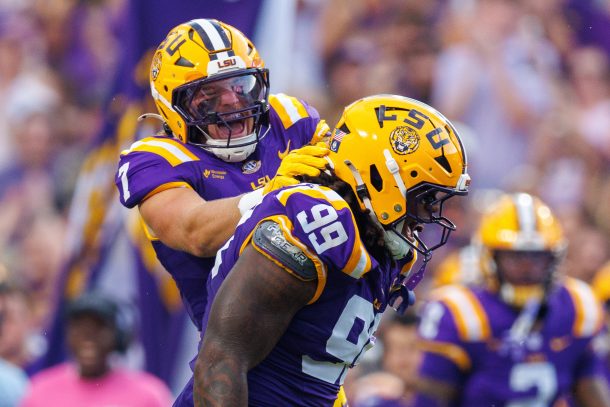
Five reasons for hope exiting spring practice: LSU.
1. Stability. Brian Kelly ran the biggest program with the most tentacles in all of college football, and became the winningest coach in Notre Dame history. He can handle LSU.
2. The options at QB: Doesn’t matter who plays — Myles Brennan, Jayden Daniels, Garrett Nussmeier — the staff feels good about the position.
3. A transfer portal haul will benefit the biggest area of concern: the defense.
4. The emergence of LT Will Campbell. The true freshman midterm enrollee is a massive presence and ready to secure the most important position on the offensive line.
5. TB John Emery Jr. is finally ready for a breakout season. Does the former elite recruit finally put it all together?
6. Your tape is your résumé
An NFL scout analyzes a draft-eligible SEC player. This week: DE Derick Hall, Auburn.
“He kind of flew under the radar last year until the Alabama game, when they could not block him. He was always an athletic guy off the edge, but late last year he started finishing. He can play in an odd or even front, and he’s athletic and fast in either situation.
“He’s going to test well at the Combine (in 2023), and he’s going to be another of those guys that will jump quickly. He’s long and has good hands, and he has that explosion that you can’t teach. I like that he has gotten better every year. If he makes similar improvement, you’re talking about a high (draft) pick.”
7. Powered Up
This week’s Power Poll, and one big thing: 1 thing I like, 1 thing I don’t like for 2022.
1. Georgia
Like: How the locker room feeds off the swagger — yes, swagger — of QB Stetson Bennett.
Don’t like: The loss MLB Nakobe Dean, the player who made the elite D go.
2. Alabama
Like: Nick Saban in bounce-back years (that’s right, bounce back from not winning it all).
Don’t like: The uncertainty on the offensive line.
3. Texas A&M
Like: Offseason momentum/focus gifted from Saban.
Don’t like: Youth on defense.
4. Kentucky
Like: All things QB Will Levis.
Don’t like: A rebuilt offensive line for Levis.
5. Arkansas
Like: Sam Pittman proving you don’t have to be a sexy coordinator to build a program.
Don’t like: Highest expectations in decades.
6. LSU
Like: The demand for accountability with Brian Kelly.
Don’t like: Roster still too thin at critical positions.
7. Tennessee
Like: Every offensive skill position will be better/deeper.
Don’t like: Game-changers needed in the defensive front 7.
8. Ole Miss
Like: The transfer TB combo og Ulysses Bentley and Zach Evans.
Don’t like: Big drop from Matt Corral to Jaxson Dart and Luke Altmyer.
9. Mississippi State
Like: The offense in Year 3 under Mike Leach.
Don’t like: The offensive line in Year 3 under Leach.
10. South Carolina:
Like: The potential of a completely different offense.
Don’t like: Inconsistencies on the lines of scrimmage.
11. Florida:
Like: What QB Anthony Richardson could be.
Don’t like: The inability to stress defenses from the WR spot.
12. Auburn:
Like: An elite pass rush.
Don’t like: Limited options at the most important position on the field.
13. Missouri:
Like: RB Nathaniel Peat following Tyler Badie and Larry Rountree as top-5 SEC rushers.
Don’t like: Too many issues in the secondary.
14. Vanderbilt:
Like: Clark Lea’s recruiting has upgraded the roster (it takes time).
Don’t like: Size on the interior lines, a lack of it.
8. Ask and you shall receive
Matt: Am I crazy to think Georgia is going to win it again? I waited 4 decades for it, now the road looks clear except for one game. But I think Georgia now knows how to beat Alabama. — Gary King, Jackson, Miss.
Gary:
This year will tell us if Georgia coach Kirby Smart can take his mentor Nick Saban’s famed “process” through the final step: never losing hunger.
I’ve said this over and over: The most overlooked and critical factor in Saban’s remarkable run at Alabama has been his ability to convince players that last year, even if it ended with a championship, won’t be as good as what you can reach this year.
He’s dealing with young men who don’t always deal with success like they should. That’s not unique to Alabama — but Saban’s ability to keep everyone on task no matter the circumstances (year after year) has been next-level.
That’s where Smart must complete the cycle of the “process.” A program that built for years to win it all finally did, and now the only thing left is to win it again.
It’s a brutal bar to reach for any program, even Alabama. Repeating in college football hasn’t happened since Alabama did it in 2011-12, a program that had Saban and Smart on staff.
Talent will not be a problem on either side of the ball. Georgia is loaded, but the dynamics of every team, every year, are different. How badly does this new team want it? That’s the key.
9. Numbers
2,714. There’s a reason Alabama was desperate for Pitt transfer WR Jordan Addison: Jameson Williams and John Metchie III combined for 2,714 yards and 23 TDs last season. Where will the Tide get that production this fall?
Transfer WR Jermaine Burton had 901 career receiving yards (53 catches) in 2 seasons at Georgia, and transfer WR Tyler Harrell had 559 yards (20 catches) in 4 seasons at Louisville.
To be fair, Williams was stuck on the bench at Ohio State before developing into the best receiver in the game. Part of that is because of the elite play of QB Bryce Young, and the offense built by offensive coordinator Bill O’Brien.
Make no mistake: if you’re expecting Alabama to compete for the national title (and who isn’t?), that means Burton and Harrell will have made significant leaps from their previous seasons in college football.
10. Quote to note
Florida coach Billy Napier on building his support staff: “You hire good people, you empower them to do their jobs — and you get out of the way.”
Matt Hayes is a national college football writer for Saturday Down South. You can hear him daily from 12-3 p.m. on 1010XL in Jacksonville. Follow on Twitter @MattHayesCFB