Film Study: What we learned about Dan Mullen and Florida’s offense in Week 1

Published:
We wrote in our “Rapid Reaction” to Florida’s 53-6 victory over Charleston Southern that the Gators’ offense looked crisp and imaginative Saturday night, obviously a refreshing change from the offensive ineptitude that colored the seven seasons of Florida football under Will Muschamp and Jim McElwain.
It’s only one game, and it shouldn’t be lost on anyone that Charleston Southern was only an FCS opponent, terribly outmatched from a personnel standpoint. We will get a better read on Florida when SEC play begins Saturday, and the Gators will be challenged by a Mark Stoops Kentucky defense led by NFL prospect Josh Allen, one of the nation’s most underrated and talented linebackers.
Still, you can only perform and execute against the opponent in front of you, and Florida executed at an exceptionally high-level in most phases Saturday night.
Today’s piece begins with an analysis of the positives that can be garnered from Florida’s opening night rout and concludes with a look at what Florida needs to improve moving forward.
Positives
Feleipe Franks mistake-free performance: The “Jump Pass” to Tyrie Cleveland (which Franks probably should have just run into the end zone for an easy touchdown) got most the postgame attention, and that’s understandable given that play’s place in Gators lore.
But it was Franks’ ability to make good decisions that is the primary takeaway.
Franks had one deflected ball on the opening series that likely induced frightening flashbacks to the Florida faithful, but otherwise, he made no glaring mistakes and showed a solid grasp of the offense throughout the season opener.
Most impressive, Franks showed he could look off a safety and make secondary reads, something that he struggled mightily with as a freshman quarterback.
This play to Freddie Swain was perhaps most demonstrative of Franks’ development under Mullen. The right guard and center are initially beat, but Franks senses the pressure, eludes it, and occupies both the Charleston Southern safety and coverage linebacker by looking to his check down.
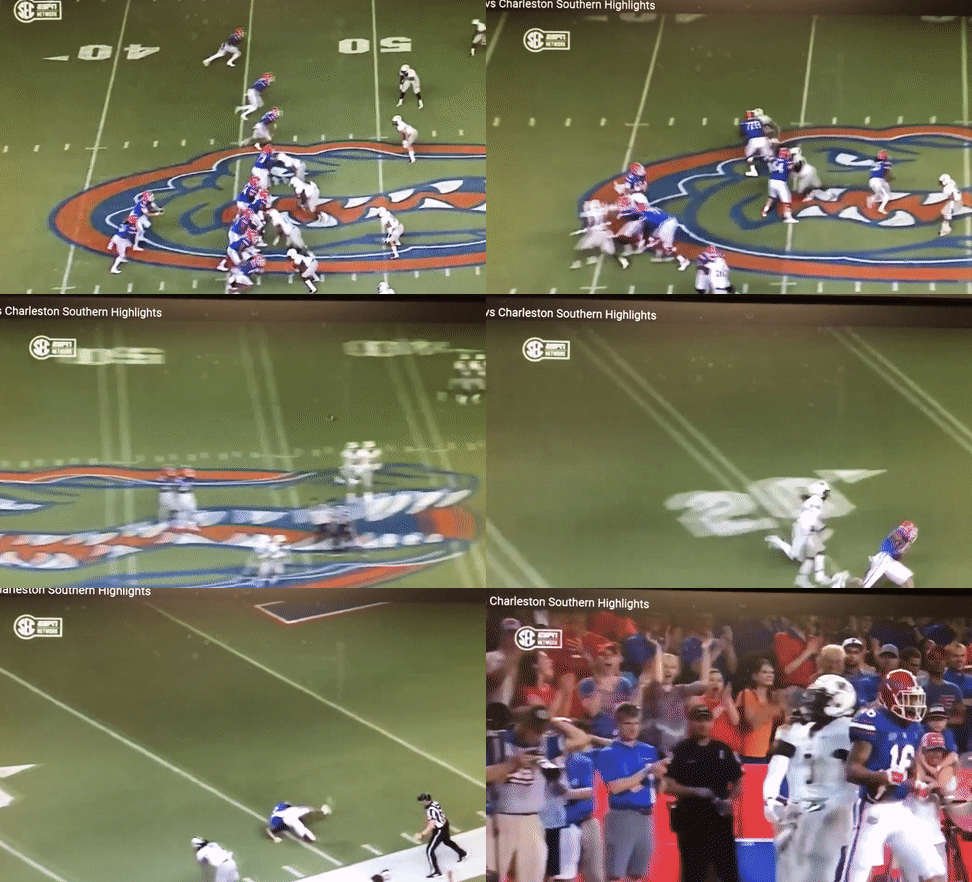
This simple moment of looking off two defenders allows Freddie Swain the time to finish an excellent deep flag route, which Franks delivers beautifully for a huge gain.
It’s an imaginative play design, and one that only works if the quarterback can occupy the safety help on Swain just long enough for the play to develop downfield.
Using tempo: Florida was extremely effective Saturday evening when it used tempo. Under Jim McElwain and offensive coordinator Doug Nussmeier, the Gators were one of the slowest teams in the country in tempo, finishing 112th in America last year at 27.8 seconds per play.
That’s problematic in both the time it gives a defense to diagnose the personnel and look Florida has on the field and time it gives a young quarterback (Franks) to overthink a play or become confused by a defense disguising looks.
Florida played much faster early on Saturday night, averaging around 23 seconds a play in the first half in building a huge lead.
The added speed helped Franks immensely, as he was able to play a lot of one read and react football, simplifying the game and making the defense adjust to Florida instead of Franks adjusting to the defense.
Getting the ball to the playmakers: One of the moments most demonstrative of Florida’s mismanagement under the McElwain and Nussmeier offensive brain trust came last year when one of Florida’s outstanding beat reporters asked about the failure to get the ball to the Gators’ multiple playmakers in the season-opening loss to Michigan.
“We want to do that more,” McElwain said. “Maybe we need to write down a list of names or something you know, to remind us.”
The answer might have been tongue-in-cheek or just plain derisive (with McElwain, it was always hard to tell), but the reality was that too often McElwain and Nussmeier would talk a good game about getting the ball to Florida’s difference-makers only to “forget” the plan come Saturdays.
Mullen certainly didn’t forget Saturday night.
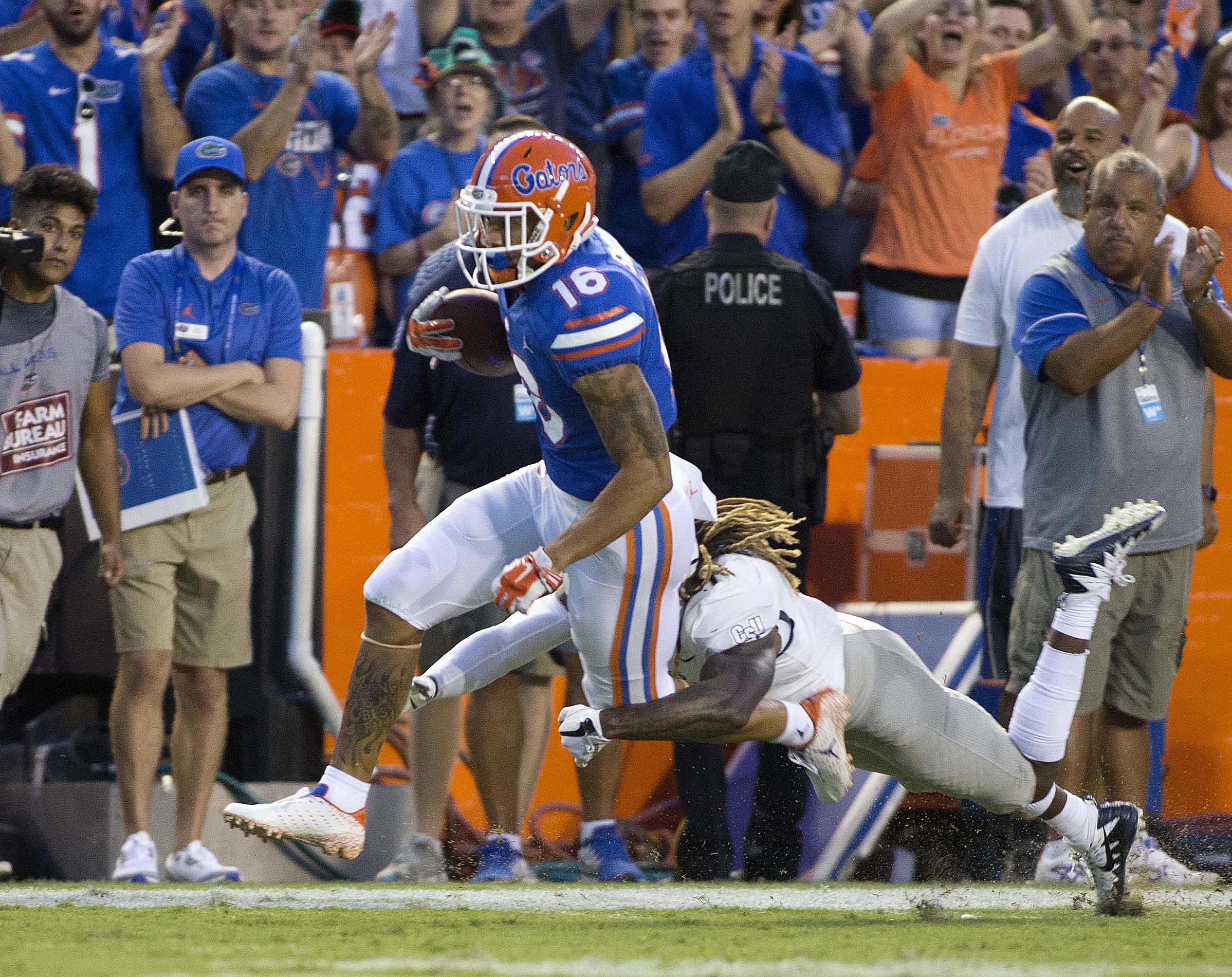
Sixteen Gators running backs, tight ends and wide receivers touched the ball, and four wide receivers scored a touchdown — the first time that has happened at Florida since the Urban Meyer era.
More critically, of Florida’s 58 touches on offense, 42 went to players who came to Florida as “blue-chip” recruits (4- or 5-stars); Malik Davis, a 3-star who earned All-SEC Freshmen team honors a year ago, accounted for 7 of the remaining 16 touches.
That’s the ratio you want, and when you spread the football around like that, you keep the defense guessing and your players happy.
What must improve
There’s no question the Gators were fortunate to escape Kroger Field with a victory last fall. Luke Del Rio rescued the Gators from a 13-point deficit in the fourth quarter and on two of Florida’s touchdowns, Kentucky made unthinkable mental mistakes, failing to cover wide open Florida receivers at the line of scrimmage.
Even in the friendly confines of The Swamp, the Gators won’t likely be able to count on self-inflicted Kentucky wounds to save the day again.
One thing Florida did well at Kentucky last season was run the football. The Gators tallied nearly 200 yards rushing and 5.2 yards a carry in last year’s victory, including 93 yards from then-true freshman Davis.
The problem?
Florida’s run blocking was mostly poor against Charleston Southern: Facing a small FCS defensive line, a veteran Florida front should have imposed its will Saturday night.
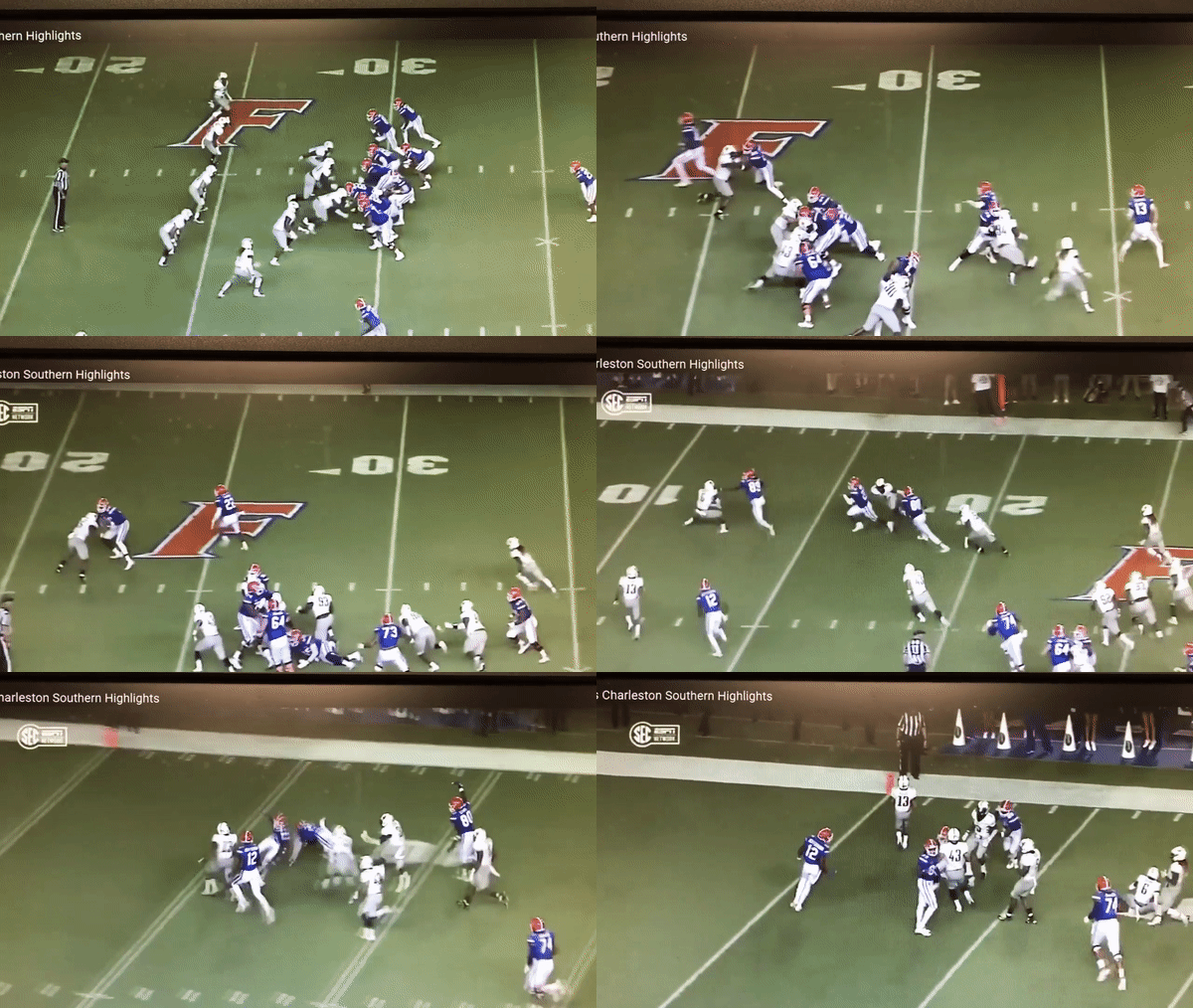
Instead, Charleston Southern mostly dictated the terms of the running game, bottling up creases in Mullen’s zone running scheme and forcing the Gators’ running backs to rely on leg drive and yards after contact to gain tough yards. Here’s one example, where Jordan Scarlett is forced to go straight at the pile after Martez Ivey, a preseason All-American, fails to get any leverage off the snap.
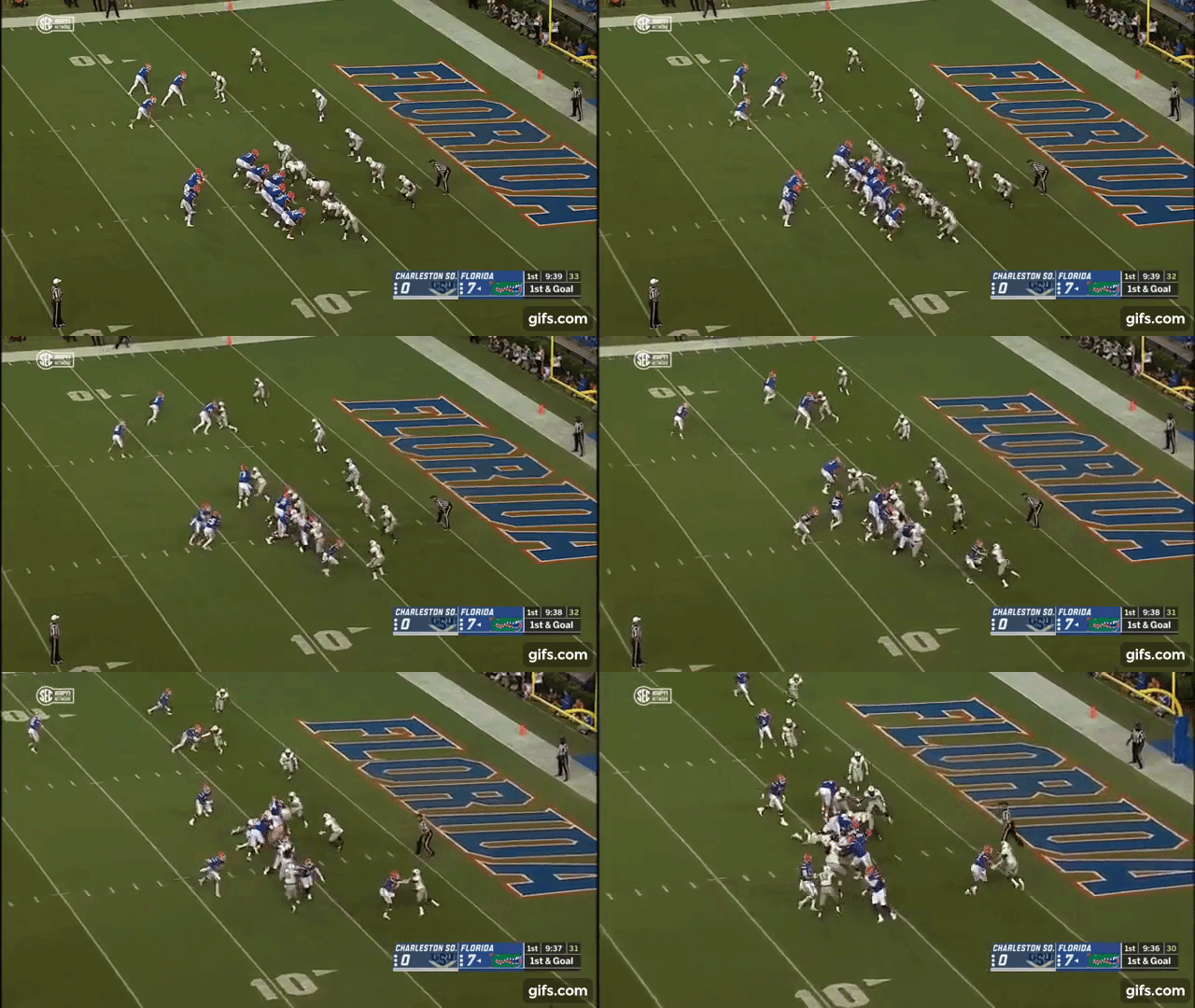
That won’t cut it Saturday night.
It isn’t all doom and gloom, though.
Florida’s did break off some big running plays, and improved blocking downfield from the wide receivers and tight ends — Cyontai Lewis in particular — keyed most of Florida’s successful running plays.
On this one, the right side of the line gets a great push and the tackle seals the edge, allowing Lamical Perine a nice crease to cut outside. The yeoman’s work on this run, however, is done by Lewis, who bullies a Charleston Southern defender for several yards, allowing Perine to run into space in the second-level.
Kentucky was poor against the run throughout 2017, but it was a point of emphasis in autumn camp for the Cats and led by Allen, they played salty run defense in their opener against Central Michigan, limiting the Chippewas to a mere 3.0 yards per attempt on 39 runs.
If the Gators want to extend their winning streak against Kentucky, dictating the football game up front will be essential. To do that, they’ll need to be more consistent than they were Saturday night.
Neil Blackmon covers SEC football and basketball for SaturdayDownSouth.com. An attorney, he is also a member of the Football and Basketball Writers Associations of America. He also coaches basketball.