It isn’t ‘Catholics vs. Convicts,’ but Miami and Notre Dame have awakened the echoes

Published:
It isn’t quite “Catholics vs. Convicts,” the storied October 1988 top-5 matchup between the University of Miami and Notre Dame that’s the subject of a documentary film and decades of lore and banter, but when No. 1 Miami visits No. 11 Notre Dame on Saturday night, it will be difficult not to sense the parallels.
In 1988, the late Lou Holtz was in Year 3 in South Bend, orchestrating a quick turnaround of a Notre Dame program that had hit a nadir in the mid-1980s under failed head coach Gerry Faust. The Fighting Irish were pounded by eventual-national-champion Miami 24-0 in the old Orange Bowl the prior fall, but with the Canes visiting their turf, Holtz and Notre Dame had a point to prove.
The Hurricanes arrived in South Bend feeling invincible, and for good reason. From the beginning of 1986 until October 1988, Jimmie Johnson’s program won 27 of 28 games, capturing the 1987 national championship.
Notre Dame won an instant classic 31-30, the defining victory for the Fighting Irish on their way to the 1988 national championship. Miami got a needed dose of humility, using the defeat as fuel throughout its run to the 1989 national championship the following season.
Nearly 40 years later, the faces have changed but Miami and Notre Dame programs on similar trajectories collide Saturday night at Notre Dame Stadium.
Even stylistically, there are similarities.
In 1988, the Hurricanes were brash, loud, and played with an unmistakable swagger.
“Most of their opponents were outright afraid of them,” Ed Orgeron, a longtime Miami assistant during the glory years, told Saturday Down South. “When you saw that orange and green get off the bus or get on the field, you knew who was coming. They fed off that fear.”
Miami was the boogeyman — too fast, too strong, too good, and the Hurricanes knew it.
Holtz’s Notre Dame?
They were disciplined. They embodied selflessness, with Holtz famously removing names from the back of Notre Dame jerseys to exemplify his commitment to winning and losing as a collective. They didn’t lack confidence, but they were buttoned up about it. Holtz limited who had access to the media and his default media position was framed by an earnest, almost inauthentic level of humility, where every Fighting Irish opponent was the Dallas Cowboys.
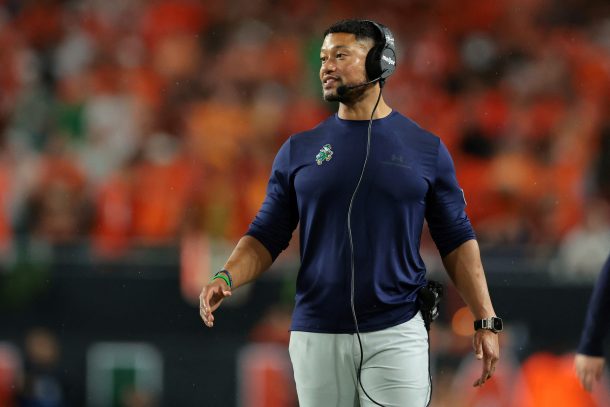
Marcus Freeman and Mario Cristobal’s programs are near mirror images of those outfits. Freeman’s team is understated, quietly confident but disciplined. Freeman rarely reacts to a play, good or bad.
Like Holtz’s teams, Freeman’s Fighting Irish play with incredible attention to detail. They lead the nation in fewest penalties against. They don’t beat themselves.
Mario Cristobal’s Hurricanes are a throwback to the program’s golden era. Michael Irvin dances and fires up the crowd on the sidelines. Players dance on sideline benches. The Canes commit penalties at one of the higher rates in the sport, but overcome it with talent and physicality. Cristobal is fiery and animated, wearing his emotions on his sleeve.
In 1988, the differences in style, swagger, and approaches to winning created natural animosity. It wasn’t just that the programs were competing for championships. It’s that they didn’t respect or understand how the other side went about winning.
“To Canes, Notre Dame was holier than thou. Look at how they are better than you,” Orgeron said.
To fans of Notre Dame, Miami’s arrogance was a character flaw. The Canes loud, flamboyant, cocky—the worst kind of winner.
The animosity spilled over on that fateful October afternoon in 1988 in ways a famous T-shirt doesn’t explain. There’s a residual effect of that animosity that still exists today.
“Growing up in the 1980s in South Florida, the Miami-Notre Dame rivalry captured the heartbeat of an emerging urban area from being a sleepy Florida backwater to an international mecca,” said Kartik Krishnaiyer, a Florida-based historian and award-winning author and longtime Canes fan. “The rivalry animated the residents of south Florida in a way no other sporting event—even the Dolphins—would. Every year Notre Dame was circled on the calendar. Every year, Miami fans were equally invested in hoping Notre Dame would lose as they were hoping Miami would win. We have rivalries in college sports like in sports across the world. But seldom have I seen a rivalry so driven by animus and hatred on both sides and by regional and cultural differences that created a brew making it an explosive rivalry. For many Miami fans, October 15, 1988, was one of the worst days of our life. As Canes, as South Floridians, we felt like we had something taken from us. For a lot of us, that still resonates, and this game is still the rivalry.”
On Saturday, 2 programs that again feature similar trajectories, but different leadership styles collide again. It’s an almost too fitting historical symmetry.
It’s Year 5, not Year 3, for Freeman at Notre Dame, but at 49-13, the only thing left for Freeman to win in South Bend is a national championship, which would be the program’s first since that special autumn in 1988.
Cristobal is also in Year 5, and while his rebuild took longer, he has the Canes back on top of the football universe again, ranked No. 1 for the first time since 2002 and more than capable of winning their first national championship since 2001.
Notre Dame lost the National Championship Game in January 2025. Miami lost the National Championship Game in January 2026.
There’s only one step left for both these coaches, and it involves holding a College Football Playoff championship trophy in a shower of confetti.
In many ways, that goal makes Saturday night’s game even bigger for Marcus Freeman.
The Fighting Irish are at home. Unlike Miami, Notre Dame does not enter the game undefeated. A controversial loss at BYU has narrowed Notre Dame’s margin for error, and if the College Football Playoff committee’s initial rankings are any long-term indicator, the Fighting Irish may not make the Playoff with 2 losses.
If Freeman misses the Playoff for a second-consecutive season, noise will start to stir in South Bend.
The stakes for Notre Dame grew even more yesterday, when it was announced that Miami star Malachi Toney would miss the game with an ankle injury. The Hurricanes’ offense is outstanding, but without Toney, they are far less difficult to scheme. Notre Dame, playing at home with one of the nation’s best defenses, should be able to slow the Hurricanes offense enough to win.

Subscribe to the Saturday Football Newsletter — Get the latest news and updates on your team, your conference, and the college football nation straight to your inbox.
Having trouble seeing the signup form? Some privacy or ad-blocking tools can prevent it from loading. You can subscribe directly here.
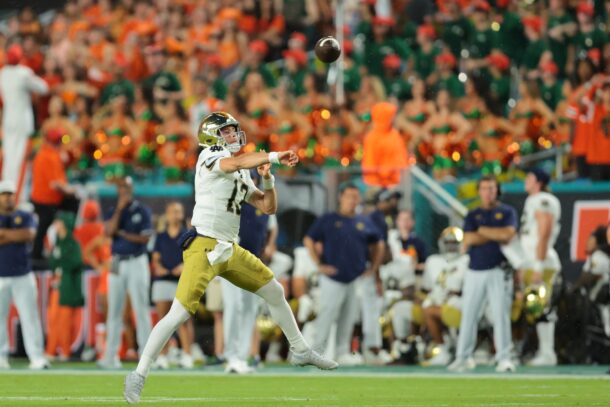
The Fighting Irish also have CJ Carr, by far the best quarterback Miami’s defense, which has struggled of late, has faced. Without Toney, the Canes will need to ride their defense more than usual, at least in theory. Miami ranks fifth nationally in time of possession, but much of that is due to its ability to sustain drives on third down, where Toney thrives. Will Miami’s struggling defense put it together against a Notre Dame offense that has scored on 59% of its possessions this season? It’s possible. It just feels unlikely.
Freeman has won plenty of big names at Notre Dame. The Fighting Irish dominated SEC champion Georgia in the 2024 College Football Playoff quarterfinals. Notre Dame’s rout of undefeated Clemson in South Bend in 2022 may have been the true beginning of the decline for Dabo Swinney. Curt Cignetti’s only Playoff loss came to Freeman and Notre Dame.
Those are historical indicators that suggest the Fighting Irish can get this done. The doubts linger anyway.
With or without Toney, this is the fastest, most talented, dynamic football team Notre Dame’s played this season. The Canes aren’t intimidated by anyone and won’t be bothered on the road in South Bend, as evidenced by their destruction of Clemson in Death Valley earlier this season. The absence of Toney also may create a one-game emotional lift, a “rally around the flag” type bump where others step up to fill the void, similar to the type of effort you see in the first game under an interim coach.
Without question, Miami can win without Toney. For Notre Dame’s College Football Playoff dreams to play out, Marcus Freeman can’t let that happen. Not in South Bend.
This isn’t “Catholics vs. Convicts.”
It doesn’t have to be to matter just as much.
Like our coverage? Make SDS a preferred source in your searches!
Neil Blackmon covers SEC football and basketball for SaturdayDownSouth.com. An attorney, he is also a member of the Football and Basketball Writers Associations of America. He also coaches basketball.