LSU football: Loss to Kentucky shows Tigers’ problems transcend running game

By Les East
Published:
LSU had its best rushing game of the season Saturday night.
It didn’t matter.
The Tigers’ 147 rushing yards weren’t that big a deal, but they were more than the previous high of 125 against McNeese State, and more than the sub-100 totals in the other 4 games.
But it didn’t matter.
Ty Davis-Price had 147 yards by himself and rushed for 2 touchdowns, but it didn’t matter.
It didn’t matter, in part, because many of those yards came after No. 16 Kentucky had taken control with a 21-0 lead early in the 3rd quarter before coasting to a dominant 42-21 victory in Lexington, Ky.
It didn’t matter, in part, because the Wildcats rushed for 329 yards, with 2 100-yard running backs to support quarterback Will Levis’ 64 rushing yards and 2 rushing touchdowns.
It didn’t matter because Kentucky was more physical than LSU on both lines of scrimmage.
It didn’t matter because Kentucky was the better team by a large margin. Period.
The Wildcats’ offensive line was better than the Tigers’ defensive line. The Wildcats’ defensive line was better than the Tigers’ offensive line.
Mark Stoops and his staff had their players better prepared at the outset than Ed Orgeron and his staff.
Nothing that happened during the ensuing 60 minutes changed what was apparent shortly after kickoff.
Kentucky is No. 16 and rising for a reason. LSU has tumbled from a poorly-conceived preseason No. 16 ranking for a reason.
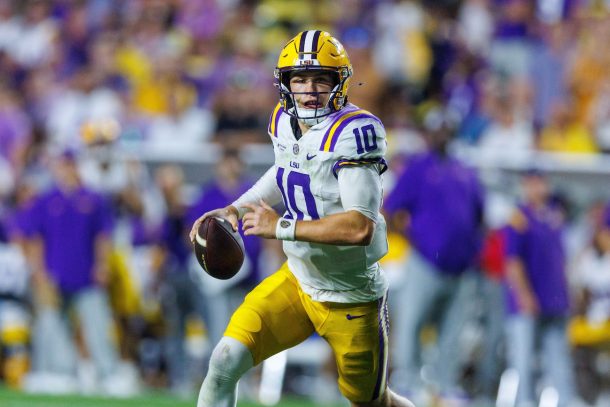
Levis outplayed LSU counterpart Max Johnson, who completed 22-of-38 for 261 yards and 1 touchdown and lost a fumble on the 1st possession of the game, leading to the 1st touchdown.
Johnson has played under duress for much of the season, competently dealing with an anemic running game and consistent pressure. The improved running game Saturday was still accompanied by consistent pressure, and it affected him.
Levis was in better shape.
In 3 previous SEC games, he had completed 32 of 57 passes for 368 yards with 2 touchdowns and 3 interceptions.
Against LSU, he was a touchdown machine, throwing for 3 and rushing for 2. He had just 7 completions in the upset win against Florida a week earlier, but he doubled that number in just 17 attempts and finished with 145 passing yards in addition to his 64 rushing yards.
He expertly managed a more manageable situation than Johnson had.
And so the Tigers are 3-3 and 1-2 in the SEC after losing consecutive conference games.
Prior to Saturday, the rushing game, which was 2nd to last in the SEC with an average of 70 yards per game, was the most glaring weakness, a handy scapegoat for the team’s erratic play.
But that changed Saturday.
The running game wasn’t great by any means, and it remains a significant factor in this team’s below-average play.
But the fact that the best rushing performance of the season came in arguably the worst overall performance of the season showed that LSU’s shortcomings are far from being limited to its inability to run the ball effectively.
It ran the ball fairly well against Kentucky, but it didn’t pass it well, and it didn’t defend either the run or the pass well.
The Tigers didn’t solve their running game problems against the Wildcats, though they were less poor than they had been previously.
Their 2nd consecutive SEC loss demonstrated that their problems transcend the running game, and an average running game isn’t going to solve the team-wide problems.
Kentucky showed emphatically that LSU’s inability to be competitive in the SEC is a result of more than just a poor running game.
Les East is a New Orleans-based football writer who covers LSU for SaturdayDownSouth.com. Follow him on Twitter @Les_East.