The Evolution of SEC Football (Part 1): ‘They told me boys from the South would fight’

By Ethan Stone
Published:
“On the East Coast, football is a cultural experience. In the Midwest, it’s a form of cannibalism. On the West Coast, it’s a tourist attraction. And in the South, football is a religion, and Saturday is the holy day.” — Marino Casem
In the late 1890s and first few decades of the 1900s, as Harvard, Princeton and Yale dominated the gridiron in the East, Vanderbilt was the football team to beat in the South.
Vanderbilt was a charter member of the South’s first major college athletics conference — the Southern Intercollegiate Athletic Association — which was primarily organized by chemistry professor and southern football pioneer William Dudley in late 1894. Hired a decade later, future Hall of Fame head coach Dan McGugin was responsible for 9 of Vanderbilt’s 11 SIAA conference titles, and he’d go on to win 2 more following Vanderbilt’s admittance into the Southern Conference — the offshoot of the SIAA and the precursor to the SEC.
Football took root in the northeast and diffused across the country, floating into the Midwest before finally reaching the South around the 1890s. Georgia and Auburn kicked off the Deep South’s Oldest Rivalry at Atlanta’s Piedmont Park in 1892, and the SIAA grew its membership slowly starting in the 1895 season, striving for “the development and purification of college athletics throughout the South.”
While the SIAA’s membership was growing, the southern game really wasn’t. Not at first. Football was a game played by college students, not yet college athletes. Teams weren’t funded by their schools, meaning games were closer to after-class club meetings than sanctioned events.
What’s crucial to remember is few people went to college at this time — especially in the South. Rosters rarely included more than 20 players, and those players saw action on both sides of the ball until the introduction of substitution rules in 1910.
Finally, while northern schools were more concentrated in a smaller region of the country, sometimes located just miles away from a rival, southern teams had to travel considerable distances to face their peers. Apart from early rival Nashville Peabody and perhaps Sewanee, located about 80 miles to the southeast, this absolutely applied to the Commodores.
McGugin and Vanderbilt were instrumental in growing the game for a southern audience. Nashville became intrigued by McGugin’s Commodores, which — unique among southern schools at the time — frequently travelled outside their comfort zone to play intersectional contests against teams that had been playing the game much longer than they had.
As these long-distance, interregional games became more common, southern audiences became more and more interested in the growing game.
Vanderbilt made inroads in 1910 when the team traveled up to New Haven, Connecticut, to face the mighty Yale Bulldogs. It was the first time Yale had ever faced a team from the South, and the expectation was a decisive Yale victory.
Vanderbilt and Yale tied, 0-0. The result, rightfully so, was considered a massive victory for the Commodores.
Twelve years and 5 SIAA titles later, Vanderbilt hosted Michigan in Nashville at the dedication of Dudley Field, at the time the largest football-only venue in the South.
Vanderbilt owes a lot of its early dominance to McGugin’s time in Ann Arbor as both a player and assistant to future Hall of Fame coach Fielding H. Yost, who also happened to be McGugin’s brother-in-law. Because of this relationship, Vanderbilt had played Michigan 7 times heading into this matchup… with zero victories to show for its efforts.
Thousands were in attendance, including politicians, alumni and common fans. Hoping to turn the tide, referring to a nearby military cemetery, McGugin addressed his players prior to kickoff: “In that cemetery are your grandfathers, and on that football field are the grandsons of the Yankees who put them there.”
Vanderbilt players probably didn’t know that McGugin’s father had been an officer in the Union Army. Like its previously mentioned attempt against a northern foe, Vanderbilt’s game against Michigan ended in a 0-0 tie.
The Game that Changed the South and the emergence of the SEC
Vanderbilt was actually late to the party in regard to the formation of the Southern Conference.
Organized in 1921 in Gainesville, Florida, the 14 charter members of one of the longest-standing conferences in the country included the following: Alabama, Alabama Polytechnic Institute (Auburn), Clemson, Georgia, Georgia School of Technology (Georgia Tech), Kentucky, Maryland, Mississippi A&M (Mississippi State), North Carolina, NC State, Tennessee, Virginia, Virginia Polytechnic Institute (Virginia Tech) and Washington & Lee.
The SoCon’s original limit for conference members (16) didn’t even last a year. Vanderbilt joined the fray in 1922 alongside LSU, Florida, Ole Miss, South Carolina and Tulane. Sewanee became the next to join in 1923, followed by VMI in 1924 and Duke in 1928, ballooning the roll call to 23 strong.
The Southern Conference had blossomed into a full-blown super league, and on the gridiron teams from the south were demanding more respect with each passing year.
In many ways, the SoCon had the Alabama Crimson Tide to thank for that.
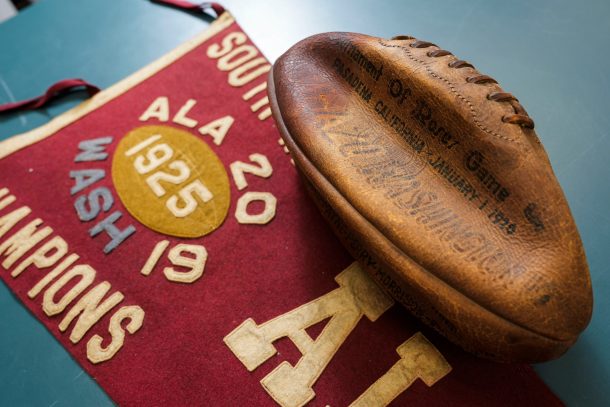
McGugin’s Vanderbilt squads walked so 1925-26 Alabama could run. The Crimson Tide allowed just one touchdown all year, finished the season undefeated (9-0) and accepted an invite to the Rose Bowl to face a Washington team that had outscored opponents 461-39, boasting a 10-0-1 record. Their lone tie came at the hands of Nebraska, 6-6.
The Tide were not the first option for the Rose Bowl committee, not by a long shot. Institutions in the northeast were increasingly pushing back on the prospect of playing in postseason events because, at the end of the day, these were still considered prestigious universities. Shirking academics in favor of traveling all the way out west to play in the Rose Bowl simply wasn’t in the cards for these schools entering the late 1920s.
Receiving denial after denial from teams such as Dartmouth, Yale and even southern squad Tulane, the committee held its nose and called on Alabama, expecting an absolute stomping from a powerhouse Washington team.
That 1926 Rose Bowl didn’t start out so well for the boys down south, either. Alabama fell behind 12-0 heading into the halftime break, seeming to affirm the expectations of both the Rose Bowl committee and the spectators in attendance.
Head coach Wallace Wade, formerly Vanderbilt’s assistant coach and a future member of the College Football Hall of Fame, meandered into the locker room and eyed his team. His message was short: “…And they told me boys from the south would fight.”
Alabama responded immediately, scoring 3 touchdowns in just over 7 minutes at the start of the 3rd quarter. The Tide’s furious comeback held, proving enough to stun Washington with a 20-19 win.
It went down as the first of 18 championships across Alabama’s football history.
***
For the time being, all was well within the Southern Conference. The game was evolving. Alabama went on to win another championship the following season, this time tying Stanford at the Rose Bowl in front of 56,000 fans. A few years later, Georgia Tech — another southern pioneer — beat Cal to claim its second national championship, 8-7.
Then came the Great Depression.
The Southern Conference, spanning from College Park, Maryland, to Baton Rouge, Louisiana, was already facing logistical issues. The Appalachian Mountains effectively split the conference in two, and the economic downturn only added to the travel costs and tediousness programs already had to endure just to play their games. With 23 teams in consideration, the situation quickly transitioned from mildly annoying to utterly unmanageable.
On December 10, 1932, at the SoCon’s annual meeting in Knoxville, Tennessee, 13 schools finally pulled the trigger and announced their resignation from the conference, forming the SEC in the process. The decision, appropriately, split the 13 schools west and south of the Appalachian Mountains from the programs residing in South Carolina, North Carolina, Maryland and Virginia along the eastern seaboard.
John J. Tigert, president of Florida, spoke on behalf of the newly formed SEC:
“In our good judgement, the time has arrived for a more compact organization for the administration of athletics and for a division of the conference to be made solely on geographical lines.” He later added, and I’m paraphrasing here if you can’t tell, “no hard feelings.”
The 13 members of the newly formed SEC included the following:
- Alabama
- Auburn
- Florida
- Georgia
- Georgia Tech
- Kentucky
- LSU
- Mississippi
- Mississippi State
- Sewanee
- Tennessee
- Tulane
- Vanderbilt
Thanks for reading Part 1 of our 3-part series. Stay tuned for Part 2 next week!
Ethan Stone is a Saturday Down South News Editor and an advocate for the return of the Seattle Supersonics.