Papa grasso, Papa magro.
That old Italian saying has predictive meaning in the Catholic Church and translates roughly to “fat pope, thin pope,” in English. In literal terms, it means that if the old pope was fat, the new pope will be thin. More broadly, it suggests institutions are often drawn to leaders who are stylistically or philosophically different from their predecessors.
Versions of the adage can also be applied beyond religion — including to college football coaching changes. If you had an offensive coach who failed, hiring a defensive coach next may be the answer. Replacing an old coach? Maybe a young one will do the trick.
That’s the bet the SEC made this offseason — whether the league’s athletic directors did so consciously or not is up for debate, but SEC head coaches are now as (collectively) youthful as they’ve been in over a quarter century.
SEC head coaches are historically young
At just 55 years old, Oklahoma coach Brent Venables will be the SEC’s oldest head coach this fall.
History says it’s incredibly rare for the SEC’s oldest coach to be that young. In fact, it hasn’t happened since 1998 when the oldest SEC head coach was Vanderbilt’s Woody Widenhofer (who was also 55). The next year in 1999, South Carolina hired a 62-year-old Lou Holtz to lead the program, which began a 27-year streak of the league having at least one sexagenarian.
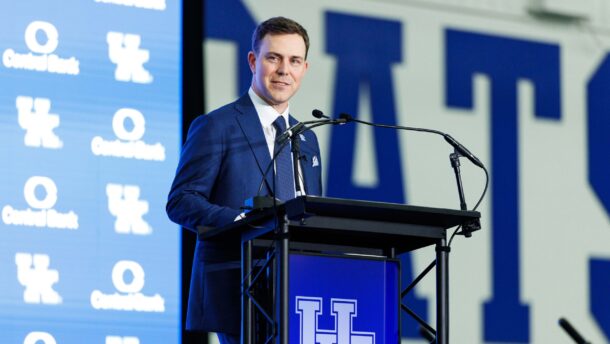
On the other end of the spectrum is Kentucky coach Will Stein, who won’t turn 37 years old until Sept. 25 of this year. The SEC’s youngest coach being in his mid-30s is much less rare. It happened as recently as 2023 with 36-year-old Zach Arnett taking over at Mississippi State.
The result is the SEC will have a mean coaching age of 47 years old in 2026, which is the lowest mark for that league since 1998.
The SEC’s largest-ever hiring cycle brings an unprecedented youth movement
The SEC had a record-breaking 6 head coaching changes this offseason, including 5 new additions from outside the league (Lane Kiffin moved from Ole Miss to LSU).
In every single instance, the SEC got younger. Here’s a chart showing coach ages (as of Sept. 1) for each of the SEC’s new hires compared to their predecessors:
Five of the league’s 6 new hires are 8+ years younger than their predecessor. In Kentucky’s case, the Wildcats hired a coach in Stein that’s a full 22 years younger than Mark Stoops was in his final season with the program.
Arkansas, Auburn, LSU and Ole Miss each also got substantially younger, to varying degrees. Florida knocked just a couple of years off by switching from Billy Napier to Jon Sumrall, but the former Tulane head coach is still under the SEC’s mean age for 2026.
In fact, all 5 of the SEC’s newcomer head coaches are under the SEC’s mean and median age this fall. Kiffin, who will turn 51 this coming May, is the lone exception for this hiring cycle.
The Big Ten is making a different bet
The Big Ten had a lighter hiring cycle this year, but that league — the SEC’s top competitor on the gridiron — did not have a similar approach. In fact, the Big Ten is skewing significantly older this coming season compared to 2025.
The Big Ten’s mean coaching age will be about 52 years old for 2026. That’s 5 years older than the SEC’s mean age of 47. For additional context, every coach in the SEC this fall is 52 years old or younger except Venables.
The Big Ten retained 14 coaches who all got a year older. Four newcomers (Kyle Whittingham at Michigan, Bob Chesney at UCLA, Matt Campbell at Penn State and Pat Fitzgerald at Michigan State) also contributed to the Big Ten’s mean coaching age rising. Of that group, only Campbell is younger than his predecessor.
The outlier is Whittingham, who will be 66 years old until November. He’s immediately the second-oldest coach in the Big Ten, though his appointment makes plenty of sense in the context of his predecessor’s departure. Michigan needed a veteran stabilizer in the wake of Sherrone Moore’s shocking firing and it found one.
It’s worth noting that Big Ten programs aren’t necessarily wrong for putting their resources in older coaches. It certainly worked out for Indiana, who hired Curt Cignetti when he was already in his 60s a couple of years ago. Kirk Ferentz is now in his 70s and continues to have reasonable success at Iowa. Bret Bielema was on the high side of 50 — older than any SEC newcomer this cycle — when Illinois hired him, and he’s done a great job of reviving that program even after failing at Arkansas.
Are older coaches winning fewer games than they used to?
It doesn’t take much effort to come up with reasons for the SEC’s youth movement. Recruiting has become an entirely different beast over the past five years, with rosters under constant threat of poaching and the ever-growing need to invest significant resources into the transfer portal. Those things — plus everything else that comes with being a head coach — require energy. Young coaches are generally more energetic. They’re hungrier. They haven’t proven themselves yet. They haven’t made generational wealth yet, as many long-time head coaches in their 50s and 60s have by now. Those ingredients seem like they should matter.
But do those things matter? Are old coaches actually winning fewer games than they did prior to NIL and the transfer portal era?
There’s some evidence to say ‘yes,’ albeit not from a huge sample. The transfer portal officially launched in October of 2018, but widespread adoption and multi-time transfer rules didn’t take hold until later. For the purposes of this exercise, we’ll draw the line in 2021.
From 2014 (the start of the Playoff era) through 2019, Power 5 coaches who were 55 years or older won over 51% of their conference games. From 2021-25 (excluding 2020 for COVID reasons) coaches in that same age range saw their winning percentage drop to just over 45%.
On the other end of the spectrum, coaches who were 54 or younger have seen their conference winning percentage rise from 49% to 52% during the same time frames. The sample size isn’t massive, but it does paint an interesting picture in light of the SEC’s apparent youth movement.
Here’s a chart showing the conference winning percentages for coaches 55 & over or 54 & under between 2014-19 and 2021-25:
It’s too early to draw sweeping conclusions from this data — the sample size isn’t big enough yet. But it is striking given the dramatic demographic shift the SEC saw this offseason. It’s reasonable to say the sport’s shifting demands now favor a different profile of coach than the one who dominated in prior eras.
It’s possible it won’t work — rookie coaches like Stein and Pete Golding are inexperienced and have very difficult jobs, after all. If this youth movement does fail, perhaps the next round of hires will prove the old proverb right.
Papa grasso, Papa magro.

Spenser is a news editor for Saturday Down South and covers college football across all Saturday Football brands.