Polymarket Fees and Funding: How to Deposit, Trade, and Cash Out

By Kevin Wolff
Last Updated:
Polymarket is the world’s largest prediction market, and it’s a top-tier option for traders located throughout the country. As a Designated Contract Market, the Polymarket platform is federally regulated by the Commodity Futures Trading Commission (CFTC) and is available in over 40 states. Follow along for a detailed breakdown of Polymarket fees and funding, including Polymarket payment methods, and how to cash out on Polymarket.

Trade $10 & Get a $20 Bonus at Polymarket!
New users can sign up with the Polymarket promo code and unlock the welcome offer to deposit $20 and get a $50 bonus.
Polymarket Fees Explained
Polymarket charges small fees on taker orders (order processed immediately at best available market price). Maker orders (limit orders at set prices) do not incur fees. Markets for Geopolitical and World Events are fee-free. The fees collected by Polymarket on taker orders sustain the trading platform and allow users to buy and sell positions with no house edge.
How Does Polymarket Make Money?
Polymarket is a peer-to-peer prediction markets exchange, meaning users are technically trading against each other, not against the house. Given this setup, Polymarket does not profit from users losing their trades. Instead, Polymarket is able to make money by charging small transaction fees (taker fees) on most trades executed on the platform.
Trading Fees: Previously, Polymarket did not collect any fees on trades, but the platform has now shifted to collect taker fees. Polymarket takes a small transaction fee (taker fee) when users buy and sell positions using quick trades at the best available market prices; these are called taker orders. Trades made at set price points (limit orders) are fee-free, as Polymarket does not collect anything from maker orders.
Market Liquidity: Polymarket maintains automated market maker (AMM) liquidity pools. This pricing model quotes prices and guarantees market liquidity, which keeps the platform running smoothly. Every AMM trade creates value for the pool by capturing the micro-differences in price between trades (the spread), thus incentivizing market liquidity. Seeing that prices are adjusted along a curve, traders will pay slightly more to buy a position than the amount they would receive if they sold that position at that exact moment. While the captured spread could be a difference as small as buying a position at $0.32 vs. $0.33, it adds up over millions of trades, creating value and market liquidity.
Data Monetization: Data licensing has proven to be a useful tool for Polymarket to make money. Polymarket has successfully monetized its real-time data on upcoming world events, and the trading platform sells market analytics and forecasting insights to various clients like hedge funds, news agencies, and AI developers. Polymarket provides its real-time data as a key indicator for movements in traditional stock and crypto markets.
Breaking Down Polymarket Trading Fees
Taker fees on Polymarket are calculated based on a dynamic probability curve. The Polymarket fee structure charges the highest fees when a position is closest to 50% implied market probability ($0.50 contract price). Given the dynamic curve, Polymarket trading fees will be the lowest when a position is closest to 1% or 99% implied market probability ($0.01 or $0.99 contract price).
Trading fees on Polymarket are calculated using a formula that scales in accordance with price uncertainty:
Fee = Θ × C × p × (1 – p)
- C – is the number of contracts
- p – is the trade price ($0.01 to $0.99)
- Θ – (theta) is the fee coefficient
Users who trade over $250,000 in taker volume will receive a taker rebate equal to 30% of their total taker fees.
See the table below for a full breakdown of the Polymarket fee schedule:
Trading fees on Polymarket will vary depending on the market category:
- Sports: $0.75 peak trading fee (per 100 shares)
- Politics/Finance/Mentions/Tech: $1.00 peak trading fee (per 100 shares)
- Economics/Weather/Culture: $1.25 peak trading fee (per 100 shares)
- Crypto: $1.80 peak trading fee (per 100 shares)
- Geopolitics: No trading fees
How to Deposit on Polymarket
Funding your account on Polymarket is very easy to do, and there are several payment methods available. Users have the option to connect a decentralized crypto wallet and deposit using USDC (USD Coin) or fiat methods.
Follow this simple process to deposit on Polymarket:
- In the Polymarket app, click the button to Deposit.
- Choose a deposit method from the available options (Apple Pay, Bank Account, Debit Card, Wire Transfer, Crypto).
- For fiat methods (non crypto):
- Enter the desired amount you wish to deposit, and confirm the payment (Note: Minimum/maximum deposit amounts as well as processing times apply).
- For crypto methods:
- Select the token and network, copy your deposit address, and send (deposit) the desired amount to that address.
- If the funds do not appear in your account at first, refresh the page, and your funds should be available in your account balance.
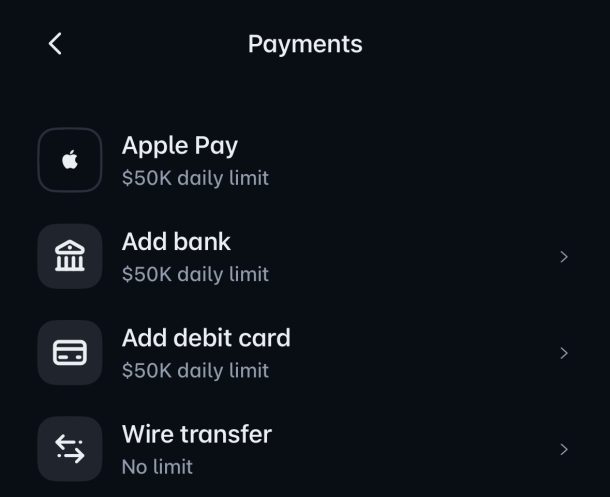
It should be pointed out that deposit fees are attached to some Polymarket payment methods. Polymarket does not charge fees on deposits; however, third-party payment processors can charge fees for fiat deposit methods.
Polymarket Funding & Transaction Chart
With the details of Polymarket fees and funding now covered, you’re ready to start trading on prediction markets! Make sure to use the Polymarket promo code SOUTH to sign up for an account and unlock a welcome offer to deposit $20 and get a $50 bonus.
After years of writing as well as Data Analyst work for Pro Football Focus, Kevin Wolff is now a Sports Betting Writer for SportRadar. A graduate of Fordham University in NYC, Kevin is also a full-time dog dad when he's not writing. He can be reached at k.wolff@sportradar.com