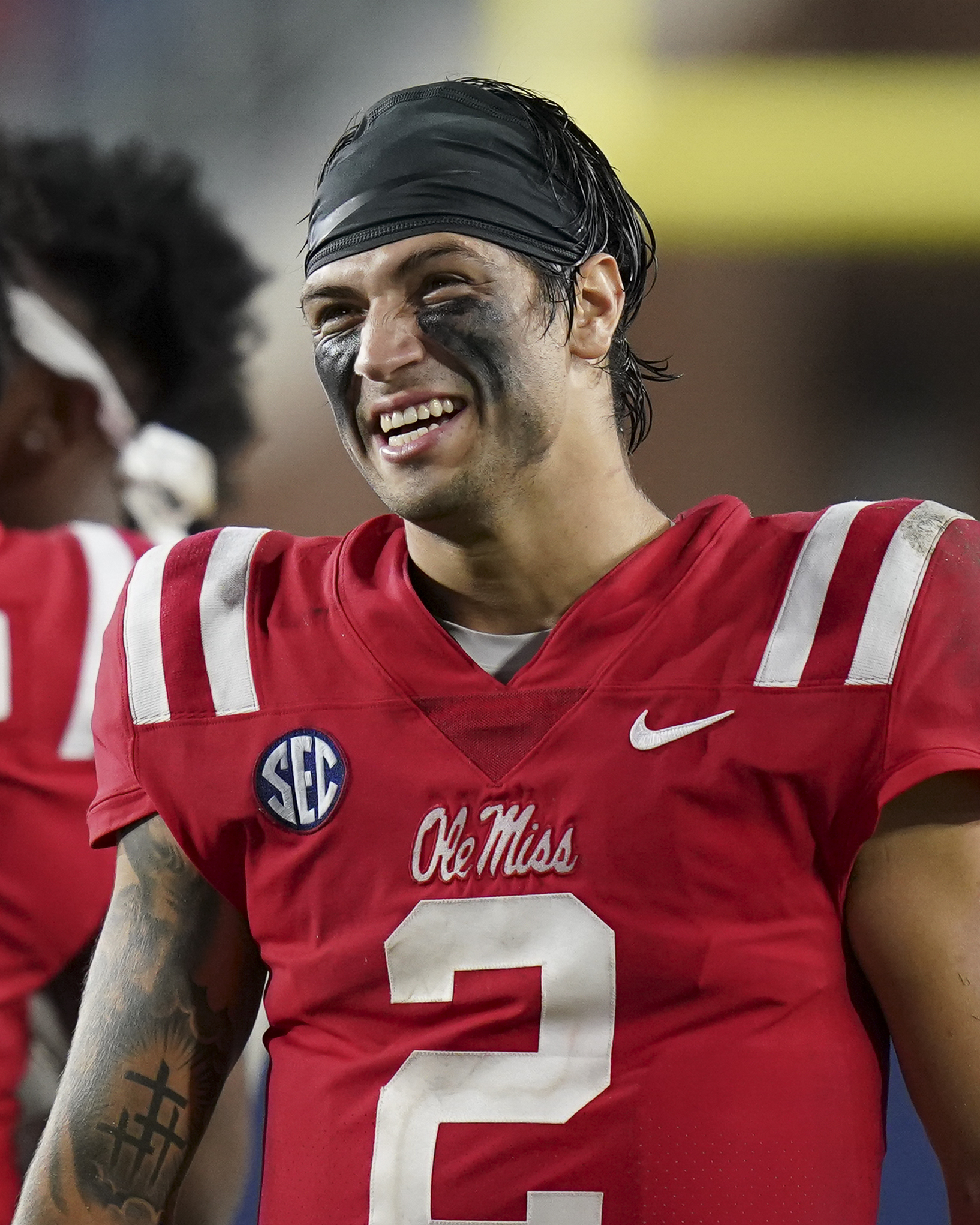
Extra Points: Control of SEC West? Heisman? No. 1 pick? It’s all right there for Ole Miss QB Matt Corral

By Matt Hayes
Published:
Each week, college football insider Matt Hayes tackles the biggest topics in the game, in and around the SEC:
Matt Corral’s big opportunity
There may not be a more impactful game for Ole Miss QB Matt Corral than this weekend at Alabama.
In one game, Corral could:
— Take control of the Heisman Trophy race.
— Move Ole Miss into the top of the SEC West Division, and change the longstanding dynamic of the annual race.
— Strengthen his hold as the No.1 quarterback in the 2022 NFL Draft.
“He’s doing exactly what you’d hope – he has gotten better, and he is playing with poise and confidence,” an NFL scout told me this week. “There has never been a question about his arm (strength) or ability to make every throw. His accuracy is terrific, and he’s staying in the pocket longer, finding ways to buy more time and find that next progression. The little things you’d hope would be sharpening, he’s doing. He looks in complete control out there.”
As good as Corral has played, he’ll need help from an Ole Miss defense that, while better than last season, still isn’t a complete unit. There are issues in coverage in the back end, many that will be exposed by Alabama QB Bryce Young and the Tide passing game.
The only question: to what extent, and can Corral and the Ole Miss offense simply outscore Alabama?
Last year, Ole Miss gave up 519 yards per game. This year: 344.7.
Last year, Ole Miss gave up 38.3 points per game. This year: 20.7.
Last year, Ole Miss opponents converted 46.6% of 3rd downs. This year: 31.1
The change is drastic, until you realize the opposition: Louisville, Austin Peay and Tulane.
Change is coming
There’s no way around it. We’re moving closer and closer to straight pay-for-play for college athletes.
The only variable is what it will look like.
“I don’t see how we can avoid it,” one Power 5 athletic director told me.
Of the 6 athletic administrators and industry sources I reached out to in the past 24 hours since the National Labor Relations Board ruled Wednesday that student-athletes should be classified as employees, all 6 said pay-for-play is inevitable and that many universities already are preparing.
One former heavy-hitting administrator – who has been a staunch proponent of the amateur model – said the NCAA can’t afford more public embarrassment by dragging out litigation.
“We need a new model,” he said.
Before we go off the deep end, understand that change – while difficult – won’t be as drastic as you’d think. We’re not talking about million-dollar contracts.
Players won’t get 48-50% of revenue like professional sports. Not even close to it.
More than likely, the “new model” will include an increase in the full cost of scholarship stipends for student-athletes. The current stipend is typically around $5,000, and would double or triple – or more – with a new model.
Those numbers would have to be negotiated or collectively bargained, much like the labor contracts of professional leagues. Players have more bargaining power since the 9-0 Supreme Court ruling in the Alston antitrust case, where Justice Brett Kavanaugh ripped the NCAA, saying it’s “not above the law.”
The NCAA argued that it wanted immunity from the normal operation of the antitrust laws. Kavanaugh said the ruling was, “an important and overdue course correction.”
“Nowhere else in America,” Kavanaugh said, “can businesses get away with agreeing not to pay their workers a fair market rate on the theory that their product is defined by not paying their workers a fair market rate.”
The night shift
UCLA coach Chip Kelly ripped the Pac-12 this week for yet another 7:30 p.m. local game time, further underscoring a longstanding friction point between coaches and the conference office.
Coaches complain the 10:30 p.m. ET start times do significant damage to the Pac-12 product and reputation, which filters down to the College Football Playoff (and the BCS before that) and even the Heisman Trophy award.
Kelly’s comments this week echo what he said 2 weeks ago when UCLA had a 7:45 p.m. local kick for the Fresno State game.
“It’s primetime in the Philippines,” Kelly said. “So let’s put on a good show for the people
in Manila.”
In the 7-year history of the College Football Playoff, there have been two Pac-12 participants (Oregon in 2014, Washington in 2016).
There has been 1 Heisman Trophy winner (Marcus Mariota, 2014) in the past 15 years, and the Pac-12 hasn’t had a non-USC Heisman winner since Jim Plunkett of Stanford in 1970.
Christian McCaffrey averaged 275 all-purpose yards a game in 2015 at Stanford, and finished runner-up in the Heisman to Alabama tailback Derrick Henry.
Since the BCS era (1998) began the postseason change, the Pac-12 has had a non-USC player finish in the top two runner-up spots of the Heisman voting only 7 times: UCLA QB Cade McNown (1998), Stanford TB Toby Gerhart (2009), Stanford QB Andrew Luck (2010-11), Oregon TB LaMichael James (2010), Stanford TB Bryce Love (2017) and McCaffrey.
The statement game
The month of October begins with Cincinnati, the Group of 5’s only legitimate hope at securing a spot in the College Football Playoff, in win or walk mode.
If the Bearcats win at Notre Dame, the anchor around their argument of reaching the CFP – playing in the American Conference – will be minimized.
Notre Dame is 4th in CFP appearances behind Alabama, Clemson, Oklahoma and Ohio State, has won 43 games in the past 4 seasons, and has played in the CFP in 2 of the past 3 years.
This is a seminal moment for the Bearcats, who more than likely will lose coach Luke Fickell to a Power 5 program at the end of the season. Forget about Notre Dame QB Jack Coan’s injury, or who plays for the Irish.
A win for Cincinnati will be a huge résumé point. The only remaining obstacle to reaching the CFP is an undefeated season. The conference schedule – and playing teams that know your personnel and schemes — is where G5 teams typically get sidetracked.
Matt Hayes is a national college football writer for Saturday Down South. You can hear him daily from 12-3 p.m. on 1010XL in Jacksonville. Follow on Twitter @MattHayesCFB