Playoff Edge: Each challenger poses a unique threat to Alabama’s defense. Here’s how.

By Matt Hinton
Published:
Playoff Edge: Each challenger poses a unique threat to Alabama’s defense. Here’s how.
The second half of the season in the SEC played out less like a competition than a coronation, and the smart money on the College Football Playoff is thinking along the same lines: Even before the pairings were announced Vegas had installed Alabama as a huge favorite to repeat as national champs, initially setting the line for Bama’s Peach Bowl date with Washington at 16.5 points — a full touchdown more than the 9.5-point spread in the Tide’s favor ahead of last year’s semifinal beatdown of Michigan State. For a very large segment of viewers, the only drama this time around is where exactly Nick Saban’s most dominant outfit to date will fall among the greatest teams in history.
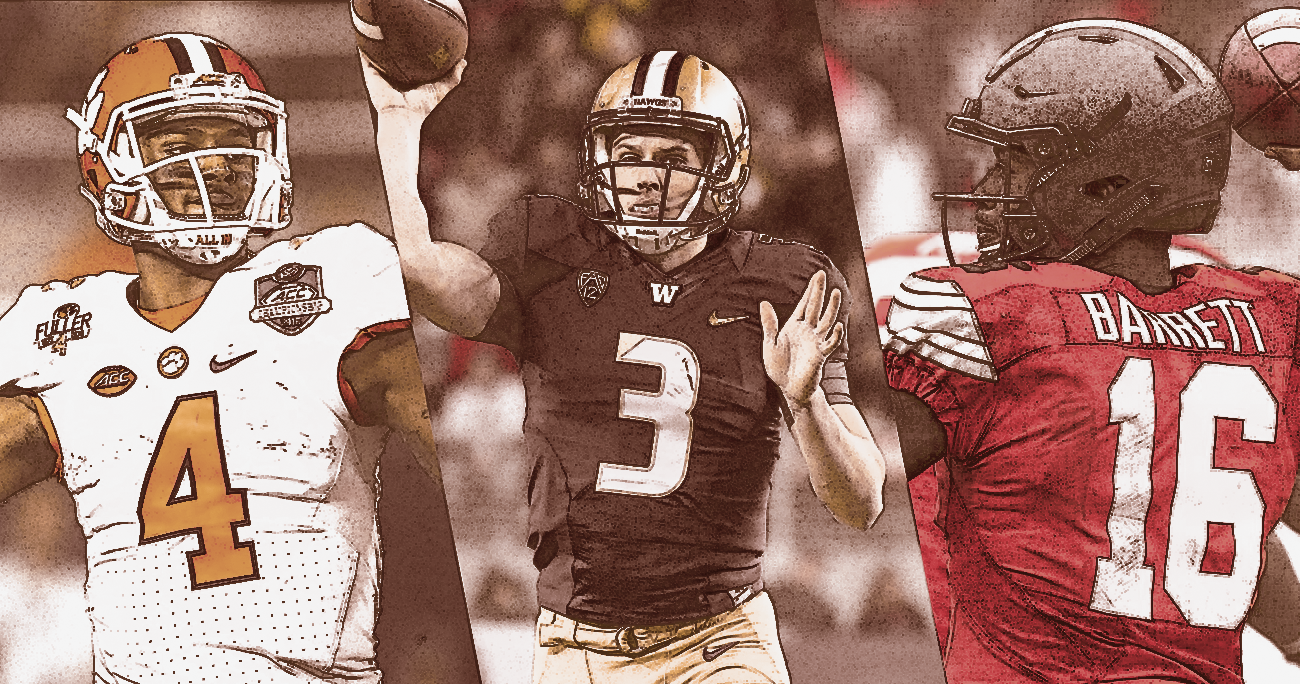
If he didn’t know better, one might get the impression that the other three teams involved are bit players, content to play out their supporting roles as footnotes in the Tide’s ascent. But of course we do know better: Between them, Washington, Ohio State, and Clemson are all worthy contenders capable of presenting a unique, specific challenge to Bama’s presumed supremacy. Over the next few days I’ll be breaking down the potential advantages the Huskies, Buckeyes, and Tigers could exploit on each side of the ball, beginning today with their respective offenses.
"That's not a slip, Joel Klatt. That is what we call an Ankle Breaker." – Gus Johnson #USCvsWash https://t.co/mEd8zwY5eh
— FOX College Football (@CFBONFOX) November 13, 2016
Washington: Going Deep
I’ve written before that Alabama’s secondary is potentially vulnerable to an elite downfield passing game, based mainly on the 421 yards, three touchdowns, and handful of big plays it yielded to Ole Miss in September in a 48-43 shootout. The problem with testing that hypothesis is that the Tide haven’t faced another legitimate pro prospect at quarterback since Chad Kelly, or a receiving corps with the sheer number of viable deep threats Kelly had at his disposal. Arkansas schemed its way to a 400-yard passing game against Bama that was more quantity than quality; Texas A&M made a couple of plays against man-to-man coverage in an otherwise futile effort. No one else has done jack, even inconsistently.
Against Washington, though, the Tide will be going up against both the most efficient passer they’ve seen this season, Jake Browning, and the most explosive set of receivers, a criminally underrated group that could hardly be more imposing even if it still included ex-Husky Damore’ea Stringfellow, a U-Dub transfer to Ole Miss who gave Alabama as many problems as any receiver they’ve faced this season.
Individually, Browning led the nation in touchdown percent, hitting paydirt on an absurd 11.9 percent of his overall attempts (for context, only one other Power 5 conference QB, Baker Mayfield, finished above 9 percent); meanwhile, his top four targets – John Ross III, Dante Pettis, Chico McClatcher, and tight end Darrell Daniels – collectively averaged 16.3 yards per catch with 39 scores between them.
In fact, adjusting for their generally run-oriented mindset, the Huskies operated arguably the most explosive passing attack in the country:
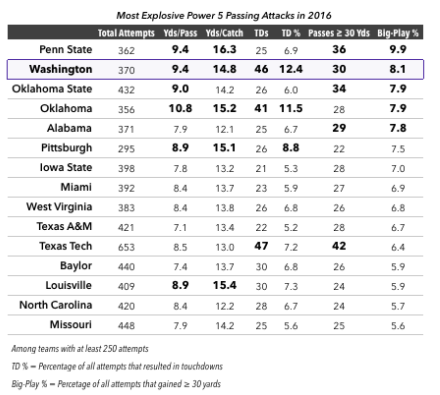
The teams are ordered there by the category I’ve labeled “Big-Play %,” but I’ve highlighted the best teams in each category to show that Washington is the only offense that ranks in the top five across across the board: First in touchdown percent, second in big-play percent, third in yards per attempt, fourth in yards per catch. Oklahoma is one 30-yard reception shy of joining the Huskies in that distinction; no one else is close.
Key Player: John Ross III
The move Ross put on consensus All-American/Jim Thorpe Award winner Adoree’ Jackson at the top of this section just about sums it up: He’s a nightmare man-to-man assignment for any college corner, and soon for most of them at the next level, too. After missing all of 2015 to a major knee injury, Ross, 5-11, 190, has evolved beyond the jack-of-all-trades slot role he occupied as an underclassman into a full-fledged, go-to wide receiver who commands the full attention of defenses and NFL scouts alike. (The popular comparison among draftniks is to DeSean Jackson.)
If draft projections aren’t your bag, just note that West Coast media types were so impressed they voted Ross as the Pac-12’s Offensive Player of the Year over both his own quarterback and Stanford’s Christian McCaffrey.
Ohio State: Grinding it Out
Alabama is perennially confident in its front seven, for very good and obvious reasons: The Tide are on pace to lead the nation against the run for the fourth time in the past six years, having successfully stuffed Leonard Fournette (again) and all other comers. Every member of the two-deep will play in the NFL.
But that was also true the last time the Tide faced Ohio State, in the 2015 Sugar Bowl, when the underdog Buckeyes ripped the No. 1 rushing defense going into that game for 281 yards on 6.7 per carry en route to an historic upset. And while these Buckeyes don’t have an individual workhorse on the order of Ezekiel Elliott – the Sugar Bowl upset over Bama was Zeke’s first breakout game on a national stage as a six-pack-flaunting sophomore – as a team their overall production on the ground hasn’t suffered at all in his absence.
In conventional terms, OSU led the Big Ten by wide margins this year in yards per game and per carry, effectively matching its 2014-15 output in both categories; according to advanced stats, it led the nation in Adjusted Line Yards and ranked second in Rushing S&P+.
Now, it ain’t always pretty, especially when the passing game isn’t clicking. But so far it has always been effective: Against the best defenses they’ve faced, the Buckeyes churned out 206 yards rushing against Michigan — arguably the front seven most comparable to Bama’s in terms of depth and overall nastiness — and 185 against Wisconsin, easily the best rushing performance against the Badgers this year. (The only other defense that managed to hold OSU below 200 yards was Penn State’s, at 168.) Including those performances, Ohio State exceeded its opponent’s average yield on the ground in every game.
And fittingly, given how they beat Michigan, the Buckeyes were notably productive in short yardage, converting 40 of 49 rush attempts on 3rd-and-3 or less for first downs. That rate (81.6 percent) was the best in the country, and helped lift OSU to No. 1 nationally in Power Success Rate, as well. Elliott’s departure for the NFL has meant fewer long, breakaway runs, but it certainly hasn’t kept Urban Meyer’s offense from keeping the chains moving.
Key Player: J.T. Barrett
Barrett didn’t play in the semifinal upset over Bama two years ago, and as far as the ground game is concerned he’s largely ceded the spotlight this year: The starting tailback, Mike Weber, extended (barely) Ohio State’s streak of 1,000-yard rushers to five consecutive years, and RB/WR hybrid Curtis Samuel emerged as a consensus All-American in the “all-purpose” role. When push came to shove, though, there was never any doubt where the Buckeyes’ bread was really buttered.
In games that were within one score at any point in the second half, Barrett logged 26 carries against Indiana, 21 against Wisconsin, 17 against Penn State, 24 against Michigan State, and 30 against Michigan, almost all of them hard-scrabble plunges between the tackles. (Only six of Barrett’s 194 carries went for at least 20 yards, roughly cutting his big-play rate in 2014-15 in half.) There were fewer highlights than you might expect from an All-Big Ten quarterback who nearly cracked 1,000 rushing himself, but in all of those games except one — Penn State, where he was sacked five times in the Buckeyes’ only loss — Barrett delivered with at least 90 yards on more than 4 yards per carry in a tough win.
Clemson: Protecting the Asset
Clemson’s offensive line doesn’t get a lot of attention relative to its skill players – the Tigers’ wide receivers are one of exceedingly few units in the country that can plausibly contend with Alabama’s defensive line for talent and depth, if not outright production – and the enduring image of last year’s Clemson/Bama clash in the championship game is of Deshaun Watson eluding rushers in a Herculean individual effort.
In fact, though, Watson had fairly outstanding protection on that night, especially relative to the Crimson Tide’s usual dominance up front: Bama came into the title game with more sacks (50) than any other defense in the country, as well as the No. 1 Adjusted Sack Rate. (To that point the Tide had also been credited with 70 QB hurries, an unofficial stat that’s not tracked consistently enough to make an honest comparison between teams, but which in this case accurately reflected the extent to which they routinely terrorized opposing passers.) Watson did go down a couple times on sacks, but otherwise was clean — aside from the sacks, Alabama didn’t record a QB hurry in the box score and (by my count) only landed one significant hit on the game film.
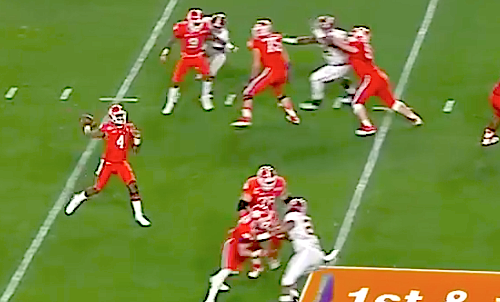
Part of that, of course, was Watson’s natural elusiveness under pressure, and part of it was Clemson’s commitment to letting him throw on the run behind a moving pocket, a tactic that resulted in plenty of time (and space) on his first touchdown pass:
But Watson often had time to set his feet and work from a conventional pocket, too, as you can see on his second touchdown pass:
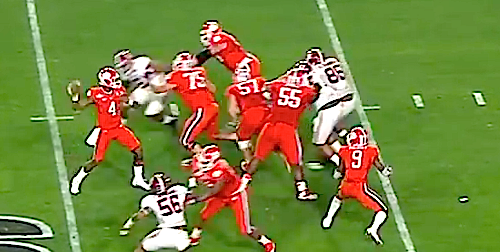
… and his third:

…and his fourth:
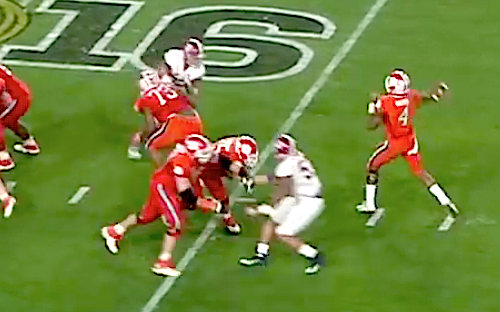
No college front will shut the Tide out when their ears are pinned back, but that’s about as well as anyone has fared in the past two years in holding the pass rush to a small handful of isolated successes as opposed to a steady drumbeat of disruption. And if Watson and his receivers have time, they’ve proven repeatedly that they can throw and catch against anyone, Bama included.
Key Player: Mitch Hyatt
This year, Clemson returned three starters from the title game (Hyatt at left tackle, guard Tyrone Crowder, and center Jay Guillermo), all of whom were voted first-team All-ACC as the anchors of a line the ranked second nationally in Adjusted Sack Rate.
In pass protection, none is more important than Hyatt, a sophomore who has started every game since he set foot on campus on Watson’s blind side and is well on his way to checking off every available box for a blue-chip o-line career by the time he’s through. He’ll also have the unenviable task of fending off, from one down to the next, Jonathan Allen, Tim Williams, and Ryan Anderson off the edge, all of whom should probably already be playing at the next level. If the Tigers advance past Ohio State and subsequently manage to keep Watson as clean as they did in January, maybe Hyatt should be, too.
Matt Hinton, author of 'Monday Down South' and our resident QB guru, has previously written for Dr. Saturday, CBS and Grantland.