
It all started, as so many success stories do, with an idea in Silicon Valley.
When he was an undergraduate student at Stanford University, Derek Belch could already see the big picture. Although he devoted much of his attention to kicking field goals and trying to help Stanford win football games in the Pac-12 — it was his game-winning extra point which lifted the Cardinal to a monumental upset at No. 2 USC in 2007 — Belch was also devising a plan that could alter the way football teams prepare in the future.
While he took a class about virtual reality with Jeremy Balienson, the head of Stanford’s distinguished Virtual Human Interaction Lab (VHIL), during the 2007 season, Belch realized that some of the same virtual reality practices could be implemented to help football players efficiently prepare for upcoming games. When the San Diego native approached Balienson with his idea, though, both agreed the timing wasn’t right.
“At that time, the consensus with myself and Jeremy was that (the technology) just wasn’t ready yet,” Belch said. “We needed a little bit more time.”
Belch returned to Stanford six years later to earn his master’s degree while working for the football team as a graduate assistant coach. Once he was back on the Stanford campus, the former kicker went back to Balienson to learn of any new advancements in the technology.
“I thought that could be a potential topic for my master’s thesis,” said Belch, who started pursuing his master’s degree in 2013. “And Jeremy said, ‘Well, remember that thing we talked about eight years ago? I think we can do it based on where the technology is now.’ That’s how the whole thing got started.”
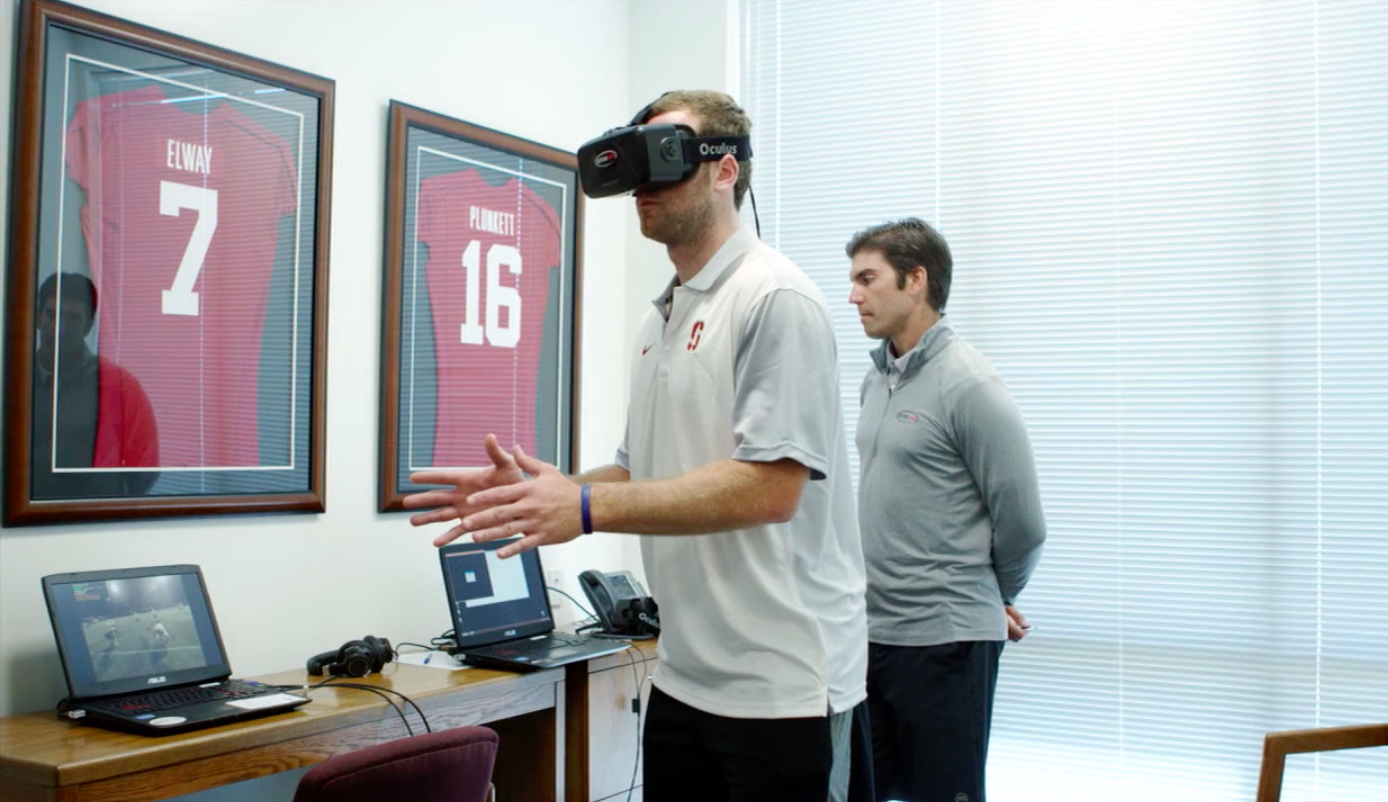
The two spent two years perfecting a way to capture practices with 360-degree videos which they could then broadcast into a virtual reality headset. Instead of watching film from a birds eye view high above, Belch and Balienson’s headsets allowed players and coaches to see plays develop in the same vantage point the player had on the field.
By the end of the 2014 season, the Stanford football team was using the technology to prepare for games. It didn’t take long for Belch’s headsets to make an impact as the Cardinal went on to win their final three games of the season, including a 45-21 blowout victory over Maryland in the Foster Farms Bowl.
Stanford’s quarterback at the time, Kevin Hogan, saw noticeable improvement over that span, even pointing out specific plays in which the technology helped during this feature on ESPN’s “College GameDay.”
Although he was falling in love with coaching, Belch knew his new technology could have a positive effect on football teams worldwide.
“My first reaction was, ‘We’ve got a chance here. This is something that could work,’” he said. “That was the reaction from a lot of the guys at Stanford, too. They said, ‘Wow, this is legit.’ So from there, we really wanted to help teams use this the right way.”
Not long after the 2014 season ended, Belch launched STRIVR — Sports Training in Virtual Reality — with hopes of changing the manner in which teams prepare for games. What started as a tool for quarterbacks to view their surroundings as they would during practice quickly morphed into an all-encompassing platform for players of all positions. Linebackers and safeties can also benefit from wearing the headsets, which display actual video rather than graphics similar to video games.
“We use real video because your brain is more engaged when you do it that way. It works from a cognitive standpoint,” Belch explains. “We really try to give the players a first-person view of what they’re seeing, not something 20 feet in the air or a view from way behind the play. We really tried to make it so they have their eyes on the field. When a player puts it on, they’re seeing exactly what they would see at the line of scrimmage. It’s all about making guys feel present. If they feel present in the headset, and if they feel present on the field, that means its working.”
As of this summer, Arkansas, Auburn, Clemson, Dartmouth and Vanderbilt, as well as the Dallas Cowboys, have each joined Stanford as STRIVR clients. However, Belch said even more college teams will be utilizing the technology in 2016, which comes as no surprise after hearing the success stories out of the SEC.
“Arkansas has definitely been one of the heaviest users, not just in the SEC but the whole country,” Belch said.
Out of all the quarterbacks that have used the virtual reality headsets, perhaps none have benefited from the experience more than the Razorbacks’ former quarterback Brandon Allen did. Arkansas implemented the STRIVR technology as a part of its routine preparations prior to the start of the 2015 season, which ultimately proved to be Allen’s best in Fayetteville.
In his final season, Allen completed 65.9 percent of his passes and threw for 3,440 yards and 30 touchdowns. Even though those numbers were far greater than the 56 percent completion rate he posted when he threw for 2,285 yards and 20 touchdowns as a junior, Belch recognizes Allen’s improved production wasn’t solely a result of using the headsets to prepare.
“One of the things we don’t do, we make sure not to attribute usage to performance,” said the former placekicker. “This is only one piece of the puzzle. We’re not going to say Brandon had a great year just because of our stuff coming in-house.”
Still, after talking with Allen — who was selected by the Jacksonville Jaguars in the sixth round (201st overall) of the 2016 NFL Draft — Belch was pleased to learn that virtual reality did play a role in the quarterback’s preparation.
“To sit down with him at the end of the season when he was preparing for the NFL Draft and to talk to him and understand what he liked and didn’t like about it, it meant a lot to hear that this was a part of his development last year,” Belch said. “We have a lot of other examples like that. Right now, there are guys that are backups and they’re going to be starters this year, so we’ll see how they perform. It’s really neat to hear how impactful this thing can be. It’s really been fun.”
It’s clear that virtual reality has been advantageous for SEC programs on the field and in the meeting rooms, but Belch also noted the technology can be used as another recruiting tool away from college campuses. While coaches compete for top-end talent on the recruiting trail, Belch believes that programs can lure potential prospects by showcasing the other benefits of using virtual reality.
“There’s a mental-edge component to this, and there’s a save-your-body component to this relative to what teams are already doing based on player development,” he said. “It can be a very powerful recruiting tool to show that investments have been made for the well-being of players.”