The statistical case for Tennessee moving on from Nico Iamaleava

Published:
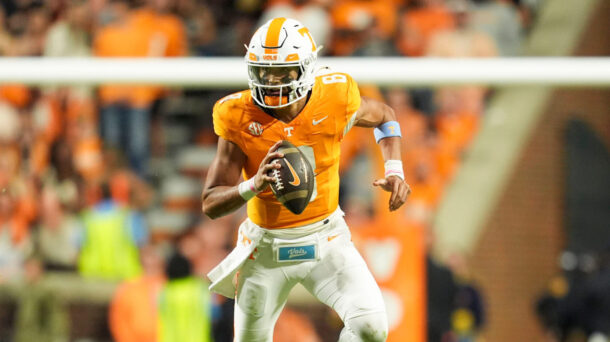
Nico Iamaleava and Tennessee appear to be at a standoff as the Vols’ spring practice period comes to a close.
Tensions are high enough that Iamaleava reportedly skipped out on practice Friday as he seeks to renegotiate his deal with the Vols. We haven’t seen something like this — at least not on this scale — in the NIL era, so it begs the question: Should Tennessee let Iamaleava walk?
I would say yes.
First things first — regardless of the statistical case for letting Iamaleava go (we’ll get to that soon), there’s an even stronger case in principle for not acquiescing to these demands. There’s value in Tennessee’s administration holding the line here, particularly when they initially went above-and-beyond with a reported $8 million offer over 3 years when Iamaleava was still in high school. That deal looks like a potential value now given where the NIL market has gone in the years since. But at the time? It was seen as a massive risk.
Is it possible Iamaleava will make a big leap in 2025 and live up to the hype? Of course. But let’s not mince words here: Individually, Iamaleava had a disappointing season in 2024. The advanced stats are clear about that. And that’s before taking his reported salary into account.
Let’s break it down with a new stat I’ve been playing around with this offseason that I’m calling “dead-end throw rate.” It’s a relatively simple stat that measures how often a quarterback either 1) throws an incomplete pass or 2) has a completion that goes for 4 yards or less. This measure is admittedly not perfect — sometimes short completions are good, depending on the situation — but this stat does correlate very well with traditional passer efficiency rating despite not accounting for high-impact (and occasionally-flukey) events like yardage, touchdowns or interceptions. Some of the single-season leaders in dead-end throw rate over the last decade are Joe Burrow, Jayden Daniels, Mac Jones, CJ Stroud, Baker Mayfield, Bo Nix and Kyler Murray.
From 2015-24, the average dead-end throw rate among qualified (min. 250 attempts) QB seasons is 50.3%. The absolute best quarterbacks in the sport over the past decade are typically under 40% or so, with Burrow posting the best season over that span at 35.1%. In 2024, Iamaleava checked in a little above average at 49.1%.
That’s certainly nothing to be embarrassed about. He’s in the same neighborhood as quarterbacks like Mason Rudolph (2016), Jordan Travis (2023), Trevor Lawrence (2019), Cam Ward (2023) and plenty more QBs who were viewed as above-average-to-great college starters. Out of 487 qualified seasons since 2015, Iamaleava’s dead-end throw rate ranks 312th.
Should he be setting the quarterback market with numbers like this? Absolutely not. Carson Beck is reportedly going to earn $4 million in NIL this season at Miami after having a down year at Georgia. Beck was not great in 2024, but he did put up a 38.6% dead-end throw rate with the Bulldogs in 2023. That’s hyper-elite — it’s the 5th-best mark by any qualified QB over the last decade and is better than multiple Heisman Trophy-winning seasons over that span. Beck then turned around in 2024 and posted the single-biggest Year 1-to-Year 2 regression in dead-end throw rate that we’ve seen over the past decade, but at least he has the track record of being extremely efficient for a full year at the college level.
Iamaleava has no such track record yet. And here’s a bigger problem for Tennessee: The data suggests meaningful improvement may not be coming. From 2015 through 2024, I’ve tracked 126 Power 5 quarterbacks who have played multiple seasons (min. 250 pass attempts) with the same program. The average improvement in dead-end throw rate from Year 1 to Year 2 is just 1.15 points. There are outliers — Burrow improved by more than 15 points from 2018 to 2019.
But for Iamaleava to get into the elite range, he’d have to improve his dead-end throw rate by about 5 points in 2025. An improvement of that caliber has only happened in 26 of 126 charted seasons, and it’s usually with quarterbacks who are starting from an already-poor place. If you only look at QBs with an above-average dead-end throw rate in Year 1, the results in Year 2 are essentially flat (-0.58 points) on average.
Now, this is not to say that quarterbacks don’t improve as they gain more experience. That would be inaccurate. I suspect what’s actually happening here is that dead-end throw rate is a reflection of both a quarterback’s skill and, perhaps more crucially, the context with which he’s playing in. Sometimes a quarterback improves year-to-year in dead-end throw rate, but many regress. This could be due to an offensive coordinator change, key pass-catchers graduating, diminished offensive line play, injuries or any other number of factors.
Which brings me to this question: If Iamaleava returns to Tennessee this fall, is his situation any better than it was a year ago? I would argue it’s almost certainly worse. The Vols leaned on Dylan Sampson in the running game a lot and he’s gone. Leading receivers Bru McCoy and Squirrel White have also departed, as has deep threat Dont’e Thornton. Tennessee’s offense ranks 87th in Bill Connelly’s returning production stat, which is actually inflated by Iamaleava’s projected return.
The reality is Iamaleava will have to take pretty significant strides this offseason just to be as statistically efficient as he was a year ago. That’s a scary proposition for Tennessee stakeholders who have already committed millions to his development only to have the program’s spring (at least partially) hijacked by these negotiations.
And perhaps Iamaleava will be able to make those requisite strides. Hendon Hooker did during his 2 seasons as Tennessee’s starter under Josh Heupel. After putting up a dead-end throw rate of 45.9% in 2021, Hooker led all qualified Power-5 quarterbacks in that stat as a senior in 2022 at 41.64%. That kind of improvement is certainly possible for Iamaleava. But I’ll again bring up Bill Connelly returning’s production stat and point out that the Vols’ offense ranked 26th in that category heading into 2022 — a far better situation than the one Iamaleava is walking into this year.
Frankly, Tennessee’s lack of returning production might be the impetus for Iamaleava working so hard to get a better deal in place for 2024. If he simply plays out his initial “contract” with the Vols and regresses 2025, his chances for a big pay day in college are probably over. But that doesn’t mean giving him $4 million is what’s best for Tennessee.
As Connor O’Gara argued on Friday, this is trending toward Iamaleava being done with the Vols after the 2025 season — if not sooner. If he’s right, and I think most would agree he is given the information we have — then Tennessee is much better off taking 2025 to rebuild around Jake Merklinger, George MacIntyre or perhaps a younger portal option. Quarterbacks under Heupel have produced above-average dead-end throw rates in all 4 years since he arrived in Knoxville, so there’s a decent chance that will happen again regardless of who is under center.
The Vols aren’t likely to contend for the title in 2025 anyways given what they’ve lost this offseason. Heupel and his staff are nowhere near the hot seat after a Playoff appearance last year. It stands to reason they can take this year as a rebuilding season if they want to and save the money earmarked for Iamaleava for a bigger push in 2026. In fact, that may just be what’s best for the Vols.
Spenser is a news editor for Saturday Down South and covers college football across all Saturday Football brands.