Winning is a Habit: An appreciation of Steve Spurrier, the Head Ball Coach who made football fun everywhere he went

Published:

Welcome to G.O.A.T. Week at Saturday Down South. Join us as we go deep with some of the “Greatest of All-Time” from SEC football history, including Bear Bryant, Herschel, the best running back duo, the best starting lineup, the Head Ball Coach and more.
“They can call us cocky, arrogant, crybaby, whatever. At least they’re not calling us losers anymore. If somebody likes you too much, it’s probably because they’re beating you.”
— Stephen Orr Spurrier, December 2001
“Winning is a habit, and it’s hard to pick up when you’ve spent time losing.”
— Vince Lombardi
He won a Heisman. He won a national championship. He not only beat his rivals, he enjoyed the heck out of it. Nobody ever had more fun on a football field than Steve Spurrier, HBC.
GAINESVILLE — As is often the case in stories about football in the South, no one saw the future better than Bear Bryant.
It was Bryant himself who proclaimed, in 1964, after a first-year starting quarterback named Steve Spurrier tormented, bedeviled and confounded his No. 3 Crimson Tide in Tuscaloosa, that the University of Florida was “the South’s sleeping giant.” Alabama won that game, 17-14, but The Bear had seen and foretold the future, even if we wouldn’t live to see his prediction come to fruition.
It was Spurrier, of course, who made good on Bryant’s promise.
First, he’d spend three years as a starting quarterback in the SEC, earning consensus All-American honors twice and winning the Heisman Trophy in 1966, when he led Florida to a victory in the Orange Bowl. Spurrier’s Heisman was the high-water mark of Florida’s finest decade, a period under the steady leadership of coach Ray Graves that saw Florida win 70 games and consistently compete, though never win, the SEC championship.
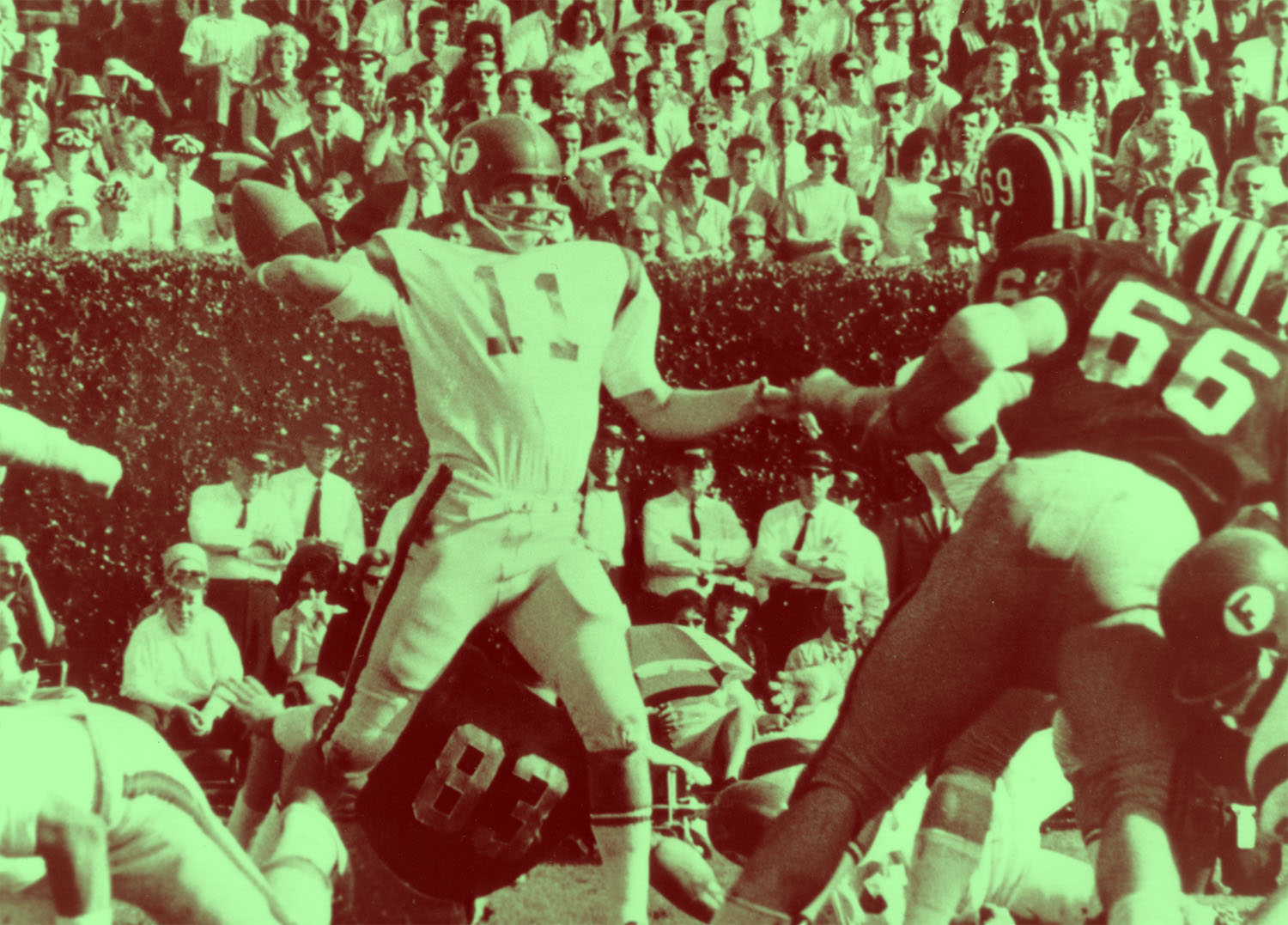
Graves, a no-nonsense but warm man with a fine reputation as a defensive coach, had won an immense victory when he persuaded Spurrier, an elite athlete in three sports, to leave his home state of Tennessee and attend Florida. Florida didn’t have the storied tradition of other places recruiting Spurrier, but Graves sold freedom on offense and the weather, emphasizing that Spurrier could wear shorts and golf in December, if that’s what he wanted to do.
In the end, Spurrier couldn’t resist the sunshine and golf, and with his prize recruit in hand, Graves and the Gators were good enough in the 1960s to foretell glories to come. Before the 1960s and particularly, before Spurrier agreed to play for Graves, Florida was in no uncertain terms, along with the other colleges and universities in the Sunshine State, a parochial backwater of college football, no match for mighty Alabama, Georgia, Ole Miss, LSU or Tennessee.
Spurrier is the winningest coach in Florida history (122), South Carolina history (86) and ranks second all-time in the SEC with 208 wins.
Beginning in 1990 and save a brief, star-crossed tenure with the Washington Redskins, Spurrier would return, spending 22-plus seasons as a head coach in the SEC, changing the conference, and the culture of two members institutions, forever.
We’ll get to that. This is, after all, as the title suggests, an appreciation.
But to truly understand the story of Steve Spurrier, competitor, innovator, believer, culture-maker, community-healer, comedian, “Evil Genius,” offensive mastermind, selfless friend and maker-of-men, son-of-a-preacher and to opponents, son-of-other-things too, the best place to begin, believe it or not, is on Tobacco Road, which is hardly ever the case in stories about football in the South.
Modern Day SEC began on Tobacco Road
It was September 1989, and the 44-year-old former Heisman winner was in his third year as the head coach at Duke.
Down the road, in a nicer building, was the office of another rising coach, Mike Krzyzewski, who had just taken Duke to a third Final Four in four seasons. Basketball practice was weeks away, and Spurrier’s team was already 1-3, having just been routed at Virginia. Most reporters around Tobacco Road were filing stories about whether this was the year Coach K and Duke broke through, behind the great senior Phil Henderson and two dynamic underclassmen, Bobby Hurley and Christian Laettner.
Eyes cast downward, Spurrier sat in a dingy press room, slouching slightly as he addressed the dwindling cadre of reporters who remained focused, if only out of a halfhearted sense of duty, on football. The Blue Devils were to play No. 7 Clemson in a few days, and a season billed with promise appeared headed for a 1-4 start.
Spurrier was taking Duke’s 1-3 start hard.
It wasn’t in his nature to accept losing.
“There’s a select group of people in my life who are the most competitive people I’ve ever been around, and Spurrier is in that group. He can’t stand to lose.”
Former Duke standout Randy Cuthbert
Randy Cuthbert was a redshirt freshman running back in 1989, who after a marvelous All-ACC career and brief foray in pro football went on to become a coach and educator. He was quick to note the impact of Spurrier’s competitive nature.
“There’s a select group of people in my life who are the most competitive people I’ve ever been around, and Spurrier is in that group,” Cuthbert told me. “He can’t stand to lose. He could be playing football or playing checkers and he’d want to win. That competitiveness, that desire to win and the emphasis that winning is important, passed on to his players.”
Clarkston Hines, a two-time All-American for Duke under Spurrier who has gone on to play leadership roles in multiple Fortune 500 companies, echoed his teammate’s sentiments.
“Coach’s confidence was infectious. Before he came back to Duke (he had previously served as an assistant coach) as head coach, we didn’t have a lot of confidence as a football team. Spurrier changed all that,” Hines wrote via email.
* * * * * *
Life’s great champions are proud, but they fear defeat more than they revel in victory. They are confident, brave and self-assured but selfless enough to adapt in the face of adversity. They are motivated and driven, at bottom, by the terrifying thought of failure. It must be avoided in any endeavor, however minimal the stakes. They maintain an abiding conviction that failure and losing, like winning, are habitual.
Steve Spurrier has always been that way.
Childhood friends in Johnson City, Tennessee, marveled at Spurrier’s ability to tell you, in painstaking detail, every critical moment of a high school basketball game (Spurrier was a star player) he had lost. Spurrier spoke of defeats with chest-collapsing angst.
Spurrier wasn’t just horrified by failure. It was agonizing to him. Losing caused him actual, physical pain.
Spurrier’s competitiveness wasn’t limited to the football field, or the golf course, where his penchant for prop-bets, penalty-stroke enforcement and desire to win is public record.
When Spurrier got to Florida, he joined the prestigious Alpha Tau Omega fraternity to have a social outlet off the football field. It helped him meet his wife, Jerri, a calming influence, but it wasn’t long until he was competing at the fraternity house, too.
“He’d leave a practice and grab a bite to eat and come play in the basement evening poker games,” Tom Blackmon, a retired Episcopalian priest and fraternity brother of Spurrier’s, told me via telephone. “He had a tremendous poker face, and he’d want to win so badly he’d borrow money when he lost and play until he won. We played for fun and laughs. Steve played to beat us.”
As a player, Spurrier’s desire to win on the football field was most famously on display in a 30-27 victory against Auburn in 1966. After driving the Gators down the field late in the fourth quarter, Florida needed a field goal to win. Spurrier knew the Gators’ usual kicker didn’t have the leg, and for fun, he’d try a field goal or two in practice. He convinced Ray Graves to let him have a go at the kick. Spurrier made the field goal, of course, and the kick sealed his victory in the Heisman Trophy balloting.
The brilliant Southern novelist, journalist and raconteur John Logue witnessed the field goal spectacle in person, and wrote this of Steve Spurrier after the Auburn game:
“Blindfolded, with his back to the wall, with his hands tied behind him, Steve Spurrier would be still be a two-point favorite at his own execution.”
* * * * * *
Favorite at his own execution or not, Spurrier’s Duke team was a double-digit underdog against Clemson in September 1989.
And so Spurrier sat in a dingy press room on a cold, rainy late September day, dutifully taking questions from a small media contingent he was trying to convince should care. If it sounds like a Sisyphean endeavor, well, this was football at Duke. Of course, it was.
Asked a question about that day’s practice, Spurrier deflected, pivoting to the longview.
“Clemson’s so good we’ve got about a one-in-a-million chance to beat them, I figure,” Spurrier said with a grimace. “Nobody thinks we’re much good. As coaches, we haven’t given them much reason to think we’re any good.”
Cuthbert told me it didn’t take long for Spurrier’s “one-in-a-million” remarks to trickle down and find Duke’s football players. Cuthbert didn’t attend Duke to hear his head coach tell him the team had a one-in-a-million chance to win, but Spurrier’s disarming honesty was a big reason that as a blue-chip running back coming out of suburban Philadelphia, he surprised many by choosing Duke and Spurrier.
“I had a big offer list. Coming out of Pennsylvania, it was hard to turn down Joe Paterno, period, but to do it for Duke? But Steve was just so different than all the other coaches,” Cuthbert told me.
“He had a way about him. He was honest. He had a great, deprecating sense of humor. He recruited in a golf shirt. He might have had a jacket every now and then. He wasn’t a screamer or yeller. He just had this resolve and confidence and I felt like that’s the guy I wanted to play for. So, when coach Spurrier said, ‘We had a one-in-a-million chance to beat Clemson,’ he said it with a purpose, and we listened.”
Duke stunned Clemson a few days later, 21-17, collecting its first victory over a top 10 opponent in 18 years and doing it despite the fact that Spurrier’s quarterback, an Alabama transfer named Billy Ray, threw five interceptions.
“We were the only people in the building that thought we would win,” Spurrier said afterward. “I thought we needed a few breaks to do that too, but we turned the ball over five times and didn’t get any breaks, and we won anyway.”
Despite long odds, the Blue Devils, and the young visor-clad coach who would soon change college football in the South forever, kept winning anyway that season.
Behind Ray, Hines and Cuthbert, who in his freshman campaign collected nearly 1,600 yards rushing and receiving along with 10 touchdowns, Duke rattled off six consecutive wins, scoring 30 points or more in every victory and touching 40 points on three occasions.
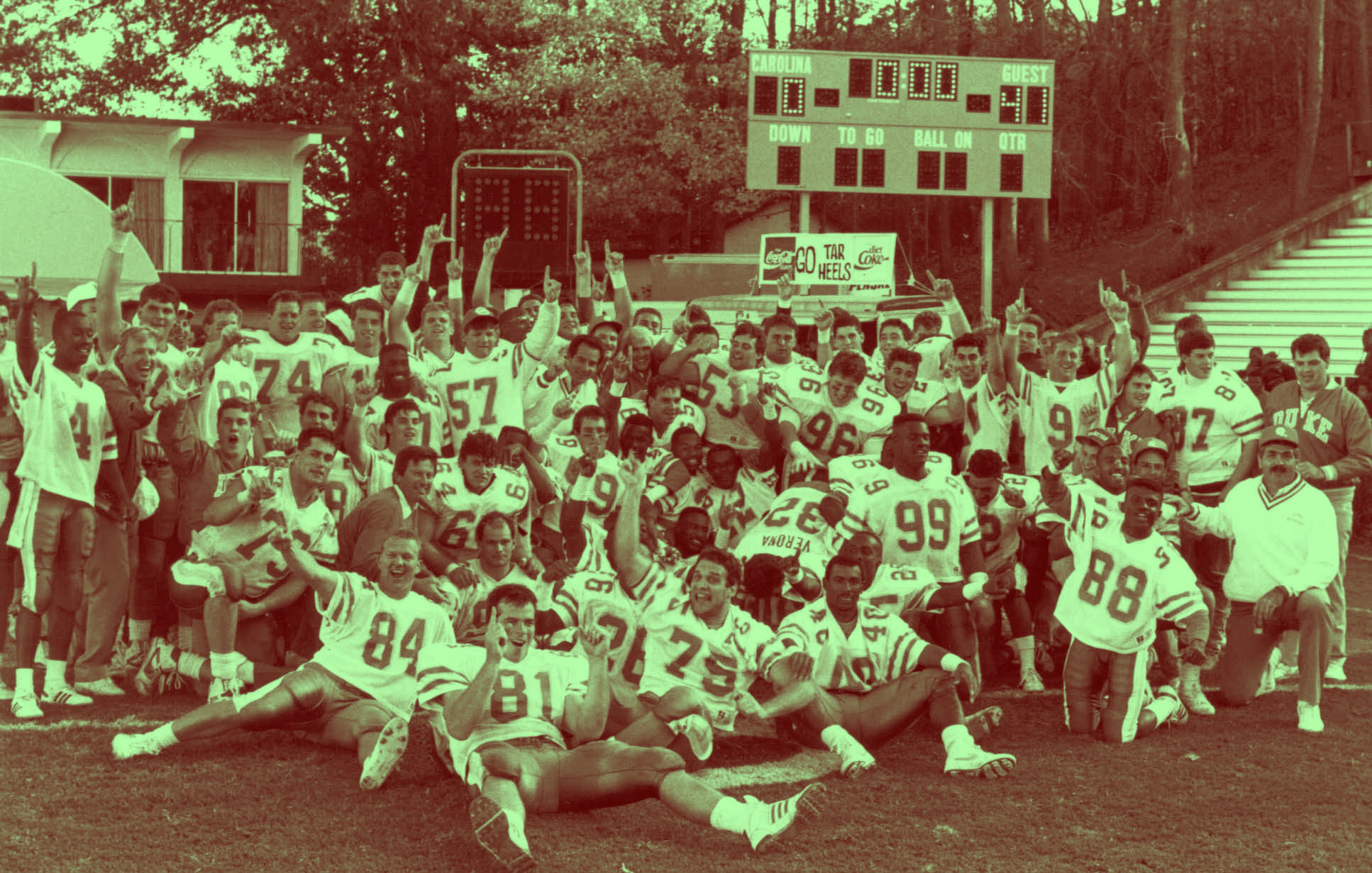
When Duke clinched the ACC Championship by blistering North Carolina 41-0 at Kenan Stadium in Chapel Hill, Spurrier gathered the whole team together for a picture in front of the Tar Heels scoreboard. Later, at Florida, he would continue this tradition in Atlanta, taking a team photograph on the field after the SEC Championship, which he called Florida’s “annual team picture.”
Add “took the first college football selfie” to Spurrier’s resume as an innovator.
It’s why playing for Spurrier was so fun, Hines and Cuthbert told me.
“When we did things well, he’d tell people about it and tell us. He wanted us to enjoy winning. He valued the hard work it took and celebrated it.”
“Coach likes to have fun and he believes in celebrating accomplishments,” Hines said. “The picture after beating UNC 41-0 was more about celebrating our first ACC Championship and bowl game in 25 years than it was rubbing the win in our biggest rival’s face.”
At Duke, it’s no secret basketball comes first, second and probably third. But in 1989 Durham, this wasn’t just about students and fan support being lukewarm.
It was about institutional commitment to football, from facilities to practice fields to team support mechanisms to investment.
“When it rained, we held practice inside a gym we shared with the student body,” Cuthbert said. “We had poor facilities, negligible administrative support. It was hard to be great at football at Duke.”
Scheme was Spurrier’s great equalizer.
Innovative offense, bravado, celebration poses in front of rival scoreboards, unadulterated joy.
These are usually things one associates with Duke’s basketball program.
Instead, thanks to a game-changing view of offense, a group Cuthbert described as a “team full of engineering students” engineered one of the more improbable seasons in ACC history.
“Winning is definitely a habit. And we didn’t win much before Coach came on board. Coach prepared us well. He put us in position to be successful.”
Duke star Clarkston Hines on Spurrier
“Winning is definitely a habit. And we didn’t win much before Coach came on board. Coach prepared us well. He put us in position to be successful,” Hines wrote.
“And yes, his Airball offense was definitely innovative. But, looking back, coach took what the defense gave us. Back in those days, the typical defensive strategy was mostly predictable: stop the run and defend the pass (especially on passing downs). So, coach called passing plays when defenses typically prepared for the run. And once we controlled the game, we would run the ball. The other advantage we had with coach being our play-caller was the fact that he played in the NFL when QBs called their own plays. He incorporated this experience into his play-calling style. And he coached our QBs to get out of bad plays by calling audibles. There wasn’t a lot of changing plays at the line of scrimmage back in those days.”
Cuthbert agreed and noted how fun the system was for players.
“It was a wide-open offense that challenged the idea of what everyone previously did. It was fun to play in,” Cuthbert told me. “He’d use his running backs in ways no one had done. I’d play the slot, play as a single back, in veer concepts, and then back to the I-formation. And even though everyone talked about the passing, he knew he couldn’t win throwing every down. He loved to throw the ball all over the place, but he knew he couldn’t win until he had balance and we could run the ball effectively. Once we started running the ball, we started winning, which he liked best.”
More was on the horizon, and the Duke players knew it.
“There was definitely a sense he was bound for bigger things,” Cuthbert said.
Hines, who grew up in Jacksonville and attended Florida football and academic power Bolles, felt the hire was a game-changer for the Gators.
“When he left for Florida, I had a similar feeling for the Gators that I had when coach was named Duke’s head coach prior to the 1987 season: optimism,” Hines wrote.
That optimism was warranted.
Spurrier’s accomplishments in college football are legion, genre-bending, legacy-securing. But Spurrier gleefully tells anyone that will listen that the 1989 ACC championship season at Duke, against long odds, means just as much if not more to him than all the historic winning that followed.
“I loved playing for him, it was life-altering,” Cuthbert told me. “And I think (the 1989 Championship) meant more to him because it was Duke and we weren’t supposed to win and didn’t win right away. To win six straight after that start and win the conference, that was special to him. It has aged well.”
The 1989 championship at Duke has aged well.
At Florida, Spurrier had shown a community and an institution that losing wasn’t a birthright, and that the program could defy expectations and rise above mediocrity.
At Duke, as an evolving coach, Spurrier again learned he was a community and culture-builder. It was the second time in his life he had taken a chance on a place without much of a winning tradition, where a culture and an institution had grown accustomed to losing.
On each occasion, Spurrier had ignored the cautionary tales, embraced the challenge and come out a clean winner on the other side.
Not long after that famous Duke football photograph in Chapel Hill, Spurrier would receive a third opportunity to embrace a challenge where others shied and slithered away in doubt.
This challenge was personal, and it would get harder before it even began.
‘The place I want to be’
It’s hard to overstate how difficult things were in Gainesville, for both the football program and the community, in the months before and after Bill Arnsparger hired Spurrier away from Duke in December of 1989.
At his introductory press conference, Spurrier was humbled, gracious, excited. He announced Florida would rip up the AstroTurf installed by the failed Doug Dickey and replace it with grass. The orange jerseys, which Spurrier associated with “a whole lot of losing,” would be gone too, supplanted by the Ray Graves-era blue.
“This is a job I’ve wanted for a long time,” Spurrier said. “This is the place I want to be, the place I should be.”
On the football field, Florida was still suffering the after effects of the heavy sanctions they received under the Charley Pell regime in the mid-1980s, which saw Florida receive No. 1 votes from enough sources in 1984 that Alabama might count it as a national title, and hold a unanimous No. 1 ranking in 1985 before the Sword of Damocles justly fell. The Gators were stripped of two SEC championships, all claims to a “national title” in 1984 fell on deaf ears and the program lost a host of scholarships.
“This is a job I’ve wanted for a long time. This is the place I want to be, the place I should be.”
Steve Spurrier during his first press conference as Florida’s head coach
The losses were staggering enough that by the time a freshman wunderkind named Emmitt Smith arrived on campus in the summer of 1987, the Gators didn’t have enough depth to compete with their league foes, much less an ascendant Florida State or Jimmy Johnson’s machine at Miami.
Smith went on to dazzle anyway, salvaging bowl seasons for Gators teams that had no business playing in such games, and when Spurrier was introduced, on New Year’s Eve 1989, the rank and file Florida faithful hoped Smith might consider playing his senior season for the new coach. He did not, opting for the NFL instead, and before Spurrier had even coached a game in Gainesville, he’d lost his best football player.
Spurrier had question marks at quarterback, no proven tailback, a group of wide receivers who hadn’t been a factor for multiple seasons, and a nice cache of defensive talent that nevertheless had not often played to its potential. Like the program itself, this was a roster with more questions than answers.
Meanwhile, as the slow, humid and sticky crawl of a north central Florida spring and summer edged toward autumn, Gainesville was shaken to the core by the brutal murders of five college students just two weeks prior to the kickoff of Spurrier’s inaugural season.
The lives of Sonja Larson, Christina Powell, Christa Hoyt, Tracy Paules and Manny Taboada were lost forever in the span of a horrifying week. The victims were University of Florida students, save Miss Hoyt, who had hoped to attend UF after finishing up at local Santa Fe Community College.
Gainesville, an idyllic college town lined with pretty houses and beautiful, expansive live oak trees, had been bustling with excitement about the return of their favorite son. Now the town bristled with terror, with many of the 34,000 students scrambling home, some never to return. Those who stayed often slept in shifts, with triple locks on doors and armed with whatever they could buy or find.
Eventually, John Lombardi, the President of the University of Florida at the time, closed the school. The football players were among the only folks left on campus, mostly tucked away in athletic dorms protected by extra security guards, watchful coaches and curfews.
In the midst of such ineffable horror, grief and loss, football seems small.
Spurrier was brought to Florida to change the culture of a football program that had spent all but one great decade mired in mediocrity. Now, with a season set to begin, just days removed from irreplaceable loss, he was perhaps the one person who could help an entire community begin to heal. He could provide joy and hope where there was only fear.
By the time Florida opened the 1990 season against Oklahoma State, the murders had stopped, and in Ocala, the man who would 16 years later be executed for committing them had been taken into custody after stealing food from a Winn-Dixie. It would be several months before investigators connected him to the Gainesville murders, and the town could finally, slowly, sadly, breathe again.
On the field, Florida provided another respite from the ever-present sorrow.
Florida crushed Oklahoma State 50-7 on opening night, with the specter of the murders very much on the mind of all the fans who poured into Gainesville to see Spurrier’s debut.
A week later, the Gators traveled to Alabama and upset the Crimson Tide 17-13, behind just enough offense and a stout defense that forced three interceptions against Alabama quarterback Gary Hollingsworth. While Florida’s offensive personnel slowly adjusted to Spurrier’s system, the defense, led by All-Americans Huey Richardson and Will White, carried the team.
The Gators rattled off five consecutive wins before being clobbered on national television by Tennessee, 45-3, but, as Spurrier put it, “the Vols spent the whole week celebrating and lost to Alabama the next week,” which allowed Florida, which finished 6-1 in the conference, to win the league outright.
The SEC voted to not allow Florida to claim the SEC championship trophy due to the infractions of the previous staff, but that never stopped Spurrier, who like most the players on that team played no role in the rules violations, from claiming that championship.
More critically than the championship Florida won but couldn’t claim, a grieving town and horrified university claimed a bit of their pride, belief and joy back.
‘At least they’re not calling us losers anymore’
In the 11 years that followed that fateful Gainesville summer and special Florida season of 1990, Florida and Steve Spurrier reigned over the SEC. The Gators won more SEC championships they were permitted to count (6) than they lost home games (5).
To no one’s surprise, Spurrier still counts the 1990 title as a seventh, and he can get snarky in his when reminded that the title doesn’t count due to infractions committed by the coaches he and his staff replaced.
“Alabama claims a whole lot of titles other people say they didn’t win,” he’ll chirp in his East Tennessee gruff, with a trademark smirk and, if you catch him on a good day, maybe even a wink.
Florida too, celebrated that fabled and bittersweet 1990 season for a while, painting “First in the SEC, 1990” on the South end zone’s orange walls until eventually, with only a whimper of protest, Jeremy Foley and the athletic department quietly removed the tribute.
Six championships or seven, Spurrier ruled the SEC with gusto and gall, without a care in the world for whether folks liked him.
“If someone likes you too much,” he’d quip, “it’s probably because they’re beating you.”
Almost no one was beating Florida.
From 1993-1996, Florida won four consecutive SEC championships, losing only two — two! — conference games in the span. Not even Nick Saban has won four consecutive conference championships. He has never had a 4-year span with only two conference defeats.
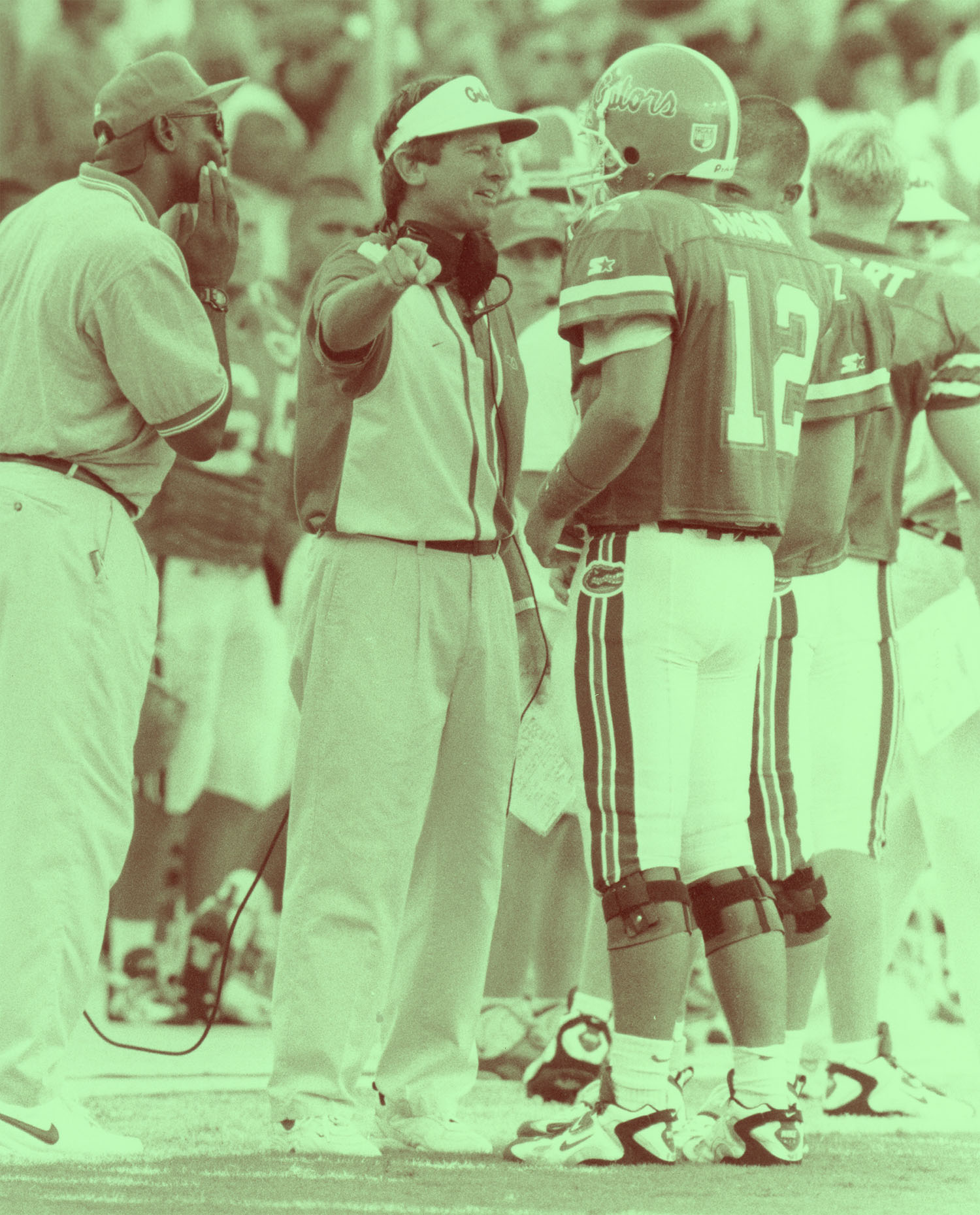
Like his Duke champions, the Gators took photographs on the field after championships, and if they appeared to be enjoying their dominance, it’s because they were. When Florida won its third consecutive SEC title to cap a 12-0 regular season in 1995, Spurrier quipped, “This is becoming our annual team picture.”
For most of the 1990s, it was, and the SEC scurried to catch up to Florida’s brand of high-octane, wide open offense and athleticism and speed on defense.
* * * * * * *
Bill King has had a press row seat to SEC football for over a quarter-century, and while Tony Barnhart is Mr. College Football, Bill King could rightly claim to be Mr. SEC. A Tennessean and longtime national sports-talk radio host, King now hosts a daily college football show on WNSR in Nashville. As a young college football show host in Nashville, King watched in awe as Spurrier dragged the SEC kicking and screaming out of the three yards a cloud of Georgia and Alabama clay stone ages.
“Steve won immediately because his concepts were imaginative and because they were antithetical to what everyone had always done,” King told me via telephone.
“First, he stretched the field with the passing game vertically, which people didn’t do, but he also figured out before anyone else that the corners and safeties playing in the SEC at that time just couldn’t handle elite speed. He had Ernie Mills and Ike Hilliard and Jacquez Green and Reidel Anthony and we would watch and just marvel at how guys were running seam routes and crosses and they were 5 yards open. It took at least half-a-decade before anyone but Tennessee really had a chance.”
Steve Spurrier was 8-4 vs. Tennessee in his 12 seasons at Florida.
Tennessee didn’t have a much of a chance, either.
The Vols were the first to adapt, open up their offense and recruit elite speed on the perimeter, which is surely to their credit given they were one of the only programs to have early success against Spurrier, whipping him and the Gators in 1990 and again in 1992. But the reality is Florida dominated the Volunteers after 1992, winning 7 of 8, despite Tennessee having elite talent and the legendary quarterback Peyton Manning, who finished his career 0-4 against the Gators.
“You can’t spell Citrus without UT,” Spurrier poked, clearly enjoying the Volunteers’ misery.
As for everyone else, it was mostly men against boys.
“When Steve entered the SEC, it just wasn’t very good,” King told me with a matter-of-fact tone and a laugh.
“Of course, Alabama was excellent under (Gene) Stallings, but he left, and they suffered for years with Fran (Dennis Franchione) and all the Mikes (Price, DuBose, Shula). Vince Dooley had just left Georgia and Spurrier was worlds better than Ray Goff and Jim Donnan. LSU was a mess until Saban showed up (and Spurrier clobbered his first two teams, too). Tennessee was good under (Phil) Fulmer, but lost to Spurrier almost every year, until 1998 and the epic game in The Swamp in 2001. But mostly the SEC was a league rightly proud of its football tradition, but at the time, it wasn’t playing good football. Steve beat everyone and was innovative and loud about it and forced the SEC to change.”
Spurrier’s dominance shook the old boys club that was the SEC to its foundation, forcing institutional investment, new recruiting methodologies and a renewed emphasis on finding modern, innovative coaches. By beating everyone, Spurrier stripped the league of any illusions it might have had that it could resist schematic, systemic change.
“There’s no one in college football right now like him,” King told me. “It was a league of Southern gentlemen and no one did (what Spurrier did). No one crushed a really good Tennessee team with guys like Peyton Manning and then said ‘Can’t spell Citrus without UT.’ No one enjoyed winning the way he did.”
* * * * * *
It was Georgia that Spurrier seemed to enjoy beating most.
He went 11-1 against Georgia as Florida’s head coach, and very few of the games were competitive. After another win over Georgia in the mid-1990s, Spurrier was asked how he managed to dominate the Bulldogs so thoroughly.
“I don’t know,” Spurrier said. “During recruiting season, they always sign all the best players. When it comes time to play the game, we have all the best players. What happens to them?”
Such was the extent of Spurrier’s dominance over Georgia, and the pure id he seemed to get from dominating, that longtime Atlanta and Georgia football scribe Mark Bradley dubbed Spurrier “The Evil Genius,” a nickname that stuck. Asked about the nickname, Spurrier wouldn’t even cede that to a Georgian.
“I prefer mastermind,” the Head Ball Coach said with a smile.Ed Chester, an All-American defensive tackle at Florida from 1995-1998, laughed a little when I asked him if Florida’s Mastermind preferred beating Georgia to anyone else, including Florida State, the Gators’ bitter in-state rival with whom the program had so many national landscape defining clashes in the 1990s.
“No,” Chester said.
But it isn’t as if the take lacks evidentiary support.
As a player at Florida, Spurrier’s Heisman campaign was spoiled by a loss to Georgia that cost a great Florida team the SEC championship, and there’s rarely an interview with the HBC when he doesn’t bring that up.
Steve Spurrier was 11-1 vs. Georgia in his 12 seasons at Florida.
It’s why Spurrier was positively gleeful when, thanks to renovations to Jacksonville’s Gator Bowl, he was able to embarrass the Bulldogs in Athens, adding a touchdown on a deep pass late because he “heard no one had ever scored half-a-hundred on Georgia” between-the-hedges.
Spurrier seemed obsessed with beating Georgia once he arrived at South Carolina as well.
In 2007, he famously waved at the Sanford Stadium faithful after upsetting a great Mark Richt team. In 2012, he nearly spoiled Aaron Murray’s senior campaign by crushing the Bulldogs 35-7 in Columbia.
But Chester, who was one of a handful of Gators who played for Spurrier to lose a game to Georgia (1997), said the coach never let on that the game was more important than any other, even if he might have felt that way personally.
“Every game was elevated on its own plane, each assigned a meaning,” Chester said. “Georgia was a league game, like Tennessee. Coach would motivate us and say if you beat Tennessee but lose to Georgia, your win over Tennessee doesn’t matter. His main thing was that at Florida, winning the Georgia game is key to every goal you set at the beginning of the season. Want to win the SEC East? Better beat Georgia. Want to win the SEC? Better beat Georgia. Want to have a chance at a national? Better beat Georgia.”
Chester played instrumental roles on Florida’s 1995 and 1996 teams, which collectively went 24-2, going unbeaten in the SEC over those two seasons and winning Florida’s first national championship in 1996 when Florida routed FSU 52-20 in a Sugar Bowl rematch.
Florida celebrated wins with the same joy as at Duke, but Chester said behind all the swagger was Spurrier’s insistence on sweat and commitment.
“It was fun to play for Spurrier, of course, but it was fun because we were busting on our behinds,” Chester told me. “The expectation with coach Spurrier was you’d work your rear end off, whether you played offense or defense, or you were on his scout team or you would sit, and we would lose, and he’d remind us that losing wasn’t fun. We did a lot of winning instead.”
“The expectation with coach Spurrier was you’d work your rear end off … and we would lose, and he’d remind us that losing wasn’t fun. We did a lot of winning instead.”
Ed Chester, an All-American defensive tackle at Florida from 1995-1998
Spurrier also never privileged pride or ego over winning.
When Florida lost the Fiesta Bowl, and the national championship, to Nebraska 62-24 in 1995, the widespread perception, with some justice, was that the Gators were soft and Spurrier placed too large an emphasis on offense, allowing his defense, and the program, to suffer.
“He cared about defense because he wanted the ball back and he wanted to win,” Chester said. “When he brought in coach (Bob) Stoops, (as defensive coordinator) everything changed.”
Stoops raised the level of competition within an already hyper-competitive program to another level, and after years of being thwarted from national championships by the likes of Nebraska and Florida State, gave Spurrier what he needed to win.
“It was so competitive between those two and the offense and defense,” Chester said, laughing and remembering the moment he realized how different things were when Stoops arrived.
“Coach Stoops hated to lose. Coach Spurrier hated to lose. We had a scrimmage once in August, and we whipped the offense the whole practice. Late in the scrimmage, the quarterback threw an interception, and on the return, the defensive back tried to pitch the ball. While the QB was getting ripped by Spurrier, Stoops blew a whistle and came over and said, ‘Good play, but don’t pitch the ball or you risk giving it back to the offense.’ A few plays later, another interception, another pitch on the run back.
“Spurrier is yelling at the quarterback and Stoops is there, perfectly calm, and just tells the defensive back, ‘Great play. But I told you not to pitch the ball.’ We finished the scrimmage and Spurrier told everyone to head to the locker room and Stoops blew his whistle and called the defense over. Then he said, ‘Great practice. But I told you not to pitch the ball. Put your helmets on. We’re going to run.’ And we ran for half an hour after a practice where we dominated the offense. But that’s the culture we had. That’s how competitive those two coaches were.”
That type of culture is a prerequisite to excellence. But it isn’t easy.
Rex Grossman was Spurrier’s last quarterback at Florida, leading the Gators to the SEC championship as a freshman in 2000 and earning first team All-American and AP National Player of the Year honors en route to finishing second to Eric Crouch in a close Heisman vote he should have won as a sophomore in 2001. As a quarterback, he had special insight into the machinations of playing for the demanding Heisman Trophy winning signal-caller.
“Coach is the ultimate perfectionist. He was the offensive coordinator, QB coach and head coach. If you played QB at Florida, you were around him 24/7, and he demanded excellence out of everyone,” Grossman recalled. “If you were a quarterback, you were around that all the time. But Coach was fair. He’d play the guy who could win the game.”
Chester agreed.
“Coach was quick to tell you when you were doing something right, but he was on you when you weren’t. You didn’t want to spend too much time with the head coach on the field, but we had a great relationship off it, too. He’d joke around with you, ask you about your life and family. He cared.”
Chester turned down NFL riches and returned for his senior season in 1998 only to suffer a brutal knee injury in a mid-season win against LSU that short-circuited his football career. Chester had an insurance policy that offset some of the financial loss, but it didn’t make it any easier for the Head Ball Coach.
“Steve was sick to his stomach about it. It gnawed at him for weeks and weeks,” recalled Rod Broadway, Chester’s position coach. “He was so invested in kids personally.”
* * * * * *
Invested.
It’s another word you hear about Spurrier when you talk to those who know him. Spurrier would turn down a raise and redirect the money to women’s programs, like softball and soccer, because he was invested in making the Florida athletic department, and by extension, the university community better.
“He demanded so much of himself and his players, but what was striking was that he and Jerri cared so deeply for their players while pushing them hard,” close Spurrier family friend and longtime University of Florida booster Gale Lemerand said. “Steve’s players, from the All-Americans to the walk-ons, were an extension of his family. And he wanted them and the entire university to succeed.”
That he cared so deeply was part of what made it so easy to decide to play for him, Grossman remembered.
Another reason? Honesty. Authenticity.
“He had this great history with quarterbacks, so you knew he was a guy that would get you better, but mainly he was honest and cared and was fair. He’d tell you’d have a chance to play if I practiced hard, which is all you want,” Grossman said. “He sold the sunshine. Coming from Indiana, it was cold in the winter and the weather was a big sell. He told me he came to Florida because his coach said he could golf in December. We had a family friend in Gainesville and the weather sounded good and he was the best quarterbacks coach in the country.”
Lemerand told me none of it is show.
“None of (the bravado, barbs at opponents, swagger) is fake with coach. That’s who he is. What you see is what you get and what you get is great.”
* * * * * *
“There’s no one in college football right now like him. It was a league of Southern gentlemen and no one did (what Spurrier did). No one crushed a really good Tennessee team with guys like Peyton Manning and then said, ‘Can’t spell Citrus without UT.’ No one enjoyed winning the way he did.”
SEC historian Bill King
By the late 1990s, the SEC was wising up, if not yet entirely caught up. Tennessee lost to Florida in 1997 but won the SEC anyway.
In 1998, Florida lost in overtime at Tennessee, and then lost their best football player when Chester as hurt against LSU. Still, the Gators had a chance to play in the first BCS National Championship game with a win at rival Florida State.
? #ChampionshipMoments 1996
FLORIDA 52 | FSU 20Steve Spurrier's "Fun and Gun" offense wins the rematch with FSU; Florida's 1st National Title pic.twitter.com/tlp6zNhemu
— Pick Six Previews (@PickSixPreviews) January 8, 2018
It was Florida State, of course, that had been Spurrier’s largest foil at Florida. As much as Spurrier and Florida lorded over the SEC, the Sunshine State had been harder to conquer.
The Seminoles were in the midst of an unprecedented run under Bobby Bowden, the Southern gentleman, Southern-drawled, coach-speaking, scripture-quoting head coach who was always painted to be so different than Spurrier, even though the two shared so many commonalities.
Above all, they both couldn’t stand the idea of losing, to anyone, let alone each other.
For 12 seasons, the Gators and Seminoles met 14 times, with every contest carrying national championship implications for one school, and often, for both. One game, of course, was actually played for the national championship.
King told me it’s hard to think of a college football rivalry that’s had such high stakes for such a sustained period of time.
“That game cost both Spurrier and Bowden multiple national championships,” King told me. “And remember Bowden lost others because of the Miami game. So that run by Florida and FSU and that game was unique, with so many NFL players on both sides and legendary coaches. Saban, as dominant as he is, hasn’t had that. LSU for a couple seasons? Auburn when they’re right? But not anything as constant as the Spurrier-Bowden meetings.”
In 1998, the game was in Tallahassee, and a win would set the Gators up for a likely rematch with Tennessee in the inaugural BCS Championship game. The Seminoles knew they too, would likely play for the national title with a win.
“We ended the year before with the great win over FSU in The Swamp that kept them from winning the national championship,” Chester said.
When the Gators lost, to an FSU team playing with backup quarterback no less, the fan base was, for the first time, truly angry with Spurrier.
“We knew what kind of personnel we had and knew we had a chance to win the East, the SEC, play for a national championship. I think that season was hard on him and us because we fell short of all our goals,” Chester told me.
Tennessee won the national championship instead, for a moment, it appeared the tide had turned in the SEC.
But after a 9-4 year in 1999, Florida rallied and won the SEC championship in 2000, crushing Auburn in the title game.
It was 2001 that broke Spurrier — and Florida’s — heart.
Florida opened the year No. 1 and cruised to two quick victories before the terrorist attacks of Sept. 11 forced the postponement of the Tennessee game. When football returned, the Gators continued to be a force, with Grossman leading a high-flying offense that averaged nearly 50 points a game.
Spurrier knew the team was great, and to let them know it, he played them Lee Ann Womack’s “I Hope You Dance,” imploring them to have fun and chase greatness.
For three months, they did, winning 10 games by an average of 33 points.
“We felt like we could beat anybody, score on anybody,” Grossman recalled. “We beat LSU and Saban by four touchdowns (and they won the SEC). We lost one game (at Auburn) in a tropical storm. They might not have even played that game today, with the increased focus on player safety. But coach knew how good we were, and we just ran people out of places. It was a blast.”
Florida recovered from the loss at Auburn and heading into the rescheduled Tennessee game, the Gators were No. 2 again, setting the stage for a SEC title game rematch with LSU and a potential national championship game with Miami.
It was never to be. In front of a record, raucous Gator crowd that came for a coronation, Fulmer delivered the pregame speech of his life (if you love football, listen to it) and behind a monstrous game from Travis Stephens, the Vols won 34-32.
Playing without Earnest Graham, who was controversially injured against FSU the prior week, the Gators lacked balance, allowing the Tennessee defense to drop six and seven into coverage.
Despite a ferocious Tennessee pass rush led by Outland Trophy winner John Henderson, Grossman threw for over 400 yards in defeat, one of the gutsiest performances in a losing effort in SEC history. It wasn’t enough to win the game, or the Heisman.
“We left it all in front of us, the SEC, Miami, it’s crushing,” a candid Grossman said afterward.
The Vols spent the week celebrating and promptly lost to Saban’s upstart LSU the next week in Atlanta, ushering in the era of Saban in the SEC.
Spurrier, unbeknownst to Gators fans everywhere, walked off the field that would later be named for him for the last time, at least as the head coach of Florida.
He left for the Redskins a month later, but he changed Florida’s culture, not just in football, forever.
Florida had won nine national championships in all sports, and zero SEC championships that counted in football when Spurrier arrived. They’ve won 31 national championships since, and counting 1990 for coach Spurrier, claimed 9 SEC football championships since.
The week of the Tennessee game, Spurrier was asked on College GameDay what he thought of the people who felt he ran up the score, or was a crybaby, or cocky, or arrogant, or brash and boastful.
His response defines his legacy at Florida.
“They can call us cocky, arrogant, crybaby, whatever. At least they’re not calling us losers anymore. If somebody likes you too much, it’s probably because they’re beating you.”
Why not South Carolina?
William Appleton’s family has been making the 2-hour trek from Charleston to Columbia for football since he was old enough to stand.
An investment banker in his early 30s, Appelton looks 10 years younger, with the trademark Carolina bowl cut, a tightly-pressed, monogrammed dress shirt, silk tie and Carolina palmetto and crescent pin affixed to his lapel. We meet outside Le Farfalle, a little Italian eatery on Beaufain Street praised for its small plates, including an octopus carpaccio, which Appleton recommends.
As I marvel over the cuisine, he’s explaining the way Spurrier changed yet another culture by simply showing up and insisting folks believe.
“In a way, he was perfect for South Carolina,” Appleton told me. “The history of the South and South Carolina in particular is a history that involves grappling with repeated defeat, and that was Carolina football before coach Spurrier. It wasn’t like the rest of the athletic program was doing much better, either.”
Appleton’s right, too. When Spurrier arrived in 2005, the school had won one solitary national championship — in women’s track and field. The football program had won one conference title, in 1969, and aside from a year or two under Lou Holtz, been a non-factor since joining the SEC in 1992. The basketball programs — men and women — celebrated NIT appearances. Winning was an exception more than expectation.
“It took Gamecock football (almost) 100 years to win a bowl game. Spurrier comes in and starts talking about beating Georgia and Florida and Tennessee and competing for conference championships. We didn’t know what to think.
“He didn’t care that we weren’t supposed to win. He saw people that supported the program anyway and embraced that sense of Carolina community. He changed our culture by insisting we not accept losing as part of our commitment. And he beat Clemson like a drum over and over for five years. (Tommy) Bowden, Dabo (Swinney), didn’t matter. People will be forever grateful for that.”
Steve Spurrier went 6-4 against Clemson in 10-plus years as South Carolina’s head coach.
Spurrier didn’t win the SEC at Carolina, but he did win the East once (2010) and subsequently led the Gamecocks to 33 wins in a 3-year stretch from 2011-2013. During that span, only Alabama, Oregon and Florida State won more football games than South Carolina.
King told me in many ways, Spurrier’s time and accomplishments at Carolina aren’t appreciated enough.
“First, it wasn’t a place you win, and (Holtz) left such a mess when Spurrier got there,” King told me.
“Then, with 11 wins in three consecutive seasons, that was even more impressive because of how he built it. I remember being astonished that outside of (Stephen) Garcia, he couldn’t get elite quarterbacks to come play for him there. I mean, it’s Steve Spurrier, and he can’t get a 4-star or 5-star kid. But Steve just says, ‘Fine,’ and turns Dylan Thompson into a winner and Connor Shaw into an All-SEC kid. That was amazing to me.”
Appleton agrees, and notes what happened everywhere else on campus mattered almost as much.
“(Spurrier) starts showing up at basketball games, and Frank Martin comes, and the program starts winning. They made a Final Four, and you know, Spurrier was the first guy who thought Carolina basketball should win too. He (and Jerri Spurrier) go to baseball games and support coach (Ray) Tanner, and they win two consecutive national championships. He’s out in Omaha with the team, celebrating Carolina. We loved that he beat Clemson and made fun of Death Valley, but we what we loved more was that he was the rising tide who lifted all boats. Carolina will never be the same.”
Nowhere Steve Spurrier has ever coached is.
One thing Appelton told me as we paid the bill on a glorious Charleston spring day stuck with me.
“Going to Carolina football games used to be about family, association, the sense of community you had as a Gamecock. I think we all love college football because of relationships and memories. It’s a thing we talk about with our dads. But as a Gamecock, there was losing and it was melancholy too,” Appleton said. “After coach Spurrier, there was a sense of esteem, and an idea you were witnessing something special. A sense you could win at Carolina too.”
As a son who spent so many autumn Saturdays growing up watching Steve Spurrier’s Gators teams play in The Swamp (Section 329, Row 8, Seats 5 and 6), I lived for Saturdays in the fall with my dad, from the 4-hour drive to Gainesville to the Tom Petty jam sessions we’d have when we exited to the tailgates at the Lutheran Church where we parked. That time with my dad, that belonging, association and community would have been enough. But I think I too felt a sense of esteem and over the years, realized that what I watched was truly special, and am grateful for it.
Everywhere Steve Spurrier has gone, he’s left it better than before.
The SEC especially.
You’re gonna LOVE this video from @GatorvisionTV featuring the HBC Steve Spurrier! @GatorsFB @SC_HBC #GoGatorshttps://t.co/Fa35UUICGf
— Florida Gators (@FloridaGators) October 13, 2015
PREVIOUSLY IN G.O.A.T. WEEK:
Gift of a Legend: The life and legacy of Bear Bryant
Herschel Walker: The greatest running back I never saw
Ronnie Brown and Cadillac Williams: The greatest RB duo
The all-time All-SEC starting lineup
General Neyland: In command, always
Neil Blackmon covers SEC football and basketball for SaturdayDownSouth.com. An attorney, he is also a member of the Football and Basketball Writers Associations of America. He also coaches basketball.