The 2026 NFL Draft took place over the weekend, and early markets for Rookie of the Year awards are now open.
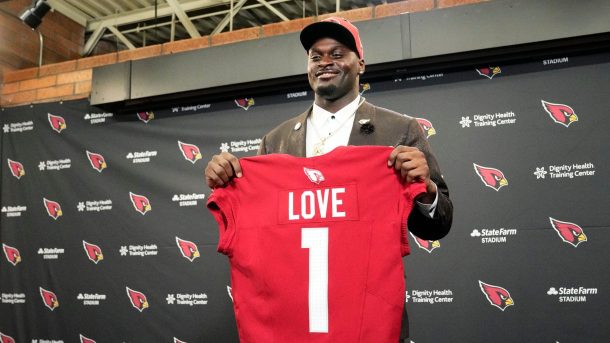
The current favorite to win the offensive award is Arizona Cardinals running back and No. 3 overall pick Jeremiyah Love. Right behind him is No. 1 overall pick and new Las Vegas Raiders quarterback Fernando Mendoza. This marks the second year in a row a running back has opened as the favorite to win OROY.
On defense, New York Jets edge David Bailey is the presumptive favorite to win DROY after being selected second overall.
Last year’s winners — Tetairoa McMillan on offense, Carson Schwesinger on defense — were both longshots in the preseason. Could something similar be in store for the 2026-27 season?
Picks to win NFL’s Offensive, Defensive Rookie of the Year awards
So which players are worth backing early on? Let’s take a look, starting on the offensive side and then shifting to the defensive side later.
Offensive Rookie of the Year
Mendoza is right there with Love as one of the early favorites to win the award. At Kalshi, they have the 2 best odds of any offensive player. I’d practice patience with both.
In Las Vegas, the Raiders helped their new franchise quarterback by building the defense first. After Mendoza at No. 1, the Raiders had 7 more picks to make in the first 5 rounds. Five of those 7 were spent on defensive players, including both Day 2 picks. Of course, Vegas still has last year’s sixth overall pick in Ashton Jeanty and 2024 first-rounder Brock Bowers, but the Raiders could use a reliable downfield threat for Mendoza. There’s also a question of Mendoza’s learning curve in the NFL; he threw a ton of back-shoulder and operated in a scheme heavily dependent on pre-snap decisions. The NFL requires post-snap expertise to be successful.
Love is undeniably the most explosive playmaker in the entire draft class on the offensive side of the ball. And I love Arizona’s second-round pick of former Texas A&M guard Chase Bisontis. Love’s volume will be there, but his production is heavily dependent on those around him.
Arizona doesn’t have an answer at right tackle. Arizona doesn’t have an answer at quarterback. The Cardinals averaged just 20.9 points per game last season (23rd) and 5.6 yards per pass attempt (26th). The run game wasn’t horrible (16th in efficiency), but defenses will be keyed to it even more in 2026. Love needs space to make magic happen. He might not have any.
The last running back to win Rookie of the Year was Saquon Barkley in 2018. Barkley was also the last top-5 running back taken in a draft. He joined a Giants team that had gone 3-13 the year prior while averaging 5.4 yards per pass attempt (26th) and 3.9 yards per run (22nd).
In Barkley’s rookie season, he had Eli Manning at quarterback — albeit a 37-year-old Manning — and Odell Beckham Jr. lining up out wide. OBJ was limited to 4 games in 2017. New York’s pass game improved to 17th in the league. Barkley got virtually every running back touch (261 carries compared to 51 for his backup) and finished as the team’s leading receiver with 91 receptions on 121 targets.
Love should have a similar stranglehold on backfield carries. But will he average 5 yards per carry like Barkley did? Questionable. And will he have the receiving production? Questionable.
A receiver has won this award 3 times in the last 5 years. Tetairoa McMillan won it last season with Carolina. Garrett Wilson (2022) and Ja’Marr Chase (2021) won it previously.
Chase had 13 touchdowns and 1,455 yards as a rookie. Wilson had 4 scores and 1,103 yards as a rookie. McMillan had 7 touchdowns and 1,014 yards as a rookie.
Titans first-round pick Carnell Tate can absolutely hit those marks in his debut season with the Titans. For that reason, Tate (17 cents per contract at Kalshi) is my pick to win OROY in the upcoming season.
While sharing the spotlight with Jeremiah Smith and Emeka Egbuka in 2024, Tate had 733 yards. Playing as the Robin to Smith’s Batman in 2025, Tate brought in 9 touchdowns and averaged 17.2 yards per catch.
We haven’t seen him as an unquestioned WR1 yet. He will be exactly that in Tennessee, and his explosiveness meshes well with quarterback Cam Ward’s appreciation for pushing the ball down the field.
Ward threw for 3,169 yards as a rookie with Elic Ayomanor, Chig Okonkwo, and Chimere Dike as his top 3 targets. Eight different Titans drew at least 36 targets. Ward entered the offseason desperate for a go-to weapon. The Titans restructured Calvin Ridley’s deal to bring him back, signed Wan’Dale Robinson, and then drafted Tate to give Ward a remade trio atop the depth chart.
Tate is going to draw a ton of targets over the top because of his ability to separate.
If you’re looking for a longshot, though, look to the Pacific Northwest, where Love’s backup at Notre Dame steps into a pretty nice situation. The Seattle Seahawks spent a first-round pick on Jadarian Price to replace Kenneth Walker III. Price will challenge Zach Charbonnet for the starting spot, but there should be enough to go around even if he doesn’t win the RB1 job.
Walker had 221 rushes and 36 targets last season. Charbonnet got 184 carries and 24 targets as Walker’s backup.
Price averaged 6 yards a carry with Notre Dame last season, scoring 11 touchdowns on the ground, 2 as a receiver, and 2 as a kickoff return man. With the defending Super Bowl champs, Price could be one of the more immediate contributors in this offensive class. He’s priced at 11 cents per contract on Kalshi. I like that price relative to the potential there.
PICK: Carnell Tate, Titans wide receiver
SLEEPER: Jadarian Price, Seattle running back

Defensive Rookie of the Year
The Dallas Cowboys got the best pure football player in the draft with the 11th pick. Not only did Dallas get great value, it got a tremendous fit. Caleb Downs is a playmaker who can line up all over the formation for defensive coordinator Christian Parker. Downs has a pathway to all the splash stats that win defensive awards.
In 30 games for the Buckeyes, Downs had 149 tackles, 12.5 tackles for loss, 1.5 sacks, 4 interceptions, 11 pass breakups, 2 forced fumbles, and a punt return for a touchdown. He’s an unreal defender with instincts that will help him immediately contribute in big ways.
A true safety hasn’t won Defensive Rookie of the Year in the NFL since 1990, but Downs can wear a number of hats in Parker’s defense.
The Cowboys ranked 32nd in the NFL last season in scoring defense, giving up more than 30 points a game. They forced only 6 interceptions all season (29th), gave up 4.7 yards per carry (26th), and allowed 7.2 yards per pass attempt (32nd).
Dallas remade its defense in the offseason, hiring Parker from the Eagles and making him the youngest DC in the organization’s storied history. Dallas then used 5 of its 7 draft selections on defensive players, and it traded a fifth-round pick to San Francisco for a linebacker.
Downs will be asked to cover pass catchers from the slot. He’ll be asked to blitz. He’ll be asked to set the edge against the run. He’ll be the nickel for Parker, meaning he’ll be an extremely important piece of the puzzle.
“That guy, he’s a corner sometimes, he’s a safety sometimes, he’s a backer sometimes. He’s a defensive end when he’s blitzing. You want to have a guy who has natural instincts and ability to feel the game and play football,” Parker said of the nickel at his introductory press conference. “He’s usually a guy who, if you were playing football on a Saturday afternoon in the neighborhood, he’s your first-round draft pick just because he feels the game naturally. That’s definitely an important guy to a good defense.”
That would be Downs.
I think Downs has a big season in a big role. Priced at 17 cents per contract, Downs is the best bet at the moment.
PICK: Caleb Downs, Cowboys safety

Derek Peterson does a bit of everything, not unlike Taysom Hill. He has covered Oklahoma, Nebraska, the Pac-12, and now delivers CFB-wide content.