The Evolution of SEC Football (Part 2): The Iron Men, the Yellow Jackets and the Green Wave

By Ethan Stone
Published:
“Because things are the way they are, things will not stay the way they are.” — Bertolt Brecht
The SEC didn’t pursue expansion in the several decades following its split from the Southern Conference in 1932. No new schools entered the fray until July 1, 1991.
There was some movement among the league’s constituents, though. Three programs — Sewanee, Georgia Tech and Tulane — elected to leave the conference within its first 35 years of operation, whittling the SEC’s headcount to 10.
Each of these programs left their mark on SEC football, in their own way. In this section, we’ll take a look at the factors that led to each of their departures from the Southeastern Conference.
The Iron Men of Sewanee
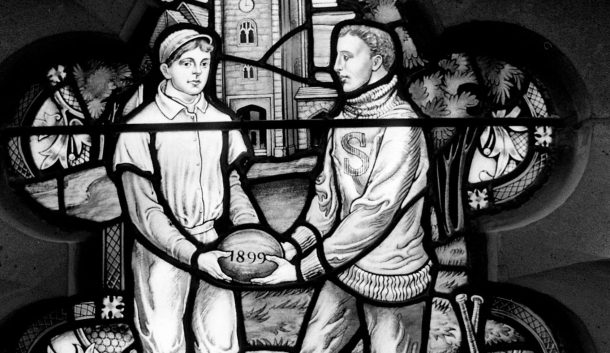
The year is 1899, and Sewanee football manager Luke Lea has a big problem.
Lea’s Tigers, coached by former Princeton star Billy Suter, just embarked on what is set to be a week-long road trip across the South. Stop 1 is Austin, where the Tigers will square off against the Texas Longhorns.
The Tigers have heated rival Vanderbilt to thank for their trip, but the prevailing sentiment regarding the Commodores doesn’t exactly come from a place of gratitude. Citing a feud over gate receipts from the 19-4 loss Sewanee handed the Commodores last year, Vanderbilt decided to up and cancel this year’s annual Thanksgiving matchup. Since that game happened to be Sewanee’s largest expected source of income, the Tigers are heading to the Lone Star State looking to make up for the lost revenue.
The trip from Southern Tennessee to Texas isn’t cheap. The Sewanee administration isn’t exactly in love with the idea of the boys traveling 1,000 miles southwest to play football during a critical time in the fall term, either.
To address this, Lea has proposed a workaround that is certifiably insane. His Tigers will face the Longhorns in Austin, then play 4 more games on their way back to Sewanee to pay for the trip. The journey will take 9 days with a planned stretch of 5 games across 6 days. All on the road.
That’s not the problem, though.
The problem, Lea just discovered, is that his team left all their cleats back at the train station.
***
Lea didn’t dare inform the team of the miscue. He wired the station, confirmed the location of the cleats and arranged for them to be put on a different train that would arrive in time for Sewanee’s battle against the Longhorns. Thankfully for Lea, the fix worked and Sewanee was ready for war.
What followed is widely considered the greatest road stretch by any team in college football history.
The Tigers demolished all 5 opponents they faced, starting with Texas, 12-0. Texas A&M was next, followed by LSU, Tulane and finally, Ole Miss. None of the games were particularly competitive — it’s like Sewanee was playing a different sport entirely.
“They were talented, they knew how to play the game and they were known for their speed.” Sewanee history professor Woody Register told Saturday Down South of the 1899 Tigers. “They tended to run circles around people. They managed not to get hurt, even as they played one game after another on their legendary trip. And as is often the case with college football at this level today, if you have 2 or 3 really talented players, you can go places.”
Led by future Hall of Fame captain Henry “Ditty” Seibels, fullback Ormond Simkins and halfback Rex Kilpatrick, Sewanee outscored its foes 91-0 across the 6-day trek, then punked Cumberland 71-0 a week later for good measure.
Only John Heisman’s Auburn Tigers were able to score on Sewanee in 1899. The penultimate game of the season, which took place a little over a week after Sewanee’s fabled trip, featured general chaos in the stands and on the field. Fist fights ensued. Guns were drawn. As the sun went down and it became too dark to play, the game was called in favor of Sewanee, 11-10.
“They were lucky,” Register admitted. “The fans were practically on the field, there was all sorts of shenanigans that went on there. Lucky that shots were not fired. They got out of that with their scalps and went on, but I think that was one of those that they were lucky to call a win.”
Sewanee beat North Carolina to close its undefeated campaign the following week, and the Tigers were named 1899 SIAA champions.
***
Forty years later, Sewanee found it increasingly difficult to compete against the physically superior public schools that prowled the SEC.
Newly introduced substitution rules (which began trickling in around 1905) meant an expanded roster and a change in style by necessity, adding to the monetary and physical strains already weighing on the struggling football program.
Recruiting was also proving to be a major challenge. The SEC was the first conference to allow athletic scholarships beginning in 1935, which the program just couldn’t afford. Nor could the private Episcopal school justify a complete overhaul in the name of better football.
The game was passing Sewanee by, and it showed. The Tigers failed to score in 26 of the 37 SEC contests they appeared in from 1933-1939, losing all 37 games by a combined score of 1,163–84. Acknowledging the writing on the wall, Sewanee opted to deemphasize athletics and leave the SEC on December 13, 1940.
“It was a misfit from the beginning,” Register said. “It took several years and it caused a lot of local bloodletting over it, that Sewanee was retreating from the field of big-time football, but there was no staying in the SEC based on the direction at which it was moving at the time.”
Today, Sewanee is a member of the Southern Athletic Association in Division III.
Bobby Dodd and Georgia Tech
Like Sewanee, Georgia Tech was relevant long before the SEC came to be. The Yellow Jackets, often called the Engineers by fans and sports writers, won national championships in 1917 and 1928 while claiming 8 conference titles across their stints in the SIAA and Southern Conference.
Unlike Sewanee, Georgia Tech was able to translate its success to the SEC. Led by future Hall of Fame coach William Alexander, the Yellow Jackets earned the program’s first SEC title in 1939, then tacked on 2 more in 1943 and 1944.
Alexander retired following the 1944 season, and Georgia Tech called on Bobby Dodd to be the program’s next head coach.
Dodd arrived in Atlanta ahead of the 1931 season, an offer in hand to coach Tech’s backfield following an All-American career as a quarterback at Tennessee. A year later, still serving as GT’s backfield coach, Dodd was named the head coach of the baseball team, a title he held for a little under 10 years. Dodd accepted the school’s AD role in 1950 — a title he wouldn’t relinquish until his retirement in 1976.
Georgia Tech was virtually unstoppable in the early part of the 1950s, all thanks to Dodd. His Yellow Jackets posted a 31-game unbeaten streak from 1951-1953, earning a pair of SEC titles. Georgia Tech won the Orange Bowl in 1951 and secured the program’s 3rd national championship in 1952 following a 12-0 campaign, capped with a Sugar Bowl victory over No. 6 Ole Miss.
The Yellow Jackets made it 6 straight bowl victories following their national championship season, winning the Sugar Bowl in 1953 and 1955, the Cotton Bowl in 1954 and the Gator Bowl in 1956. By the time his GT career was over, Dodd was responsible for a 165-64-8 record — including a 9-4 record in bowl games — with 2 SEC titles and 1 claimed national championship.
Today, Georgia Tech plays home games at Bobby Dodd Stadium. Each year, the coach in college football whose team excels on the field and in the community is gifted the Bobby Dodd Coach of the Year Award.
And because of Dodd, the modern Yellow Jackets compete in the ACC — not the SEC.
***
On December 2, 1957, Alabama football hired SEC and Crimson Tide legend Paul “Bear” Bryant.
Bryant and Dodd’s coaching styles couldn’t possibly have been more opposite. Dodd was widely known as a player-first coach. Rather than running his players through boot camp and tiring them out with high-intensity practices, Dodd preferred to save their energy with concise, well-executed sprints that targeted crucial tenants of the game. Sometimes. Other times, Georgia Tech practices devolved into volleyball games.
Bryant, meanwhile, believed in heavy conditioning, preparation and work ethic. “I’m no miracle man,” Bryant famously said. “I guarantee nothing but hard work.”
Alabama and Georgia Tech were fierce rivals, but a mutual respect existed between Dodd and Bryant. That changed in 1961.
In the 4th quarter of a close game, Georgia Tech’s Chick Graning looked to the sky and signaled for a fair catch following an Alabama punt. Crimson Tide linebacker Darwin Holt collided hard with Graning, striking the defenseless returner in the head with his elbow. Graning was knocked unconscious by the hit, which also broke his nose, shattered his cheekbone and gave him a concussion.
Graning never played football again, and the play didn’t even receive a penalty flag.
Dodd was adamant that Holt’s hit was intentional and a direct result of Bryant’s no-mercy philosophy. Incensed, he penned a letter to Bryant asking him to suspend Holt and make a public statement. Bryant, labeling the hit as incidental contact, refused to suspend Holt and did not make a public apology. Holt later stated the hit “definitely wasn’t intentional.”
Dodd’s relationship with Bryant and the SEC became rather shaky after this incident, but it was further strained a few years later.
In 1963, the SEC introduced the “140 rule,” which capped the total number of scholarships that teams could distribute between football and basketball at 140. Dodd vocally opposed to this rule and accused some coaches of overrecruiting, including Bryant.
Before the 140 rule was enacted, no league-wide cap for athletic scholarships existed in the SEC. Dodd didn’t necessarily have an issue with the cap itself; he had an issue with the rule’s yearly limit of 45 scholarships, which he thought was too high and invited “tryouts” for precious scholarship spots.
Keep the best, cut the worst.
Addressing the rule, Dodd said, “It is not the recruit’s fault for not making the squad, it was the coaches’ fault for misjudging their talents.”
Dodd called for a vote to scrap the rule and essentially gave the SEC an ultimatum: Either the 140 rule goes or Georgia Tech will. Dodd even secured a blessing from Bryant, who told him that he’d convince Alabama President Frank Rose to side with Georgia Tech. When the day of the vote came, Bryant was absent and Rose voted against Dodd, knotting the vote at 6-6 and upholding the 140 rule for the conference.
Immediately after, Georgia Tech President Edwin Harrison announced that the school intended to withdraw from the SEC. In December 1964, Tech made good on its promise and officially became an independent.
“I have no regrets about that,” Dodd later said regarding Tech’s decision. “The conference really left me no choice. It insisted upon keeping a rule that forced me to either kick players off the squad or limit recruiting to the point where we couldn’t compete.”
Tulane Waves Goodbye
Tulane’s decision to leave the SEC is one of the most intriguing “what ifs” in college football history.
The Green Wave’s story starts with an absolute walloping at the hands of No. 1 Notre Dame in 1949. Tulane, ranked No. 4 and a popular preseason pick to win the national championship, entered its pivotal midseason matchup against the Fighting Irish with high hopes. Anticlimactically, the game was never close and Tulane lost, 46-7.
While a loss to the No. 1 team in the country may not sound all that detrimental, it represented a ceiling for Tulane as a football program. Following a so-so 1950 season and a flat-out bad showing in 1951, Tulane President Rufus Harris made the decision to widely de-scale the school’s athletics programs. He felt athletics were standing in the way of Tulane’s prestige and reputation as one of the top universities in the South at a time when college football just wasn’t the moneymaker that it is today.
The football team saw its scholarship cap cut from 100 to 75 while the salaries of coaches and staff were slashed in an effort to save money. Additionally, Harris targeted student-athletes by eliminating physical education as a major, promoting more focus on schoolwork and less focus on practice. Head coach Henry Frnka resigned in protest soon after these changes were made.
Now, it’s important to note something here: Tulane is and was a private institution, but it was not a small-town program like Sewanee with limited resources and a lack of proven success in the SEC. In 1951, Tulane Stadium’s capacity was just north of 80,000, one of the largest venues in the country. The Green Wave won the Sugar Bowl in 1939, held bitter rivalries against the likes of LSU and Ole Miss and boasted 3 SEC titles heading into the 1950s.
Harris’s actions had immediate and devastating consequences for the promising program. Tulane suddenly couldn’t manage a winning record in conference play, failing to win more than 3 SEC games across any single season from 1951-1966. By the time the 1960s rolled around, the Green Wave were struggling to win any games at all — in 1962, Tulane bottomed out with a woeful 0-10 finish.
The program was hemorrhaging money, losing an average of $500,000 per season in the later years. Other SEC programs out-recruited the Green Wave, which further powered their cycle of struggle. Tulane administrators tasked with navigating the issue came to the determination that the team simply couldn’t compete with the rest of the SEC anymore.
Without the knowledge that the SEC would soon become a multi-billion-dollar entity capable of solving its financial troubles and then some, Tulane began throwing around the idea of becoming an independent program like Georgia Tech, Notre Dame and Penn State. Tulane was already recruiting on a national scale because of its academic standards, so why not expand the football slate to widen its national reach?
In December of 1964, President Herbert E. Longenecker officially announced that Tulane intended to leave the SEC. He called Tulane’s time in the SEC, “pleasant.” Tulane officially became an independent program in June of 1966.
“It sure can’t do us any harm,” Tulane coach Tommy O’Boyle said of the decision to leave the SEC. “Tulane is a national university. Now we can play a national schedule.”
A little under 20 years later, the landmark 1984 NCAA v. Board of Regents of the University of Oklahoma case stripped the NCAA of its broadcast monopoly, handing the negotiation rights for TV deals over to the conferences.
In 2024-25, the SEC paid out $1.03 billion in revenue sharing to its member schools.
Thanks for reading Part 2 of our 3-part series. Read Part 1 here and stay tuned for Part 3 next week!
Ethan Stone is a Saturday Down South News Editor and an advocate for the return of the Seattle Supersonics.